SolveIt is under development
SolveItClass 12 · Exemplar

NCERT Exemplar · Class 12 Physics Electromagnetic Induction

32 questions

Very Short Answer Questions 11–17 (part 3 of 5)

  1. Exercise 11

    Consider a magnet surrounded by a wire with an on/off switch S (Fig 6.4\displaystyle 6.4). If the switch is thrown from the off position (open circuit) to the on position (closed circuit), will a current flow in the circuit? Explain. NCERT_Question_Class12_Physics_Exemplar_Ch6_Q11
    NCERT’s answer
    No part of the wire is moving and so motional e.m.f. is zero. The magnet is stationary and hence the magnetic field does not change with time. This means no electromotive force is produced and hence no current will flow in the circuit.
    Magnet and loop are at rest, so the flux, though non-zero, stays steady: \[\Phi_B=\text{constant}\ \Rightarrow\ \varepsilon=-\frac{d\Phi_B}{dt}=0\ \Rightarrow\ I=0 \] Answer: No current flows, since the flux through the loop does not change.
  2. Exercise 12

    A wire in the form of a tightly wound solenoid is connected to a DC source, and carries a current. If the coil is stretched so that there are gaps between successive elements of the spiral coil, will the current increase or decrease? Explain.
    NCERT’s answer
    The current will increase. As the wires are pulled apart the flux will leak through the gaps. Lenz's law demands that induced e.m.f. resist this decrease, which can be done by an increase in current.
    Stretching lengthens the coil, lowering the inductance and the flux: \[L=\frac{\mu_0N^2A}{\ell},\qquad \ell\uparrow\ \Rightarrow\ L\downarrow\ \Rightarrow\ \Phi=LI\downarrow \] Induced emf opposes the fall, aiding the battery: \[I=\frac{V+\left|d\Phi/dt\right|}{R}>\frac{V}{R} \] Answer: The current increases while stretching, then returns to \(\displaystyle V/R\).
  3. Exercise 13

    A solenoid is connected to a battery so that a steady current flows through it. If an iron core is inserted into the solenoid, will the current increase or decrease? Explain.
    NCERT’s answer
    The current will decrease. As the iron core is inserted in the solenoid, the magnetic field increases and the flux increases. Lent's law implies that induced e.m.f. should resist this increase, which can be achieved by a decrease in current.
    Iron raises the inductance, hence the flux: \[L=\frac{\mu_0\mu_rN^2A}{\ell},\qquad \mu_r\gg1\ \Rightarrow\ L\uparrow\ \Rightarrow\ \Phi=LI\uparrow \] Induced emf opposes the rise, against the battery: \[I=\frac{V-\left|d\Phi/dt\right|}{R}<\frac{V}{R} \] Answer: The current decreases while the core enters, then returns to \(\displaystyle V/R\).
  4. Exercise 14

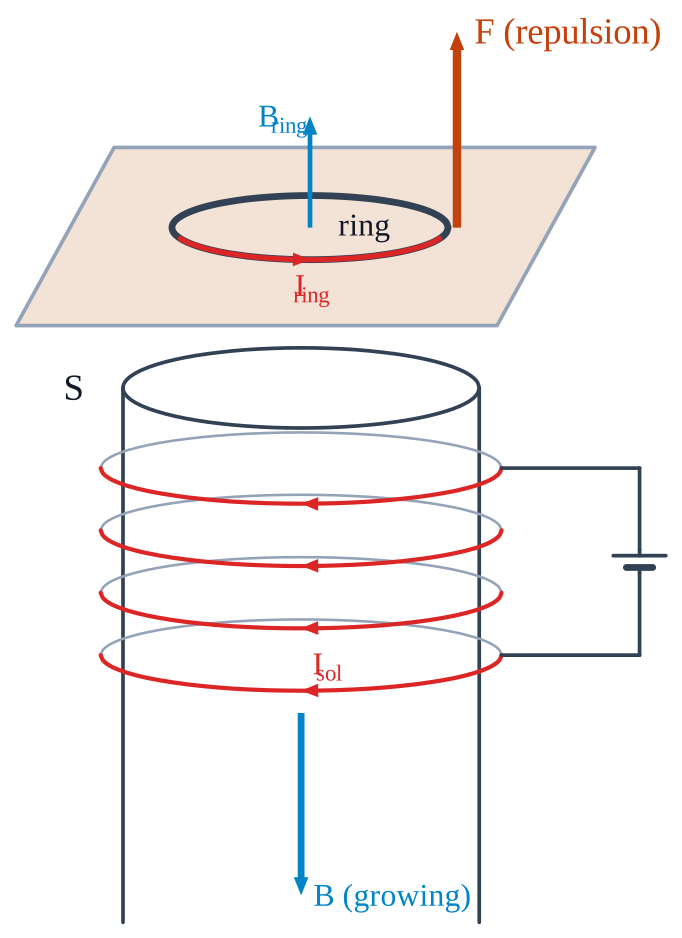
    Consider a metal ring kept on top of a fixed solenoid (say on a carboard) (Fig 6.5\displaystyle 6.5). The centre of the ring coincides with the axis of the solenoid. If the current is suddenly switched on, the metal ring jumps up. Explain NCERT_Question_Class12_Physics_Exemplar_Ch6_Q14
    NCERT’s answer
    No flux was passing through the metal ring initially. When the current is switched on, flux passes through the ring. According to Lenz's law this increase will be resisted and this can happen if the ring moves away from the solenoid. One can analyse this in more detail (Fig $\displaystyle 6.5$). If the current in the solenoid is as shown, the flux (downward) increases and this will cause a counterclockwise current (as seen form the top in the ring). As the flow of current is in the opposite direction to that in the solenoid, they will repel each other and the ring will move upward.
    Flux through the ring rises from zero, so a current is induced: \[\Phi_B:\ 0\to BA\ \text{(downward)},\qquad \varepsilon=-\frac{d\Phi_B}{dt}\neq0 \] Lenz's law: it opposes the solenoid current, giving repulsion: \[I_{ring}\ \text{antiparallel to}\ I_{sol}\ \Rightarrow\ \text{repulsion}\ \Rightarrow\ \mathbf{F}\ \text{upward} \] NCERT_Solution_Class12_Physics_Exemplar_Ch6_Q14 Answer: The ring is repelled upward, so it jumps.
  5. Exercise 15

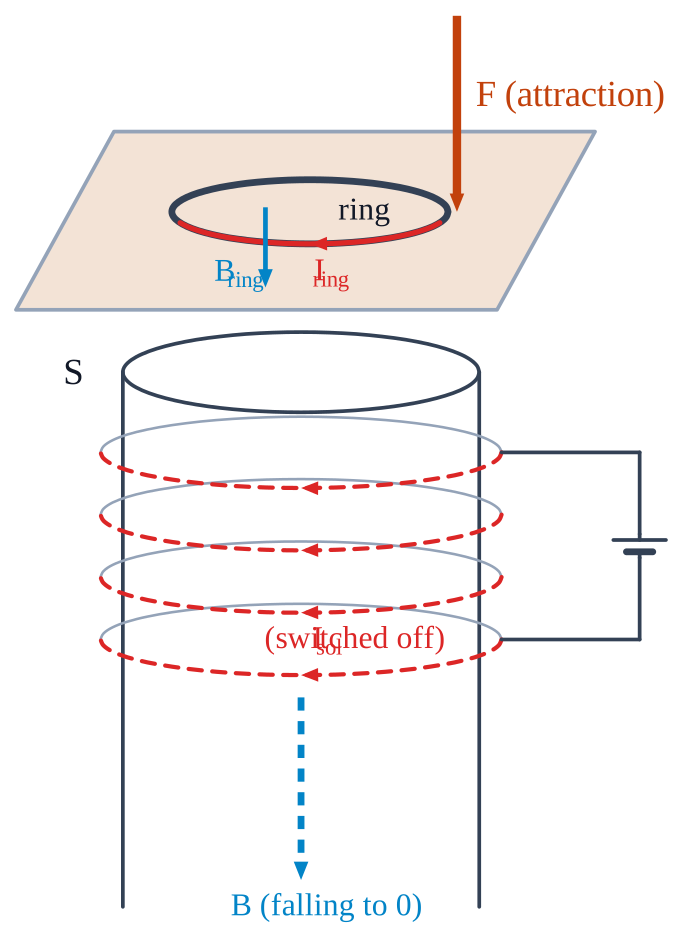
    Consider a metal ring kept (supported by a cardboard) on top of a fixed solenoid carrying a current I\displaystyle I (see Fig 6.5\displaystyle 6.5). The centre of the ring coincides with the axis of the solenoid. If the current in the solenoid is switched off, what will happen to the ring? NCERT_Question_Class12_Physics_Exemplar_Ch6_Q15
    NCERT’s answer
    When the current in the solenoid decreases a current flows in the same direction in the metal ring as in the solenoid. Thus there will be a downward force. This means the ring will remain on the cardboard. The upward reaction of the cardboard on the ring will increase.
    Flux through the ring falls to zero, so a current is induced: \[\Phi_B:\ BA\ \text{(downward)}\to0,\qquad \varepsilon=-\frac{d\Phi_B}{dt}\neq0 \] Lenz's law: it aids the solenoid's old current, giving attraction: \[I_{ring}\ \text{parallel to}\ I_{sol}\ \Rightarrow\ \text{attraction}\ \Rightarrow\ \mathbf{F}\ \text{downward} \] NCERT_Solution_Class12_Physics_Exemplar_Ch6_Q15 Answer: The ring is pulled down against the cardboard and stays put.
  6. Exercise 16

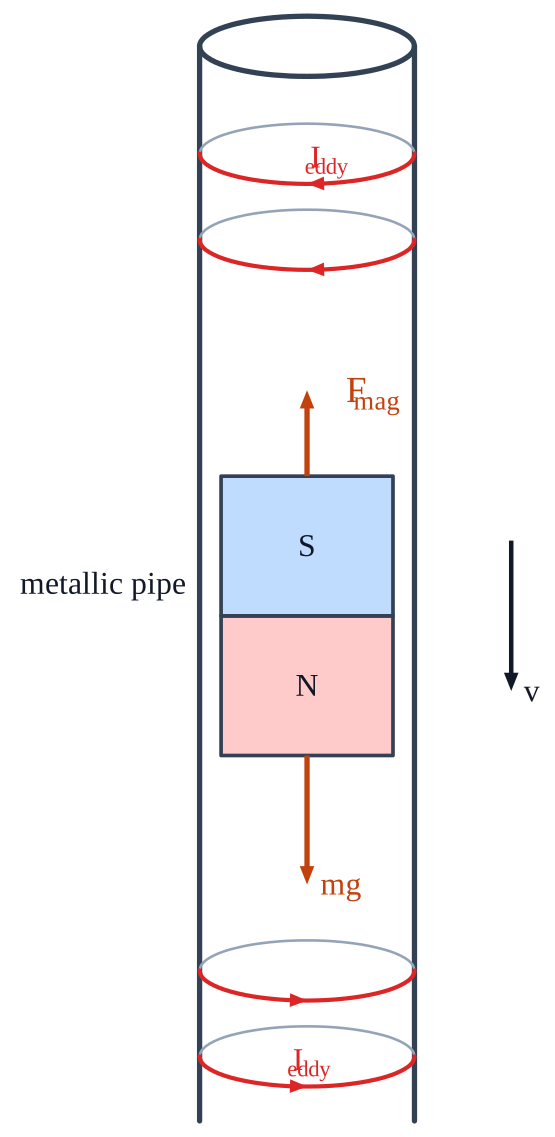
    Consider a metallic pipe with an inner radius of 1\displaystyle 1 cm. If a cylindrical bar magnet of radius 0.8cm is dropped through the pipe, it takes more time to come down than it takes for a similar unmagnetised cylindrical iron bar dropped through the metallic pipe. Explain.
    NCERT’s answer
    For the magnet, eddy currents are produced in the metallic pipe. These currents will oppose the motion of the magnet. Therefore magnet's downward acceleration will be less than the acceleration due to gravity \(\displaystyle g\). On the other hand, an unmagnetised iron bar will not produce eddy currents and will fall with an acceleration \(\displaystyle g\). Thus the magnet will take more time.
    Falling magnet: changing flux drives eddy currents in the pipe that oppose the motion: \[\varepsilon=-\frac{d\Phi_B}{dt}\neq0\ \Rightarrow\ I_{eddy}\ \Rightarrow\ F_{mag}\ \text{upward},\qquad ma=mg-F_{mag}\ \Rightarrow\ a<g \] Unmagnetised iron: no flux change, no eddy currents: \[\Phi_B=\text{constant}\ \Rightarrow\ F_{mag}=0\ \Rightarrow\ a=g \] NCERT_Solution_Class12_Physics_Exemplar_Ch6_Q16 Answer: The magnet is braked by eddy currents, so it falls slower.
  7. Exercise 17

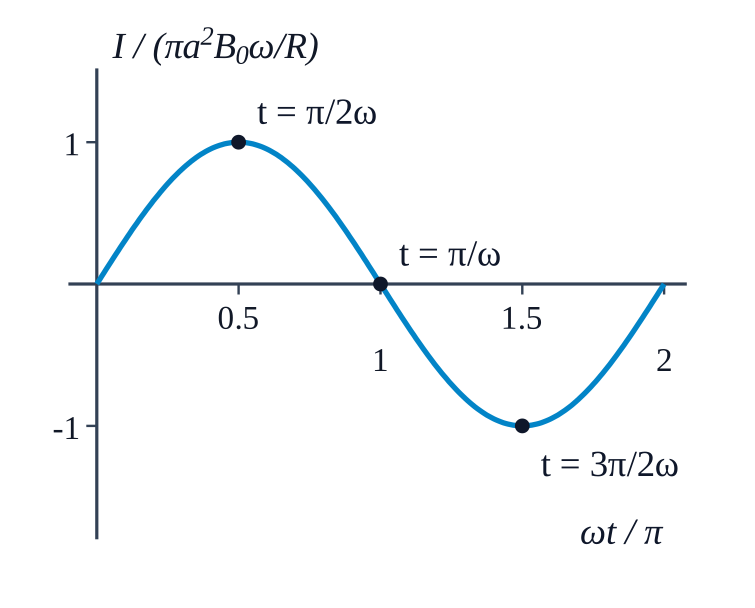
    A magnetic field in a certain region is given by B=Bocos⁡(ωt)k^\displaystyle \mathbf{B}=B_o \cos (\omega t) \hat{\mathbf{k}} and a coil of radius a\displaystyle a with resistance R\displaystyle R is placed in the x−y\displaystyle x-y plane with its centre at the origin in the magnetic field (see Fig 6.6\displaystyle 6.6) . Find the magnitude and the direction of the current at (a,0,0)\displaystyle (a, 0,0) at t=π/2ω,t=π/ω\displaystyle t=\pi / 2 \omega, t=\pi / \omega and t=3π/2ω\displaystyle t=3 \pi / 2 \omega. NCERT_Question_Class12_Physics_Exemplar_Ch6_Q17
    NCERT’s answer
    Flux through the ring \[\begin{aligned} & \phi=B_o\left(\pi a^2\right) \cos \omega t \\ & \varepsilon=B\left(\pi a^2\right) \omega \sin \omega t \\ & I=B\left(\pi a^2\right) \omega \sin \omega t / R \end{aligned} \] Current at \[\begin{aligned} & t=\frac{\pi}{2 \omega} ; I=\frac{B\left(\pi a^2\right) \omega}{R} \text { along } \hat{\mathbf{j}} \\ & t=\frac{\pi}{\omega} ; I=0 \\ & t=\frac{3}{2} \frac{\pi}{\omega} ; I=\frac{B\left(\pi a^2\right) \omega}{R} \text { along }-\hat{\mathbf{j}} . \end{aligned} \] NCERT_Solution_Class12_Physics_Exemplar_Ch6_Q17_ncert
    \[\Phi_B=B_0\cos(\omega t)\,\pi a^2 \] \[\varepsilon=-\frac{d\Phi_B}{dt}=\pi a^2B_0\,\omega\sin(\omega t) \] \[I=\frac{\varepsilon}{R}=\frac{\pi a^2B_0\,\omega}{R}\sin(\omega t) \] Positive \(\displaystyle \varepsilon\) is anticlockwise seen from \(\displaystyle +z\), i.e. along \(\displaystyle +\hat{\mathbf{j}}\) at \(\displaystyle (a,0,0)\): \[t=\frac{\pi}{2\omega}:\ \sin\omega t=1\ \Rightarrow\ I=\frac{\pi a^2B_0\omega}{R},\ \text{along}\ +\hat{\mathbf{j}} \] \[t=\frac{\pi}{\omega}:\ \sin\omega t=0\ \Rightarrow\ I=0 \] \[t=\frac{3\pi}{2\omega}:\ \sin\omega t=-1\ \Rightarrow\ I=\frac{\pi a^2B_0\omega}{R},\ \text{along}\ -\hat{\mathbf{j}} \] NCERT_Solution_Class12_Physics_Exemplar_Ch6_Q17 Answer: \(\displaystyle I=\dfrac{\pi a^2B_0\omega}{R}\) along \(\displaystyle +\hat{\mathbf{j}}\), then \(\displaystyle 0\), then \(\displaystyle \dfrac{\pi a^2B_0\omega}{R}\) along \(\displaystyle -\hat{\mathbf{j}}\).