Exercise 18
Consider a closed loop C in a magnetic field (Fig ). The flux passing through the loop is defined by choosing a surface whose edge coincides with the loop and using the formula . Now if we chose two different surfaces and having C as their edge, would we get the same answer for flux. Jusity your answer.

NCERT’s answer
One gets the same answer for flux. Flux can be throught of as the number of magnetic field lines passing through the surface (we draw \(\displaystyle \mathrm{d} N=B \Delta A\) lines in an area \(\displaystyle \Delta \mathrm{A} \perp\) to \(\displaystyle \mathbf{B}\)), As lines of of \(\displaystyle \mathbf{B}\) cannot end or start in space (they form closed loops) number of lines passing through surface \(\displaystyle S_1\) must be the same as the number of lines passing through the surface \(\displaystyle S_2\).

Yes, the same. S\(\displaystyle _1\) and S\(\displaystyle _2\) together enclose a volume. The outward normal on S\(\displaystyle _1\) is opposite to the normal chosen for the loop's flux, so S\(\displaystyle _1\) contributes \(\displaystyle -\phi_1\).\[\oint_{S_1+S_2}\mathbf{B}\cdot d\mathbf{A}=0 \quad (\text{no magnetic monopole}) \]\[\phi_2+(-\phi_1)=0 \]\[\phi_1=\phi_2 \]Answer: Yes, the flux is the same for S\(\displaystyle _1\) and S\(\displaystyle _2\), because the net flux of \(\displaystyle \mathbf{B}\) through the closed surface S\(\displaystyle _1+\)S\(\displaystyle _2\) is zero.


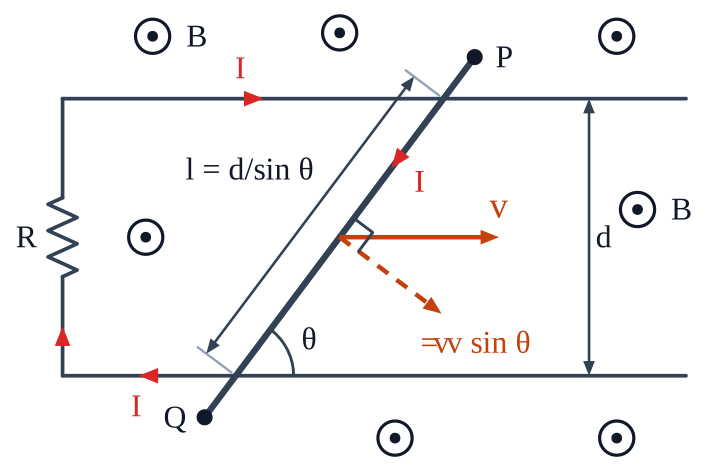 Direction (Lenz): \(\displaystyle \phi_{\text{out}}\uparrow \Rightarrow\) induced field into the page \(\displaystyle \Rightarrow\) clockwise, so \(\displaystyle P\to Q\) in the rod and upward through \(\displaystyle R\).Answer: \(\displaystyle I=\dfrac{Bvd}{R}\), independent of \(\displaystyle \theta\), clockwise.

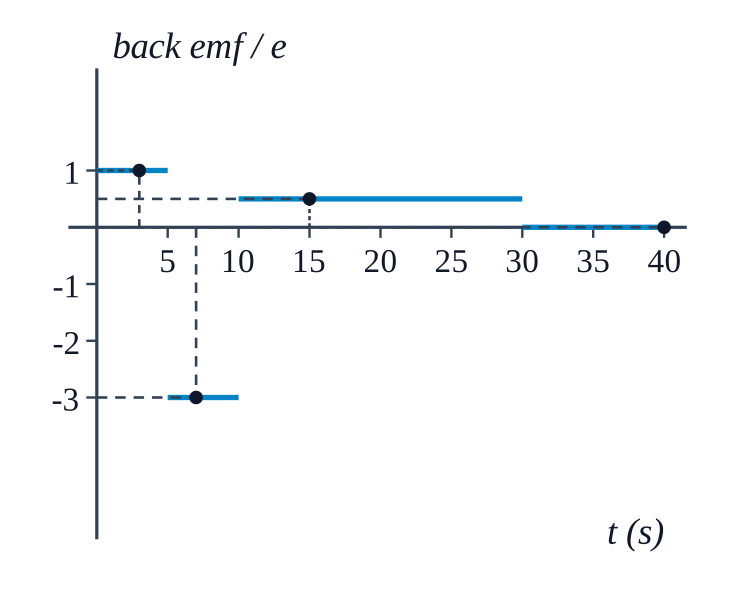 Answer: Maximum between \(\displaystyle t=5\ \mathrm{s}\) and \(\displaystyle 10\ \mathrm{s}\) (segment AB); \(\displaystyle \varepsilon_{7}=-3e\), \(\displaystyle \varepsilon_{15}=e/2\), \(\displaystyle \varepsilon_{40}=0\).