SolveIt is under development
SolveItClass 12 · Exemplar

NCERT Exemplar · Class 12 Physics Electromagnetic Induction

32 questions

Long Answer Questions 22–32 (part 5 of 5)

  1. Exercise 22

    A magnetic field B=Bosin⁡(ωt)k^\displaystyle \mathbf{B}=B_o \sin (\omega t) \hat{\mathbf{k}} covers a large region where a wire AB slides smoothly over two parallel conductors separated by a distance d\displaystyle d (Fig. 6.10\displaystyle 6.10). The wires are in the x−y\displaystyle x-y plane. The wire AB (of length d\displaystyle d ) has resistance R\displaystyle R and the parallel wires have negligible resistance. If AB is moving with velocity v\displaystyle \boldsymbol{v}, what is the current in the circuit. What is the force needed to keep the wire moving at constant velocity? NCERT_Question_Class12_Physics_Exemplar_Ch6_Q22
    NCERT’s answer
    Let us assume that the parallel wires at are \(\displaystyle y=0\) and \(\displaystyle y=d\). At \(\displaystyle t=0\), AB has \(\displaystyle x=0\) and moves with a velocity \(\displaystyle v \hat{\mathbf{i}}\). At time \(\displaystyle t\), wire is at \(\displaystyle x(t)=v t\). Motional e.m.f. \(\displaystyle =\left(B_o \sin \omega t\right) v d(-\hat{\mathbf{j}})\) E.m.f due to change in field (along OBAC) \[=-B_o \omega \cos \omega t x(t) d \] Total e.m.f \(\displaystyle =-B_o d[\omega x \cos (\omega t)+v \sin (\omega t)]\) Along OBAC, Current (clockwise) \(\displaystyle =\frac{B_o d}{R}(\omega x \cos \omega t+v \sin \omega t)\) Force needed along \(\displaystyle \hat{\mathbf{i}}=\frac{B_o d}{R}(\omega x \cos \omega t+v \sin \omega t) \times d \times B_o \sin \omega t\) \[=\frac{B_o^2 d^2}{R}(\omega x \cos \omega t+v \sin \omega t) \sin \omega t . \] NCERT_Solution_Class12_Physics_Exemplar_Ch6_Q22_ncert
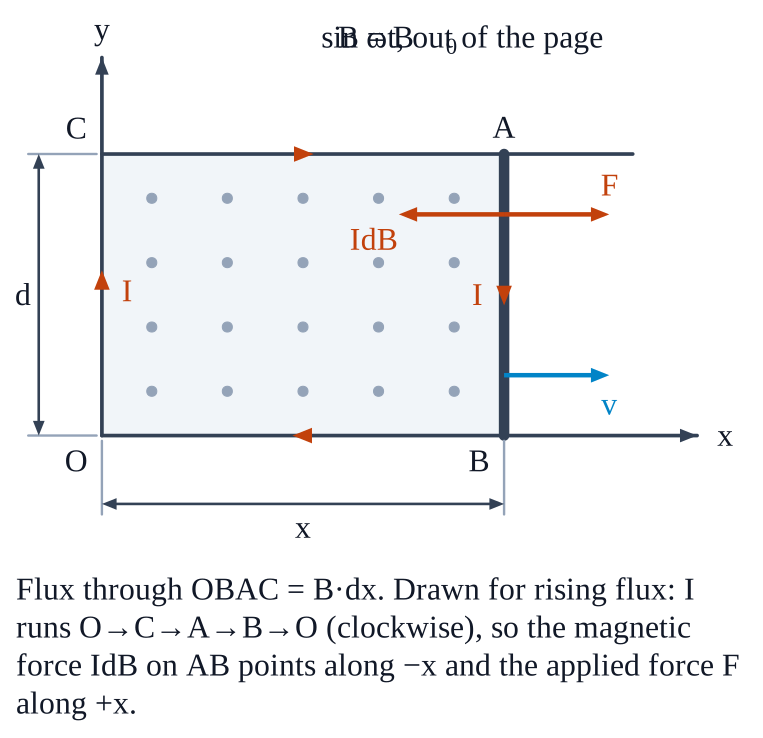
    AB is at distance \(\displaystyle x\) from OC, \(\displaystyle \dfrac{dx}{dt}=v\). Both the changing area and the changing \(\displaystyle B\) contribute.NCERT_Solution_Class12_Physics_Exemplar_Ch6_Q22\[\Phi = B\,A = B_0\sin\omega t\cdot d\,x \;\;(\mathrm{Wb}) \] \[\frac{d\Phi}{dt} = B_0 d\left(v\sin\omega t + \omega x\cos\omega t\right)\;\;(\mathrm{V}) \] \[I = \frac{1}{R}\frac{d\Phi}{dt} = \frac{B_0 d}{R}\left(v\sin\omega t + \omega x\cos\omega t\right)\;\;(\mathrm{A}) \] \[x=vt:\quad I = \frac{B_0 d\,v}{R}\left(\sin\omega t + \omega t\cos\omega t\right)\;\;(\mathrm{A}) \]\(\displaystyle \mathbf{B}\) is out of the page, so rising flux drives \(\displaystyle I\) clockwise (O \(\displaystyle \to\) C \(\displaystyle \to\) A \(\displaystyle \to\) B \(\displaystyle \to\) O); a negative value means anticlockwise.In AB the current runs A \(\displaystyle \to\) B, so the magnetic force is along \(\displaystyle -x\) and the applied force along \(\displaystyle +x\):\[F = I\,d\,B = I\,d\,B_0\sin\omega t\;\;(\mathrm{N}) \] \[F = \frac{B_0^{2}d^{2}}{R}\,\sin\omega t\left(v\sin\omega t + \omega x\cos\omega t\right)\;\;(\mathrm{N}) \] \[x=vt:\quad F = \frac{B_0^{2}d^{2}v}{R}\,\sin\omega t\left(\sin\omega t + \omega t\cos\omega t\right)\;\;(\mathrm{N}) \]Answer: \(\displaystyle I=\dfrac{B_0 d}{R}\left(v\sin\omega t+\omega x\cos\omega t\right)\), clockwise; \(\displaystyle F=\dfrac{B_0^{2}d^{2}}{R}\sin\omega t\left(v\sin\omega t+\omega x\cos\omega t\right)\) along \(\displaystyle +x\) (a negative value means along \(\displaystyle -x\)).
  2. Exercise 23

    A conducting wire XY of mass m\displaystyle m and neglibile resistance slides smoothly on two parallel conducting wires as shown in Fig 6.11. The closed circuit has a resistance R\displaystyle R due to AC. AB and CD are perfect conductors. There is a magnetic field B=B(t)k^\displaystyle \mathbf{B}=B(t) \hat{\mathbf{k}}.
    (i)
    Write down equation for the acceleration of the wire XY.
    (ii)
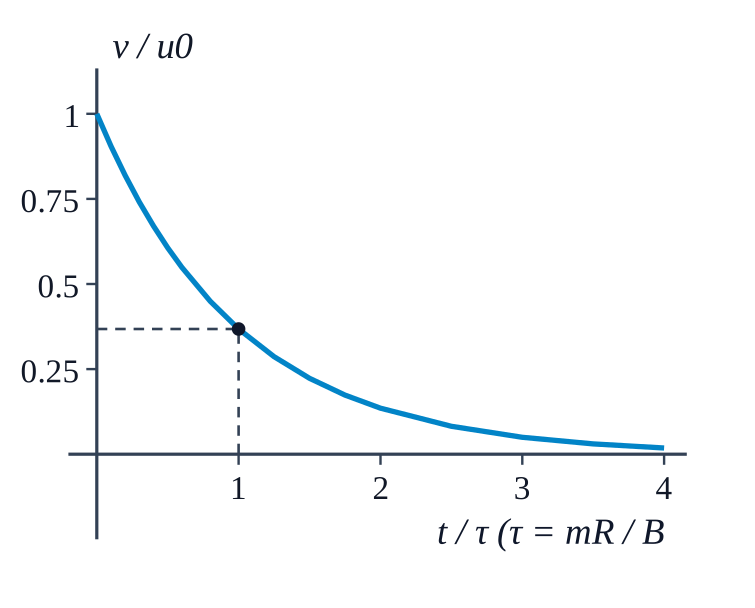
    If B\displaystyle \mathbf{B} is independent of time, obtain v(t)\displaystyle v(t), assuming v\displaystyle v (0)=u0\displaystyle (0)=u_0.
    (iii)
    For (b), show that the decrease in kinetic energy of XY equals the heat lost in R\displaystyle R.
    NCERT_Question_Class12_Physics_Exemplar_Ch6_Q23
    NCERT’s answer
    (i)
    Let the wire be at \(\displaystyle x=x(t)\) at time \(\displaystyle t\).
    \[\begin{aligned} & \text { Flux }=B(t) l x(t) \\ & E=-\frac{d \phi}{d t}=-\frac{d B(t)}{d t} l x(t)-B(t) l . v(t) \text { (second term due to motional emf) } \end{aligned} \]
    \[I=\frac{1}{R} E \]
    \[\text { Force }=\frac{l B(t)}{R}\left[-\frac{d B}{d t} l x(t)-B(t) l v(t)\right] \hat{\mathbf{i}} \]
    \[m \frac{d^2 x}{d t^2}=-\frac{l^2 B}{R} \frac{d B}{d t} x(t)-\frac{l^2 B^2}{R} \frac{d x}{d t} \]
    (ii)
    \[\begin{gathered} \frac{d B}{d t}=0, \quad \frac{d^2 x}{d t^2}+\frac{l^2 B^2}{m R} \frac{d x}{d t}=0 \\ \frac{d v}{d t}+\frac{l^2 B^2}{m R} v=0 \end{gathered} \]
    \[v=\mathrm{A} \exp \left(\frac{-l^2 B^2 t}{m R}\right) \]
    At \(\displaystyle t=0, v=\mathrm{u}\)
    \(\displaystyle v(\mathrm{t})=\mathrm{u} \exp \left(-\mathrm{l}^2 \mathrm{~B}^2 \mathrm{t} / \mathrm{mR}\right)\).
    (iii)
    \[\begin{aligned} & I^2 R=\frac{B^2 l^2 v^2(t)}{R^2} \times R=\frac{B^2 l^2}{R} u^2 \exp \left(-2 l^2 B^2 t / m R\right) \\ & \text { Power lost }=\int_0^t I^2 R d t=\frac{B^2 l^2}{R} u^2 \frac{m R}{2 l^2 B^2}\left[1-\mathrm{e}^{-\left(l^2 B^2 t / m R\right)}\right] \\ & =\frac{m}{2} u^2-\frac{m}{2} v^2(t) \\ & =\text { decrease in kinetic energy. } \end{aligned} \]
    NCERT_Solution_Class12_Physics_Exemplar_Ch6_Q23_ncert
    Let XY be at \(\displaystyle x(t)\) from AC, with \(\displaystyle v=\dfrac{dx}{dt}\).(i) \[\Phi = B(t)\,l\,x \] \[\varepsilon = -\frac{d\Phi}{dt} = -l\left(B v + x\frac{dB}{dt}\right) \] \[F = I\,l\,B = \frac{\varepsilon}{R}\,l\,B \] \[a = \frac{dv}{dt} = -\frac{B\,l^{2}}{mR}\left(B v + x\frac{dB}{dt}\right)\;\;(\mathrm{m\,s^{-2}}) \](ii) \(\displaystyle B\) constant, so \(\displaystyle \dfrac{dB}{dt}=0\): \[m\frac{dv}{dt} = -\frac{B^{2}l^{2}}{R}\,v \] \[\int_{u_0}^{v}\frac{dv}{v} = -\frac{B^{2}l^{2}}{mR}\int_0^{t}dt \] \[v(t) = u_0\,e^{-B^{2}l^{2}t/(mR)}\;\;(\mathrm{m\,s^{-1}}) \]NCERT_Solution_Class12_Physics_Exemplar_Ch6_Q23(iii) Heat in \(\displaystyle R\) up to time \(\displaystyle t\), with \(\displaystyle I=\dfrac{Blv}{R}\): \[H = \int_0^{t} I^{2}R\,dt' = \frac{B^{2}l^{2}u_0^{2}}{R}\int_0^{t} e^{-2B^{2}l^{2}t'/(mR)}\,dt' \] \[H = \frac{B^{2}l^{2}u_0^{2}}{R}\cdot\frac{mR}{2B^{2}l^{2}}\left(1-e^{-2B^{2}l^{2}t/(mR)}\right) = \tfrac12 m u_0^{2} - \tfrac12 m v^{2}\;\;(\mathrm{J}) \] \[\Delta KE = \tfrac12 m u_0^{2} - \tfrac12 m v^{2} = H \]Answer: (i) \(\displaystyle a=-\dfrac{Bl^{2}}{mR}\left(Bv+x\dfrac{dB}{dt}\right)\); (ii) \(\displaystyle v=u_0e^{-B^{2}l^{2}t/(mR)}\); (iii) the kinetic energy lost equals the heat in \(\displaystyle R\) at every instant.
  3. Exercise 24

    ODBAC is a fixed rectangular conductor of negilible resistance (CO is not connnected) and OP is a conductor which rotates clockwise with an angular velocity ω\displaystyle \omega (Fig 6.12\displaystyle 6.12). The entire system is in a uniform magnetic field B\displaystyle \mathbf{B} whose direction is along the normal to the surface of the rectangular conductor ABDC. The conductor OP is in electric contact with ABDC. The rotating conductor has a resistance of λ\displaystyle \lambda per unit length. Find the current in the rotating conductor, as it rotates by 180\displaystyle 180°. NCERT_Question_Class12_Physics_Exemplar_Ch6_Q24
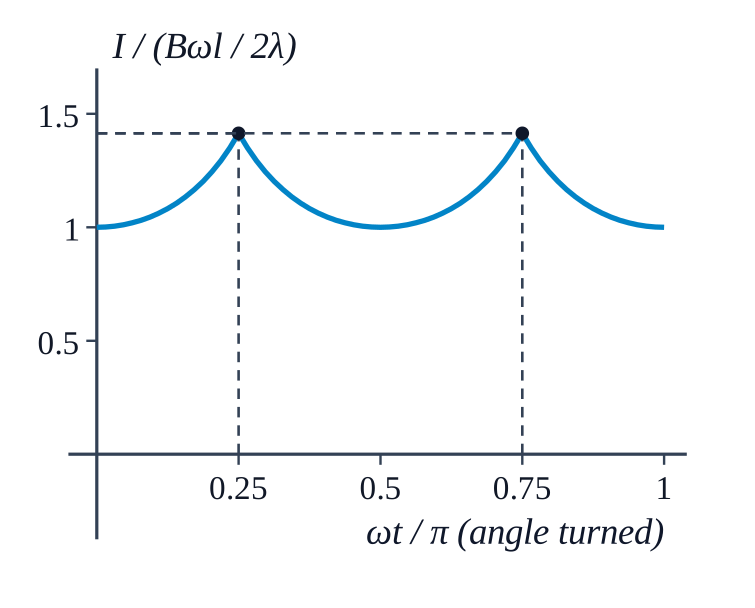
    Let OP have turned through \(\displaystyle \varphi=\omega t\), touching the fixed conductor at Q, with \(\displaystyle OQ=r\). Only OQ is in a closed circuit (O \(\displaystyle \to\) Q \(\displaystyle \to\) conductor \(\displaystyle \to\) D \(\displaystyle \to\) O); the part beyond Q carries no current.\[\varepsilon = \int_0^{r} B\omega x\,dx = \tfrac12 B\omega r^{2}\;\;(\mathrm{V}) \] \[R_{OQ} = \lambda r\;\;(\Omega) \] \[I = \frac{\varepsilon}{R_{OQ}} = \frac{B\omega r^{2}/2}{\lambda r} = \frac{B\omega r}{2\lambda}\;\;(\mathrm{A}) \]Contact length \(\displaystyle r\) (rectangle \(\displaystyle 2l\times l\), O at the midpoint of CD):\[0\le\varphi\le\tfrac{\pi}{4}:\; r=\frac{l}{\cos\varphi}\;\Rightarrow\; I=\frac{B\omega l}{2\lambda\cos\omega t} \] \[\tfrac{\pi}{4}\le\varphi\le\tfrac{3\pi}{4}:\; r=\frac{l}{\sin\varphi}\;\Rightarrow\; I=\frac{B\omega l}{2\lambda\sin\omega t} \] \[\tfrac{3\pi}{4}\le\varphi\le\pi:\; r=\frac{l}{|\cos\varphi|}\;\Rightarrow\; I=\frac{B\omega l}{2\lambda\,|\cos\omega t|} \]NCERT_Solution_Class12_Physics_Exemplar_Ch6_Q24\[I_{min}=\frac{B\omega l}{2\lambda}\;\;(\varphi=0,\ \tfrac{\pi}{2},\ \pi),\qquad I_{max}=\frac{B\omega l}{\sqrt2\,\lambda}\;\;(\varphi=\tfrac{\pi}{4},\ \tfrac{3\pi}{4}) \]Answer: \(\displaystyle I=\dfrac{B\omega r}{2\lambda}\), with \(\displaystyle r=l/\cos\omega t\), \(\displaystyle l/\sin\omega t\), \(\displaystyle l/|\cos\omega t|\) in the three ranges above.
  4. Exercise 25

    Consider an infinitely long wire carrying a current I(t)\displaystyle I(t), with dIdt=λ=\displaystyle \frac{d I}{d t}=\lambda= constant. Find the current produced in the rectangular loop of wire ABCD if its resistance is R\displaystyle R (Fig. 6.13\displaystyle 6.13). NCERT_Question_Class12_Physics_Exemplar_Ch6_Q25
    NCERT’s answer
    At a distance \(\displaystyle r\) from the wire, Field \(\displaystyle B(r)=\frac{\mu_o I}{2 \pi r}\) (out of paper). Total flux through the loop is \[\text { Flux }=\frac{\mu_o I}{2 \pi} l \int_{x_o}^x \frac{d r}{r}=\frac{\mu_o I}{2 \pi} \ln \frac{x}{x_o} \] \[\frac{1}{R} \frac{d I}{d t}=\frac{\varepsilon}{R}=I=\frac{\mu_o l}{2 \pi} \frac{\lambda}{R} \ln \frac{x}{x_0} \] NCERT_Solution_Class12_Physics_Exemplar_Ch6_Q25_ncert
    \(\displaystyle B\) falls off with distance, so integrate over a strip \(\displaystyle dr\) of area \(\displaystyle l\,dr\) at distance \(\displaystyle r\) from the wire.\[B = \frac{\mu_0 I}{2\pi r} \] \[d\Phi = B\,l\,dr = \frac{\mu_0 I l}{2\pi}\,\frac{dr}{r} \] \[\Phi = \frac{\mu_0 I l}{2\pi}\int_{x_0}^{x}\frac{dr}{r} = \frac{\mu_0 I l}{2\pi}\ln\frac{x}{x_0}\;\;(\mathrm{Wb}) \] \[|\varepsilon| = \frac{d\Phi}{dt} = \frac{\mu_0 l}{2\pi}\ln\frac{x}{x_0}\cdot\frac{dI}{dt} = \frac{\mu_0 l\lambda}{2\pi}\ln\frac{x}{x_0}\;\;(\mathrm{V}) \] \[i = \frac{|\varepsilon|}{R} = \frac{\mu_0 l\lambda}{2\pi R}\ln\frac{x}{x_0}\;\;(\mathrm{A}) \]\(\displaystyle \lambda\) is constant, so \(\displaystyle i\) is constant. The flux out of the page grows, so the current is clockwise.Answer: \(\displaystyle i=\dfrac{\mu_0 l\lambda}{2\pi R}\ln\dfrac{x}{x_0}\), constant in time.
  5. Exercise 26

    A rectangular loop of wire ABCD is kept close to an infinitely long wire carrying a current I(t)=Io(1−t/T)\displaystyle I(t)=I_o(1-t / T) for 0≤t≤T\displaystyle 0 \leq t \leq T and I(0)=0\displaystyle I(0)=0 for t>T\displaystyle t>T (Fig. 6.14\displaystyle 6.14). Find the total charge passing through a given point in the loop, in time T\displaystyle T. The resistance of the loop is R\displaystyle R. NCERT_Question_Class12_Physics_Exemplar_Ch6_Q26
    For \(\displaystyle 0\le t\le T\) the flux through ABCD changes at a steady rate; for \(\displaystyle t>T\), \(\displaystyle I=0\) and nothing is induced. Integrate over strips, since \(\displaystyle B\) varies with distance \(\displaystyle r\) from the wire.\[B = \frac{\mu_0 I}{2\pi r},\qquad d\Phi = B\,L_1\,dr \] \[\Phi = \frac{\mu_0 I L_1}{2\pi}\int_{x}^{x+L_2}\frac{dr}{r} = \frac{\mu_0 I L_1}{2\pi}\ln\frac{x+L_2}{x}\;\;(\mathrm{Wb}) \] \[\left|\frac{dI}{dt}\right| = \frac{I_0}{T} \] \[|\varepsilon| = \frac{\mu_0 L_1}{2\pi}\ln\!\left(1+\frac{L_2}{x}\right)\frac{I_0}{T}\;\;(\mathrm{V}) \] \[i = \frac{|\varepsilon|}{R} = \frac{\mu_0 L_1 I_0}{2\pi R\,T}\ln\!\left(1+\frac{L_2}{x}\right)\;\;(\mathrm{A}) \] \[q = i\,T = \frac{\mu_0 L_1 I_0}{2\pi R}\ln\!\left(1+\frac{L_2}{x}\right)\;\;(\mathrm{C}) \]Check: \(\displaystyle q=\dfrac{|\Delta\Phi|}{R}\) gives the same value.Answer: \(\displaystyle q=\dfrac{\mu_0 L_1 I_0}{2\pi R}\ln\!\left(1+\dfrac{L_2}{x}\right)\).
  6. Exercise 27

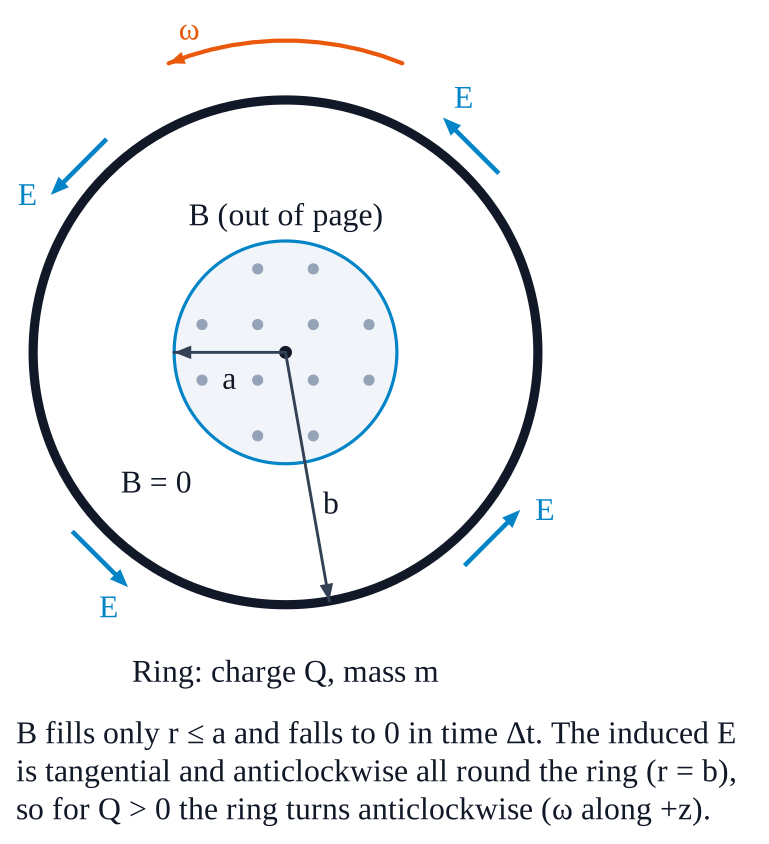
    A magnetic field B\displaystyle \mathbf{B} is confined to a region r≤a\displaystyle r \leq a and points out of the paper (the z\displaystyle z-axis), r=0\displaystyle r=0 being the centre of the circular region. A charged ring (charge =Q\displaystyle =\mathrm{Q}) of radius b,b>a\displaystyle b, b>a and mass m\displaystyle m lies in the x−y\displaystyle x-y plane with its centre at the origin. The ring is free to rotate and is at rest. The magnetic field is brought to zero in time Δt\displaystyle \Delta t. Find the angular velocity ω\displaystyle \omega of the ring after the field vanishes.
    NCERT’s answer
    \(\displaystyle 2 \pi b E=E . M . F=\frac{B . \pi a^2}{\Lambda t}\) where \(\displaystyle E\) is the electric field generated around the ring. \[\begin{aligned} \text { Torque }=b \times \text { Force }=Q E b & =Q\left[\frac{B \pi a^2}{2 \pi b \Delta t}\right] b \\ & =Q \frac{B a^2}{2 \Delta t} \end{aligned} \] If \(\displaystyle \Delta L\) is the change in angular momentum \[\Delta L=\text { Torque } \times \Delta t=Q \frac{B a^2}{2} \] Initial angular momentum = $\displaystyle 0$ Final angular momentum \(\displaystyle =m b^2 \omega=\frac{Q B a^2}{2}\) \[\omega=\frac{Q B a^2}{2 m b^2} . \]
    The falling \(\displaystyle B\) induces a tangential electric field around the ring. Flux exists only inside \(\displaystyle r\le a\), so it is \(\displaystyle \pi a^{2}B\), not \(\displaystyle \pi b^{2}B\). Here \(\displaystyle B\) is the initial field.NCERT_Solution_Class12_Physics_Exemplar_Ch6_Q27\[\oint \mathbf{E}\cdot d\mathbf{l} = -\frac{d\Phi}{dt}\;\Rightarrow\; E\,(2\pi b) = \pi a^{2}\left|\frac{dB}{dt}\right| \] \[E = \frac{a^{2}}{2b}\left|\frac{dB}{dt}\right|\;\;(\mathrm{V\,m^{-1}}) \] \[\tau = \oint (dq)\,E\,b = Q\,E\,b = \frac{Q a^{2}}{2}\left|\frac{dB}{dt}\right| \] \[mb^{2}\,\frac{d\omega}{dt} = \tau \] \[mb^{2}\,\omega = \frac{Q a^{2}}{2}\int_0^{\Delta t}\left|\frac{dB}{dt}\right|dt = \frac{Q a^{2}B}{2} \] \[\omega = \frac{Q B a^{2}}{2\,m\,b^{2}}\;\;(\mathrm{rad\,s^{-1}}) \]For \(\displaystyle Q>0\), the ring turns anticlockwise (along \(\displaystyle +z\)).Answer: \(\displaystyle \omega=\dfrac{QBa^{2}}{2mb^{2}}\), whatever the way \(\displaystyle B\) is switched off.
  7. Exercise 28

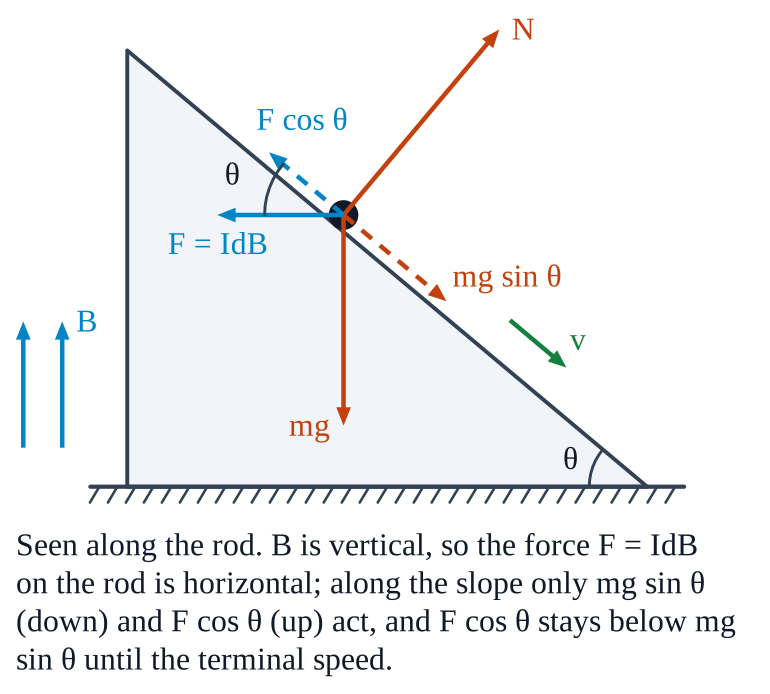
    A rod of mass m\displaystyle m and resistance R\displaystyle R slides smoothly over two parallel perfectly conducting wires kept sloping at an angle θ\displaystyle \theta with respect to the horizontal (Fig. 6.15\displaystyle 6.15). The circuit is closed through a perfect conductor at the top. There is a constant magnetic field B\displaystyle \mathbf{B} along the vertical direction. If the rod is initially at rest, find the velocity of the rod as a function of time. NCERT_Question_Class12_Physics_Exemplar_Ch6_Q28
    NCERT’s answer
    \(\displaystyle m \frac{d^2 x}{d t^2}=m g \sin \theta-\frac{B \cos \theta d}{R}\left(\frac{d x}{d t}\right) \times(B d) \cos \theta\) \[\begin{aligned} & \frac{d v}{d t}=g \sin \theta-\frac{B^2 d^2}{m R}(\cos \theta)^2 v \\ & \frac{d v}{d t}+\frac{B^2 d^2}{m R}(\cos \theta)^2 v=g \sin \theta \end{aligned} \] \(\displaystyle v=\frac{g \sin \theta}{\left(\dfrac{B^2 d^2 \cos ^2 \theta}{m R}\right)}+A \exp \left(-\frac{B^2 d^2}{m R}\left(\cos ^2 \theta\right) t\right)\) (A is a constant to be determine by initial conditions) \[=\frac{m g R \sin \theta}{B^2 d^2 \cos ^2 \theta}\left(1-\exp \left(-\frac{B^2 d^2}{m R}\left(\cos ^2 \theta\right) t\right)\right) \]
    With \(\displaystyle d\) the separation of the rails, the field component normal to the incline is \(\displaystyle B\cos\theta\). \[\varepsilon = B\cos\theta\; d\,v \] \[I=\frac{\varepsilon}{R}=\frac{B d v\cos\theta}{R} \] NCERT_Solution_Class12_Physics_Exemplar_Ch6_Q28 The force \(\displaystyle IdB\) on the rod is horizontal; its component up the slope opposes the motion: \[F_\parallel = IdB\cos\theta=\frac{B^2d^2\cos^2\theta}{R}\,v \] \[m\frac{dv}{dt}=mg\sin\theta-\frac{B^2d^2\cos^2\theta}{R}\,v \] Put \(\displaystyle \alpha=\dfrac{B^2d^2\cos^2\theta}{mR}\), with \(\displaystyle v(0)=0\): \[\int_0^{v}\frac{dv}{g\sin\theta-\alpha v}=\int_0^{t}dt \;\Rightarrow\; -\frac{1}{\alpha}\ln\frac{g\sin\theta-\alpha v}{g\sin\theta}=t \] \[v(t)=\frac{mgR\sin\theta}{B^2d^2\cos^2\theta}\left[1-e^{-B^2d^2\cos^2\theta\,t/(mR)}\right] \] Caution: \(\displaystyle \cos\theta\) enters twice, once in the emf and once in the component of the force along the slope.Answer: \(\displaystyle v(t)=\dfrac{mgR\sin\theta}{B^2d^2\cos^2\theta}\left[1-e^{-B^2d^2\cos^2\theta\,t/(mR)}\right]\), rising to a terminal speed \(\displaystyle \dfrac{mgR\sin\theta}{B^2d^2\cos^2\theta}\).
  8. Exercise 29

    Find the current in the sliding rod AB (resistance =R\displaystyle =R) for the arrangement shown in Fig 6.16. B\displaystyle \mathbf{B} is constant and is out of the paper. Parallel wires have no resistance. v\displaystyle \mathbf{v} is constant. Switch S is closed at time t=0\displaystyle t=0. NCERT_Question_Class12_Physics_Exemplar_Ch6_Q29
    NCERT’s answer
    If \(\displaystyle Q(t)\) is charge on the capacitor (note current flows from A to B) \[\begin{aligned} I & =\frac{v B d}{R}-\frac{Q}{R C} \\ & \Rightarrow \frac{Q}{R C}+\frac{d Q}{d t}=\frac{v B d}{R} \end{aligned} \] \[\begin{aligned} & Q=v B d C+A e^{-t / R C} \\ & \therefore \Rightarrow Q=v B d C\left[1-e^{-t / R C}\right] \end{aligned} \] (At time \(\displaystyle t=0, Q=0=A=-v B d c\)). Differentiating, we get \[I=\frac{v B d}{R} e^{-t / R C} \] NCERT_Solution_Class12_Physics_Exemplar_Ch6_Q29_ncert
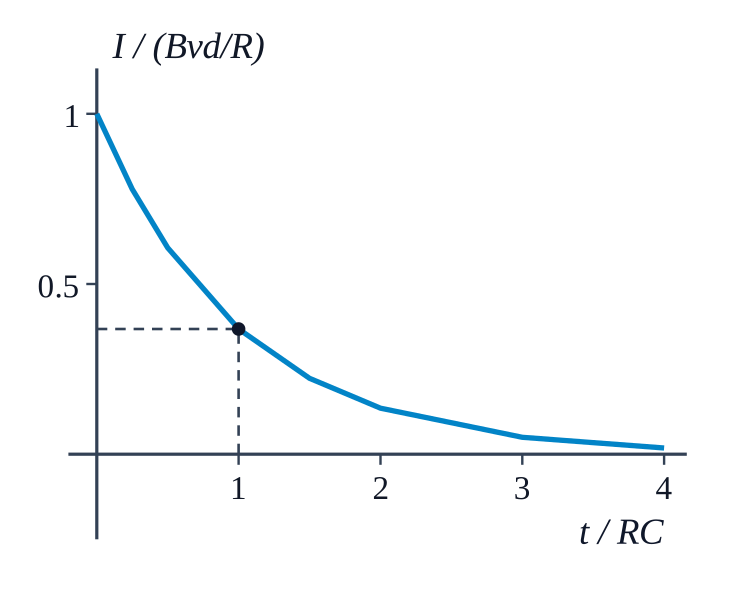
    Motional emf across the rod, constant because \(\displaystyle v\) is constant: \[\varepsilon = Bvd \] Rod (\(\displaystyle R\)) in series with \(\displaystyle C\), initially uncharged, S closed at \(\displaystyle t=0\): \[Bvd = IR+\frac{q}{C},\qquad I=\frac{dq}{dt} \] Differentiating, \(\displaystyle \varepsilon\) being constant: \[R\frac{dI}{dt}+\frac{I}{C}=0,\qquad I(0)=\frac{Bvd}{R} \] \[I(t)=\frac{Bvd}{R}\,e^{-t/RC} \] NCERT_Solution_Class12_Physics_Exemplar_Ch6_Q29 \[q(t)=CBvd\left(1-e^{-t/RC}\right)\;\to\; CBvd \] \(\displaystyle \mathbf{v}\times\mathbf{B}\) points from A to B in the rod, so the current circulates clockwise.Caution: at \(\displaystyle t=0\) the uncharged \(\displaystyle C\) has no voltage, so all of \(\displaystyle Bvd\) drops across \(\displaystyle R\).Answer: \(\displaystyle I=\dfrac{Bvd}{R}\,e^{-t/RC}\).
  9. Exercise 30

    Find the current in the sliding rod AB (resistance =R\displaystyle =R) for the arrangement shown in Fig 6.17. B\displaystyle \mathbf{B} is constant and is out of the paper. Parallel wires have no resistance. v\displaystyle \boldsymbol{v} is constant. Switch S is closed at time t=0\displaystyle t=0. NCERT_Question_Class12_Physics_Exemplar_Ch6_Q30
    NCERT’s answer
    \(\displaystyle -L \frac{d I}{d t}+v B d=I R\) \[\begin{aligned} & L \frac{d I}{d t}+I R=v B d \\ & I=\frac{v B d}{R}+\mathrm{Ae}^{-R t / 2} \end{aligned} \] At \(\displaystyle t=0 \quad I=0 \Rightarrow A=-\frac{v B d}{R}\) \[I=\frac{v B d}{R}\left(1-e^{-R t / L}\right) . \] NCERT_Solution_Class12_Physics_Exemplar_Ch6_Q30_ncert
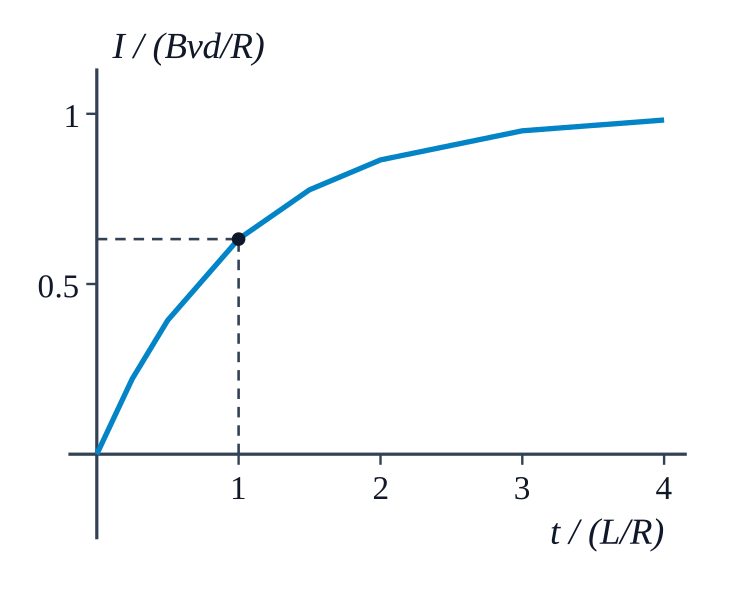
    Motional emf across the rod, constant because \(\displaystyle v\) is constant: \[\varepsilon = Bvd \] Rod (\(\displaystyle R\)) in series with \(\displaystyle L\), S closed at \(\displaystyle t=0\): \[Bvd = IR+L\frac{dI}{dt},\qquad I(0)=0 \] \[\int_0^{I}\frac{dI}{Bvd-IR}=\frac{1}{L}\int_0^{t}dt \;\Rightarrow\; -\frac{1}{R}\ln\frac{Bvd-IR}{Bvd}=\frac{t}{L} \] \[I(t)=\frac{Bvd}{R}\left(1-e^{-Rt/L}\right) \] NCERT_Solution_Class12_Physics_Exemplar_Ch6_Q30 \[t\to\infty:\quad I\to\frac{Bvd}{R} \] \(\displaystyle \mathbf{v}\times\mathbf{B}\) points from A to B in the rod, so the current circulates clockwise.Caution: \(\displaystyle I(0)=0\), because \(\displaystyle L\) opposes a sudden change of current; \(\displaystyle Bvd/R\) is only the final value.Answer: \(\displaystyle I=\dfrac{Bvd}{R}\left(1-e^{-Rt/L}\right)\).
  10. Exercise 31

    A metallic ring of mass m\displaystyle m and radius l\displaystyle l (ring being horizontal) is falling under gravity in a region having a magnetic field. If z\displaystyle z is the vertical direction, the z-component of magnetic field is Bz=Bo\displaystyle B_z=B_o (1+λz)\displaystyle (1+\lambda z). If R\displaystyle R is the resistance of the ring and if the ring falls with a velocity v, find the energy lost in the resistance. If the ring has reached a constant velocity, use the conservation of energy to determine v\displaystyle v in terms of m,B,λ\displaystyle m, B, \lambda and acceleration due to gravity g\displaystyle g.
    NCERT’s answer
    \(\displaystyle \frac{d \phi}{d t}=\) rate of change in flux \(\displaystyle =\left(\pi l^2\right) B_{\mathrm{o}} l \frac{d z}{d t}=I R\). \[I=\frac{\pi l^2 B_o \lambda}{R} v \] Energy lost/second \(\displaystyle =I^2 R=\frac{\left(\pi l^2 \lambda\right)^2 B_o{ }^2 v^2}{R}\) This must come from rate of change in \(\displaystyle \mathrm{PE}=m g \frac{d z}{d t}=m g v\) (as kinetic energy is constant for \(\displaystyle v=\) constant) Thus, \(\displaystyle m g v=\frac{\left(\pi l^2 \lambda B_0\right)^2 v^2}{R}\) Or, \(\displaystyle v=\frac{m g R}{\left(\pi l^2 \lambda B_o\right)^2}\).
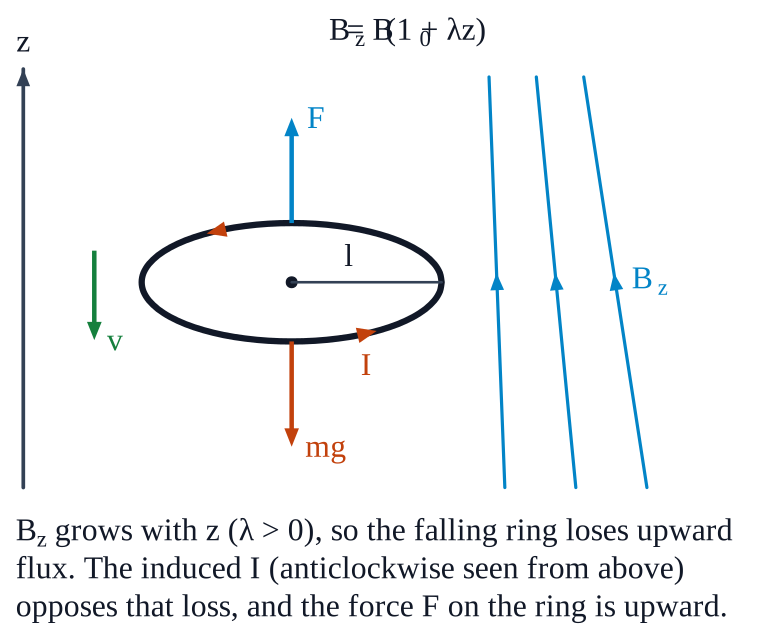
    Only \(\displaystyle B_z\) links the horizontal ring, and it changes because the ring moves through the gradient. \[\Phi = B_z\,\pi l^2 = B_0(1+\lambda z)\,\pi l^2 \] \[|\varepsilon|=\left|\frac{d\Phi}{dt}\right| = B_0\lambda\,\pi l^2\left|\frac{dz}{dt}\right| = B_0\lambda\pi l^2 v \] NCERT_Solution_Class12_Physics_Exemplar_Ch6_Q31 Heat produced in the ring: \[P=\frac{\varepsilon^2}{R}=\frac{\pi^2 l^4B_0^2\lambda^2v^2}{R} \] \[E=Pt=\frac{\pi^2 l^4B_0^2\lambda^2v^2}{R}\,t \] At constant velocity the kinetic energy does not change, so gravity's power equals the heating power: \[mgv=\frac{\pi^2 l^4B_0^2\lambda^2v^2}{R} \] \[v=\frac{mgR}{\pi^2 l^4B_0^2\lambda^2} \] Caution: the field change is \(\displaystyle B_0\lambda\,dz/dt\), not a time-varying \(\displaystyle B\).Answer: energy lost in \(\displaystyle R\) is \(\displaystyle \dfrac{\pi^2 l^4B_0^2\lambda^2v^2}{R}\) per second; \(\displaystyle v=\dfrac{mgR}{\pi^2 l^4B_0^2\lambda^2}\).
  11. Exercise 32

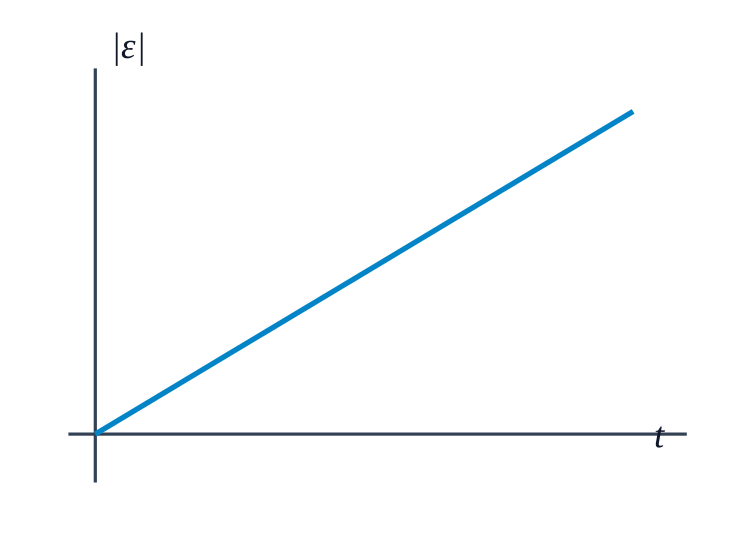
    A long solenoid 'S' has 'n\displaystyle n' turns per meter, with diameter 'a\displaystyle a'. At the centre of this coil we place a smaller coil of 'N\displaystyle N' turns and diameter 'b\displaystyle b' (where b<a\displaystyle b<a). If the current in the solenoid increases linearly, with time, what is the induced emf appearing in the smaller coil. Plot graph showing nature of variation in emf, if current varies as a function of mt2+C\displaystyle m t^2+\mathrm{C}.
    Field inside the long solenoid is uniform, and the small coil lies wholly inside it: \[B=\mu_0 nI \] \[\Phi = N\,B\,\frac{\pi b^2}{4}=\frac{\pi\mu_0 nNb^2}{4}\,I \] \[\varepsilon=-\frac{d\Phi}{dt}=-\frac{\pi\mu_0 nNb^2}{4}\,\frac{dI}{dt} \] Linear increase, \(\displaystyle dI/dt=k\) constant: \[\varepsilon=-\frac{\pi\mu_0 nNb^2}{4}\,k \quad(\text{constant}) \] For \(\displaystyle I=mt^2+C\), \(\displaystyle dI/dt=2mt\): \[\varepsilon=-\frac{\pi\mu_0 nNb^2m}{2}\,t \] NCERT_Solution_Class12_Physics_Exemplar_Ch6_Q32 Caution: the area is that of the small coil, \(\displaystyle \pi b^2/4\), not the solenoid's; the minus sign only says the emf opposes the rise of \(\displaystyle I\).Answer: \(\displaystyle \varepsilon=-\dfrac{\pi\mu_0 nNb^2}{4}\dfrac{dI}{dt}\); for \(\displaystyle I=mt^2+C\), \(\displaystyle |\varepsilon|=\dfrac{\pi\mu_0 nNb^2m}{2}\,t\), a straight line through the origin.