SolveIt is under development
SolveItClass 12 · Exemplar

NCERT Exemplar · Class 12 Physics Electromagnetic Induction

32 questions

Multiple Choice Questions (Type I) 1–6 (part 1 of 5)

  1. Exercise 1

    A square of side L\displaystyle L meters lies in the x−y\displaystyle x-y plane in a region, where the magnetic field is given by B=Bo(2i^+3j^+4k^)T\displaystyle \mathbf{B}=B_o(2 \hat{\mathbf{i}}+3 \hat{\mathbf{j}}+4 \hat{\mathbf{k}}) \mathrm{T}, where Bo\displaystyle B_o is constant. The magnitude of flux passing through the square is
    (a)
    2BoL2 Wb\displaystyle 2 B_o L^2 \mathrm{~Wb}.
    (b)
    3BoL2 Wb\displaystyle 3 B_o L^2 \mathrm{~Wb}.
    (c)
    4BoL2 Wb\displaystyle 4 B_o L^2 \mathrm{~Wb}.
    (d)
    29BoL2 Wb\displaystyle \sqrt{29} B_o L^2 \mathrm{~Wb}.
    NCERT’s answer
    (c)
    (c) Only the \(\displaystyle \hat{\mathbf{k}}\) component of \(\displaystyle \mathbf{B}\) is normal to the square, whose area vector lies along \(\displaystyle \hat{\mathbf{k}}\). \[\mathbf{A}=L^{2}\,\hat{\mathbf{k}}\ \mathrm{m^{2}} \] \[\phi=\mathbf{B}\cdot\mathbf{A}=B_o\,(2\hat{\mathbf{i}}+3\hat{\mathbf{j}}+4\hat{\mathbf{k}})\cdot L^{2}\hat{\mathbf{k}}=4B_oL^{2}\ \mathrm{Wb} \]
  2. Exercise 2

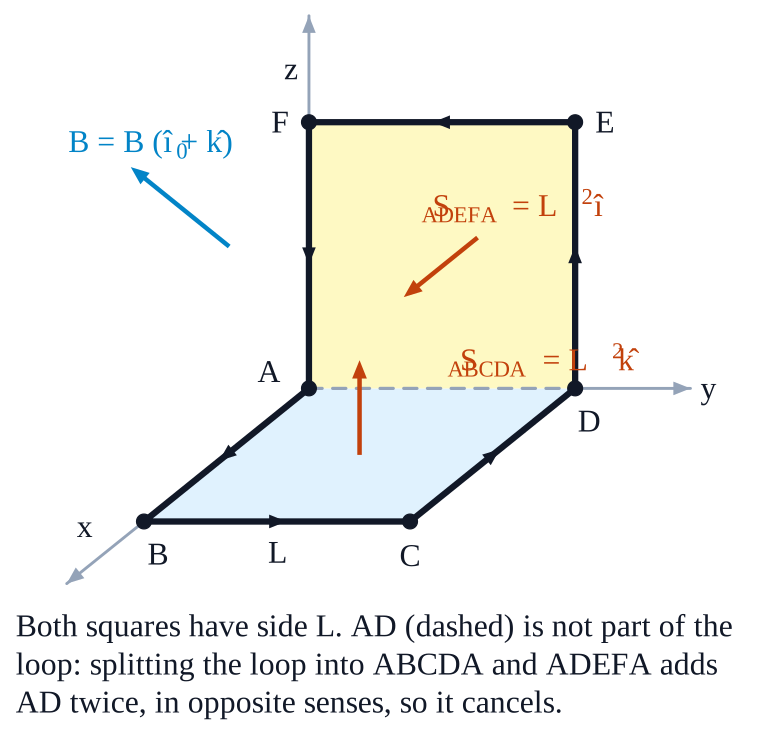
    A loop, made of straight edges has six corners at A(0,0,0\displaystyle 0{,}0{,}0), B(L,O,0\displaystyle 0) C(L,L,0),D(0, L,0)E(0,L,L)\displaystyle \mathrm{C}(L, L, 0), \mathrm{D}(0, \mathrm{~L}, 0) \mathrm{E}(0, L, L) and F(0,0,L)\displaystyle \mathrm{F}(0,0, L). A magnetic field B=Bo(i^+k^)T\displaystyle \mathbf{B}=B_o(\hat{\mathbf{i}}+\hat{\mathbf{k}}) \mathrm{T} is present in the region. The flux passing through the loop ABCDEFA (in that order) is
    (a)
    BoL2 Wb\displaystyle B_o L^2 \mathrm{~Wb}.
    (b)
    2BoL2 Wb\displaystyle 2 B_o L^2 \mathrm{~Wb}.
    (c)
    2BoL2 Wb\displaystyle \sqrt{2} B_o L^2 \mathrm{~Wb}.
    (d)
    4BoL2 Wb\displaystyle 4 B_o L^2 \mathrm{~Wb}.
    NCERT’s answer
    (b)
    (b) The loop is square ABCD (\(\displaystyle x\)-\(\displaystyle y\) plane) plus square ADEF (\(\displaystyle y\)-\(\displaystyle z\) plane); edge AD is traversed twice, in opposite senses, and cancels. NCERT_Solution_Class12_Physics_Exemplar_Ch6_Q2 \[\mathbf{S}_{ABCDA}=L^{2}\hat{\mathbf{k}},\qquad \mathbf{S}_{ADEFA}=L^{2}\hat{\mathbf{i}}\quad(\text{right-hand rule}) \] \[\mathbf{S}=L^{2}\,(\hat{\mathbf{i}}+\hat{\mathbf{k}})\ \mathrm{m^{2}} \] \[\phi=\mathbf{B}\cdot\mathbf{S}=B_oL^{2}\,(\hat{\mathbf{i}}+\hat{\mathbf{k}})\cdot(\hat{\mathbf{i}}+\hat{\mathbf{k}})=2B_oL^{2}\ \mathrm{Wb} \]
  3. Exercise 3

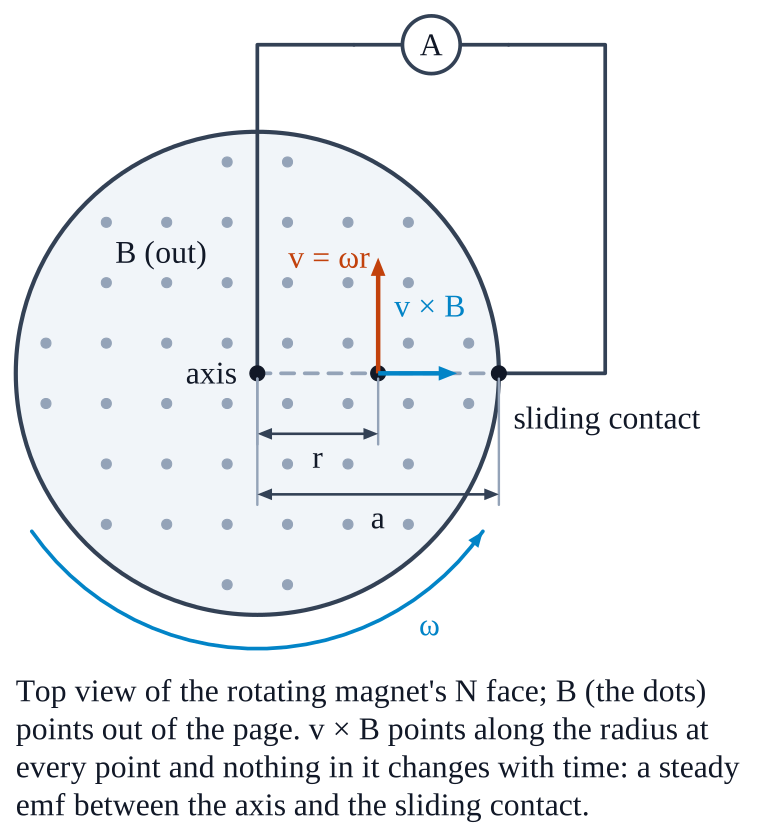
    A cylindrical bar magnet is rotated about its axis (Fig 6.1\displaystyle 6.1). A wire is connected from the axis and is made to touch the cylindrical surface through a contact. Then
    (a)
    a direct current flows in the ammeter A.
    (b)
    no current flows through the ammeter A.
    (c)
    an alternating sinusoidal current flows through the ammeter A with a time period T=2π/ω\displaystyle T=2 \pi / \omega.
    (d)
    a time varying non-sinosoidal current flows through the ammeter A.
    NCERT_Question_Class12_Physics_Exemplar_Ch6_Q3
    NCERT’s answer
    (a)
    (a) The magnet is itself the rotating conductor and its axially symmetric field never changes, so \(\displaystyle \mathbf{v}\times\mathbf{B}\) drives a steady radial emf between axis and rim: direct current. NCERT_Solution_Class12_Physics_Exemplar_Ch6_Q3 \[\text{pole face:}\quad \mathbf{v}\times\mathbf{B}=\omega r\,\hat{\boldsymbol{\phi}}\times B_z\hat{\mathbf{z}}=\omega r\,B_z\,\hat{\mathbf{r}} \] \[\mathcal{E}=\int_0^{a}\omega r\,B_z\,dr\ \ (\text{no }t\text{ in the integrand})\ \Rightarrow\ \mathcal{E},\ I=\text{constant (dc)} \]
  4. Exercise 4

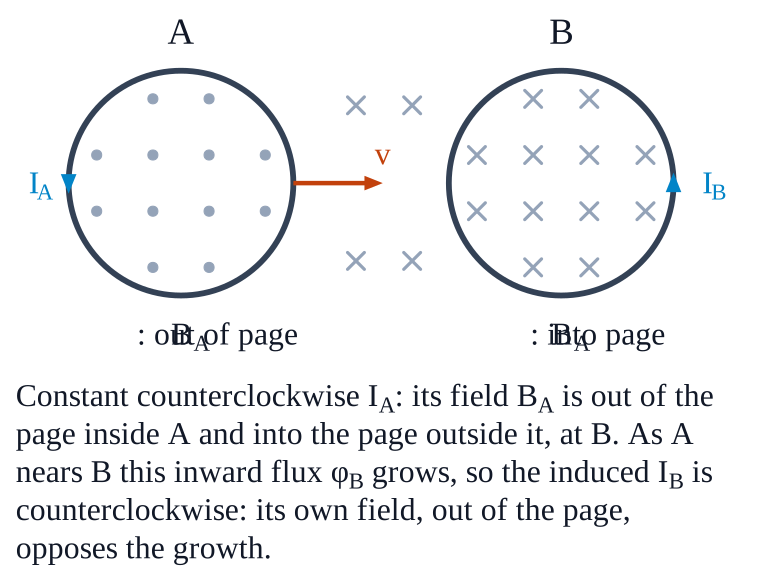
    There are two coils A and B as shown in Fig 6.2. A current starts flowing in B as shown, when A is moved towards B and stops when A stops moving. The current in A is counterclockwise. B is kept stationary when A moves. We can infer that
    (a)
    there is a constant current in the clockwise direction in A.
    (b)
    there is a varying current in A.
    (c)
    there is no current in A.
    (d)
    there is a constant current in the counterclockwise direction in A.
    NCERT_Question_Class12_Physics_Exemplar_Ch6_Q4
    NCERT’s answer
    (d)
    (d) B carries current only while A moves, so \(\displaystyle I_A\) is steady and non-zero; Lenz's law then confirms the counterclockwise sense. NCERT_Solution_Class12_Physics_Exemplar_Ch6_Q4 \[\mathcal{E}_B=-\frac{d(MI_A)}{dt}=-M\frac{dI_A}{dt}-I_A\frac{dM}{dt} \] \[\text{A at rest: }\ \frac{dM}{dt}=0,\ \ \mathcal{E}_B=0\ \Rightarrow\ \frac{dI_A}{dt}=0 \] \[\text{A moving: }\ \mathcal{E}_B\neq0\ \Rightarrow\ I_A\neq0 \] \[I_A\ (\text{ccw})\Rightarrow \mathbf{B}_A\text{ at B into page (reversed outside the loop)};\quad \text{A nears B}\Rightarrow\phi_B\uparrow\Rightarrow I_B\ (\text{ccw}) \]
  5. Exercise 5

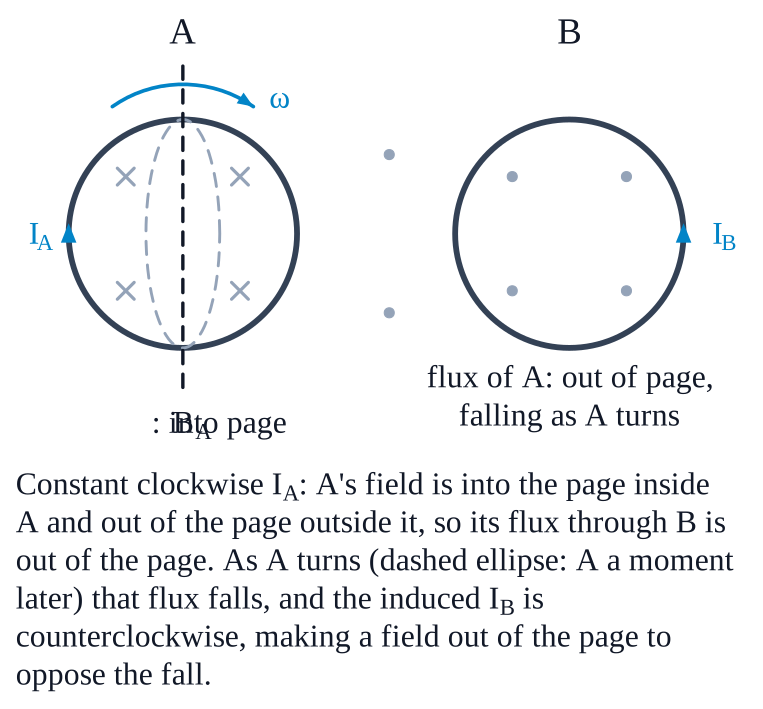
    Same as problem 4\displaystyle 4 except the coil A is made to rotate about a vertical axis (Fig 6.3\displaystyle 6.3). No current flows in B if A is at rest. The current in coil A, when the current in B (at t=0\displaystyle t=0) is counterclockwise and the coil A is as shown at this instant, t=0\displaystyle \mathrm{t}=0, is
    (a)
    constant current clockwise.
    (b)
    varying current clockwise.
    (c)
    varying current counterclockwise.
    (d)
    constant current counterclockwise.
    NCERT_Question_Class12_Physics_Exemplar_Ch6_Q5
    NCERT’s answer
    (a)
    (a) B carries no current while A rests, so \(\displaystyle I_A\) is constant; counterclockwise \(\displaystyle I_B\) then makes it clockwise. NCERT_Solution_Class12_Physics_Exemplar_Ch6_Q5 \[\text{A at rest: }\ I_B=0\ \Rightarrow\ \mathcal{E}_B=-M\frac{dI_A}{dt}=0\ \Rightarrow\ I_A=\text{constant} \] \[I_B\ (\text{ccw})\Rightarrow \text{induced field out of page}\Rightarrow \text{flux of A through B is out of page and falling} \] \[\text{A's field at B (outside A) is opposite to its field inside A}\Rightarrow \mathbf{B}_A\ \text{inside A: into page}\Rightarrow I_A\ \text{clockwise} \]
  6. Exercise 6

    The self inductance L\displaystyle L of a solenoid of length l\displaystyle l and area of cross-section A\displaystyle A, with a fixed number of turns N\displaystyle N increases as
    (a)
    l\displaystyle l and A increase.
    (b)
    l\displaystyle l decreases and A increases.
    (c)
    l\displaystyle l increases and A decreases.
    (d)
    both l\displaystyle l and A decrease.
    NCERT’s answer
    (b)
    (b) \(\displaystyle l\) decreases and \(\displaystyle A\) increases. \[L=\frac{\mu_0N^{2}A}{l}\qquad(N\text{ fixed}) \] \[A\uparrow,\ l\downarrow\ \Rightarrow\ \frac{A}{l}\uparrow\ \Rightarrow\ L\uparrow \]