Exercise 19
Positronium is just like a H-atom with the proton replaced by the positively charged anti-particle of the electron (called the positron which is as massive as the electron). What would be the ground state energy of positronium?
NCERT’s answer
The '\(\displaystyle m\)' that occurs in the Bohr formula \(\displaystyle E_n=-\frac{m e^4}{8 \varepsilon_0 n^2 h^2}\) is the reduced mass. For H-atom \(\displaystyle m \approx m_{\mathrm{e}}\). For positronium \(\displaystyle m \approx m_e / 2\). Hence for a positonium \(\displaystyle E_1 \approx-6.8 \mathrm{eV}\).
The two particles have equal mass \(\displaystyle m\) and circle their common centre of mass, so the reduced mass \(\displaystyle \mu\) replaces \(\displaystyle m\), not the electron mass alone.\[\mu=\frac{m\cdot m}{m+m}=\frac{m}{2} \]\[E_n=-\frac{\mu e^{4}}{8\varepsilon_0^{2}h^{2}}\cdot\frac{1}{n^{2}},\qquad \mu_{\mathrm{H}}\approx m\;\Rightarrow\;E_1(\mathrm{H})=-13.6\ \mathrm{eV} \]\[\frac{E_1(\mathrm{Ps})}{E_1(\mathrm{H})}=\frac{\mu_{\mathrm{Ps}}}{\mu_{\mathrm{H}}}=\frac{m/2}{m}=\frac{1}{2} \]\[E_1(\mathrm{Ps})=\frac{1}{2}\times(-13.6\ \mathrm{eV})=-6.8\ \mathrm{eV} \]Answer: \(\displaystyle E_1=-6.8\ \mathrm{eV}\)
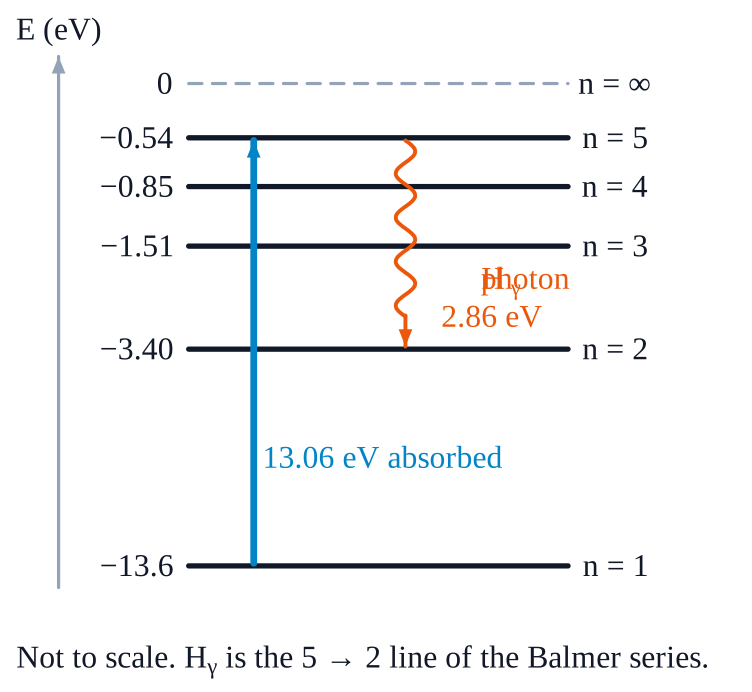 \[E=E_5-E_1=13.6\left(1-\frac{1}{25}\right)\ \mathrm{eV}=13.6\times0.96\ \mathrm{eV}=13.06\ \mathrm{eV} \]With \(\displaystyle L_n=\dfrac{nh}{2\pi}\), the atom's loss of angular momentum goes to the photon:\[L_{\gamma}=L_5-L_2=\frac{(5-2)\,h}{2\pi}=\frac{3\times6.63\times10^{-34}\ \mathrm{J\,s}}{2\pi}=3.17\times10^{-34}\ \mathrm{J\,s} \]Answer: \(\displaystyle E=13.06\ \mathrm{eV}\); \(\displaystyle L_\gamma=\dfrac{3h}{2\pi}\approx3.17\times10^{-34}\ \mathrm{J\,s}\)