SolveIt is under development
SolveItClass 12 · Exemplar

NCERT Exemplar · Class 12 Physics Atoms

29 questions

Long Answer Questions 24–29 (part 5 of 5)

  1. Exercise 24

    The first four spectral lines in the Lyman serics of a H-atom are λ=1218A˚,1028A˚,974.3A˚\displaystyle \lambda=1218 \AA, 1028 \AA, 974.3 \AA and 951.4A˚\displaystyle 951.4 \AA. If instead of Hydrogen, we consider Deuterium, calculate the shift in the wavelength of these lines.
    NCERT’s answer
    Reduced mass for \(\displaystyle H=\mu_H=\frac{m_e}{1+\dfrac{m_e}{M}} \simeq m_e\left(1-\frac{m_e}{M}\right)\) Reduced mass for \(\displaystyle D=\mu_D \simeq m_e\left(1-\frac{m_e}{2 M}\right)=m_e\left(1-\frac{m_e}{2 M}\right)\left(1+\frac{m_e}{2 M}\right)\) \(\displaystyle h \nu_{i j}=\left(E_i-E_j\right) \alpha \mu\). Thus, \(\displaystyle \lambda_{i j} \alpha \frac{1}{\mu}\) If for Hydrogen/Deuterium the wavelength is \(\displaystyle \lambda_H / \lambda_D\) \[\begin{aligned} & \frac{\lambda_D}{\lambda_H}=\frac{\mu_H}{\mu_D} \simeq\left(1+\frac{m_e}{2 M}\right)^{-1} \simeq\left(1-\frac{1}{2 \times 1840}\right) \\ & \lambda_D=\lambda_H \times(0.99973) \end{aligned} \] Thus lines are \(\displaystyle 1217.7 \AA, 1027.7 \AA, 974.04 \AA, 951.143 \AA\).
    Nuclear motion replaces \(\displaystyle m_e\) by the reduced mass \(\displaystyle \mu\); the heavier deuteron gives a larger \(\displaystyle \mu\), so every line moves to a shorter wavelength. \[\frac{1}{\lambda}=\frac{\mu e^4}{8\varepsilon_0^2h^3c}\left(1-\frac{1}{n^2}\right),\qquad \mu=\frac{m_eM}{m_e+M} \] \[\frac{\lambda_D}{\lambda_H}=\frac{\mu_H}{\mu_D}=\frac{1+m_e/M_D}{1+m_e/M_H} \] \[\frac{m_e}{M_H}=\frac{1}{1836}=5.45\times10^{-4},\qquad \frac{m_e}{M_D}=\frac{1}{3672}=2.72\times10^{-4} \] \[\frac{\Delta\lambda}{\lambda_H}=1-\frac{1.000272}{1.000545}=2.7\times10^{-4} \] \[\Delta\lambda=2.7\times10^{-4}\times(1218,\ 1028,\ 974.3,\ 951.4)\ \AA \approx 0.33,\ 0.28,\ 0.26,\ 0.26\ \AA \] Answer: Each line of deuterium is shorter by about \(\displaystyle 2.7\times10^{-4}\) of its wavelength: \(\displaystyle \approx 0.33,\ 0.28,\ 0.26,\ 0.26\ \AA\) respectively.
  2. Exercise 25

    Deutrium was discovered in 1932\displaystyle 1932 by Harold Urey by measuring the small change in wavelength for a particular transition in 1H\displaystyle { }^1 \mathrm{H} and 2H\displaystyle { }^2 \mathrm{H}. This is because, the wavelength of transition depend to a certain extent on the nuclear mass. If nuclear motion is taken into account then the electrons and nucleus revolve around their common centre of mass. Such a system is equivalent to a single particle with a reduced mass μ\displaystyle \mu, revolving around the nucleus at a distance equal to the electron-nucleus separation. Here μ=meM/(me+M)\displaystyle \mu=m_e M /\left(m_e+M\right) where M\displaystyle M is the nuclear mass and me\displaystyle m_e is the electronic mass. Estimate the percentage difference in wavelength for the 1st line of the Lyman series in 1H\displaystyle { }^1 \mathrm{H} and 2H\displaystyle { }^2 \mathrm{H}. (Mass of 1H\displaystyle { }^1 \mathrm{H} nucleus is 1.6725×10⁻²⁷ kg\displaystyle 1.6725 \times 10^{-27} \mathrm{~kg}, Mass of 2H\displaystyle { }^2 \mathrm{H} nucleus is 3.3374×10⁻²⁷ kg\displaystyle 3.3374 \times 10^{-27} \mathrm{~kg}, Mass of electron =9.109×10⁻³¹ kg\displaystyle =9.109 \times 10^{-31} \mathrm{~kg}.)
    NCERT’s answer
    Taking into account the nuclear motion, the stationary state energies shall be, \(\displaystyle E_n=-\frac{\mu Z^2 e^4}{8 \varepsilon_0^2 h^2}\left(\frac{1}{n^2}\right)\). Let \(\displaystyle \mu_H\) be the reduced mass of Hydrogen and \(\displaystyle \mu_D\) that of Deutrium. Then the frequency of the \(\displaystyle 1{ }^{\text {st }}\) Lyman line in Hydrogen is \(\displaystyle h \nu_H=\frac{\mu_H e^4}{8 \varepsilon_0^2 h^2}\left(1-\frac{1}{4}\right)=\frac{3}{4} \frac{\mu_H e^4}{8 \varepsilon_0^2 h^2}\). Thus the wavelength of the transition is \(\displaystyle \lambda_H=\frac{3}{4} \frac{\mu_H e^4}{8 \varepsilon_0^2 h^3 c}\). The wavelength of the transition for the same line in Deutrium is \(\displaystyle \lambda_D=\frac{3}{4} \frac{\mu_D e^4}{8 \varepsilon_0^2 h^3 c}\). \[\therefore \Delta \lambda=\lambda_D-\lambda_H \] Hence the percentage difference is \[\begin{aligned} & 100 \times \frac{\Delta \lambda}{\lambda_H}=\frac{\lambda_D-\lambda_H}{\lambda_H} \times 100=\frac{\mu_D-\mu_H}{\mu_H} \times 100 \\ & =\frac{\dfrac{m_e M_D}{\left(m_e+M_D\right)}-\dfrac{m_e M_H}{\left(m_e+M_H\right)}}{m_e M_H /\left(m_e+M_H\right)} \times 100 \\ & =\left[\left(\frac{m_e+M_H}{m_e+M_D}\right) \frac{M_D}{M_H}-1\right] \times 100 \end{aligned} \] Since \(\displaystyle m_{\mathrm{e}} \ll M_H<M_D\) \[\begin{aligned} \frac{\Delta \lambda}{\lambda_H} \times 100 & =\left[\frac{M_H}{M_D} \times \frac{M_D}{M_H}\left(\frac{1+m_e / M_H}{1+m_e / M_D}\right)-1\right] \times 100 \\ & =\left[\left(1+m_e / M_H\right)\left(1+m_e / M_D\right)^{-1}-1\right] \times 100 \\ & \simeq\left[(1+\frac{m_e}{M_H}-\frac{m_e}{M_D}-1\right] \times 100 \\ & \approx m_e\left[\frac{1}{M_H}-\frac{1}{M_D}\right] \times 100 \\ & =9.1 \times 10^{-31}\left[\frac{1}{1.6725 \times 10^{-27}}-\frac{1}{3.3374 \times 10^{-27}}\right] \times 100 \\ & =9.1 \times 10^{-4}[0.5979-0.2996] \times 100 \\ & =2.714 \times 10^{-2} \% \end{aligned} \]
    Wavelength varies inversely with the reduced mass, so compare \(\displaystyle \mu\) for the two nuclei. \[\mu_H=\frac{m_eM_H}{m_e+M_H}=\frac{9.109\times10^{-31}\times1.6725\times10^{-27}}{9.109\times10^{-31}+1.6725\times10^{-27}}=9.10404\times10^{-31}\ \mathrm{kg} \] \[\mu_D=\frac{m_eM_D}{m_e+M_D}=\frac{9.109\times10^{-31}\times3.3374\times10^{-27}}{9.109\times10^{-31}+3.3374\times10^{-27}}=9.10651\times10^{-31}\ \mathrm{kg} \] \[\frac{1}{\lambda}=\frac34\,\frac{\mu e^4}{8\varepsilon_0^2h^3c}\ \Rightarrow\ \lambda_H\mu_H=\lambda_D\mu_D \] \[\frac{\lambda_H-\lambda_D}{\lambda_H}\times100=\left(1-\frac{\mu_H}{\mu_D}\right)\times100=\frac{9.10651-9.10404}{9.10651}\times100=0.027\% \] Answer: The first Lyman line of \(\displaystyle ^2\mathrm{H}\) is shorter than that of \(\displaystyle ^1\mathrm{H}\) by about \(\displaystyle 0.027\%\).
  3. Exercise 26

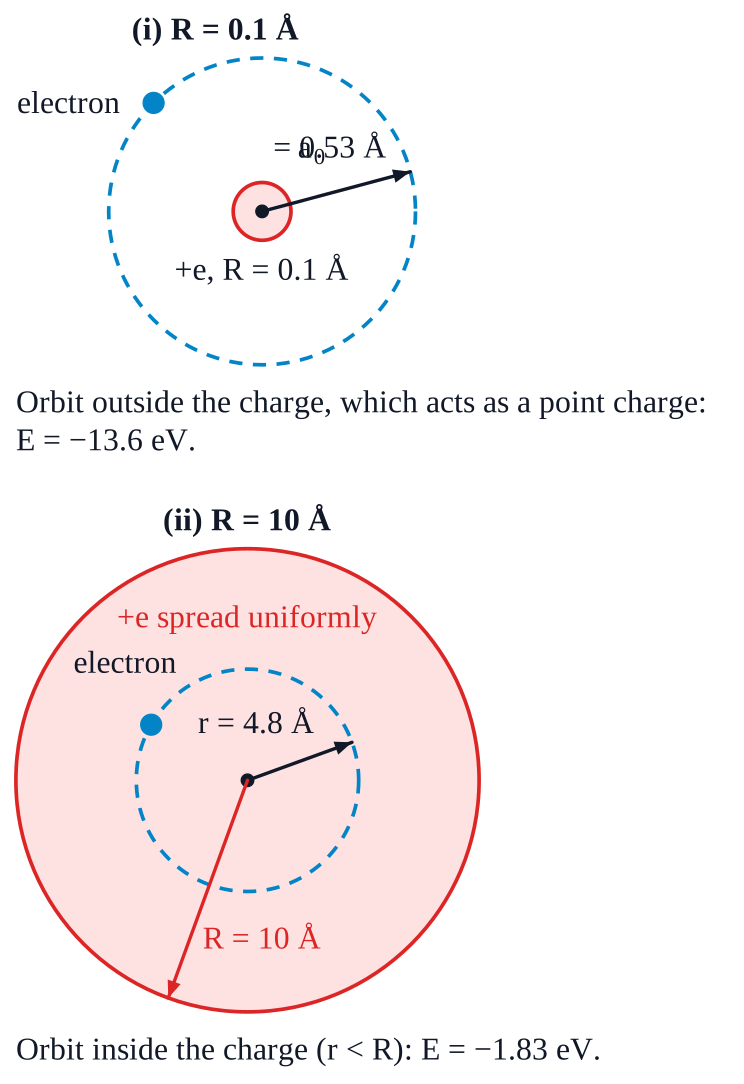
    If a proton had a radius R\displaystyle R and the charge was uniformly distributed, calculate using Bohr theory, the ground state energy of a H-atom when (i) R=0.1A˚\displaystyle R=0.1 \AA, and (ii) R=10A˚\displaystyle R=10 \AA.
    First locate the Bohr orbit relative to the charged sphere: \(\displaystyle a_0=0.53\ \AA\). NCERT_Solution_Class12_Physics_Exemplar_Ch12_Q26 (i) \(\displaystyle R=0.1\ \AA<a_0\): the orbit lies outside the charge, which acts as a point charge. \[E=-\frac{e^2}{8\pi\varepsilon_0a_0}=-13.6\ \mathrm{eV} \] (ii) \(\displaystyle R=10\ \AA>a_0\): the orbit lies inside the sphere. \[F=\frac{e^2\,r}{4\pi\varepsilon_0R^3},\qquad U(r)=-\frac{e^2\,(3R^2-r^2)}{8\pi\varepsilon_0R^3} \] \[\frac{mv^2}{r}=F,\quad mvr=\hbar\ \Rightarrow\ \frac{\hbar^2}{mr^2}=\frac{e^2r^2}{4\pi\varepsilon_0R^3}\ \Rightarrow\ r^4=a_0R^3 \] \[r=(0.53)^{1/4}(10)^{3/4}\ \AA=4.8\ \AA<R\ \checkmark \] \[E=\tfrac12mv^2+U=-\frac{e^2}{8\pi\varepsilon_0R}\left(3-\frac{2r^2}{R^2}\right)=-\frac{14.4}{2\times10}\,(3-0.46)\ \mathrm{eV}=-1.83\ \mathrm{eV} \] Answer: (i) \(\displaystyle -13.6\ \mathrm{eV}\); (ii) \(\displaystyle \approx-1.83\ \mathrm{eV}\).
  4. Exercise 27

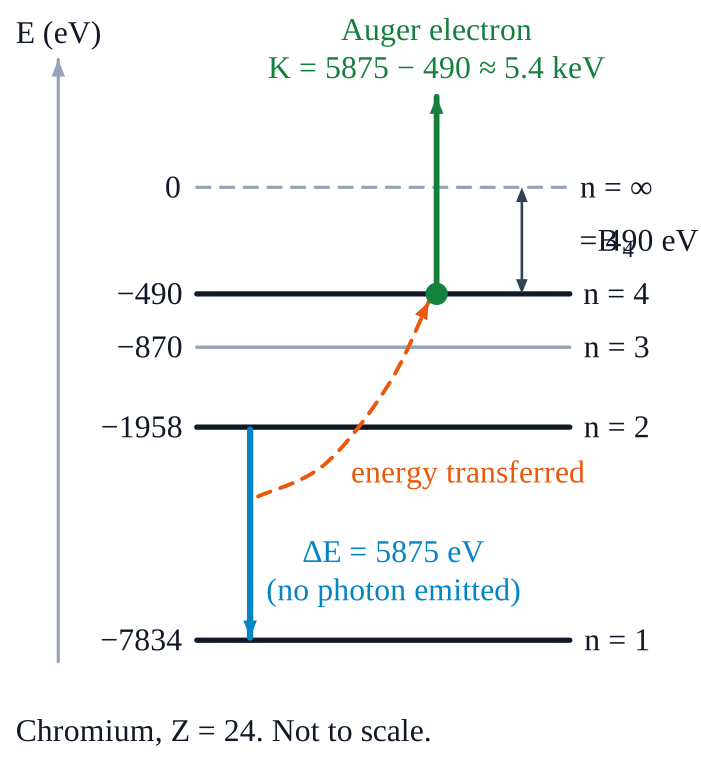
    In the Auger process an atom makes a transition to a lower state without emitting a photon. The excess energy is transferred to an outer electron which may be ejected by the atom. (This is called an Auger electron). Assuming the nucleus to be massive, calculate the kinetic energy of an n=4\displaystyle \mathrm{n}=4 Auger electron emitted by Chromium by absorbing the energy from a n=2\displaystyle n=2 to n=1\displaystyle n=1 transition.
    NCERT’s answer
    As the nucleus is massive, recoil momentum of the atom may be neglected and the entire energy of the transition may be considered transferred to the Auger electron. As there is a single valence electron in Cr, the energy states may be thought of as given by the Bohr model. The energy of the \(\displaystyle n\)th state \(\displaystyle E_n=-Z^2 R \frac{1}{n^2}\) where \(\displaystyle R\) is the Rydberg constant and \(\displaystyle Z=24\). The energy released in a transition from $\displaystyle 2$ to $\displaystyle 1$ is \(\displaystyle \Delta E=Z^2 R\left(1-\frac{1}{4}\right)=\frac{3}{4} Z^2 R\). The energy required to eject a \(\displaystyle n=4\) electron is \(\displaystyle E_4=Z^2 R \frac{1}{16}\). Thus the kinetic energy of the Auger electron is \[\begin{aligned} & K . E=Z^2 R\left(\frac{3}{4}-\frac{1}{16}\right)=\frac{1}{16} Z^2 R \\ & =\frac{11}{16} \times 24 \times 24 \times 13.6 \mathrm{eV} \\ & =5385.6 \mathrm{eV} \end{aligned} \]
    No photon leaves: the \(\displaystyle n=2\to n=1\) energy is handed to the \(\displaystyle n=4\) electron, which first pays its binding energy. NCERT_Solution_Class12_Physics_Exemplar_Ch12_Q27 \[E_n=-\frac{13.6\,Z^2}{n^2}\ \mathrm{eV},\qquad Z=24 \] \[\Delta E_{2\to1}=13.6\times24^2\left(1-\frac14\right)=5.88\times10^{3}\ \mathrm{eV} \] \[B_4=\frac{13.6\times24^2}{4^2}=4.9\times10^{2}\ \mathrm{eV} \] \[K=\Delta E_{2\to1}-B_4=5875-490\approx5.4\times10^{3}\ \mathrm{eV} \] Answer: \(\displaystyle K\approx5.4\ \mathrm{keV}\).
  5. Exercise 28

    The inverse square law in electrostatics is ∣F∣=e2(4πε0).r2\displaystyle |\mathbf{F}|=\frac{e^2}{\left(4 \pi \varepsilon_0\right) . r^2} for the force between an electron and a proton. The (1r)\displaystyle \left(\frac{1}{r}\right) dependence of ∣F∣\displaystyle |\mathbf{F}| can be understood in quantum theory as being due to the fact that the 'particle' of light (photon) is massless. If photons had a mass mp\displaystyle m_p, force would be modified to ∣F∣=e2(4πε0)r2[1r2+λr].e×p(−λr) where λ=mpc/ℏ and ℏ=h2π.|\mathbf{F}|=\frac{e^2}{\left(4 \pi \varepsilon_0\right) r^2}\left[\frac{1}{r^2}+\frac{\lambda}{r}\right] . e \times p(-\lambda r) \text { where } \lambda=m_p c / \hbar \text { and } \hbar=\frac{h}{2 \pi} . Estimate the change in the ground state energy of a H-atom if mp\displaystyle m_p were 10−6\displaystyle 10^{-6} times the mass of an electron.
    NCERT’s answer
    \[\begin{aligned} m_p c^2 & =10^{-6} \times \text { electron mass } \times c^2 \\ & \approx 10^{-6} \times 0.5 \mathrm{MeV} \\ & \approx 10^{-6} \times 0.5 \times 1.6 \times 10^{-13} \\ & \approx 0.8 \times 10^{-19} \mathrm{~J} \end{aligned} \] \(\displaystyle \frac{\hbar}{m_p c}=\frac{\hbar c}{m_p c^2}=\frac{10^{-34} \times 3 \times 10^8}{0.8 \times 10^{-19}} \approx 4 \times 10^{-7} \mathrm{~m} \gg\) Bohr radius. \[|\mathbf{F}|=\frac{e^2}{4 \pi \varepsilon_0}\left[\frac{1}{r^2}+\frac{\lambda}{r}\right] \exp (-\lambda r) \] where \(\displaystyle \lambda^{-1}=\frac{\hbar}{m_p c} \approx 4 \times 10^{-7} \mathrm{~m} \gg r_B\) \[\begin{aligned} & \therefore \lambda \ll \frac{1}{r_B} i . e \lambda r_B \ll 1 \\ & U(r)=-\frac{e^2}{4 \pi \varepsilon_0} \cdot \frac{\exp (-\lambda r)}{r} \\ & m v r=\hbar \therefore v=\frac{\hbar}{m r} \end{aligned} \] Also : \(\displaystyle \frac{m v^2}{r}=\approx\left(\frac{e^2}{4 \pi \varepsilon_0}\right)\left[\frac{1}{r^2}+\frac{\lambda}{r}\right]\) \[\begin{aligned} & \therefore \frac{\hbar^2}{m r^3}=\left(\frac{e^2}{4 \pi \varepsilon_0}\right)\left[\frac{1}{r^2}+\frac{\lambda}{r}\right] \\ & \therefore \frac{\hbar^2}{m}=\left(\frac{e^2}{4 \pi \varepsilon_0}\right)\left[r+\lambda r^2\right] \end{aligned} \] If \(\displaystyle \lambda=0 ; r=r_B=\frac{\hbar}{m} \cdot \frac{4 \pi \varepsilon_0}{e^2}\) \[\frac{\hbar^2}{m}=\frac{e^2}{4 \pi \varepsilon_0} \cdot r_B \] Since \(\displaystyle \lambda^{-1} \gg r_B\), put \(\displaystyle r=r_B+\delta\) \[\therefore r_B=r_B+\delta+\lambda\left(r_B^2+\delta^2+2 \delta r_B\right) ; \text { negect } \delta^2 \] or \(\displaystyle 0=\lambda r_B^2+\delta\left(1+2 \lambda r_B\right)\) \[\delta=\frac{-\lambda r_B^2}{1+2 \lambda r_B} \approx \lambda r_B^2\left(1-2 \lambda r_B\right)=-\lambda r_B^2 \text { since } \lambda r_B \ll 1 \] \[\therefore V(r)=-\frac{e^2}{4 \pi \varepsilon_0} \cdot \frac{\exp \left(-\lambda \delta-\lambda r_B\right)}{r_B+\delta} \] \[\therefore V(r)=-\frac{e^2}{4 \pi \varepsilon_0} \frac{1}{r_B}\left[\left(1-\frac{\delta}{r_B}\right) \cdot\left(1-\lambda r_B\right)\right] \] \(\displaystyle \cong(-27.2 \mathrm{eV})\) remains unchanged. \[\begin{aligned} & K . E=-\frac{1}{2} m v^2=\frac{1}{2} m \cdot \frac{\hbar^2}{m r^2}=\frac{\hbar^2}{2\left(r_B+\delta\right)^2}=\frac{\hbar^2}{2 r_B^2}\left(1-\frac{2 \delta}{r_B}\right) \\ & =(13.6 \mathrm{eV})\left[1+2 \lambda r_B\right] \end{aligned} \] \[\begin{gathered} \text { Total energy }=\quad-\frac{e^2}{4 \pi \varepsilon_0 r_B}+\frac{\hbar^2}{2 r_B^2}\left[1+2 \lambda r_B\right] \\ =-27.2+13.6\left[1+2 \lambda r_B\right] \mathrm{eV} \end{gathered} \] Change in energy \(\displaystyle =13.6 \times 2 \lambda r_B \mathrm{eV}=27.2 \lambda r_B \mathrm{eV}\)
    A massive photon screens the Coulomb potential (Yukawa form); the force is its gradient. \[V(r)=-\frac{e^2}{4\pi\varepsilon_0}\frac{e^{-\lambda r}}{r}\ \Rightarrow\ |\mathbf{F}|=\frac{dV}{dr}=\frac{e^2}{4\pi\varepsilon_0}\left[\frac{1}{r^2}+\frac{\lambda}{r}\right]e^{-\lambda r} \] \[\lambda=\frac{m_pc}{\hbar}=\frac{10^{-6}\times9.11\times10^{-31}\times3\times10^{8}}{1.055\times10^{-34}}=2.6\times10^{6}\ \mathrm{m^{-1}} \] \[\lambda a_0=2.6\times10^{6}\times0.53\times10^{-10}=1.4\times10^{-4}\ll1 \] \[(1+\lambda r)e^{-\lambda r}\approx1-\tfrac12\lambda^2r^2\approx1\ \Rightarrow\ r,\ K\ \text{unchanged} \] \[V\approx-\frac{e^2}{4\pi\varepsilon_0r}\,(1-\lambda r)=-\frac{e^2}{4\pi\varepsilon_0r}+\frac{e^2\lambda}{4\pi\varepsilon_0} \] \[\Delta E=\frac{e^2\lambda}{4\pi\varepsilon_0}=(14.4\ \mathrm{eV\,\AA})(2.6\times10^{-4}\ \AA^{-1})=3.7\times10^{-3}\ \mathrm{eV} \] Answer: The ground-state energy rises by about \(\displaystyle 3.7\times10^{-3}\ \mathrm{eV}\) (from \(\displaystyle -13.6\ \mathrm{eV}\) to \(\displaystyle \approx-13.596\ \mathrm{eV}\)).
  6. Exercise 29

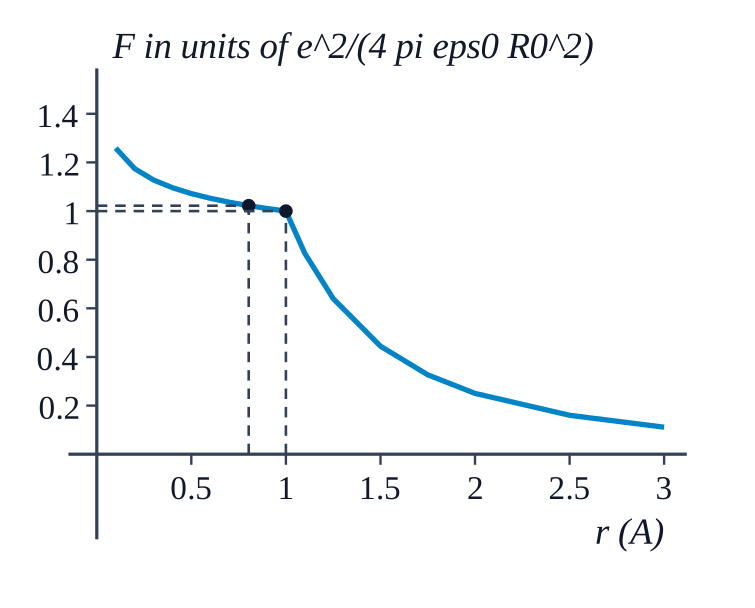
    The Bohr model for the H-atom relies on the Coulomb's law of electrostatics. Coulomb's law has not directly been verified for very short distances of the order of angstroms. Supposing Coulomb's law between two opposite charge +q1,−q2\displaystyle +q_1,-q_2 is modified to ∣F∣=q1q2(4πε0)1r2,r≥R0=q1q24πε01R02(R0r)ε,r≤R0\begin{aligned} & |\mathbf{F}|=\frac{q_1 q_2}{\left(4 \pi \varepsilon_0\right)} \frac{1}{r^2}, \quad r \geq R_0 \\ & =\frac{q_1 q_2}{4 \pi \varepsilon_0} \frac{1}{R_0^2}\left(\frac{R_0}{r}\right)^{\varepsilon}, r \leq R_0 \end{aligned} Calculate in such a case, the ground state energy of a H-atom, if ε=0.1,R0=1A˚\displaystyle \varepsilon=0.1, R_0=1 \AA.
    NCERT’s answer
    Let \(\displaystyle \varepsilon=2+\delta\)
    \[\begin{aligned} F= & \frac{q_1 q_2}{4 \pi \varepsilon_0} \cdot \frac{R_0^\delta}{r^{2+\delta}}=\wedge \frac{R_0^\delta}{r^{2+\delta}}, \text { where } \frac{q_1 q_2}{4 \pi_0 \varepsilon}=\wedge, \wedge=\left(1.6 \times 10^{-19}\right)^2 \times 9 \times 10^9 \\ & =23.04 \times 10^{-29} \end{aligned} \]
    \[\begin{array}{r} =\frac{m v^2}{r} \\ v^2=\frac{\wedge R_0^\delta}{m r^{1+\delta}} \end{array} \]
    (i)
    \(\displaystyle m v r=n \hbar, r=\frac{n \hbar}{m v}=\frac{n \hbar}{m}\left[\frac{m}{\wedge R_0^\delta}\right]^{1 / 2} r^{1 / 2+\delta / 2}\)
    Solving this for \(\displaystyle r\), we get \(\displaystyle r_n=\left[\frac{n^2 \hbar^2}{m \wedge R_0^\delta}\right]^{\frac{1}{1-\delta}}\)
    For \(\displaystyle n=1\) and substituting the values of constant, we get
    \[\begin{aligned} & r_1=\left[\frac{\hbar^2}{m \wedge R_0^\delta}\right]^{\frac{1}{1-\delta}} \\ & r_1=\left[\frac{1.05^2 \times 10^{-68}}{9.1 \times 10^{-31} \times 2.3 \times 10^{-28} \times 10^{+19}}\right]^{\frac{1}{2.9}}=8 \times 10^{-11}=0.08 \mathrm{~nm} \\ & (<0.1 \mathrm{~nm}) \end{aligned} \]
    (ii)
    \(\displaystyle v_n=\frac{n \hbar}{m r_n}=n \hbar\left(\frac{m \wedge R_0^\delta}{n^2 \hbar^2}\right)^{\frac{1}{1-\delta}}\). For \(\displaystyle n=1, v_1=\frac{\hbar}{m r_1}=1.44 \times 10^6 \mathrm{~m} / \mathrm{s}\)
    (iii)
    K.E. \(\displaystyle =\frac{1}{2} m v_1^2=9.43 \times 10^{-19} \mathrm{~J}=5.9 \mathrm{eV}\)
    P.E. till \(\displaystyle R_0=-\frac{\wedge}{R_0}\)
    P.E. from \(\displaystyle R_0\) to \(\displaystyle r=+\wedge R_0^\delta \int_{R_0}^r \frac{d r}{r^{2+\delta}}=+\frac{\wedge R_0^\delta}{-1-\delta}\left[\frac{1}{r^{1+\delta}}\right]_{R_0}^r\)
    \[\begin{aligned} & =-\frac{\wedge R_0^\delta}{1+\delta}\left[\frac{1}{r^{1+\delta}}-\frac{1}{R_0^{1+\delta}}\right] \\ & =-\frac{\wedge}{1+\delta}\left[\frac{R_0^\delta}{r^{1+\delta}}-\frac{1}{R_0}\right] \end{aligned} \]
    \[P . E .=-\frac{\wedge}{1+\delta}\left[\frac{R_0^\delta}{r^{1+\delta}}-\frac{1}{R_0}+\frac{1+\delta}{R_0}\right] \]
    \[\begin{aligned} P . E . & =-\frac{\wedge}{-0.9}\left[\frac{R_0^{-1.9}}{r^{-0.9}}-\frac{1.9}{R_0}\right] \\ & =\frac{2.3}{0.9} \times 10^{-18}\left[(0.8)^{0.9}-1.9\right] \mathrm{J}=-17.3 \mathrm{eV} \end{aligned} \]
    Total energy is \(\displaystyle (-17.3+5.9)=-11.4 \mathrm{eV}\).
    The Coulomb force is modified only for \(\displaystyle r\le R_0\), so check where the orbit falls. Try \(\displaystyle r<R_0\) and verify afterwards. NCERT_Solution_Class12_Physics_Exemplar_Ch12_Q29 \[\frac{mv^2}{r}=\frac{e^2}{4\pi\varepsilon_0R_0^2}\left(\frac{R_0}{r}\right)^{\varepsilon},\qquad mvr=\hbar \] \[r^{\,3-\varepsilon}=a_0R_0^{\,2-\varepsilon}\ \Rightarrow\ r^{2.9}=0.53\times1^{1.9}\ \Rightarrow\ r=0.80\ \AA<R_0\ \checkmark \] \[K=\tfrac12mv^2=\frac{e^2}{8\pi\varepsilon_0R_0}\left(\frac{r}{R_0}\right)^{1-\varepsilon}=7.2\times(0.80)^{0.9}\approx5.9\ \mathrm{eV} \] \[U=-\int_r^{\infty}F\,dr=-\frac{e^2}{4\pi\varepsilon_0R_0}\left[1+\frac{1-(r/R_0)^{1-\varepsilon}}{1-\varepsilon}\right]=-14.4\left[1+\frac{1-0.82}{0.9}\right]\approx-17.3\ \mathrm{eV} \] \[E=K+U=5.9-17.3\approx-11.4\ \mathrm{eV} \] Answer: \(\displaystyle E\approx-11.4\ \mathrm{eV}\) (instead of \(\displaystyle -13.6\ \mathrm{eV}\)).