SolveIt is under development
SolveItClass 12 · Exemplar

NCERT Exemplar · Class 12 Physics Atoms

29 questions

Multiple Choice Questions (Type I) 1–7 (part 1 of 5)

  1. Exercise 1

    Taking the Bohr radius as a0=53pm\displaystyle a_0=53 \mathrm{pm}, the radius of Li++\displaystyle \mathrm{Li}^{++} ion in its ground state, on the basis of Bohr's model, will be about
    (a)
    53\displaystyle 53 pm
    (b)
    27\displaystyle 27 pm
    (c)
    18\displaystyle 18 pm
    (d)
    13\displaystyle 13 pm
    NCERT’s answer
    (c)
    (c) $\displaystyle 18$ pm. \(\displaystyle \mathrm{Li^{++}}\) is hydrogen-like with \(\displaystyle Z=3\).\[r_n=\frac{n^2a_0}{Z} \]\[r_1=\frac{1^2\times 53\ \mathrm{pm}}{3}\approx 17.7\ \mathrm{pm}\approx 18\ \mathrm{pm} \]
  2. Exercise 2

    The binding energy of a H-atom, considering an electron moving around a fixed nuclei (proton), is B=−me48n2ε02h2\displaystyle B=-\frac{m e^4}{8 n^2 \varepsilon_0^2 h^2}. (m=\displaystyle m= electron mass).
    If one decides to work in a frame of reference where the electron is at rest, the proton would be moving arround it. By similar arguments, the binding energy would be
    B=−Me48n2ε02h2(M= proton mass )B=-\frac{M e^4}{8 n^2 \varepsilon_0^2 h^2} \quad(M=\text { proton mass })
    This last expression is not correct because
    (a)
    n\displaystyle n would not be integral.
    (b)
    Bohr-quantisation applies only to electron
    (c)
    the frame in which the electron is at rest is not inertial.
    (d)
    the motion of the proton would not be in circular orbits, even approximately.
    NCERT’s answer
    (c)
    (c) The electron accelerates around the proton, so its rest frame is not inertial and the Bohr force balance does not hold there.\[a_e=\frac{v^2}{r}\neq 0 \Rightarrow \text{non-inertial frame} \]\[B=-\frac{\mu e^4}{8n^2\varepsilon_0^2h^2},\qquad \mu=\frac{mM}{m+M}\approx m \]
  3. Exercise 3

    The simple Bohr model cannot be directly applied to calculate the energy levels of an atom with many electrons. This is because
    (a)
    of the electrons not being subject to a central force.
    (b)
    of the electrons colliding with each other
    (c)
    of screening effects
    (d)
    the force between the nucleus and an electron will no longer be given by Coulomb's law.
    NCERT’s answer
    (a)
    (a) The repulsion from the other electrons adds a force that does not point at the nucleus, so the force is not central.\[\mathbf{F}_i=-\frac{Ze^2}{4\pi\varepsilon_0 r_i^2}\,\hat{\mathbf{r}}_i+\sum_{j\neq i}\frac{e^2}{4\pi\varepsilon_0 r_{ij}^2}\,\hat{\mathbf{r}}_{ij} \]\[\text{second term depends on the other electrons' positions} \Rightarrow \mathbf{F}_i\nparallel\hat{\mathbf{r}}_i \]
  4. Exercise 4

    For the ground state, the electron in the H-atom has an angular momentum =ℏ\displaystyle =\hbar, according to the simple Bohr model. Angular momentum is a vector and hence there will be infinitely many orbits with the vector pointing in all possible directions. In actuality, this is not true,
    (a)
    because Bohr model gives incorrect values of angular momentum.
    (b)
    because only one of these would have a minimum energy.
    (c)
    angular momentum must be in the direction of spin of electron.
    (d)
    because electrons go around only in horizontal orbits.
    NCERT’s answer
    (a)
    (a) The Bohr value is wrong: the real ground state has no angular momentum, so there is no direction to vary.\[L_{\text{Bohr}}=n\hbar=\hbar\qquad(n=1) \]\[L_{\text{actual}}=\sqrt{\ell(\ell+1)}\,\hbar=0\qquad(\ell=0) \]\[L=0 \Rightarrow \text{no axis} \Rightarrow \text{one spherically symmetric ground state} \]
  5. Exercise 5

    O2\displaystyle \mathrm{O}_2 molecule consists of two oxygen atoms. In the molecule, nuclear force between the nuclei of the two atoms
    (a)
    is not important because nuclear forces are short-ranged.
    (b)
    is as important as electrostatic force for binding the two atoms.
    (c)
    cancels the repulsive electrostatic force between the nuclei.
    (d)
    is not important because oxygen nucleus have equal number of neutrons and protons.
    NCERT’s answer
    (a)
    (a) Nuclear forces act over only about a femtometre, far less than the separation of the two nuclei.\[d_{\mathrm{O-O}}\approx 1.2\times10^{-10}\ \mathrm{m}\gg R_{\text{nuclear}}\sim10^{-15}\ \mathrm{m} \]\[\frac{d_{\mathrm{O-O}}}{R_{\text{nuclear}}}\sim10^{5}\Rightarrow F_{\text{nuclear}}\approx 0 \]
  6. Exercise 6

    Two H atoms in the ground state collide inelastically. The maximum amount by which their combined kinetic energy is reduced is
    (a)
    10.20\displaystyle 20 eV
    (b)
    20.40\displaystyle 40 eV
    (c)
    13.6\displaystyle 6 eV
    (d)
    27.2\displaystyle 2 eV
    NCERT’s answer
    (a)
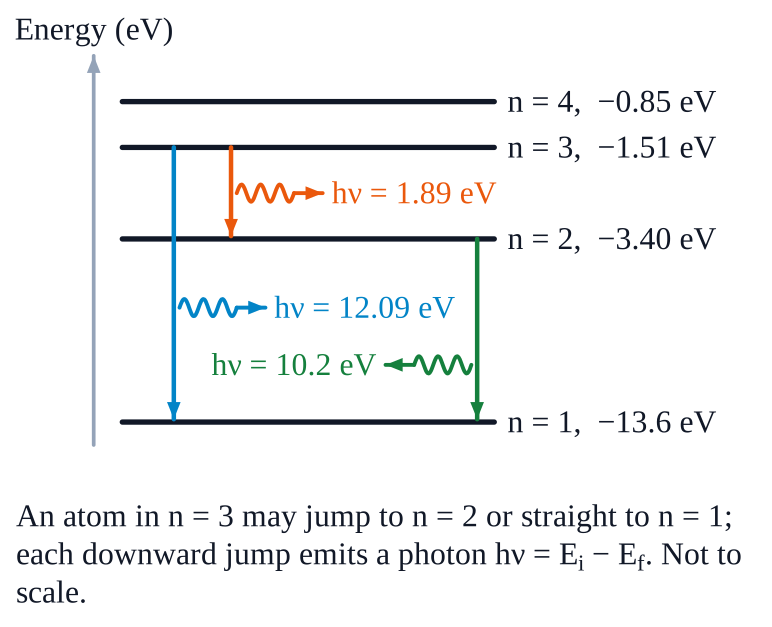
    (a) $\displaystyle 10.20$ eV. Kinetic energy is lost only by exciting an atom, and the first allowed step is \(\displaystyle n=1\to2\).\[E_n=-\frac{13.6}{n^2}\ \mathrm{eV} \]\[\Delta E=E_2-E_1=-3.4\ \mathrm{eV}-(-13.6\ \mathrm{eV})=10.2\ \mathrm{eV} \]
  7. Exercise 7

    A set of atoms in an excited state decays.
    (a)
    in general to any of the states with lower energy.
    (b)
    into a lower state only when excited by an external electric field.
    (c)
    all together simultaneously into a lower state.
    (d)
    to emit photons only when they collide.
    NCERT’s answer
    (a)
    (a) Each excited atom decays spontaneously to any lower level, emitting a photon.\[h\nu=E_i-E_f,\qquad E_f<E_i \]NCERT_Solution_Class12_Physics_Exemplar_Ch12_Q7\[n=3\to2:\ h\nu=-1.51-(-3.40)=1.89\ \mathrm{eV} \]\[n=3\to1:\ h\nu=-1.51-(-13.6)=12.09\ \mathrm{eV} \]