SolveIt is under development
SolveItClass 12 · Exemplar

NCERT Exemplar · Class 12 Physics Atoms

29 questions

Multiple Choice Questions (Type II) 8–13 (part 2 of 5)

  1. Exercise 8

    An ionised H-molecule consists of an electron and two protons. The protons are separated by a small distance of the order of angstrom. In the ground state,
    (a)
    the electron would not move in circular orbits.
    (b)
    the energy would be (2)4\displaystyle (2)^4 times that of a H-atom.
    (c)
    the electrons, orbit would go arround the protons.
    (d)
    the molecule will soon decay in a proton and a H-atom.
    NCERT’s answer
    (a), (c)
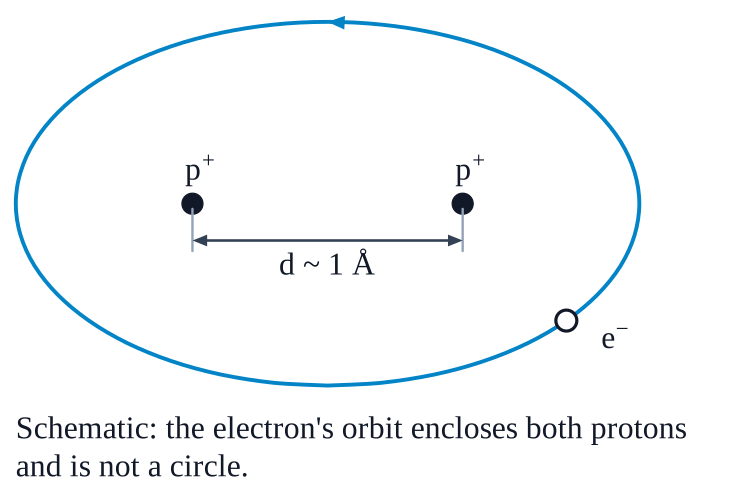
    (a), (c) Two protons give a non-central field, so no circular orbit; the electron's orbit encloses both.
    NCERT_Solution_Class12_Physics_Exemplar_Ch12_Q8
    Limit of merged protons (\(\displaystyle Z=2\)):
    \[E_1=-13.6\,Z^{2}\ \mathrm{eV}=4\times(-13.6\ \mathrm{eV}) \]
    \[4\neq 2^{4}=16 \]
    (b)
    is false; the ion is bound, so (d) is false.
  2. Exercise 9

    Consider aiming a beam of free electrons towards free protons. When they scatter, an electron and a proton cannot combine to produce a H-atom,
    (a)
    because of energy conservation.
    (b)
    without simultaneously releasing energy in the from of radiation.
    (c)
    because of momentum conservation.
    (d)
    because of angular momentum conservation.
    NCERT’s answer
    (a), (b)
    (a), (b) Momentum balances trivially in the centre-of-mass frame, so (c) is no barrier; (d) is irrelevant. Energy is the obstacle: a photon must carry off the surplus.\[E_i=K_{rel}\ge 0,\qquad E_f=-13.6\ \mathrm{eV} \] \[E_i-E_f=K_{rel}+13.6\ \mathrm{eV}\ \ge 13.6\ \mathrm{eV}\neq 0 \] \[h\nu\approx K_{rel}+13.6\ \mathrm{eV} \]
  3. Exercise 10

    The Bohr model for the spectra of a H-atom
    (a)
    will not be applicable to hydrogen in the molecular from.
    (b)
    will not be applicable as it is for a He-atom.
    (c)
    is valid only at room temperature.
    (d)
    predicts continuous as well as discrete spectral lines.
    NCERT’s answer
    (a), (b)
    (a), (b) The model needs one electron about one nucleus, so \(\displaystyle \mathrm{H_2}\) and He fail it. Its levels are discrete, giving discrete lines only; temperature plays no part.\[E_n=-\frac{13.6}{n^{2}}\ \mathrm{eV}\quad (n=1,2,3,\dots),\qquad h\nu=E_i-E_f \]
  4. Exercise 11

    The Balmer series for the H-atom can be observed
    (a)
    if we measure the frequencies of light emitted when an excited atom falls to the ground state.
    (b)
    if we measure the frequencies of light emitted due to transitions between excited states and the first excited state.
    (c)
    in any transition in a H-atom.
    (d)
    as a sequence of frequencies with the higher frequencies getting closely packed.
    NCERT’s answer
    (b), (d)
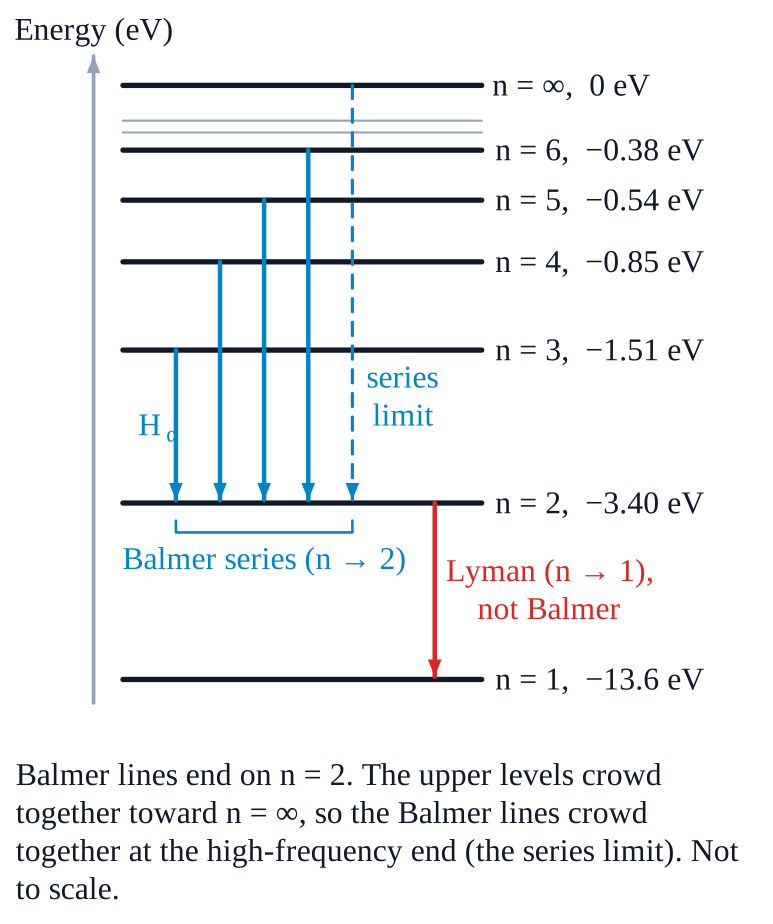
    (b), (d) Balmer lines are the \(\displaystyle n\to2\) transitions (ending on \(\displaystyle n=1\) is Lyman), and their spacing shrinks as \(\displaystyle n\) grows, so the high-frequency end crowds up.NCERT_Solution_Class12_Physics_Exemplar_Ch12_Q11\[\nu_n=cR\left(\frac{1}{2^{2}}-\frac{1}{n^{2}}\right),\qquad n=3,4,5,\dots \] \[\nu_{n+1}-\nu_n=cR\left[\frac{1}{n^{2}}-\frac{1}{(n+1)^{2}}\right]\to 0,\qquad \nu_\infty=\frac{cR}{4} \]
  5. Exercise 12

    Let En=−18ε02me4n2h2\displaystyle E_n=\frac{-1}{8 \varepsilon_0^2} \frac{m e^4}{n^2 h^2} be the energy of the nth \displaystyle n^{\text {th }} level of H-atom. If all the H-atoms are in the ground state and radiation of frequency (E2−E1)/h\displaystyle \left(E_2-E_1\right) / h falls on it,
    (a)
    it will not be absorbed at all
    (b)
    some of atoms will move to the first excited state.
    (c)
    all atoms will be excited to the n=2\displaystyle n=2 state.
    (d)
    no atoms will make a transition to the n=3\displaystyle n=3 state.
    NCERT’s answer
    (b), (d)
    (b), (d) Only the \(\displaystyle 1\to2\) gap matches the photon, so some atoms reach \(\displaystyle n=2\) and none reach \(\displaystyle n=3\). Excited atoms fall back, so not all stay excited.\[E_n=-\frac{13.6}{n^{2}}\ \mathrm{eV}:\qquad E_1=-13.6,\ \ E_2=-3.40,\ \ E_3=-1.51\ \mathrm{eV} \] \[h\nu=E_2-E_1=10.2\ \mathrm{eV} \] \[E_3-E_1=12.1\ \mathrm{eV}\neq 10.2\ \mathrm{eV},\qquad E_3-E_2=1.89\ \mathrm{eV}\neq 10.2\ \mathrm{eV} \]
  6. Exercise 13

    The simple Bohr modle is not applicable to He4\displaystyle \mathrm{He}^4 atom because
    (a)
    He4\displaystyle \mathrm{He}^4 is an inert gas.
    (b)
    He4\displaystyle \mathrm{He}^4 has neutrons in the nucleus.
    (c)
    He4\displaystyle \mathrm{He}^4 has one more electron.
    (d)
    electrons are not subject to central forces.
    NCERT’s answer
    (c), (d)
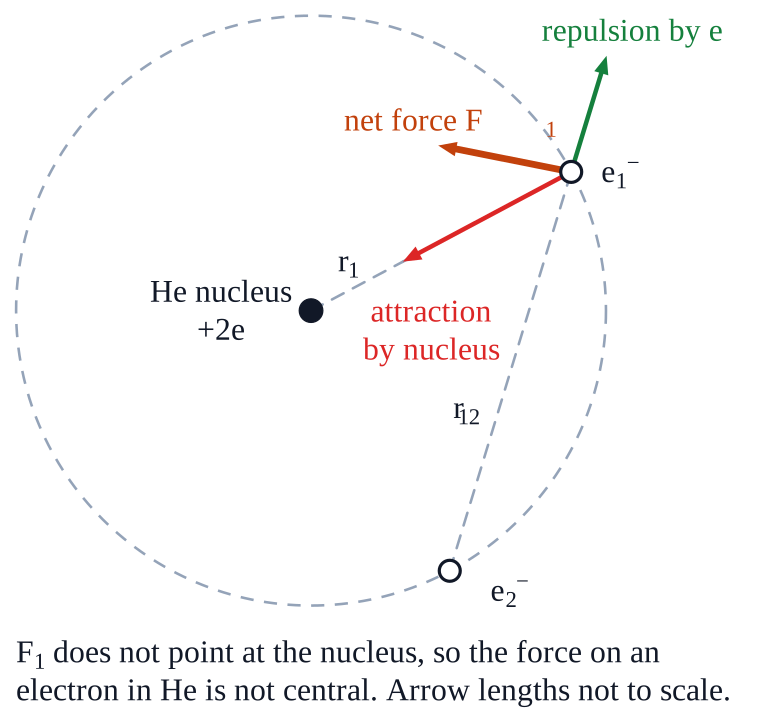
    (c), (d) The extra electron repels the first, so the force on it is not along the line to the nucleus.NCERT_Solution_Class12_Physics_Exemplar_Ch12_Q13\[\mathbf F_1=-\frac{2e^{2}}{4\pi\varepsilon_0 r_1^{2}}\,\hat{\mathbf r}_1+\frac{e^{2}}{4\pi\varepsilon_0 r_{12}^{2}}\,\hat{\mathbf r}_{12} \]\(\displaystyle \hat{\mathbf r}_{12}\) points from electron $\displaystyle 2$ to electron $\displaystyle 1$; the second term is not along \(\displaystyle \hat{\mathbf r}_1\).