SolveIt is under development
SolveItClass 12 · Exemplar

NCERT Exemplar · Class 12 Physics Alternating Current

31 questions

Very Short Answer Questions 14–20 (part 3 of 5)

  1. Exercise 14

    If a LC\displaystyle L C circuit is considered analogous to a harmonically oscillating spring block system, which energy of the LC\displaystyle L C circuit would be analogous to potential energy and which one analogous to kinetic energy?
    NCERT’s answer
    Magnetic energy analogous to kinetic energy and electrical energy analogous to potential energy.
    Match the energy terms one by one.\[\tfrac12kx^2\;\leftrightarrow\;\frac{q^2}{2C},\qquad \tfrac12mv^2\;\leftrightarrow\;\tfrac12Li^2 \]\[x\leftrightarrow q,\quad v\leftrightarrow i,\quad m\leftrightarrow L,\quad k\leftrightarrow\frac1C \]\[\omega=\sqrt{\frac{k}{m}}\;\leftrightarrow\;\omega_0=\frac{1}{\sqrt{LC}} \] Answer: The capacitor's electrical energy is analogous to potential energy; the inductor's magnetic energy to kinetic energy.
  2. Exercise 15

    Draw the effective equivalent circuit of the circuit shown in Fig 7.1\displaystyle 7.1, at very high frequencies and find the effective impedance. NCERT_Question_Class12_Physics_Exemplar_Ch7_Q15
    NCERT’s answer
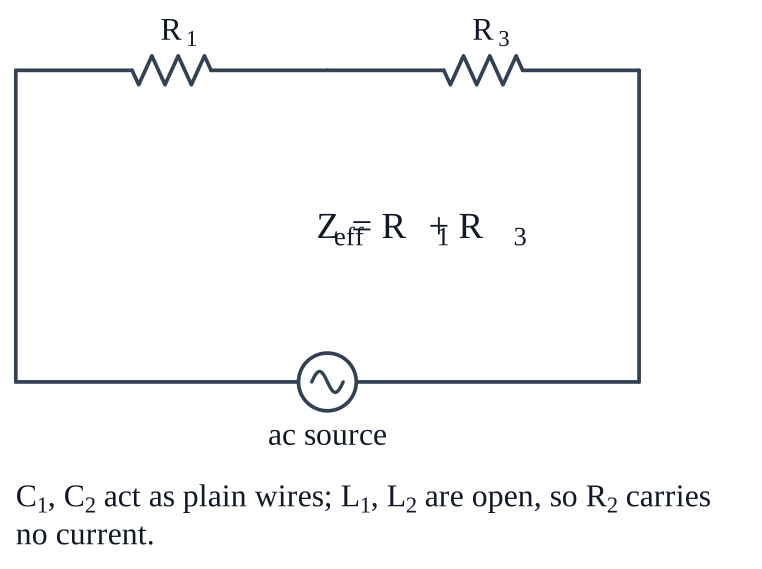
    At high frequencies, capacitor \(\displaystyle \approx\) short circuit (low reactance) and inductor \(\displaystyle \approx\) open circuit (high reactance). Therefore, the equivalent circuit \(\displaystyle Z \approx R_1+R_3\) as shown in the Fig. NCERT_Solution_Class12_Physics_Exemplar_Ch7_Q15_ncert
    At very high \(\displaystyle \omega\), capacitors act as wires and inductors as open circuits.\[X_C=\frac{1}{\omega C}\to0,\qquad X_L=\omega L\to\infty \]NCERT_Solution_Class12_Physics_Exemplar_Ch7_Q15\(\displaystyle L_1\) and \(\displaystyle L_2\) open, so \(\displaystyle R_2\) carries no current; \(\displaystyle C_1\), \(\displaystyle C_2\) shorted, so the current runs through \(\displaystyle R_1\) and \(\displaystyle R_3\) in series.\[Z_{eff}=R_1+R_3 \] Answer: \(\displaystyle Z_{eff}=R_1+R_3\).
  3. Exercise 16

    Study the circuits (a) and (b) shown in Fig 7.2\displaystyle 7.2 and answer the following questions.
    (a)
    Under which conditions would the rms currents in the two circuits be the same?
    (b)
    Can the rms current in circuit (b) be larger than that in (a)?
    NCERT_Question_Class12_Physics_Exemplar_Ch7_Q16
    NCERT’s answer
    (a)
    Yes, if rms voltage in the two circuits are same then at resonance, the rms current in LCR will be same as that in \(\displaystyle R\) circuit.
    (d)
    No, because \(\displaystyle R \leq Z\), so \(\displaystyle I_{\mathrm{a}} \geq I_{\mathrm{b}}\).
    Both circuits have the same source and the same \(\displaystyle R\).\[I_a=\frac{V_{rms}}{R},\qquad I_b=\frac{V_{rms}}{\sqrt{R^2+(X_L-X_C)^2}} \](a) \[I_b=I_a\;\Rightarrow\;X_L=X_C\;\Rightarrow\;\omega=\frac{1}{\sqrt{LC}} \](b) \[\sqrt{R^2+(X_L-X_C)^2}\ge R\;\Rightarrow\;I_b\le I_a \] Answer: (a) At resonance, \(\displaystyle \omega=1/\sqrt{LC}\). (b) No; \(\displaystyle I_b\le I_a\) always.
  4. Exercise 17

    Can the instantaneous power output of an ac source ever be negative? Can the average power output be negative?
    NCERT’s answer
    Yes, No.
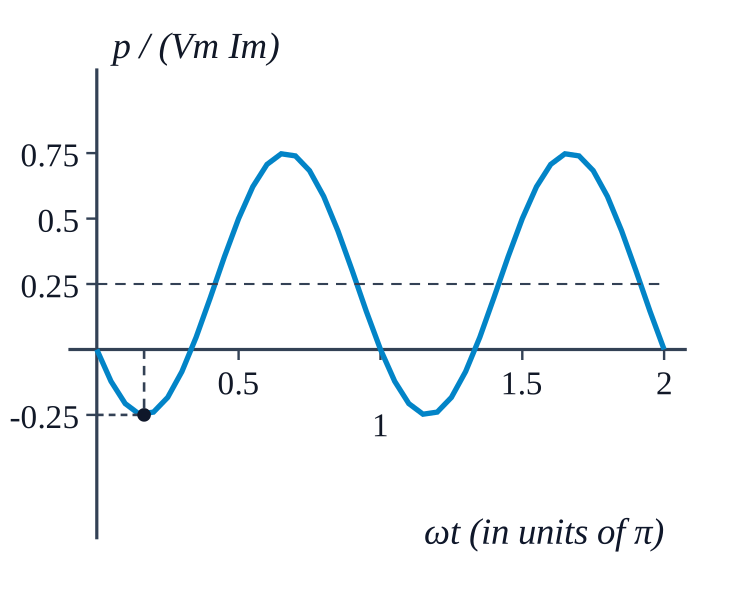
    \[v=V_m\sin\omega t,\qquad i=I_m\sin(\omega t-\phi) \]\[p=vi=\frac{V_mI_m}{2}\left[\cos\phi-\cos(2\omega t-\phi)\right] \]NCERT_Solution_Class12_Physics_Exemplar_Ch7_Q17\(\displaystyle p<0\) whenever \(\displaystyle v\) and \(\displaystyle i\) have opposite signs, which happens for \(\displaystyle \phi\neq0\); the circuit then returns energy to the source.\[P_{av}=V_{rms}I_{rms}\cos\phi,\qquad |\phi|\le90^\circ\;\Rightarrow\;P_{av}\ge0 \] Answer: Yes, \(\displaystyle p\) can be negative (\(\displaystyle \phi\neq0\)); no, \(\displaystyle P_{av}\) cannot, for a passive circuit.
  5. Exercise 18

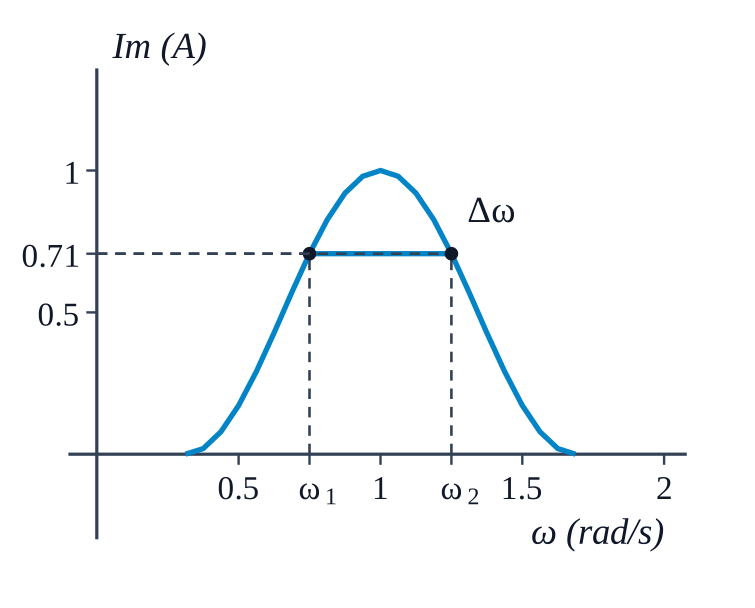
    In series LCR circuit, the plot of Imax⁡\displaystyle I_{\max } vs ω\displaystyle \omega is shown in Fig 7.3. Find the bandwidth and mark in the figure. NCERT_Question_Class12_Physics_Exemplar_Ch7_Q18
    Bandwidth is the width of the curve at \(\displaystyle I_{max}/\sqrt2\).\[I_{max}=1.0\ \mathrm{A}\ \text{ at }\ \omega_0=1.0\ \mathrm{rad\,s^{-1}} \]\[I=\frac{I_{max}}{\sqrt2}=\frac{1.0}{1.414}\approx0.71\ \mathrm{A} \]NCERT_Solution_Class12_Physics_Exemplar_Ch7_Q18\[\omega_1\approx0.75\ \mathrm{rad\,s^{-1}},\qquad \omega_2\approx1.25\ \mathrm{rad\,s^{-1}} \]\[\Delta\omega=\omega_2-\omega_1\approx1.25-0.75=0.5\ \mathrm{rad\,s^{-1}} \] Answer: \(\displaystyle \Delta\omega\approx0.5\ \mathrm{rad\,s^{-1}}\), marked between \(\displaystyle \omega_1\) and \(\displaystyle \omega_2\) at \(\displaystyle 0.71\ \mathrm{A}\).
  6. Exercise 19

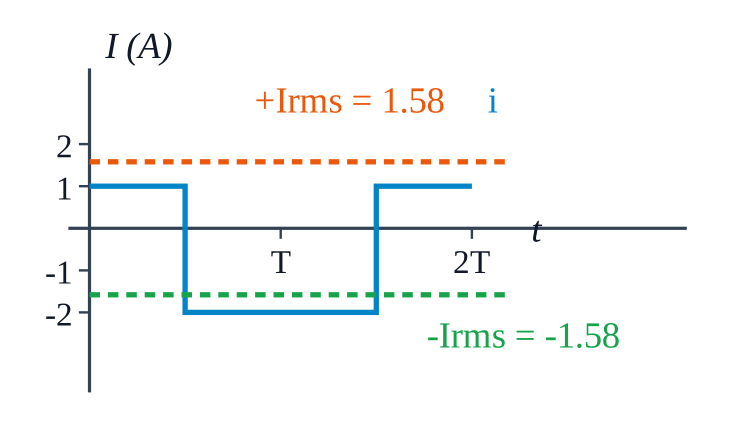
    The alternating current in a circuit is described by the graph shown in Fig 7.4\displaystyle 7.4 . Show rms current in this graph. NCERT_Question_Class12_Physics_Exemplar_Ch7_Q19
    NCERT’s answer
    \(\displaystyle I_{\text {rms }}=1.6 \mathrm{~A}\) (shown in Fig. by dotted line) NCERT_Solution_Class12_Physics_Exemplar_Ch7_Q19_ncert
    In one period \(\displaystyle 2T\): \(\displaystyle i=+1\ \mathrm{A}\) for a total time \(\displaystyle T\), and \(\displaystyle i=-2\ \mathrm{A}\) for a time \(\displaystyle T\).\[I_{rms}^2=\frac{1}{2T}\int_0^{2T}i^2\,dt=\frac{(1)^2\,T+(-2)^2\,T}{2T} \]\[I_{rms}^2=\frac{1+4}{2}=2.5\ \mathrm{A^2}\;\Rightarrow\;I_{rms}=\sqrt{2.5}\approx1.58\ \mathrm{A} \]NCERT_Solution_Class12_Physics_Exemplar_Ch7_Q19Square before averaging: the mean of \(\displaystyle i\) is \(\displaystyle -0.5\ \mathrm{A}\), not \(\displaystyle I_{rms}\). Answer: \(\displaystyle I_{rms}=\sqrt{2.5}\approx1.58\ \mathrm{A}\), drawn as the dashed lines at \(\displaystyle \pm1.58\ \mathrm{A}\).
  7. Exercise 20

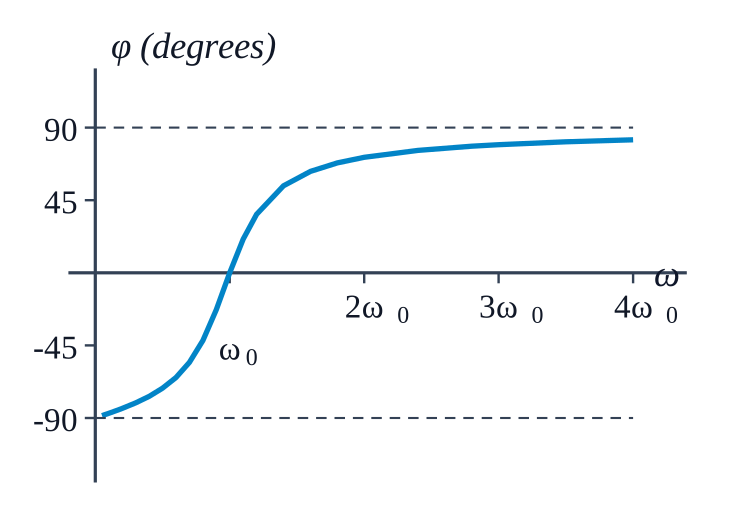
    How does the sign of the phase angle ϕ\displaystyle \phi, by which the supply voltage leads the current in an LCR series circuit, change as the supply frequency is gradually increased from very low to very high values.
    NCERT’s answer
    From negative to zero to positive; zero at resonant frequency.
    \[\tan\phi=\frac{X_L-X_C}{R}=\frac{\omega L-\dfrac{1}{\omega C}}{R} \]\[\omega\to0:\quad X_C\gg X_L\;\Rightarrow\;\phi\to-90^\circ \] \[\omega=\omega_0=\frac{1}{\sqrt{LC}}:\quad X_L=X_C\;\Rightarrow\;\phi=0 \] \[\omega\to\infty:\quad X_L\gg X_C\;\Rightarrow\;\phi\to+90^\circ \]NCERT_Solution_Class12_Physics_Exemplar_Ch7_Q20\(\displaystyle \omega\uparrow\Rightarrow\phi\) rises from negative, through zero at resonance, to positive. Answer: \(\displaystyle \phi\) changes sign from negative (capacitive) to positive (inductive), passing through zero at \(\displaystyle \omega_0\).