SolveIt is under development
SolveItClass 12 · Exemplar

NCERT Exemplar · Class 12 Physics Alternating Current

31 questions

Long Answer Questions 27–31 (part 5 of 5)

  1. Exercise 27

    An electrical device draws 2kW power from AC mains (voltage 223 V(rms)=50,000 V)\displaystyle 223 \mathrm{~V}(\mathrm{rms})=\sqrt{50,000} \mathrm{~V}). The current differs (lags) in phase by ϕ(tan⁡ϕ=−34)\displaystyle \phi\left(\tan \phi=\frac{-3}{4}\right) as compared to voltage. Find (i) R\displaystyle R, (ii) XC−XL\displaystyle X_C-X_L, and (iii) IM\displaystyle I_M. Another device has twice the values for R,XC\displaystyle R, X_C and XL\displaystyle X_L. How are the answers affected?
    Lagging current means \(\displaystyle X_L>X_C\), so \(\displaystyle X_C-X_L\) is negative.\[\tan\phi=-\tfrac34 \;\Rightarrow\; \cos\phi=\tfrac45 \]\[P=V_{\mathrm{rms}}I_{\mathrm{rms}}\cos\phi \;\Rightarrow\; I_{\mathrm{rms}}=\frac{2000\ \mathrm{W}}{\sqrt{50000}\ \mathrm{V}\times0.8}=\sqrt{125}\ \mathrm{A}\approx11.2\ \mathrm{A} \](i)\[P=I_{\mathrm{rms}}^{2}R \;\Rightarrow\; R=\frac{2000}{125}=16\ \Omega \](ii)\[\tan\phi=\frac{X_C-X_L}{R} \;\Rightarrow\; X_C-X_L=-\frac34\times16=-12\ \Omega \](iii)\[I_M=\sqrt2\,I_{\mathrm{rms}}=\sqrt{250}\ \mathrm{A}\approx15.8\ \mathrm{A} \]Check:\[Z=\frac{R}{\cos\phi}=\frac{16}{0.8}=20\ \Omega,\qquad \frac{V_{\mathrm{rms}}}{Z}=\frac{\sqrt{50000}}{20}=11.2\ \mathrm{A} \]Second device on the same mains:\[R'=32\ \Omega,\qquad X_C'-X_L'=-24\ \Omega,\qquad Z'=2Z=40\ \Omega \]\[\tan\phi'=\frac{-24}{32}=-\frac34 \quad(\phi\ \text{unchanged}) \]\[I_M'=\frac{\sqrt2\,\sqrt{50000}}{40}=\frac{I_M}{2}\approx7.9\ \mathrm{A},\qquad P'=I_{\mathrm{rms}}'^{\,2}R'=5.59^{2}\times32\approx1000\ \mathrm{W}=\frac P2 \]Answer: \(\displaystyle R=16\ \Omega\), \(\displaystyle X_C-X_L=-12\ \Omega\), \(\displaystyle I_M\approx15.8\ \mathrm{A}\). For the second device \(\displaystyle R\) and \(\displaystyle X_C-X_L\) double, \(\displaystyle \phi\) is unchanged, \(\displaystyle I_M\) halves to about \(\displaystyle 7.9\ \mathrm{A}\) and the power halves to \(\displaystyle 1\ \mathrm{kW}\).
  2. Exercise 28

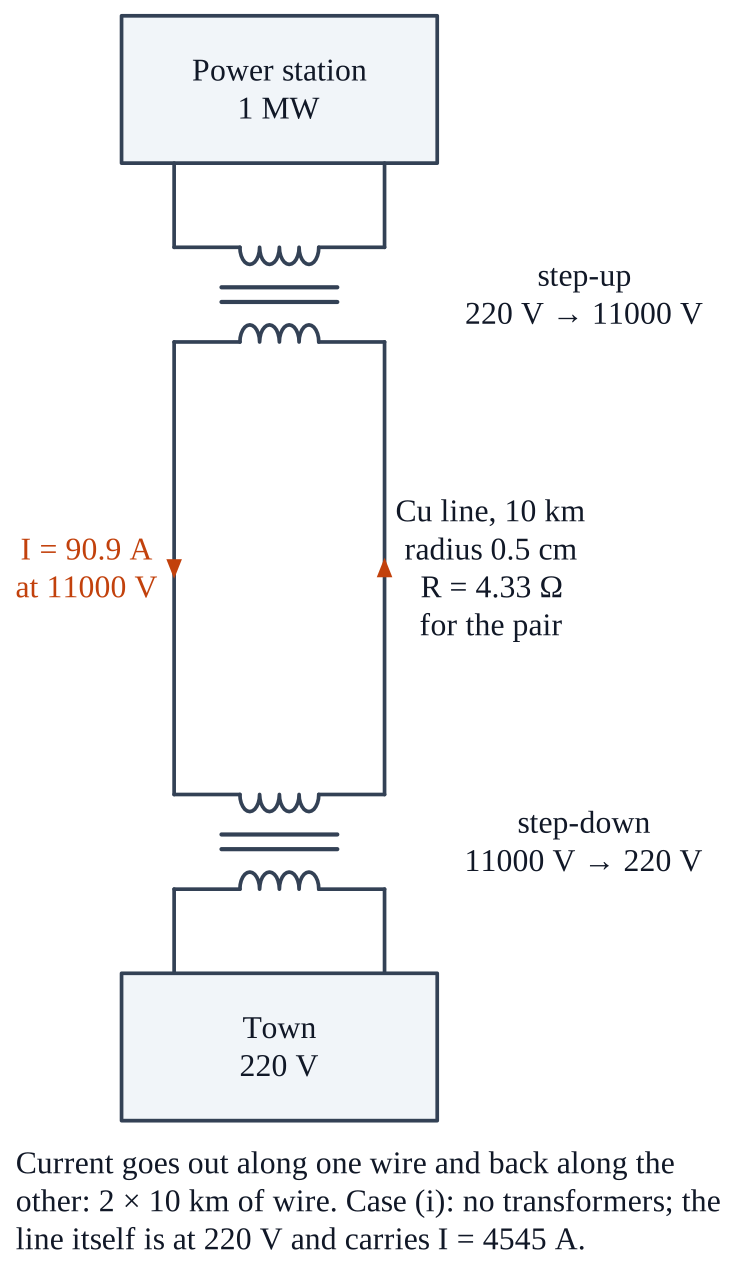
    1MW power is to be delivered from a power station to a town 10\displaystyle 10 km away. One uses a pair of Cu wires of radius 0.5\displaystyle 0.5 cm for this purpose. Calculate the fraction of ohmic losses to power transmitted if
    (i)
    power is transmitted at 220V. Comment on the feasibility of doing this.
    (ii)
    a step-up transformer is used to boost the voltage to 11000\displaystyle 11000 V, power transmitted, then a step-down transfomer is used to bring voltage to 220\displaystyle 220 V.
    (ρCu=1.7×10⁻⁸SI unit )\left(\rho_{C u}=1.7 \times 10^{-8} \mathrm{SI} \text { unit }\right)
    Current flows out and back, so the line is two wires of length \(\displaystyle l=10\ \mathrm{km}\). Caution: the loss uses the line current at the transmission voltage, not the $\displaystyle 220$ V of the town.NCERT_Solution_Class12_Physics_Exemplar_Ch7_Q28\[A=\pi r^{2}=\pi\,(0.5\times10^{-2}\ \mathrm{m})^{2}=7.85\times10^{-5}\ \mathrm{m^{2}} \]\[R=\rho\,\frac{2l}{A}=\frac{1.7\times10^{-8}\times2\times10^{4}}{7.85\times10^{-5}}\ \Omega=4.33\ \Omega \](i) Transmission at $\displaystyle 220$ V\[I=\frac{P}{V}=\frac{10^{6}\ \mathrm{W}}{220\ \mathrm{V}}=4545\ \mathrm{A} \]\[P_{\mathrm{loss}}=I^{2}R=(4545)^{2}\times4.33\approx8.9\times10^{7}\ \mathrm{W} \]\[\frac{P_{\mathrm{loss}}}{P}=\frac{8.9\times10^{7}}{10^{6}}\approx89 \]The line would waste about $\displaystyle 89$ times the power sent, so this is not feasible.(ii) Step-up to $\displaystyle 11000$ V\[I=\frac{10^{6}\ \mathrm{W}}{11000\ \mathrm{V}}=90.9\ \mathrm{A} \]\[P_{\mathrm{loss}}=I^{2}R=(90.9)^{2}\times4.33\approx3.6\times10^{4}\ \mathrm{W} \]\[\frac{P_{\mathrm{loss}}}{P}=\frac{3.6\times10^{4}}{10^{6}}\approx0.036=3.6\% \]Answer: (i) loss \(\displaystyle \approx89\) times the power sent (\(\displaystyle \approx8.9\times10^{7}\ \mathrm{W}\)), so not feasible; (ii) loss \(\displaystyle \approx3.6\%\) of the power sent.
  3. Exercise 29

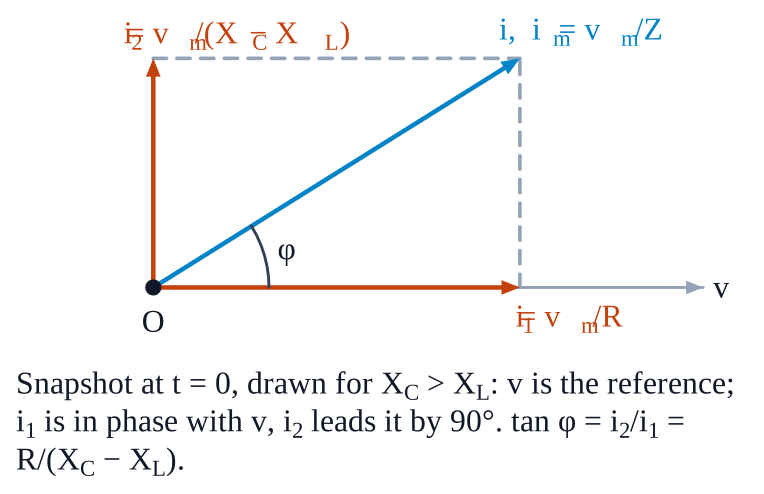
    Consider the LCR\displaystyle L C R circuit shown in Fig 7.6. Find the net current i\displaystyle i and the phase of i\displaystyle i. Show that i=vZ\displaystyle i=\frac{v}{Z}. Find the impedence Z\displaystyle Z for this circuit. NCERT_Question_Class12_Physics_Exemplar_Ch7_Q29
    \(\displaystyle R\) and the \(\displaystyle L\)-\(\displaystyle C\) branch are in parallel across the source, so each sees \(\displaystyle v=v_m\sin\omega t\), and \(\displaystyle i=i_1+i_2\). Caution: \(\displaystyle i_1\) and \(\displaystyle i_2\) are \(\displaystyle 90^\circ\) apart, so add them as phasors, not as plain numbers.\[i_1=\frac{v_m}{R}\sin\omega t \quad(\text{in phase with }v) \]\[i_2=\frac{v_m}{X_C-X_L}\sin\!\left(\omega t+\frac\pi2\right)=\frac{v_m}{X_C-X_L}\cos\omega t,\qquad X_C=\frac1{\omega C},\ X_L=\omega L \]NCERT_Solution_Class12_Physics_Exemplar_Ch7_Q29\[i=i_1+i_2=\frac{v_m}{R}\sin\omega t+\frac{v_m}{X_C-X_L}\cos\omega t=i_m\sin(\omega t+\phi) \]\[i_m=v_m\sqrt{\frac1{R^{2}}+\frac1{(X_C-X_L)^{2}}},\qquad \tan\phi=\frac{R}{X_C-X_L} \]Define \(\displaystyle Z\) by\[\frac1Z=\sqrt{\frac1{R^{2}}+\frac1{(X_C-X_L)^{2}}} \;\Rightarrow\; i_m=\frac{v_m}{Z},\qquad i_{\mathrm{rms}}=\frac{v_{\mathrm{rms}}}{Z} \]\[Z=\frac{R\,\lvert X_C-X_L\rvert}{\sqrt{R^{2}+(X_C-X_L)^{2}}}=\left[\frac1{R^{2}}+\frac{\omega^{2}C^{2}}{(1-\omega^{2}LC)^{2}}\right]^{-1/2} \]If \(\displaystyle X_C<X_L\), \(\displaystyle i_2\) lags \(\displaystyle v\) and \(\displaystyle \phi<0\); the same formulas hold.Answer: \(\displaystyle i=i_m\sin(\omega t+\phi)\) with \(\displaystyle \tan\phi=\dfrac{R}{X_C-X_L}\), \(\displaystyle i_m=\dfrac{v_m}{Z}\), and \(\displaystyle \dfrac1Z=\sqrt{\dfrac1{R^{2}}+\dfrac1{(X_C-X_L)^{2}}}\).
  4. Exercise 30

    For an LCR\displaystyle L C R circuit driven at frequency ω\displaystyle \omega, the equation reads
    Ldidt+Ri+qC=vi=vmsin⁡ωtL \frac{d i}{d t}+R i+\frac{q}{C}=v_i=v_m \sin \omega t
    (i)
    Multiply the equation by i\displaystyle i and simplify where possible.
    (ii)
    Interpret each term physically.
    (iii)
    Cast the equation in the form of a conservation of energy statement.
    (iv)
    Intergrate the equation over one cycle to find that the phase difference between v\displaystyle v and i must be acute.
    NCERT’s answer
    \(\displaystyle L i \frac{d i}{d t}+R i^2+\frac{q i}{c}=v i ; L i \frac{d i}{d t}=\frac{d}{d t}\left(\frac{1}{2} L i^2\right)=\) rate of change of energy stored in an inductor. \(\displaystyle \mathrm{R} i^2=\) joule heating loss \(\displaystyle \frac{q}{C} i=\frac{d}{d t}\left(\frac{q^2}{2 C}\right)=\) rate of change of energy stored in the capacitor. \(\displaystyle v i=\) rate at which driving force pours in energy. It goes into (i) ohmic loss and (ii) increase of stored energy. \[\int_0^T d t \frac{d}{d t}\left(\frac{1}{2} i^2+\frac{q^2}{C}\right)+\int_0^T R i^2 d t=\int_0^T v i d t \] \[0+(+v e)=\int_0^T v i d t \] \(\displaystyle \int_0^T v i d t>0\) if phase difference, a constant is acute.
    (i) Multiply by \(\displaystyle i=\dfrac{dq}{dt}\), and use \(\displaystyle Li\dfrac{di}{dt}=\dfrac{d}{dt}\!\left(\tfrac12Li^{2}\right)\), \(\displaystyle \dfrac qC\,i=\dfrac{d}{dt}\!\left(\dfrac{q^{2}}{2C}\right)\):\[Li\frac{di}{dt}+Ri^{2}+\frac qC\,i=v_m i\sin\omega t \]\[\frac{d}{dt}\!\left(\tfrac12Li^{2}\right)+Ri^{2}+\frac{d}{dt}\!\left(\frac{q^{2}}{2C}\right)=vi \](ii) Term by term:\[\frac{d}{dt}\!\left(\tfrac12Li^{2}\right):\ \text{rate of change of energy in the inductor's magnetic field} \]\[Ri^{2}:\ \text{rate of Joule heating in } R \]\[\frac{d}{dt}\!\left(\frac{q^{2}}{2C}\right):\ \text{rate of change of energy in the capacitor's electric field} \]\[vi:\ \text{power supplied by the source} \](iii) With \(\displaystyle U_L=\tfrac12Li^{2}\) and \(\displaystyle U_C=\dfrac{q^{2}}{2C}\):\[vi=\frac{d}{dt}\left(U_L+U_C\right)+Ri^{2} \]Source power = rate of storing energy in \(\displaystyle L\) and \(\displaystyle C\) + rate of dissipation in \(\displaystyle R\).(iv) Over one period \(\displaystyle T=\dfrac{2\pi}{\omega}\), \(\displaystyle i\) and \(\displaystyle q\) return to their starting values, so\[\int_0^T\frac{d}{dt}\!\left(\tfrac12Li^{2}\right)dt=0,\qquad \int_0^T\frac{d}{dt}\!\left(\frac{q^{2}}{2C}\right)dt=0 \;\Rightarrow\; \int_0^T vi\,dt=R\int_0^T i^{2}\,dt \]Put \(\displaystyle v=v_m\sin\omega t\), \(\displaystyle i=i_m\sin(\omega t+\phi)\):\[\frac{v_mi_mT}{2}\cos\phi=\frac{Ri_m^{2}T}{2}\;\Rightarrow\;\cos\phi=\frac{Ri_m}{v_m}>0 \]\[\cos\phi>0\;\Rightarrow\;-\frac\pi2<\phi<\frac\pi2 \]Answer: \(\displaystyle vi=\dfrac{d}{dt}\left(\tfrac12Li^{2}+\dfrac{q^{2}}{2C}\right)+Ri^{2}\); over a cycle \(\displaystyle \cos\phi=Ri_m/v_m>0\), so the phase difference between \(\displaystyle v\) and \(\displaystyle i\) is acute.
  5. Exercise 31

    In the LCR\displaystyle L C R circuit shown in Fig 7.7\displaystyle 7.7, the ac driving voltage is v=vmsin⁡ωt\displaystyle v=v_m \sin \omega t.
    (i)
    Write down the equation of motion for q(t)\displaystyle q(t).
    (ii)
    At t=to\displaystyle t=t_o, the voltage source stops and R\displaystyle R is short circuited. Now write down how much energy is stored in each of L\displaystyle L and C\displaystyle C.
    (iii)
    Describe subsequent motion of charges.
    NCERT_Question_Class12_Physics_Exemplar_Ch7_Q31
    NCERT’s answer
    (i)
    \(\displaystyle L \frac{d^2 q}{d t^2}+R \frac{d q}{d t}+\frac{q}{C}=v_m \sin \omega t\)
    Let \(\displaystyle q=q_m \sin (\omega t+\phi)=-q_m \cos (\omega t+\phi)\)
    \[\begin{aligned} & i=i_{\mathrm{m}} \sin (\omega t+\phi)=q_m \omega \sin (w t+\phi) \\ & i_m=\frac{v_m}{Z}=\frac{v_m}{\sqrt{R^2+\left(X_C-X_L\right)^2}} ; \phi=\tan ^{-1}\left(\frac{X_C-X_L}{R}\right) \end{aligned} \]
    (ii)
    \(\displaystyle U_L=\frac{1}{2} L i^2=\frac{1}{2} L\left[\frac{v_m}{\sqrt{\left.R^2+X_C-X_L\right)^2}{ }_0}\right]^2 \sin ^2\left(\omega t_0+\phi\right)\)
    \[U_C=\frac{1}{2} \frac{q^2}{C}=\frac{1}{2 C}\left[\frac{v_m}{\sqrt{R^2+\left(X_C-X_L\right)^2}}\right]^2 \frac{1}{\omega^2} \cos ^2\left(\omega t_0+\phi\right) \]
    (iii)
    Left to itself, it is an \(\displaystyle L C\) oscillator. The capacitor will go on discharging and all energy will go to \(\displaystyle L\) and back and forth.
    (i) Loop rule with \(\displaystyle i=\dfrac{dq}{dt}\):\[L\frac{d^{2}q}{dt^{2}}+R\frac{dq}{dt}+\frac qC=v_m\sin\omega t \](ii) After \(\displaystyle t_o\) only \(\displaystyle L\) and \(\displaystyle C\) remain. Caution: inductor current and capacitor charge cannot jump, so the values at \(\displaystyle t_o\) carry over. With \(\displaystyle i_o=\left.\dfrac{dq}{dt}\right|_{t_o}\) and \(\displaystyle q_o=q(t_o)\):\[U_L=\tfrac12Li_o^{2},\qquad U_C=\frac{q_o^{2}}{2C} \]In steady state, \(\displaystyle i=i_m\sin(\omega t+\phi)\) and \(\displaystyle q=-\dfrac{i_m}{\omega}\cos(\omega t+\phi)\), so\[U_L=\tfrac12Li_m^{2}\sin^{2}(\omega t_o+\phi),\qquad U_C=\frac{i_m^{2}}{2\omega^{2}C}\cos^{2}(\omega t_o+\phi) \]\[i_m=\frac{v_m}{\sqrt{R^{2}+(X_C-X_L)^{2}}},\qquad \tan\phi=\frac{X_C-X_L}{R} \](iii) With \(\displaystyle t'=t-t_o\), no source and no resistance:\[L\frac{d^{2}q}{dt^{2}}+\frac qC=0 \;\Rightarrow\; q=q_o\cos\omega_0t'+\frac{i_o}{\omega_0}\sin\omega_0t',\qquad \omega_0=\frac1{\sqrt{LC}} \]The charge sloshes back and forth through \(\displaystyle L\) without damping, and the current reverses every half cycle. Energy passes between \(\displaystyle C\) (all of it when \(\displaystyle i=0\)) and \(\displaystyle L\) (all of it when \(\displaystyle q=0\)):\[U_L+U_C=\tfrac12Li_o^{2}+\frac{q_o^{2}}{2C}=\frac{q_m^{2}}{2C}=\text{constant},\qquad q_m^{2}=q_o^{2}+LCi_o^{2} \]Answer: (i) \(\displaystyle L\ddot q+R\dot q+q/C=v_m\sin\omega t\); (ii) \(\displaystyle U_L=\tfrac12Li_o^{2}\), \(\displaystyle U_C=q_o^{2}/2C\); (iii) undamped \(\displaystyle LC\) oscillation at \(\displaystyle \omega_0=1/\sqrt{LC}\) with constant total energy.