SolveIt is under development
SolveItClass 12 · Exemplar

NCERT Exemplar · Class 12 Physics Alternating Current

31 questions

Short Answer Questions 21–26 (part 4 of 5)

  1. Exercise 21

    A device 'X' is connected to an a.c source. The variation of voltage, current and power in one complete cycle is shown in Fig 7.5.
    (a)
    Which curve shows power consumption over a full cycle?
    (b)
    What is the average power consumption over a cycle?
    (c)
    Identify the device 'X'.
    NCERT_Question_Class12_Physics_Exemplar_Ch7_Q21
    NCERT’s answer
    (a)
    A (b) Zero
    (c)
    \(\displaystyle L\) or \(\displaystyle C\) or \(\displaystyle L C\)
    B and C are \(\displaystyle v\) and \(\displaystyle i\) in either order, one varying as \(\displaystyle \sin\omega t\), the other as \(\displaystyle \cos\omega t\): a quarter cycle apart.
    (a)
    Instantaneous power:
    \[p=vi=V_0I_0\sin\omega t\cos\omega t=\tfrac12V_0I_0\sin2\omega t \]
    Double frequency, zero wherever B or C is zero: curve A.
    (b)
    A's positive and negative lobes cancel: zero.
    \[\bar p=\tfrac12V_0I_0\,\overline{\sin2\omega t}=0 \]
    (c)
    A quarter cycle apart means no resistance:
    \[|\phi|=\frac{\pi}{2}\;\Rightarrow\;\cos\phi=\frac{R}{Z}=0\;\Rightarrow\;R=0 \]
    Answer: (a) A; (b) zero; (c) a pure inductor, a pure capacitor, or an LC combination with no resistance.
  2. Exercise 22

    Both alternating current and direct current are measured in amperes. But how is the ampere defined for an alternating current?
    NCERT’s answer
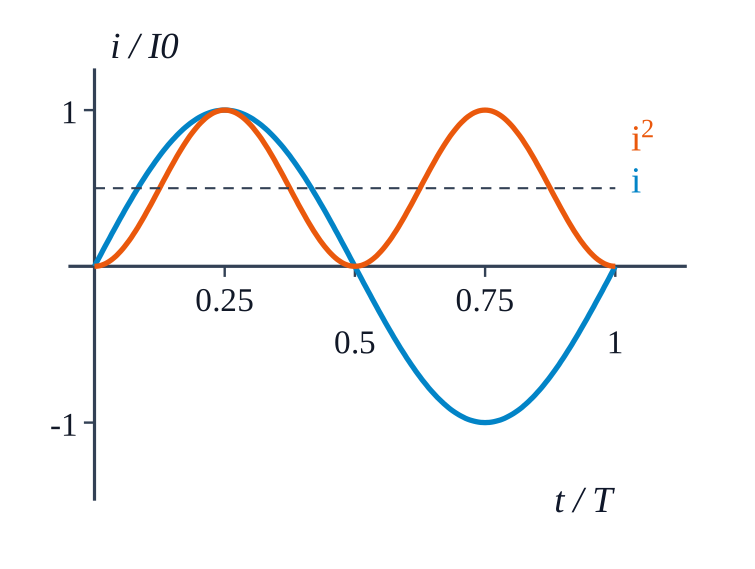
    An a.c current changes direction with the source frequency and the attractive force would average to zero. Thus, the a.c ampere must be defined in terms of some property that is independent of the direction of current. Joule's heating effect is such property and hence it is used to define rms value of a.c.
    The mean of \(\displaystyle i\) over a cycle is zero, so an alternating current is rated by its heating effect.\[I_{\mathrm{rms}}=\sqrt{\overline{i^{2}}}=\sqrt{\frac1T\int_0^T I_0^{2}\sin^{2}\omega t\,dt}=\frac{I_0}{\sqrt2}=0.707\,I_0 \]NCERT_Solution_Class12_Physics_Exemplar_Ch7_Q22\[H_{\mathrm{ac}}=I_{\mathrm{rms}}^{2}Rt=I_{\mathrm{dc}}^{2}Rt\;\Rightarrow\;I_{\mathrm{dc}}=I_{\mathrm{rms}} \]Answer: $\displaystyle 1$ A of alternating current is the rms current \(\displaystyle I_0/\sqrt2\): it heats a resistor exactly as $\displaystyle 1$ A of direct current does.
  3. Exercise 23

    A coil of 0.01\displaystyle 0.01 henry inductance and 1\displaystyle 1 ohm resistance is connected to 200\displaystyle 200 volt, 50\displaystyle 50 Hz ac supply. Find the impedance of the circuit and time lag between max. alternating voltage and current.
    NCERT’s answer
    \(\displaystyle X_L=\omega L=2 p f L\) \[=3.14 \Omega \] \[\begin{aligned} Z & =\sqrt{R^2+L^2} \\ & =\sqrt{(3.14)^2+(1)^2}=\sqrt{10.86} \\ & \simeq 3.3 \Omega \end{aligned} \] \[\tan \phi=\frac{\omega L}{R}=3.14 \] \[\begin{aligned} \phi & =\tan ^{-1}(3.14) \\ & \simeq 72^{\circ} \\ & \simeq \frac{72 \times \pi}{180} \mathrm{rad} . \end{aligned} \] Timelag \(\displaystyle \Delta t=\frac{\phi}{\omega}=\frac{72 \times \pi}{180 \times 2 \pi \times 50}=\frac{1}{250} \mathrm{~s}\)
    \[X_L=2\pi fL=2\pi(50\ \mathrm{Hz})(0.01\ \mathrm{H})=\pi\ \Omega=3.14\ \Omega \]\[Z=\sqrt{R^{2}+X_L^{2}}=\sqrt{(1\ \Omega)^{2}+(3.14\ \Omega)^{2}}=3.3\ \Omega \]NCERT_Solution_Class12_Physics_Exemplar_Ch7_Q23\[\tan\phi=\frac{X_L}{R}=\frac{3.14}{1}\;\Rightarrow\;\phi=72.3^\circ \]The lag is a fraction \(\displaystyle \phi/360^\circ\) of the period \(\displaystyle T=1/f\).\[\Delta t=\frac{\phi}{360^\circ}\,T=\frac{72.3^\circ}{360^\circ}\times\frac{1}{50\ \mathrm{Hz}}=4.0\times10^{-3}\ \mathrm{s} \]Answer: \(\displaystyle Z\approx3.3\ \Omega\); the current lags the voltage by \(\displaystyle \approx4\ \mathrm{ms}\).
  4. Exercise 24

    A 60\displaystyle 60 W load is connected to the secondary of a transformer whose primary draws line voltage. If a current of 0.54\displaystyle 0.54 A flows in the load, what is the current in the primary coil? Comment on the type of transformer being used.
    NCERT’s answer
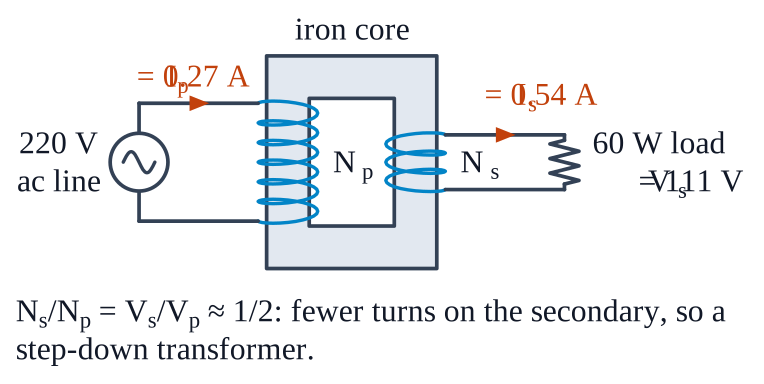
    \(\displaystyle P_L=60 \mathrm{~W}, I_L=0.54 \mathrm{~A}\) \[V_L=\frac{60}{0.54}=110 \mathrm{~V} . \] The transformer is step-down and have \(\displaystyle \frac{1}{2}\) input voltage. Hence \[i_p=\frac{1}{2} \times I_2=0.27 \mathrm{~A} . \]
    Take line voltage \(\displaystyle V_p=220\ \mathrm{V}\) and an ideal transformer (no losses).\[P_p=P_s=60\ \mathrm{W} \]\[I_p=\frac{P_p}{V_p}=\frac{60\ \mathrm{W}}{220\ \mathrm{V}}=0.27\ \mathrm{A} \]\[V_s=\frac{P_s}{I_s}=\frac{60\ \mathrm{W}}{0.54\ \mathrm{A}}=111\ \mathrm{V} \]\[\frac{N_s}{N_p}=\frac{V_s}{V_p}=\frac{111}{220}\approx\frac12<1 \]NCERT_Solution_Class12_Physics_Exemplar_Ch7_Q24\(\displaystyle V_s<V_p\) and \(\displaystyle I_s>I_p\): a step-down transformer.Answer: \(\displaystyle I_p=0.27\ \mathrm{A}\); a step-down transformer.
  5. Exercise 25

    Explain why the reactance provided by a capacitor to an alternating current decreases with increasing frequency.
    NCERT’s answer
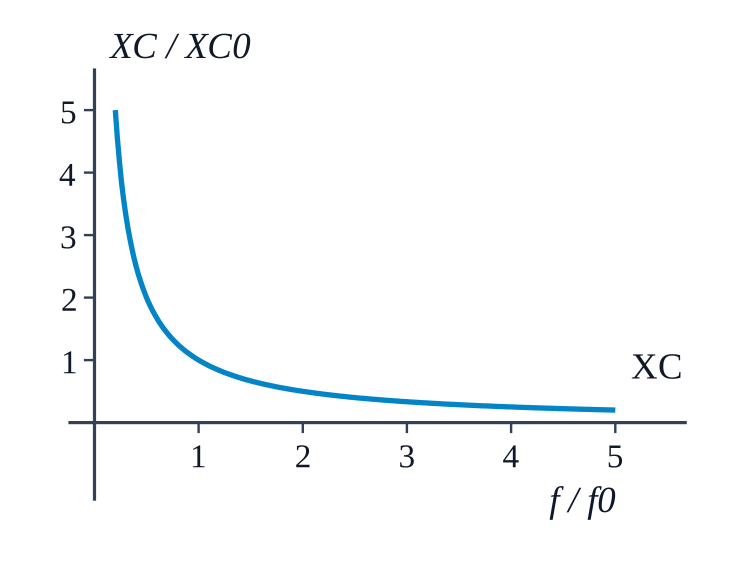
    A capacitor does not allow flow of direct current through it as the resistance across the gap is infinite. When an alternating voltage is applied across the capacitor plates, the plates are alternately charged and discharged. The current through the capacitor is a result of this changing voltage (or charge). Thus, a capacitor will pass more current through it if the voltage is changing at a faster rate, i.e. if the frequency of supply is higher. This implies that the reactance offered by a capacitor is less with increasing frequency; it is given by \(\displaystyle 1 / \omega C\).
    The current through a capacitor is the rate at which its charge changes.\[q=Cv=CV_0\sin\omega t \]\[i=\frac{dq}{dt}=\omega CV_0\cos\omega t\;\Rightarrow\;I_0=\omega CV_0 \]\[X_C=\frac{V_0}{I_0}=\frac{1}{\omega C}=\frac{1}{2\pi fC} \]\(\displaystyle f\uparrow\Rightarrow\) charge carried per second \(\displaystyle \uparrow\Rightarrow I_0\uparrow\Rightarrow X_C\downarrow\)NCERT_Solution_Class12_Physics_Exemplar_Ch7_Q25Answer: at higher frequency the capacitor is charged and discharged more often, more charge flows per second for the same \(\displaystyle V_0\), so \(\displaystyle X_C=1/2\pi fC\) falls.
  6. Exercise 26

    Explain why the reactance offered by an inductor increases with increasing frequency of an alternating voltage.
    NCERT’s answer
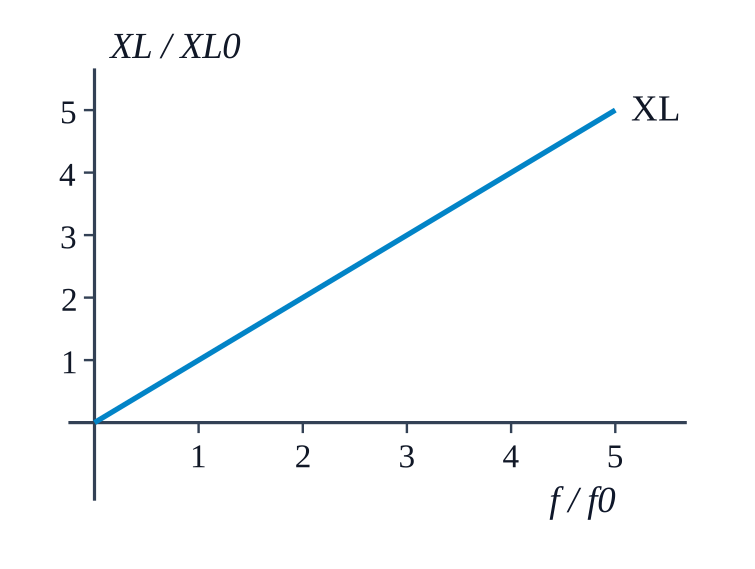
    An inductor opposes flow of current through it by developing a back emf according to Lenz's law. The induced voltage has a polarity so as to maintain the current at its present value. If the current is decreasing, the polarity of the induced emf will be so as to increase the current and vice versa. Since the induced emf is proportional to the rate of change of current, it will provide greater reactance to the flow of current if the rate of change is faster, i.e. if the frequency is higher. The reactance of an inductor, therefore, is proportional to the frequency, being given by \(\displaystyle \omega L\).
    A changing current induces a back emf that opposes it. For \(\displaystyle i=I_0\sin\omega t\):\[\varepsilon=-L\frac{di}{dt}=-\omega LI_0\cos\omega t \]The source voltage balances it, \(\displaystyle v=-\varepsilon\):\[V_0=\omega LI_0\;\Rightarrow\;X_L=\frac{V_0}{I_0}=\omega L=2\pi fL \]For the same \(\displaystyle I_0\): \(\displaystyle f\uparrow\Rightarrow\left|\dfrac{di}{dt}\right|_{\max}=\omega I_0\uparrow\Rightarrow|\varepsilon|_{\max}\uparrow\Rightarrow V_0\uparrow\Rightarrow X_L\uparrow\)NCERT_Solution_Class12_Physics_Exemplar_Ch7_Q26Answer: faster alternation makes the current change faster, so the back emf grows and opposes more strongly; \(\displaystyle X_L=2\pi fL\) rises.