SolveIt is under development
SolveItClass 12 · Exemplar

NCERT Exemplar · Class 12 Physics Alternating Current

31 questions

Multiple Choice Questions (Type II) 8–13 (part 2 of 5)

  1. Exercise 8

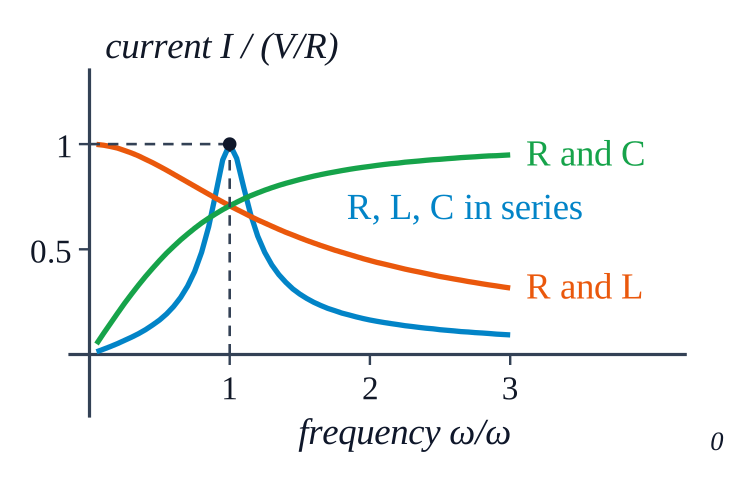
    As the frequency of an ac circuit increases, the current first increases and then decreases. What combination of circuit elements is most likely to comprise the circuit?
    (a)
    Inductor and capacitor.
    (b)
    Resistor and inductor.
    (c)
    Resistor and capacitor.
    (d)
    Resistor, inductor and capacitor.
    NCERT’s answer
    (a), (d)
    (a), (d) Current peaks where \(\displaystyle X_L=X_C\); with R and L alone it only falls, with R and C alone it only rises. \[I=\dfrac{V}{\sqrt{R^2+\left(\omega L-\dfrac{1}{\omega C}\right)^2}} \] \[\omega_0=\dfrac{1}{\sqrt{LC}}\ \Rightarrow\ I=I_{max} \] \[\text{R, L: } I=\dfrac{V}{\sqrt{R^2+\omega^2L^2}}\ \downarrow \qquad \text{R, C: } I=\dfrac{V}{\sqrt{R^2+1/\omega^2C^2}}\ \uparrow \] NCERT_Solution_Class12_Physics_Exemplar_Ch7_Q8
  2. Exercise 9

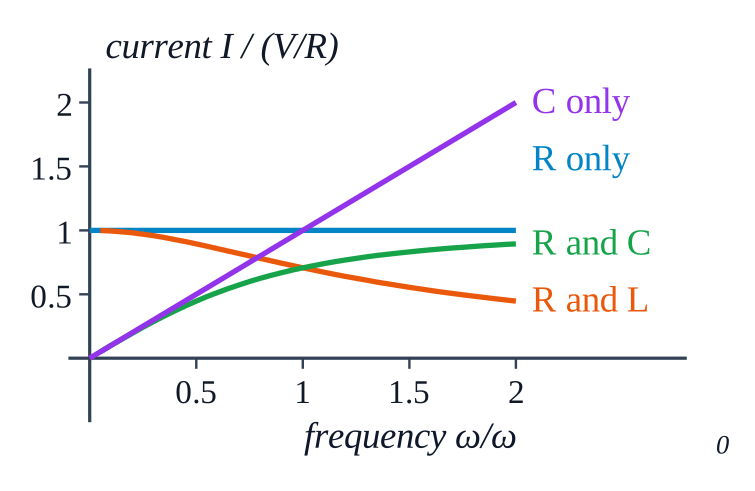
    In an alternating current circuit consisting of elements in series, the current increases on increasing the frequency of supply. Which of the following elements are likely to constitute the circuit ?
    (a)
    Only resistor.
    (b)
    Resistor and an inductor.
    (c)
    Resistor and a capacitor.
    (d)
    Only a capacitor.
    NCERT’s answer
    (c), (d)
    (c), (d) Capacitive reactance falls as \(\displaystyle f\) rises, so current rises; a resistor alone is frequency-independent and an inductor lowers the current. \[\text{R only: } I=\dfrac{V}{R}\ \text{(constant)} \] \[\text{R, L: } I=\dfrac{V}{\sqrt{R^2+\omega^2L^2}}\ \downarrow \] \[\text{R, C: } I=\dfrac{V}{\sqrt{R^2+1/\omega^2C^2}}\ \uparrow \] \[\text{C only: } I=\dfrac{V}{1/\omega C}=\omega CV\ \uparrow \] NCERT_Solution_Class12_Physics_Exemplar_Ch7_Q9
  3. Exercise 10

    Electrical energy is transmitted over large distances at high alternating voltages. Which of the following statements is (are) correct?
    (a)
    For a given power level, there is a lower current.
    (b)
    Lower current implies less power loss.
    (c)
    Transmission lines can be made thinner.
    (d)
    It is easy to reduce the voltage at the receiving end using step-down transformers.
    NCERT’s answer
    (a), (b), (d)
    (a), (b), (d) At fixed power a higher voltage means a lower current, so less \(\displaystyle I^2R\) loss; a step-down transformer restores a safe voltage. (c) fails: a thinner wire has larger \(\displaystyle R\). \[I=\dfrac{P}{V}\ \downarrow \quad (V\uparrow,\ P\ \text{fixed}) \] \[P_{loss}=I^2R=\dfrac{P^2}{V^2}\,R\ \downarrow \] \[\dfrac{V_s}{V_p}=\dfrac{N_s}{N_p}<1 \quad (\text{step-down}) \] \[A\downarrow\ \Rightarrow\ R=\dfrac{\rho\, l}{A}\ \uparrow\ \Rightarrow\ I^2R\ \uparrow \]
  4. Exercise 11

    For an LCR circuit, the power transferred from the driving source to the driven oscillator is P=I2Zcos⁡ϕ\displaystyle P=I^2 Z \cos \phi.
    (a)
    Here, the power factor cos⁡ϕ≥0,P≥0\displaystyle \cos \phi \geq 0, P \geq 0.
    (b)
    The driving force can give no energy to the oscillator (P=0)\displaystyle (P=0) in some cases.
    (c)
    The driving force cannot syphon out (P<0\displaystyle \mathrm{P}<0) the energy out of oscillator.
    (d)
    The driving force can take away energy out of the oscillator.
    NCERT’s answer
    (a), (b), (c)
    (a), (b), (c) Average power equals \(\displaystyle I^2R\), which cannot be negative; it is zero when \(\displaystyle R=0\) (pure L, pure C or L with C). \[\cos\phi=\dfrac{R}{Z},\quad R\ge 0\ \Rightarrow\ \cos\phi\ge 0 \] \[P=I^2Z\cos\phi=I^2R\ \ge 0 \] \[R=0\ \Rightarrow\ \phi=\pm\dfrac{\pi}{2}\ \Rightarrow\ P=0 \] \[P\ge 0\ \Rightarrow\ \text{no net energy is taken out of the oscillator} \]
  5. Exercise 12

    When an AC voltage of 220\displaystyle 220 V is applied to the capacitor C\displaystyle C
    (a)
    the maximum voltage between plates is 220\displaystyle 220 V.
    (b)
    the current is in phase with the applied voltage.
    (c)
    the charge on the plates is in phase with the applied voltage.
    (d)
    power delivered to the capacitor is zero.
    NCERT’s answer
    (c), (d)
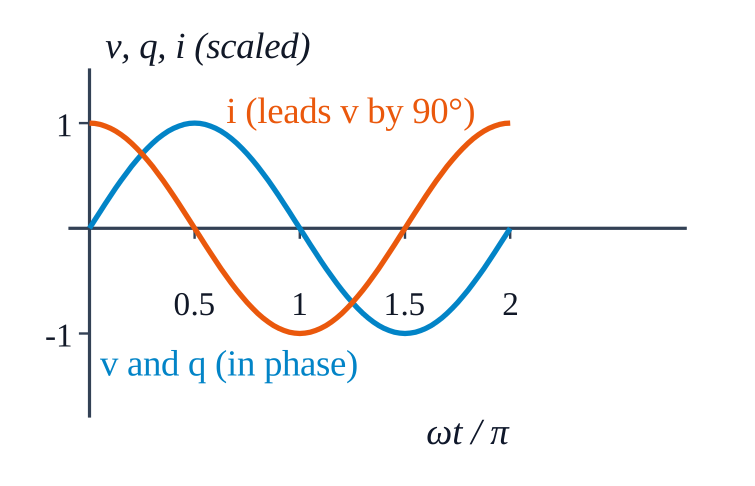
    (c), (d) $\displaystyle 220$ V is the rms value, so the peak is larger; the charge \(\displaystyle q=Cv\) follows \(\displaystyle v\), while \(\displaystyle i\) leads by \(\displaystyle 90^\circ\), giving zero average power. \[V_0=\sqrt{2}\,V_{rms}=\sqrt{2}\times 220\ \mathrm{V}\approx 311\ \mathrm{V} \] \[v=V_0\sin\omega t,\qquad q=Cv=CV_0\sin\omega t \] \[i=\dfrac{dq}{dt}=\omega CV_0\cos\omega t=I_0\sin\!\left(\omega t+\dfrac{\pi}{2}\right) \] \[\bar{P}=V_{rms}I_{rms}\cos 90^\circ=0 \] NCERT_Solution_Class12_Physics_Exemplar_Ch7_Q12
  6. Exercise 13

    The line that draws power supply to your house from street has
    (a)
    zero average current.
    (b)
    220\displaystyle 220 V average voltage.
    (c)
    voltage and current out of phase by 90\displaystyle 90°.
    (d)
    voltage and current possibly differing in phase ϕ\displaystyle \phi such that
    ∣ϕ∣<π2.|\phi|<\frac{\pi}{2} .
    NCERT’s answer
    (a), (d)
    (a), (d) $\displaystyle 220$ V is the rms value; the mean of a sinusoid over a cycle is zero. A house draws net power, so \(\displaystyle \phi\) cannot be \(\displaystyle 90^\circ\). \[\langle i\rangle=\dfrac{1}{T}\int_0^T I_0\sin\omega t\,dt=0 \] \[\langle v\rangle=0\ \ne\ 220\ \mathrm{V}\quad (220\ \mathrm{V}=V_{rms}) \] \[\bar{P}=V_{rms}I_{rms}\cos\phi>0\ \Rightarrow\ \cos\phi>0\ \Rightarrow\ |\phi|<\dfrac{\pi}{2} \]