SolveIt is under development
SolveItNCERT · CBSE · NEET

NCERT Exemplar · Class 12 Mathematics Continuity and Differentiability

106 questions · 106 still being checked

EXERCISE 5.3 71–80 (part 8 of 11)

  1. Exercise 71

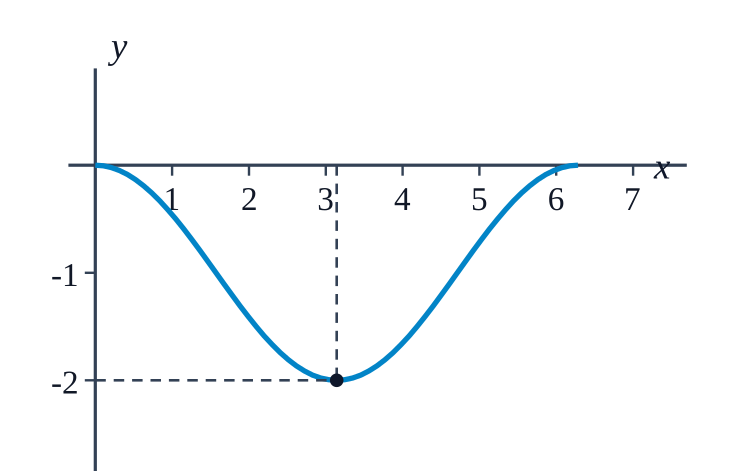
    Find the points on the curve y=(cos⁡x−1)\displaystyle y=(\cos x-1) in [0,2π]\displaystyle [0,2 \pi], where the tangent is parallel to x\displaystyle x-axis.

    Matches the book, not yet reviewed

    This working reaches the answer NCERT prints. It has not yet been read through by hand.

    NCERT’s answer
    \(\displaystyle (\pi,-2)\)
    Continuous on \(\displaystyle [0,2\pi]\), differentiable on \(\displaystyle (0,2\pi)\), and \[y(0)=\cos 0-1=0,\qquad y(2\pi)=\cos 2\pi-1=0 \;\Rightarrow\; y(0)=y(2\pi) \] By Rolle's theorem, \(\displaystyle \dfrac{dy}{dx}=0\) at some interior point \(\displaystyle c\in(0,2\pi)\) (at \(\displaystyle x=0,\,2\pi\) only a one-sided derivative exists). \[\frac{dy}{dx}=-\sin x \] \[-\sin c=0,\ \ c\in(0,2\pi) \;\Rightarrow\; c=\pi \] \[y(\pi)=\cos\pi-1=-2 \] NCERT_Solution_Class12_Maths_Exemplar_Ch5_Ex5-3_Q71 Answer: \(\displaystyle (\pi,-2)\).
  2. Exercise 72

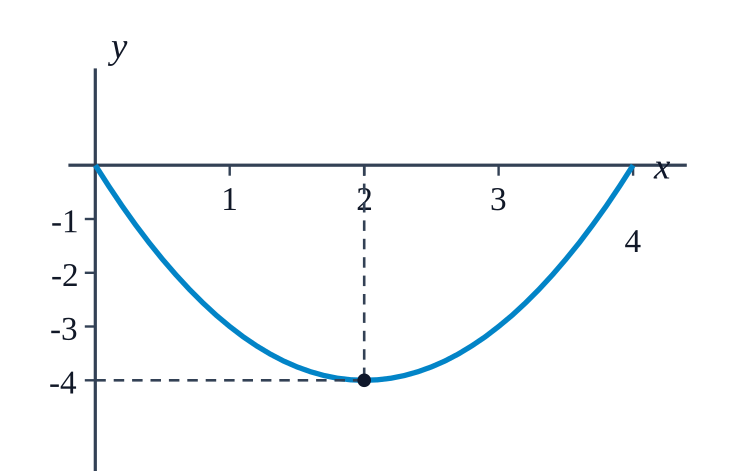
    Using Rolle's theorem, find the point on the curve y=x(x−4),x∈[0,4]\displaystyle y=x(x-4), x \in[0,4], where the tangent is parallel to x\displaystyle x-axis.

    Matches the book, not yet reviewed

    This working reaches the answer NCERT prints. It has not yet been read through by hand.

    NCERT’s answer
    \(\displaystyle (2, -4)\)
    A polynomial: continuous on \(\displaystyle [0,4]\), differentiable on \(\displaystyle (0,4)\). \[f(0)=0,\qquad f(4)=4\cdot 0=0 \;\Rightarrow\; f(0)=f(4) \] \[f'(x)=2x-4 \] \[f'(c)=0 \;\Rightarrow\; c=2\in(0,4) \] \[y(2)=2(2-4)=-4 \] NCERT_Solution_Class12_Maths_Exemplar_Ch5_Ex5-3_Q72 Answer: The point is \(\displaystyle (2,-4)\).
  3. Verify mean value theorem for each of the functions given Exercises $\displaystyle 73$ to 76.

    Exercise 73

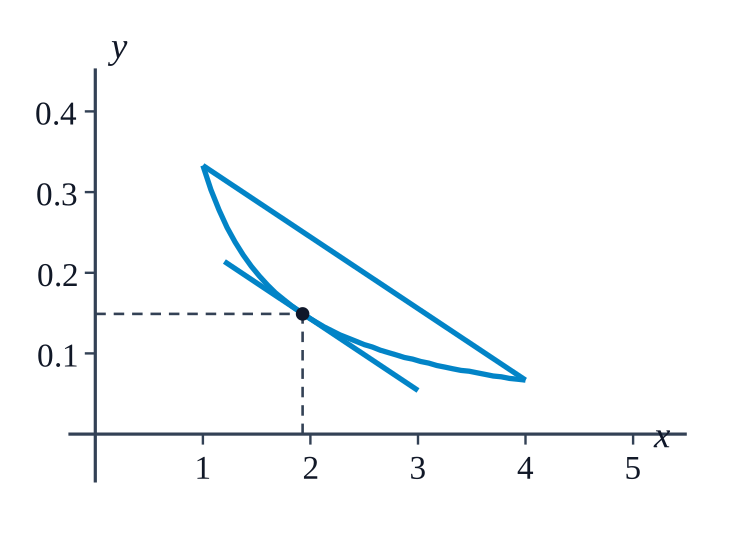
    f(x)=14x−1\displaystyle f(x)=\frac{1}{4 x-1} in [1,4]\displaystyle [1,4].

    Not cross-checked

    NCERT prints no numerical answer for this exercise, so this working has not been cross-checked against the book.

    \(\displaystyle f\) is continuous on \(\displaystyle [1,4]\) and differentiable on \(\displaystyle (1,4)\), since \(\displaystyle 4x-1\neq0\) there. \[f'(x)=-\frac{4}{(4x-1)^2} \] \[\frac{f(4)-f(1)}{4-1}=\frac{\frac1{15}-\frac13}{3}=-\frac{4}{45} \] \[f'(c)=-\frac{4}{45}\Rightarrow(4c-1)^2=45 \] \[4c-1=3\sqrt5\quad(4c-1>0) \] \[c=\frac{1+3\sqrt5}{4}\approx1.93\in(1,4) \] NCERT_Solution_Class12_Maths_Exemplar_Ch5_Ex5-3_Q73 Answer: Mean value theorem holds, with \(\displaystyle c=\frac{1+3\sqrt5}{4}\).
  4. Exercise 74

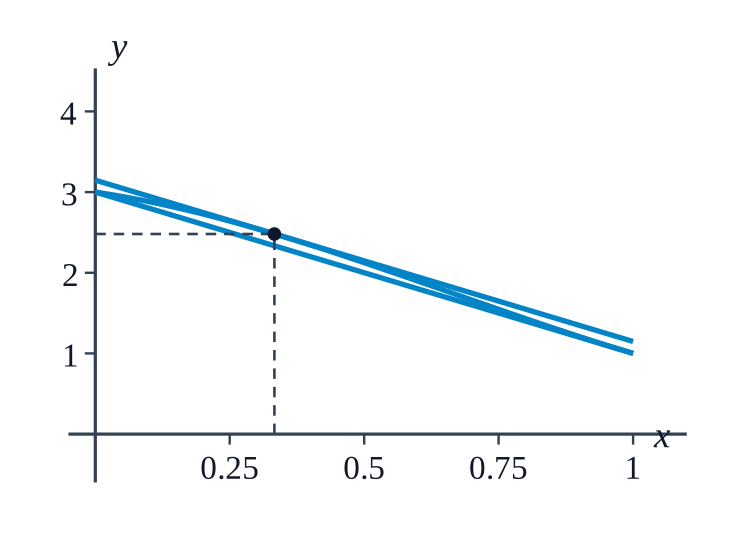
    f(x)=x3−2x2−x+3\displaystyle f(x)=x^3-2 x^2-x+3 in [0,1]\displaystyle [0,1].

    Not cross-checked

    NCERT prints no numerical answer for this exercise, so this working has not been cross-checked against the book.

    \(\displaystyle f\) is a polynomial, so continuous on \(\displaystyle [0,1]\) and differentiable on \(\displaystyle (0,1)\). \[f(0)=3,\quad f(1)=1-2-1+3=1 \] \[\frac{f(1)-f(0)}{1-0}=-2 \] \[f'(x)=3x^2-4x-1 \] \[f'(c)=-2\Rightarrow3c^2-4c+1=0 \] \[(3c-1)(c-1)=0\Rightarrow c=\tfrac13\ \text{or}\ 1 \] Only \(\displaystyle c=\tfrac13\) lies in \(\displaystyle (0,1)\). NCERT_Solution_Class12_Maths_Exemplar_Ch5_Ex5-3_Q74 Answer: Verified, with \(\displaystyle c=\tfrac13\).
  5. Exercise 75

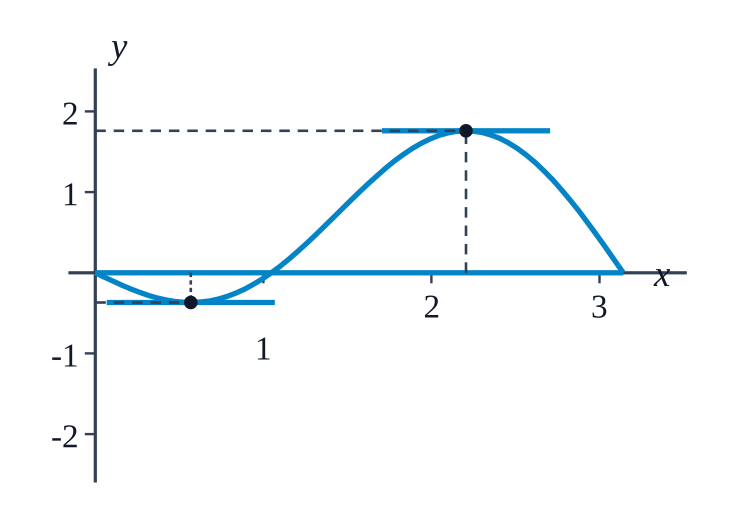
    f(x)=sin⁡x−sin⁡2x\displaystyle f(x)=\sin x-\sin 2 x in [0,π]\displaystyle [0, \pi].

    Not cross-checked

    NCERT prints no numerical answer for this exercise, so this working has not been cross-checked against the book.

    \(\displaystyle f\) is continuous and differentiable everywhere, so on \(\displaystyle [0,\pi]\) and \(\displaystyle (0,\pi)\). \[f(0)=0,\quad f(\pi)=\sin\pi-\sin2\pi=0 \] \[\frac{f(\pi)-f(0)}{\pi-0}=0 \] \[f'(x)=\cos x-2\cos2x \] \[f'(c)=0\Rightarrow\cos c-2(2\cos^2c-1)=0 \] \[4\cos^2c-\cos c-2=0 \] \[\cos c=\frac{1\pm\sqrt{33}}{8} \] Both values lie in \(\displaystyle (-1,1)\) (about \(\displaystyle 0.84\) and \(\displaystyle -0.59\)), so each gives a \(\displaystyle c\) in \(\displaystyle (0,\pi)\). NCERT_Solution_Class12_Maths_Exemplar_Ch5_Ex5-3_Q75 Answer: Verified, with \(\displaystyle c=\cos^{-1}\frac{1+\sqrt{33}}{8}\approx0.57\) and \(\displaystyle c=\cos^{-1}\frac{1-\sqrt{33}}{8}\approx2.21\).
  6. Exercise 76

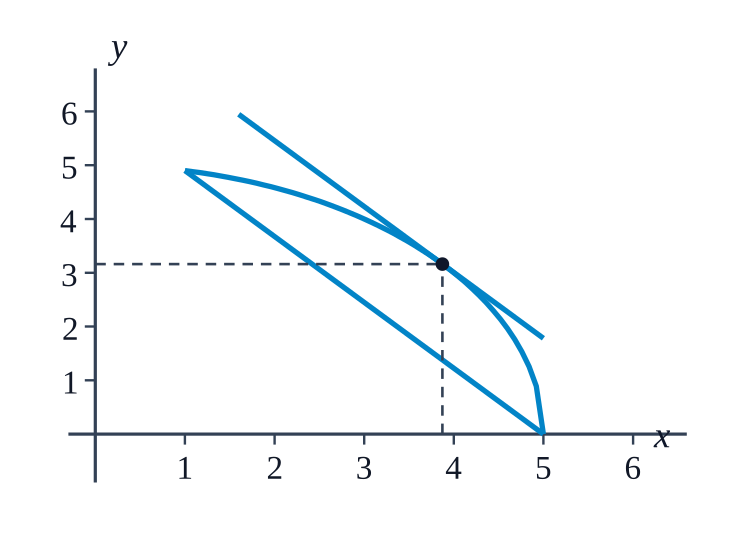
    f(x)=25−x2\displaystyle f(x)=\sqrt{25-x^2} in [1,5]\displaystyle [1,5].

    Not cross-checked

    NCERT prints no numerical answer for this exercise, so this working has not been cross-checked against the book.

    \(\displaystyle f\) is continuous on \(\displaystyle [-5,5]\) and differentiable on \(\displaystyle (-5,5)\), so on \(\displaystyle [1,5]\) and \(\displaystyle (1,5)\). \[f(1)=\sqrt{24}=2\sqrt6,\quad f(5)=0 \] \[\frac{f(5)-f(1)}{5-1}=-\frac{\sqrt6}{2} \] \[f'(x)=-\frac{x}{\sqrt{25-x^2}} \] \[-\frac{c}{\sqrt{25-c^2}}=-\frac{\sqrt6}{2}\Rightarrow4c^2=6(25-c^2) \] \[c^2=15\Rightarrow c=\sqrt{15}\in(1,5) \] NCERT_Solution_Class12_Maths_Exemplar_Ch5_Ex5-3_Q76 Answer: Verified, with \(\displaystyle c=\sqrt{15}\).
  7. Exercise 77

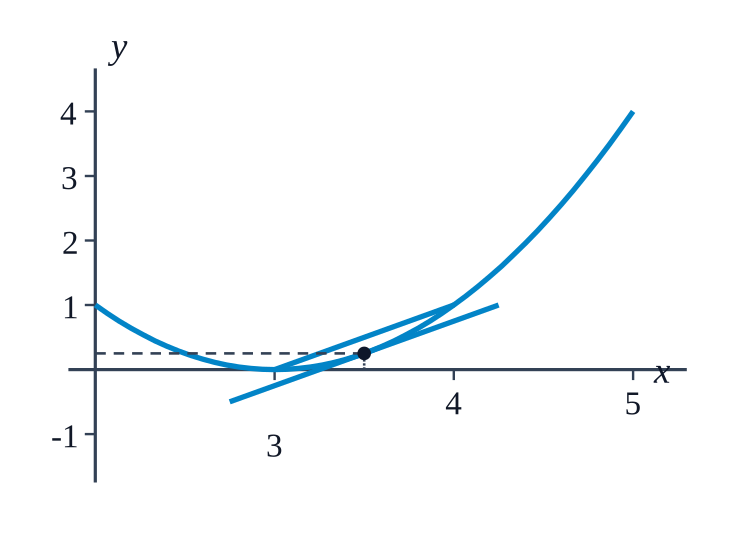
    Find a point on the curve y=(x−3)2\displaystyle y=(x-3)^2, where the tangent is parallel to the chord joining the points (3,0)\displaystyle (3,0) and (4,1)\displaystyle (4, 1).

    Matches the book, not yet reviewed

    This working reaches the answer NCERT prints. It has not yet been read through by hand.

    NCERT’s answer
    \(\displaystyle \left(\frac{7}{2}, \frac{1}{4}\right)\)
    Tangent slope must equal the chord slope. \[\text{slope of chord}=\frac{1-0}{4-3}=1 \] \[\frac{dy}{dx}=2(x-3) \] \[2(x-3)=1\Rightarrow x=\tfrac72 \] \[y=\left(\tfrac72-3\right)^2=\tfrac14 \] NCERT_Solution_Class12_Maths_Exemplar_Ch5_Ex5-3_Q77 Answer: The point is \(\displaystyle \left(\tfrac72,\tfrac14\right)\).
  8. Exercise 78

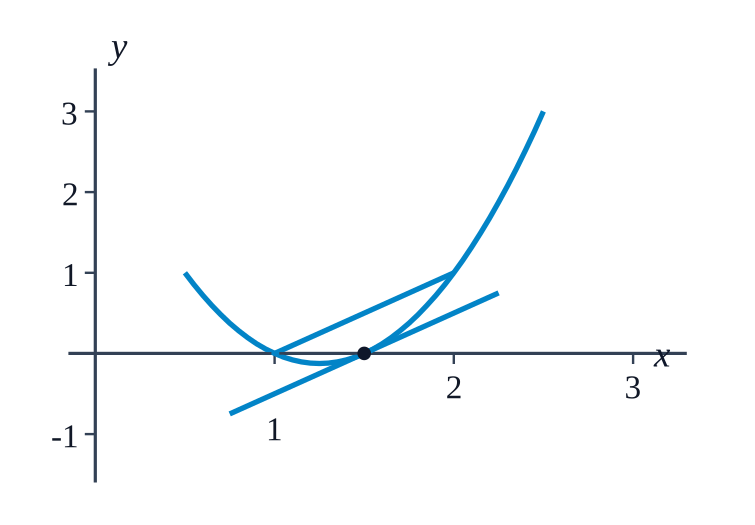
    Using mean value theorem, prove that there is a point on the curve y=2x2−5x+3\displaystyle y=2 x^2-5 x+3 between the points A(1,0)\displaystyle \mathrm{A}(1,0) and B(2,1)\displaystyle \mathrm{B}(2,1), where tangent is parallel to the chord AB. Also, find that point.

    Matches the book, not yet reviewed

    This working reaches the answer NCERT prints. It has not yet been read through by hand.

    NCERT’s answer
    \(\displaystyle \left(\frac{3}{2}, 0\right)\)
    The curve is a polynomial, so continuous on \(\displaystyle [1,2]\) and differentiable on \(\displaystyle (1,2)\). \[f(x)=2x^2-5x+3,\quad f(1)=0,\quad f(2)=1 \] \[\frac{f(2)-f(1)}{2-1}=1=\text{slope of AB} \] By the mean value theorem there is \(\displaystyle c\in(1,2)\) with \(\displaystyle f'(c)=1\): the tangent there is parallel to AB. \[f'(x)=4x-5 \] \[4c-5=1\Rightarrow c=\tfrac32\in(1,2) \] \[f\left(\tfrac32\right)=2\cdot\tfrac94-\tfrac{15}{2}+3=0 \] NCERT_Solution_Class12_Maths_Exemplar_Ch5_Ex5-3_Q78 Answer: The point is \(\displaystyle \left(\tfrac32,0\right)\).
  9. Exercise 79

    Find the values of p\displaystyle p and q\displaystyle q so that f(x)={x2+3x+p, if x≤1qx+2, if x>1f(x)= \begin{cases}x^2+3 x+p & , \text { if } x \leq 1 \\ q x+2 & , \text { if } x>1\end{cases} is differentiable at x=1\displaystyle x=1.

    Matches the book, not yet reviewed

    This working reaches the answer NCERT prints. It has not yet been read through by hand.

    NCERT’s answer
    \(\displaystyle p=3, q=5\)
    Differentiable at \(\displaystyle x=1\) requires continuity there. \[\lim_{x\to1^-}f(x)=1+3+p,\quad \lim_{x\to1^+}f(x)=q+2 \] \[4+p=q+2\Rightarrow q=p+2 \] The one-sided derivatives must also agree. \[f'(1^-)=\left.(2x+3)\right|_{x=1}=5 \] \[f'(1^+)=q \] \[q=5\Rightarrow p=3 \] Answer: \(\displaystyle p=3,\ q=5\).
  10. Exercise 80

    If xm.yn=(x+y)m+n\displaystyle x^m . y^n=(x+y)^{m+n}, prove that
    (i)
    dydx=yx\displaystyle \frac{d y}{d x}=\frac{y}{x} and
    (ii)
    d2ydx2=0\displaystyle \frac{d^2 y}{d x^2}=0.

    Not cross-checked

    NCERT prints no numerical answer for this exercise, so this working has not been cross-checked against the book.

    Take logarithms and differentiate with respect to \(\displaystyle x\). \[m\ln x+n\ln y=(m+n)\ln(x+y) \] \[\frac mx+\frac ny\frac{dy}{dx}=\frac{m+n}{x+y}\left(1+\frac{dy}{dx}\right) \] \[\frac{dy}{dx}\left[\frac ny-\frac{m+n}{x+y}\right]=\frac{m+n}{x+y}-\frac mx \] \[\frac{dy}{dx}\cdot\frac{nx-my}{y(x+y)}=\frac{nx-my}{x(x+y)} \] Cancel \(\displaystyle nx-my\); it is not zero, since \(\displaystyle nx=my\) would force \(\displaystyle m^mn^n=(m+n)^{m+n}\), impossible for \(\displaystyle m,n>0\). \[\text{(i)}\quad\frac{dy}{dx}=\frac yx \] \[\text{(ii)}\quad\frac{d^2y}{dx^2}=\frac{x\dfrac{dy}{dx}-y}{x^2}=\frac{y-y}{x^2}=0 \] Answer: \(\displaystyle \frac{dy}{dx}=\frac yx\) and \(\displaystyle \frac{d^2y}{dx^2}=0\).