SolveIt is under development
SolveItNCERT · CBSE · NEET

NCERT Exemplar · Class 12 Mathematics Continuity and Differentiability

106 questions · 106 still being checked

EXERCISE 5.3 101–106 (part 11 of 11)

  1. Fill in the blanks in each of the Exercises $\displaystyle 97$ to $\displaystyle 101$:

    Exercise 101

    For the curve x+y=1,dydx\displaystyle \sqrt{x}+\sqrt{y}=1, \frac{d y}{d x} at (14,14)\displaystyle \left(\frac{1}{4}, \frac{1}{4}\right) is ____.

    Matches the book, not yet reviewed

    This working reaches the answer NCERT prints. It has not yet been read through by hand.

    NCERT’s answer
    \(\displaystyle -1\)
    \(\displaystyle -1\)\[\sqrt x+\sqrt y=1 \]\[\frac{1}{2\sqrt x}+\frac{1}{2\sqrt y}\frac{dy}{dx}=0 \]\[\frac{dy}{dx}=-\frac{\sqrt y}{\sqrt x} \]\[\left.\frac{dy}{dx}\right|_{\left(\frac14,\frac14\right)}=-\frac{1/2}{1/2}=-1 \]
  2. State True or False for the statements in each of the Exercises $\displaystyle 102$ to 106.

    Exercise 102

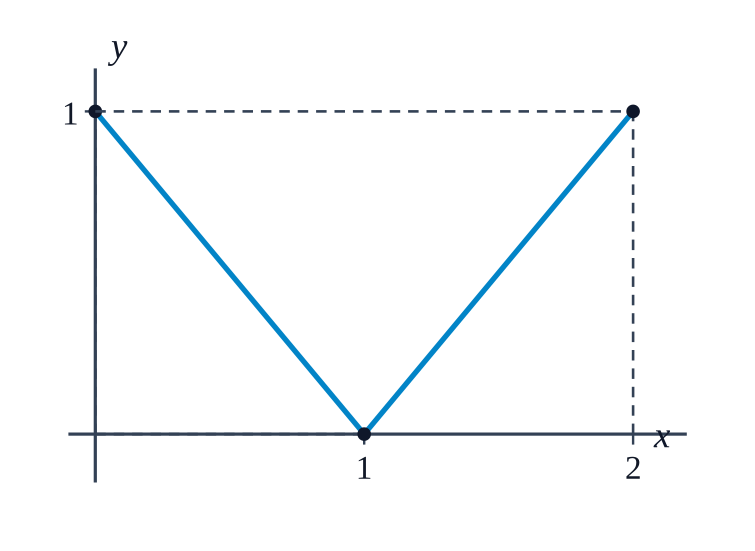
    Rolle's theorem is applicable for the function f(x)=∣x−1∣\displaystyle f(x)=|x-1| in [0\displaystyle 0, 2\displaystyle 2].

    Matches the book, not yet reviewed

    This working reaches the answer NCERT prints. It has not yet been read through by hand.

    NCERT’s answer
    False
    False\(\displaystyle f\) is continuous on \(\displaystyle [0,2]\) and \(\displaystyle f(0)=f(2)=1\), but at \(\displaystyle x=1\):NCERT_Solution_Class12_Maths_Exemplar_Ch5_Ex5-3_Q102\[f'(1^-)=-1 \ne 1=f'(1^+) \]\(\displaystyle f\) is not differentiable at \(\displaystyle 1\in(0,2)\), so Rolle's theorem does not apply.
  3. Exercise 103

    If f\displaystyle f is continuous on its domain D, then ∣f∣\displaystyle |f| is also continuous on D.

    Matches the book, not yet reviewed

    This working reaches the answer NCERT prints. It has not yet been read through by hand.

    NCERT’s answer
    True
    TrueFor any \(\displaystyle c\in D\):\[\big|\,|f(x)|-|f(c)|\,\big|\le |f(x)-f(c)| \]\[f \text{ continuous at } c \;\Rightarrow\; |f(x)-f(c)|\to 0 \text{ as } x\to c \]\[\lim_{x\to c}|f(x)|=|f(c)| \]
  4. Exercise 104

    The composition of two continuous function is a continuous function.

    Matches the book, not yet reviewed

    This working reaches the answer NCERT prints. It has not yet been read through by hand.

    NCERT’s answer
    True
    TrueLet \(\displaystyle f\) be continuous at \(\displaystyle c\) and \(\displaystyle g\) continuous at \(\displaystyle f(c)\):\[\lim_{x\to c}g\big(f(x)\big)=g\Big(\lim_{x\to c}f(x)\Big)=g\big(f(c)\big) \]So \(\displaystyle g\circ f\) is continuous at \(\displaystyle c\).
  5. Exercise 105

    Trigonometric and inverse - trigonometric functions are differentiable in their respective domain.

    Check this one against your book

    NCERT’s printed answer for this exercise does not match its own question. This working follows the question as printed.

    False — \(\displaystyle \sin^{-1}x\) is a counterexample: it is defined on \(\displaystyle [-1,1]\) but is not differentiable at both end points.\[f(x)=\sin^{-1}x,\quad \text{domain } [-1,1] \]\[f'(x)=\frac{1}{\sqrt{1-x^{2}}},\quad |x|<1 \]\[\lim_{x\to 1^{-}}\frac{1}{\sqrt{1-x^{2}}}=\infty \]\[\Rightarrow\; f'(1)\ \text{does not exist, likewise } f'(-1) \]
  6. Exercise 106

    If f.g\displaystyle f . g is continuous at x=a\displaystyle x=a, then f\displaystyle f and g\displaystyle g are separately continuous at x=a\displaystyle x=a.

    Matches the book, not yet reviewed

    This working reaches the answer NCERT prints. It has not yet been read through by hand.

    NCERT’s answer
    False
    False — a counterexample at \(\displaystyle x=0\) is enough.\[f(x)=g(x)=\begin{cases}1, & x\ge 0\\ -1, & x<0\end{cases} \]\[(f\cdot g)(x)=\big(f(x)\big)^{2}=1\ \text{ for all } x \;\Rightarrow\; f\cdot g \text{ is continuous at } 0 \]\[\lim_{x\to 0^{-}}f(x)=-1\neq 1=f(0) \]\[\Rightarrow\; f \text{ and } g \text{ are not continuous at } x=0 \]