SolveIt is under development
SolveItNCERT · CBSE · NEET

NCERT Exemplar · Class 12 Mathematics Continuity and Differentiability

106 questions · 106 still being checked

EXERCISE 5.3 91–100 (part 10 of 11)

  1. Choose the correct answers from the given four options in each of the Exercises $\displaystyle 83$ to 96.

    Exercise 91

    If y=log⁡(1−x21+x2)\displaystyle y=\log \left(\frac{1-x^2}{1+x^2}\right), then dydx\displaystyle \frac{d y}{d x} is equal to
    (A)
    4x31−x4\displaystyle \frac{4 x^3}{1-x^4}
    (B)
    −4x1−x4\displaystyle \frac{-4 x}{1-x^4}
    (C)
    14−x4\displaystyle \frac{1}{4-x^4}
    (D)
    −4x31−x4\displaystyle \frac{-4 x^3}{1-x^4}

    Matches the book, not yet reviewed

    This working reaches the answer NCERT prints. It has not yet been read through by hand.

    NCERT’s answer
    B
    (B) \(\displaystyle \frac{-4x}{1-x^4}\)\[y=\log(1-x^2)-\log(1+x^2) \]\[\frac{dy}{dx}=\frac{-2x}{1-x^2}-\frac{2x}{1+x^2} \]\[\frac{dy}{dx}=\frac{-2x(1+x^2)-2x(1-x^2)}{(1-x^2)(1+x^2)} \]\[\frac{dy}{dx}=\frac{-4x}{1-x^4} \]
  2. Exercise 92

    If y=sin⁡x+y\displaystyle y=\sqrt{\sin x+y}, then dydx\displaystyle \frac{d y}{d x} is equal to
    (A)
    cos⁡x2y−1\displaystyle \frac{\cos x}{2 y-1}
    (B)
    cos⁡x1−2y\displaystyle \frac{\cos x}{1-2 y}
    (C)
    sin⁡x1−2y\displaystyle \frac{\sin x}{1-2 y}
    (D)
    sin⁡x2y−1\displaystyle \frac{\sin x}{2 y-1}

    Matches the book, not yet reviewed

    This working reaches the answer NCERT prints. It has not yet been read through by hand.

    NCERT’s answer
    A
    (A) \(\displaystyle \frac{\cos x}{2y-1}\)Square both sides, then differentiate implicitly.\[y^2=\sin x+y \]\[2y\frac{dy}{dx}=\cos x+\frac{dy}{dx} \]\[(2y-1)\frac{dy}{dx}=\cos x \]\[\frac{dy}{dx}=\frac{\cos x}{2y-1} \]
  3. Exercise 93

    The derivative of cos⁡−1(2x2−1)\displaystyle \cos ^{-1}\left(2 x^2-1\right) w.r.t. cos⁡−1x\displaystyle \cos ^{-1} x is
    (A)
    2\displaystyle 2 (B) −121−x2\displaystyle \frac{-1}{2 \sqrt{1-x^2}}
    (C)
    2x\displaystyle \frac{2}{x}
    (D)
    1−x2\displaystyle 1-x^2

    Matches the book, not yet reviewed

    This working reaches the answer NCERT prints. It has not yet been read through by hand.

    NCERT’s answer
    A
    (A) \(\displaystyle 2\)Take \(\displaystyle 0<x<1\) and put \(\displaystyle x=\cos\theta\), \(\displaystyle 0<\theta<\frac{\pi}{2}\).\[2x^2-1=2\cos^2\theta-1=\cos2\theta \]\[u=\cos^{-1}(\cos2\theta)=2\theta \quad (0<2\theta<\pi) \]\[v=\cos^{-1}x=\theta \]\[\frac{du}{dv}=\frac{d(2\theta)}{d\theta}=2 \]
  4. Exercise 94

    If x=t2,y=t3\displaystyle x=t^2, y=t^3, then d2ydx2\displaystyle \frac{d^2 y}{d x^2} is
    (A)
    32\displaystyle \frac{3}{2}
    (B)
    34t\displaystyle \frac{3}{4 t}
    (C)
    32t\displaystyle \frac{3}{2 t}
    (D)
    34\displaystyle \frac{3}{4}

    Matches the book, not yet reviewed

    This working reaches the answer NCERT prints. It has not yet been read through by hand.

    NCERT’s answer
    B
    (B) \(\displaystyle \frac{3}{4t}\)\[\frac{dx}{dt}=2t,\qquad \frac{dy}{dt}=3t^2 \]\[\frac{dy}{dx}=\frac{3t^2}{2t}=\frac{3t}{2} \]\[\frac{d^2y}{dx^2}=\frac{d}{dt}\!\left(\frac{3t}{2}\right)\cdot\frac{dt}{dx}=\frac{3}{2}\cdot\frac{1}{2t} \]\[\frac{d^2y}{dx^2}=\frac{3}{4t} \]
  5. Exercise 95

    The value of c\displaystyle c in Rolle's theorem for the function f(x)=x3−3x\displaystyle f(x)=x^3-3 x in the interval [0,3]\displaystyle [0, \sqrt{3}] is
    (A)
    1\displaystyle 1 (B) - 1\displaystyle 1 (C) 32\displaystyle \frac{3}{2}
    (D)
    13\displaystyle \frac{1}{3}

    Matches the book, not yet reviewed

    This working reaches the answer NCERT prints. It has not yet been read through by hand.

    NCERT’s answer
    A
    (A) \(\displaystyle 1\)Rolle's theorem: \(\displaystyle f(0)=f(\sqrt3)\), then \(\displaystyle f'(c)=0\) for some \(\displaystyle c\in(0,\sqrt3)\).\[f(0)=0,\qquad f(\sqrt3)=3\sqrt3-3\sqrt3=0 \]\[f'(x)=3x^2-3=0 \]\[x=\pm1 \]Only \(\displaystyle 1\in(0,\sqrt3)\), so \(\displaystyle c=1\).
  6. Exercise 96

    For the function f(x)=x+1x,x∈[1,3]\displaystyle f(x)=x+\frac{1}{x}, x \in[1,3], the value of c\displaystyle c for mean value theorem is
    (A)
    1\displaystyle 1 (B) 3\displaystyle \sqrt{3}
    (C)
    2\displaystyle 2 (D) none of these

    Matches the book, not yet reviewed

    This working reaches the answer NCERT prints. It has not yet been read through by hand.

    NCERT’s answer
    B
    (B) \(\displaystyle \sqrt3\)Mean value theorem: \(\displaystyle f'(c)=\frac{f(3)-f(1)}{3-1}\).\[f(1)=2,\qquad f(3)=3+\frac13=\frac{10}{3} \]\[f'(c)=\frac{\dfrac{10}{3}-2}{2}=\frac{2}{3} \]\[f'(x)=1-\frac{1}{x^2}\;\Rightarrow\;1-\frac{1}{c^2}=\frac23 \]\[c^2=3\;\Rightarrow\;c=\sqrt3\in(1,3) \]
  7. Fill in the blanks in each of the Exercises $\displaystyle 97$ to $\displaystyle 101$:

    Exercise 97

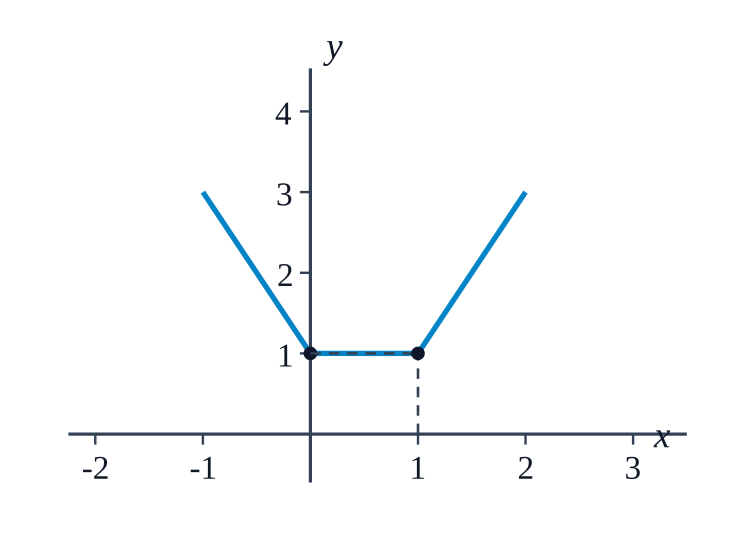
    An example of a function which is continuous everywhere but fails to be differentiable exactly at two points is ____.

    Matches the book, not yet reviewed

    This working reaches the answer NCERT prints. It has not yet been read through by hand.

    NCERT’s answer
    \(\displaystyle |x|+|x-1|\)
    \(\displaystyle f(x)=|x|+|x-1|\)\[f(x)=\begin{cases}1-2x, & x<0\\ 1, & 0\le x\le 1\\ 2x-1, & x>1\end{cases} \]NCERT_Solution_Class12_Maths_Exemplar_Ch5_Ex5-3_Q97Sum of continuous functions, so \(\displaystyle f\) is continuous everywhere.\[f'(0^-)=-2 \ne 0=f'(0^+) \]\[f'(1^-)=0 \ne 2=f'(1^+) \]Elsewhere \(\displaystyle f\) is linear, hence differentiable.
  8. Exercise 98

    Derivative of x2\displaystyle x^2 w.r.t. x3\displaystyle x^3 is ____.

    Matches the book, not yet reviewed

    This working reaches the answer NCERT prints. It has not yet been read through by hand.

    NCERT’s answer
    \(\displaystyle \frac{2}{3 x}\)
    \(\displaystyle \dfrac{2}{3x}\)\[u=x^2,\quad v=x^3 \]\[\frac{du}{dx}=2x,\quad \frac{dv}{dx}=3x^2 \]\[\frac{du}{dv}=\frac{du/dx}{dv/dx}=\frac{2x}{3x^2}=\frac{2}{3x} \quad (x\ne 0) \]
  9. Exercise 99

    If f(x)=∣cos⁡x∣\displaystyle f(x)=|\cos x|, then f′(π4)=\displaystyle f^{\prime}\left(\frac{\pi}{4}\right)= ____.

    Matches the book, not yet reviewed

    This working reaches the answer NCERT prints. It has not yet been read through by hand.

    NCERT’s answer
    \(\displaystyle \frac{-1}{\sqrt{2}}\)
    \(\displaystyle -\dfrac{1}{\sqrt2}\)\[\cos x>0 \text{ near } x=\tfrac{\pi}{4} \;\Rightarrow\; f(x)=\cos x \]\[f'(x)=-\sin x \]\[f'\left(\frac{\pi}{4}\right)=-\sin\frac{\pi}{4}=-\frac{1}{\sqrt2} \]
  10. Exercise 100

    If f(x)=∣cos⁡x−sin⁡x∣\displaystyle f(x)=|\cos x-\sin x|, then f′(π3)=\displaystyle f^{\prime}\left(\frac{\pi}{3}\right)= ____.

    Matches the book, not yet reviewed

    This working reaches the answer NCERT prints. It has not yet been read through by hand.

    NCERT’s answer
    \(\displaystyle \left(\frac{\sqrt{3}+1}{2}\right)\)
    \(\displaystyle \dfrac{1+\sqrt3}{2}\)\[\cos\frac{\pi}{3}-\sin\frac{\pi}{3}=\frac{1-\sqrt3}{2}<0 \]So near \(\displaystyle x=\tfrac{\pi}{3}\):\[f(x)=-(\cos x-\sin x)=\sin x-\cos x \]\[f'(x)=\cos x+\sin x \]\[f'\left(\frac{\pi}{3}\right)=\frac12+\frac{\sqrt3}{2}=\frac{1+\sqrt3}{2} \]