SolveIt is under development
SolveItNCERT · CBSE · NEET

NCERT Exemplar · Class 12 Mathematics Continuity and Differentiability

106 questions · 106 still being checked

EXERCISE 5.3 61–70 (part 7 of 11)

  1. Exercise 61

    If y=(cos⁡x)(cos⁡x)(cos⁡x)…∞\displaystyle y=(\cos x)^{(\cos x)^{(\cos x) \ldots \infty}}, show that dydx=y2tan⁡xylog⁡cos⁡x−1\displaystyle \frac{d y}{d x}=\frac{y^2 \tan x}{y \log \cos x-1}.

    Not cross-checked

    NCERT prints no numerical answer for this exercise, so this working has not been cross-checked against the book.

    The exponent tower is \(\displaystyle y\) itself, so\[y=(\cos x)^{y} \]\[\log y=y\log\cos x \]Differentiate with respect to \(\displaystyle x\).\[\frac1y\frac{dy}{dx}=\frac{dy}{dx}\log\cos x+y\cdot\frac{-\sin x}{\cos x} \]\[\frac{dy}{dx}\left(\frac1y-\log\cos x\right)=-y\tan x \]\[\frac{dy}{dx}\cdot\frac{1-y\log\cos x}{y}=-y\tan x \]\[\frac{dy}{dx}=\frac{-y^2\tan x}{1-y\log\cos x}=\frac{y^2\tan x}{y\log\cos x-1} \]
  2. Exercise 62

    If xsin⁡(a+y)+sin⁡acos⁡(a+y)=0\displaystyle x \sin (a+y)+\sin a \cos (a+y)=0, prove that dydx=sin⁡2(a+y)sin⁡a\displaystyle \frac{d y}{d x}=\frac{\sin ^2(a+y)}{\sin a}.

    Not cross-checked

    NCERT prints no numerical answer for this exercise, so this working has not been cross-checked against the book.

    Solve for \(\displaystyle x\).\[x=-\sin a\cdot\frac{\cos(a+y)}{\sin(a+y)}=-\sin a\cot(a+y) \]Differentiate with respect to \(\displaystyle y\).\[\frac{dx}{dy}=\sin a\,\operatorname{cosec}^2(a+y)=\frac{\sin a}{\sin^2(a+y)} \]\[\frac{dy}{dx}=\frac{1}{dx/dy}=\frac{\sin^2(a+y)}{\sin a} \]
  3. Exercise 63

    If 1−x2+1−y2=a(x−y)\displaystyle \sqrt{1-x^2}+\sqrt{1-y^2}=a(x-y), prove that dydx=1−y21−x2\displaystyle \frac{d y}{d x}=\sqrt{\frac{1-y^2}{1-x^2}}.

    Not cross-checked

    NCERT prints no numerical answer for this exercise, so this working has not been cross-checked against the book.

    Put \(\displaystyle x=\sin A,\ y=\sin B\) with \(\displaystyle A,B\in\left[-\tfrac{\pi}{2},\tfrac{\pi}{2}\right]\).\[\cos A+\cos B=a(\sin A-\sin B) \]\[2\cos\frac{A+B}{2}\cos\frac{A-B}{2}=2a\cos\frac{A+B}{2}\sin\frac{A-B}{2} \]Cancel \(\displaystyle \cos\frac{A+B}{2}\).\[\cot\frac{A-B}{2}=a \quad\Rightarrow\quad A-B=2\cot^{-1}a \]\[\sin^{-1}x-\sin^{-1}y=2\cot^{-1}a \]\(\displaystyle a\) is constant, so differentiate with respect to \(\displaystyle x\).\[\frac{1}{\sqrt{1-x^2}}-\frac{1}{\sqrt{1-y^2}}\frac{dy}{dx}=0 \]\[\frac{dy}{dx}=\sqrt{\frac{1-y^2}{1-x^2}} \]
  4. Exercise 64

    If y=tan⁡−1x\displaystyle y=\tan ^{-1} x, find d2ydx2\displaystyle \frac{d^2 y}{d x^2} in terms of y\displaystyle y alone.

    Matches the book, not yet reviewed

    This working reaches the answer NCERT prints. It has not yet been read through by hand.

    NCERT’s answer
    \(\displaystyle -2 \sin y \cos ^3 y\)
    \[\frac{dy}{dx}=\frac{1}{1+x^2} \]\[\frac{d^2y}{dx^2}=\frac{-2x}{(1+x^2)^2} \]Use \(\displaystyle x=\tan y\) and \(\displaystyle 1+x^2=\sec^2y\).\[\frac{d^2y}{dx^2}=\frac{-2\tan y}{\sec^4y}=-2\sin y\cos^3y \]Answer: \(\displaystyle -2\sin y\cos^3y\) (equivalently \(\displaystyle -\sin 2y\cos^2y\))
  5. Verify the Rolle’s theorem for each of the functions in Exercises $\displaystyle 65$ to 69.

    Exercise 65

    f(x)=x(x−1)2\displaystyle f(x)=x(x-1)^2 in [0,1]\displaystyle [0,1].

    Not cross-checked

    NCERT prints no numerical answer for this exercise, so this working has not been cross-checked against the book.

    A polynomial: continuous on \(\displaystyle [0,1]\), differentiable on \(\displaystyle (0,1)\). \[f(0)=0,\qquad f(1)=1\cdot 0^2=0 \;\Rightarrow\; f(0)=f(1) \] \[f'(x)=(x-1)^2+2x(x-1)=(x-1)(3x-1) \] \[f'(c)=0 \;\Rightarrow\; c=\tfrac13\in(0,1) \] Answer: Rolle's theorem holds, with \(\displaystyle c=\tfrac13\).
  6. Exercise 66

    f(x)=sin⁡4x+cos⁡4x\displaystyle f(x)=\sin ^4 x+\cos ^4 x in [0,π2]\displaystyle \left[0, \frac{\pi}{2}\right].

    Not cross-checked

    NCERT prints no numerical answer for this exercise, so this working has not been cross-checked against the book.

    Built from \(\displaystyle \sin x,\cos x\): continuous on \(\displaystyle [0,\tfrac{\pi}{2}]\), differentiable on \(\displaystyle (0,\tfrac{\pi}{2})\). \[f(0)=0+1=1,\qquad f\!\left(\tfrac{\pi}{2}\right)=1+0=1 \] \[f(x)=(\sin^2x+\cos^2x)^2-2\sin^2x\cos^2x=1-\tfrac12\sin^2 2x \] \[f'(x)=-\tfrac12\cdot 2\sin 2x\cos 2x\cdot 2=-\sin 4x \] \[f'(c)=0 \;\Rightarrow\; \sin 4c=0 \;\Rightarrow\; 4c=\pi \;\Rightarrow\; c=\tfrac{\pi}{4}\in\left(0,\tfrac{\pi}{2}\right) \] Answer: Rolle's theorem holds, with \(\displaystyle c=\tfrac{\pi}{4}\).
  7. Exercise 67

    f(x)=log⁡(x2+2)−log⁡3\displaystyle f(x)=\log \left(x^2+2\right)-\log 3 in [−1,1]\displaystyle [-1,1].

    Not cross-checked

    NCERT prints no numerical answer for this exercise, so this working has not been cross-checked against the book.

    Since \(\displaystyle x^2+2>0\), \(\displaystyle f\) is continuous on \(\displaystyle [-1,1]\) and differentiable on \(\displaystyle (-1,1)\). \[f(-1)=\log 3-\log 3=0,\qquad f(1)=\log 3-\log 3=0 \] \[f'(x)=\frac{2x}{x^2+2} \] \[f'(c)=0 \;\Rightarrow\; c=0\in(-1,1) \] Answer: Rolle's theorem holds, with \(\displaystyle c=0\).
  8. Exercise 68

    f(x)=x(x+3)e−x/2\displaystyle f(x)=x(x+3) e^{-x / 2} in [−3,0]\displaystyle [-3,0].

    Not cross-checked

    NCERT prints no numerical answer for this exercise, so this working has not been cross-checked against the book.

    Polynomial times \(\displaystyle e^{-x/2}\): continuous on \(\displaystyle [-3,0]\), differentiable on \(\displaystyle (-3,0)\). \[f(-3)=(-3)(0)e^{3/2}=0,\qquad f(0)=0 \] \[f'(x)=(2x+3)e^{-x/2}-\tfrac12\,x(x+3)e^{-x/2} \] \[f'(x)=-\tfrac12 e^{-x/2}\,(x^2-x-6)=-\tfrac12 e^{-x/2}(x-3)(x+2) \] \[f'(c)=0 \;\Rightarrow\; c=-2\in(-3,0)\qquad(x=3\notin(-3,0)) \] Answer: Rolle's theorem holds, with \(\displaystyle c=-2\).
  9. Exercise 69

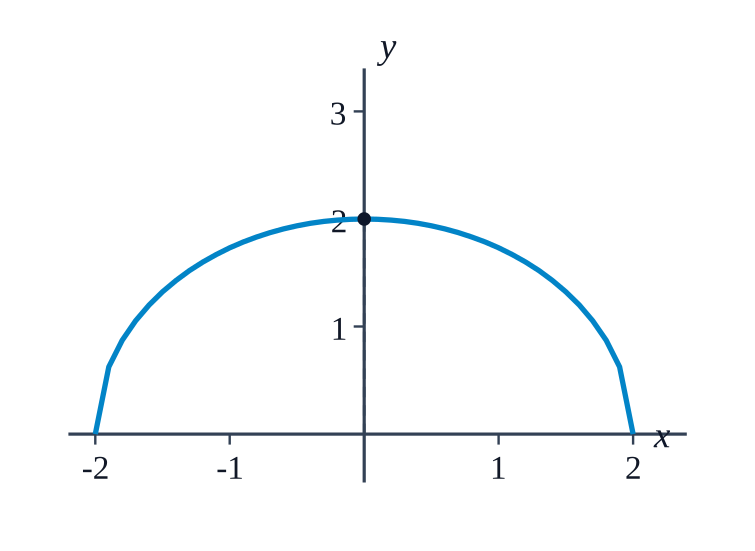
    f(x)=4−x2\displaystyle f(x)=\sqrt{4-x^2} in [−2,2]\displaystyle [-2,2].

    Not cross-checked

    NCERT prints no numerical answer for this exercise, so this working has not been cross-checked against the book.

    \(\displaystyle 4-x^2\ge 0\) on \(\displaystyle [-2,2]\), so \(\displaystyle f\) is continuous there. \[f'(x)=\frac{-x}{\sqrt{4-x^2}}\ \text{ exists for every } x\in(-2,2) \] \[f(-2)=0=f(2) \] \[f'(c)=0 \;\Rightarrow\; c=0\in(-2,2) \] NCERT_Solution_Class12_Maths_Exemplar_Ch5_Ex5-3_Q69 Answer: Rolle's theorem holds, with \(\displaystyle c=0\).
  10. Exercise 70

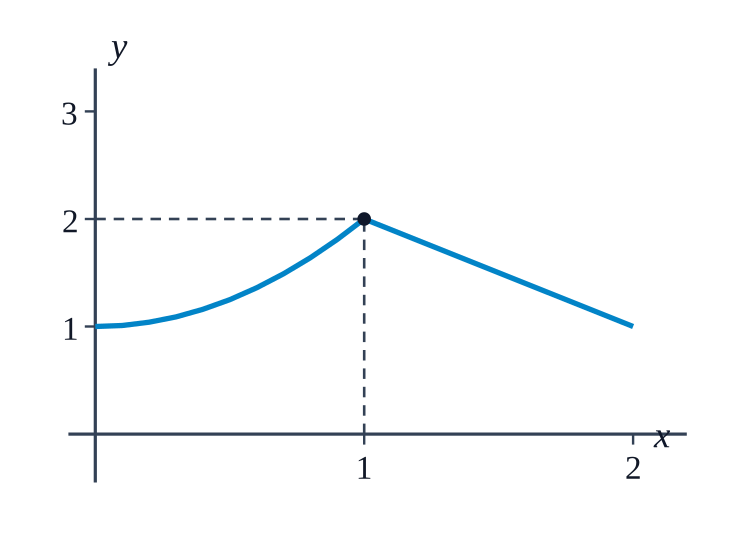
    Discuss the applicability of Rolle's theorem on the function given by f(x)={x2+1, if 0≤x≤13−x, if 1≤x≤2.f(x)=\left\{\begin{array}{l} x^2+1, \text { if } 0 \leq x \leq 1 \\ 3-x, \text { if } 1 \leq x \leq 2 \end{array} .\right.

    Matches the book, not yet reviewed

    This working reaches the answer NCERT prints. It has not yet been read through by hand.

    NCERT’s answer
    Not applicable since \(\displaystyle f\) is not differentiable at \(\displaystyle x = 1\)
    Each piece is a polynomial; check the join at \(\displaystyle x=1\). \[\lim_{x\to1^-}f(x)=1^2+1=2,\qquad \lim_{x\to1^+}f(x)=3-1=2=f(1) \] \[f(0)=1,\qquad f(2)=3-2=1 \;\Rightarrow\; f(0)=f(2) \] \[f'(1^-)=2x\Big|_{x=1}=2,\qquad f'(1^+)=-1 \] \[2\neq-1 \;\Rightarrow\; f \text{ is not differentiable at } x=1\in(0,2) \] NCERT_Solution_Class12_Maths_Exemplar_Ch5_Ex5-3_Q70 Answer: \(\displaystyle f\) is continuous on \(\displaystyle [0,2]\) with \(\displaystyle f(0)=f(2)\), but not differentiable at \(\displaystyle x=1\); Rolle's theorem is not applicable.