SolveIt is under development
SolveItNCERT · CBSE · NEET

NCERT Exemplar · Class 12 Mathematics Application of Derivatives

64 questions · 64 still being checked

EXERCISE 6.3 31–40 (part 4 of 7)

  1. Exercise 31

    If the sum of the surface areas of cube and a sphere is constant, what is the ratio of an edge of the cube to the diameter of the sphere, when the sum of their volumes is minimum?

    Matches the book, not yet reviewed

    This working reaches the answer NCERT prints. It has not yet been read through by hand.

    NCERT’s answer
    $\displaystyle 1$:$\displaystyle 1$
    Edge of the cube \(\displaystyle x\), radius of the sphere \(\displaystyle r\), total surface area \(\displaystyle S\) constant. \[6x^2+4\pi r^2=S \;\Rightarrow\; 12x+8\pi r\frac{dr}{dx}=0 \;\Rightarrow\; \frac{dr}{dx}=-\frac{3x}{2\pi r} \] \[V=x^3+\frac43\pi r^3 \] \[\frac{dV}{dx}=3x^2+4\pi r^2\frac{dr}{dx}=3x^2-6xr=3x(x-2r) \] \[\frac{dV}{dx}=0 \;\Rightarrow\; x=2r \] \[\frac{d^2V}{dx^2}=6x-6r-6x\frac{dr}{dx}=6x-6r+\frac{9x^2}{\pi r} \] \[\left.\frac{d^2V}{dx^2}\right|_{x=2r}=12r-6r+\frac{36r}{\pi}>0 \quad\text{(minimum)} \] \[\frac{\text{edge}}{\text{diameter}}=\frac{x}{2r}=1 \] Answer: \(\displaystyle 1:1\)
  2. Exercise 32

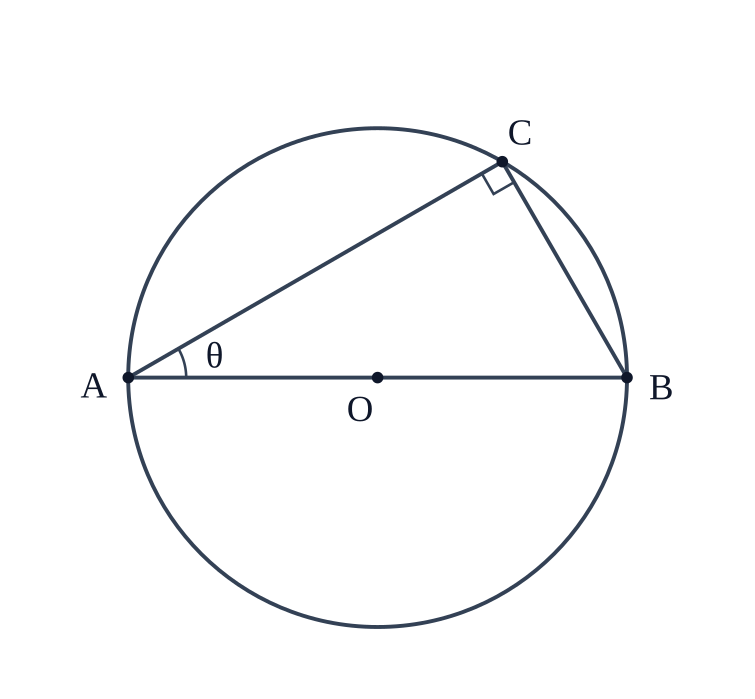
    AB is a diameter of a circle and C is any point on the circle. Show that the area of ΔABC\displaystyle \Delta \mathrm{ABC} is maximum, when it is isosceles.

    Not cross-checked

    NCERT prints no numerical answer for this exercise, so this working has not been cross-checked against the book.

    Let \(\displaystyle r\) be the radius, so \(\displaystyle AB=2r\), and \(\displaystyle \theta=\angle CAB\). NCERT_Solution_Class12_Maths_Exemplar_Ch6_Ex6-3_Q32 \[\angle ACB=90^\circ \quad\text{(angle in a semicircle)} \] \[AC=2r\cos\theta,\qquad BC=2r\sin\theta \] \[S=\tfrac12\,AC\cdot BC=2r^2\sin\theta\cos\theta=r^2\sin2\theta \] \[\frac{dS}{d\theta}=2r^2\cos2\theta=0 \;\Rightarrow\; \theta=\frac{\pi}{4} \] \[\frac{d^2S}{d\theta^2}=-4r^2\sin2\theta=-4r^2<0 \quad\text{(maximum)} \] \[AC=2r\cos\frac{\pi}{4}=\sqrt2\,r,\qquad BC=2r\sin\frac{\pi}{4}=\sqrt2\,r \] \[AC=BC \] Answer: the area is maximum when \(\displaystyle AC=BC\), that is, when \(\displaystyle \Delta ABC\) is isosceles.
  3. Exercise 33

    A metal box with a square base and vertical sides is to contain 1024 cm3\displaystyle 1024 \mathrm{~cm}^3. The material for the top and bottom costs Rs 5/cm2\displaystyle 5 / \mathrm{cm}^2 and the material for the sides costs Rs 2.50/cm2\displaystyle 2.50 / \mathrm{cm}^2. Find the least cost of the box.

    Matches the book, not yet reviewed

    This working reaches the answer NCERT prints. It has not yet been read through by hand.

    NCERT’s answer
    Rs $\displaystyle 1920$
    Let the base side be \(\displaystyle x\) cm and the height \(\displaystyle h\) cm.\[x^2 h = 1024 \Rightarrow h = \frac{1024}{x^2} \]\[C = 2x^2(5) + 4xh(2.5) = 10x^2 + 10xh \]\[C = 10x^2 + \frac{10240}{x} \]\[\frac{dC}{dx} = 20x - \frac{10240}{x^2} = 0 \Rightarrow x^3 = 512 \Rightarrow x = 8 \]\[\frac{d^2C}{dx^2} = 20 + \frac{20480}{x^3} > 0 \quad \text{(minimum at } x = 8) \]\[h = \frac{1024}{64} = 16 \]\[C_{\min} = 10(64) + \frac{10240}{8} = 640 + 1280 = 1920 \]Answer: Least cost = Rs \(\displaystyle 1920\) (base \(\displaystyle 8\) cm, height \(\displaystyle 16\) cm).
  4. Exercise 34

    The sum of the surface areas of a rectangular parallelopiped with sides x,2x\displaystyle x, 2 x and x3\displaystyle \frac{x}{3} and a sphere is given to be constant. Prove that the sum of their volumes is minimum, if x\displaystyle x is equal to three times the radius of the sphere. Also find the minimum value of the sum of their volumes.

    Matches the book, not yet reviewed

    This working reaches the answer NCERT prints. It has not yet been read through by hand.

    NCERT’s answer
    \(\displaystyle \frac{2}{3}x^3\left(1+\frac{2\pi}{27}\right)\)
    Let the sphere have radius \(\displaystyle r\).\[\text{Cuboid surface} = 2\left(x\cdot 2x + 2x\cdot\frac{x}{3} + \frac{x}{3}\cdot x\right) = 6x^2 \]\[S = 6x^2 + 4\pi r^2 = \text{constant} \]\[V = x\cdot 2x\cdot\frac{x}{3} + \frac{4}{3}\pi r^3 = \frac{2}{3}x^3 + \frac{4}{3}\pi r^3 \]Differentiate \(\displaystyle S\) with respect to \(\displaystyle x\):\[12x + 8\pi r\,\frac{dr}{dx} = 0 \Rightarrow \frac{dr}{dx} = -\frac{3x}{2\pi r} \]\[\frac{dV}{dx} = 2x^2 + 4\pi r^2\,\frac{dr}{dx} = 2x^2 - 6xr = 2x(x - 3r) \]\[\frac{dV}{dx} = 0 \Rightarrow x = 3r \]\[\frac{d^2V}{dx^2} = 4x - 6r - 6x\,\frac{dr}{dx} = 4x - 6r + \frac{9x^2}{\pi r} \]\[\left.\frac{d^2V}{dx^2}\right|_{x=3r} = 6r + \frac{81r}{\pi} > 0 \]So \(\displaystyle V\) is minimum when \(\displaystyle x = 3r\).\[V_{\min} = \frac{2}{3}(3r)^3 + \frac{4}{3}\pi r^3 = 18r^3 + \frac{4}{3}\pi r^3 = \frac{2}{3}(27 + 2\pi)r^3 \]\[S = 54r^2 + 4\pi r^2 \Rightarrow V_{\min} = \frac{rS}{3} \]Answer: \(\displaystyle x = 3r\) gives the minimum, \(\displaystyle V_{\min} = \dfrac{2}{3}(27 + 2\pi)r^3\).
  5. Choose the correct answer from the given four options in each of the following questions $\displaystyle 35$ to $\displaystyle 39$:

    Exercise 35

    The sides of an equilateral triangle are increasing at the rate of 2\displaystyle 2 cm/sec. The rate at which the area increases, when side is 10\displaystyle 10 cm is:
    (A)
    10 cm2/s\displaystyle 10 \mathrm{~cm}^2 / \mathrm{s}
    (B)
    3 cm2/s\displaystyle \sqrt{3} \mathrm{~cm}^2 / \mathrm{s}
    (C)
    103 cm2/s\displaystyle 10 \sqrt{3} \mathrm{~cm}^2 / \mathrm{s}
    (D)
    103 cm2/s\displaystyle \frac{10}{3} \mathrm{~cm}^2 / \mathrm{s}

    Matches the book, not yet reviewed

    This working reaches the answer NCERT prints. It has not yet been read through by hand.

    NCERT’s answer
    C
    (C) \(\displaystyle 10\sqrt{3}\ \text{cm}^2/\text{s}\)\[A = \frac{\sqrt{3}}{4}s^2 \]\[\frac{dA}{dt} = \frac{\sqrt{3}}{2}\,s\,\frac{ds}{dt} \]\[\left.\frac{dA}{dt}\right|_{s=10} = \frac{\sqrt{3}}{2}(10)(2) = 10\sqrt{3} \]
  6. Exercise 36

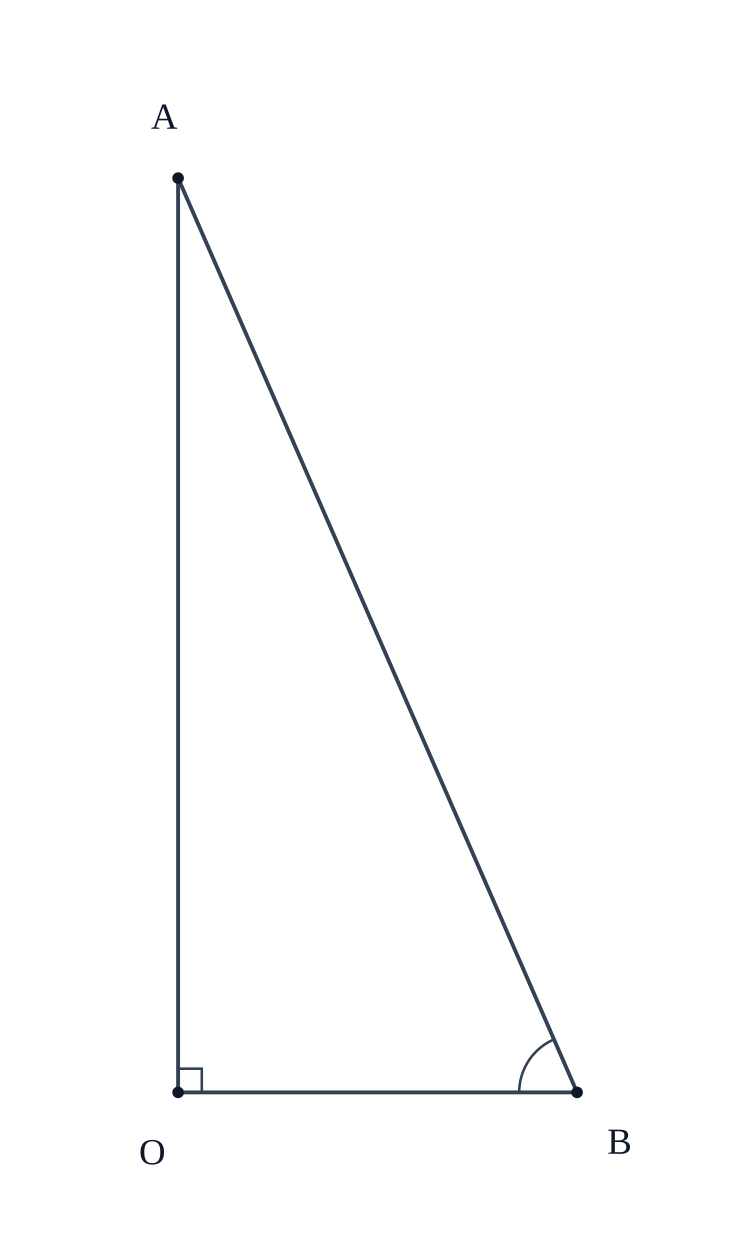
    A ladder, 5\displaystyle 5 meter long, standing on a horizontal floor, leans against a vertical wall. If the top of the ladder slides downwards at the rate of 10 cm/sec\displaystyle 10 \mathrm{~cm} / \mathrm{sec}, then the rate at which the angle between the floor and the ladder is decreasing when lower end of ladder is 2\displaystyle 2 metres from the wall is:
    (A)
    110radian/sec\displaystyle \frac{1}{10} \mathrm{radian} / \mathrm{sec}
    (B)
    120radian/sec\displaystyle \frac{1}{20} \mathrm{radian} / \mathrm{sec}
    (C)
    20\displaystyle 20 radian/sec
    (D)
    10\displaystyle 10 radian/sec

    Matches the book, not yet reviewed

    This working reaches the answer NCERT prints. It has not yet been read through by hand.

    NCERT’s answer
    B
    (B) \(\displaystyle \dfrac{1}{20}\) radian/secLet \(\displaystyle \angle ABO = \theta\) and \(\displaystyle OA = y\) m.NCERT_Solution_Class12_Maths_Exemplar_Ch6_Ex6-3_Q36\[y = 5\sin\theta \]\[\frac{dy}{dt} = 5\cos\theta\,\frac{d\theta}{dt} \]\[\frac{dy}{dt} = -10\ \text{cm/s} = -0.1\ \text{m/s}, \qquad \cos\theta = \frac{OB}{AB} = \frac{2}{5} \]\[-0.1 = 5\cdot\frac{2}{5}\,\frac{d\theta}{dt} \Rightarrow \frac{d\theta}{dt} = -\frac{1}{20} \]\(\displaystyle \theta\) decreases at \(\displaystyle \frac{1}{20}\) radian/sec.
  7. Exercise 37

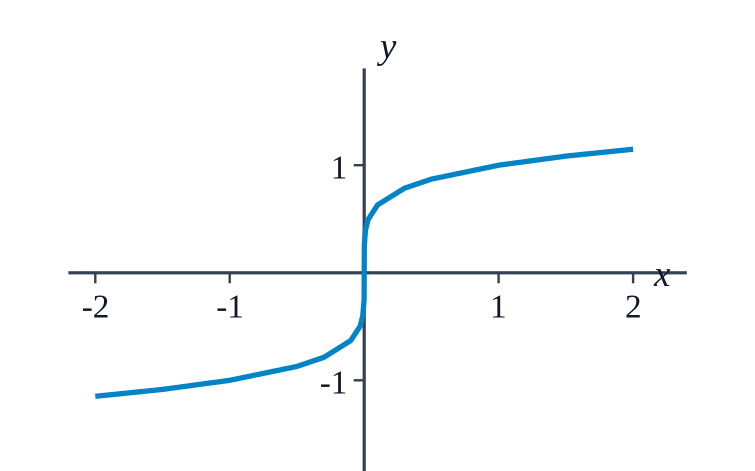
    The curve y=x15\displaystyle y=x^{\frac{1}{5}} has at (0,0)\displaystyle (0,0)
    (A)
    a vertical tangent (parallel to y\displaystyle y-axis)
    (B)
    a horizontal tangent (parallel to x\displaystyle x-axis)
    (C)
    an oblique tangent
    (D)
    no tangent

    Matches the book, not yet reviewed

    This working reaches the answer NCERT prints. It has not yet been read through by hand.

    NCERT’s answer
    A
    (A) a vertical tangentNCERT_Solution_Class12_Maths_Exemplar_Ch6_Ex6-3_Q37\[\frac{dy}{dx} = \frac{1}{5}x^{-4/5} \to \infty \quad (x \to 0) \]\[x = y^5 \Rightarrow \frac{dx}{dy} = 5y^4 = 0 \quad \text{at } (0,0) \]The tangent at the origin is the \(\displaystyle y\)-axis.
  8. Exercise 38

    The equation of normal to the curve 3x2−y2=8\displaystyle 3 x^2-y^2=8 which is parallel to the line x+3y=8\displaystyle x+3 y=8 is
    (A)
    3x−y=8\displaystyle 3 x-y=8
    (B)
    3x+y+8=0\displaystyle 3 x+y+8=0
    (C)
    x+3y±8=0\displaystyle x+3 y \pm 8=0
    (D)
    x+3y=0\displaystyle x+3 y=0

    Matches the book, not yet reviewed

    This working reaches the answer NCERT prints. It has not yet been read through by hand.

    NCERT’s answer
    C
    (C) \(\displaystyle x + 3y \pm 8 = 0\)\[3x^2 - y^2 = 8 \Rightarrow \frac{dy}{dx} = \frac{3x}{y} \]\[-\frac{y}{3x} = -\frac{1}{3} \quad \text{(slope of } x + 3y = 8) \Rightarrow y = x \]\[3x^2 - x^2 = 8 \Rightarrow x = \pm 2 \Rightarrow (2,2),\ (-2,-2) \]\[y - 2 = -\frac{1}{3}(x - 2) \Rightarrow x + 3y - 8 = 0 \]\[y + 2 = -\frac{1}{3}(x + 2) \Rightarrow x + 3y + 8 = 0 \]
  9. Exercise 39

    If the curve ay+x2=7\displaystyle a y+x^2=7 and x3=y\displaystyle x^3=y, cut orthogonally at (1,1)\displaystyle (1,1), then the value of a\displaystyle a is:
    (A)
    1\displaystyle 1 (B) 0\displaystyle 0 (C) −6\displaystyle -6 (D) .6

    Matches the book, not yet reviewed

    This working reaches the answer NCERT prints. It has not yet been read through by hand.

    NCERT’s answer
    D
    (D) \(\displaystyle a = 6\)\[m_1 = \frac{dy}{dx}\bigg|_{(1,1)} = -\frac{2x}{a} = -\frac{2}{a} \]\[m_2 = \frac{d(x^3)}{dx}\bigg|_{(1,1)} = 3x^2 = 3 \]\[m_1 m_2 = -1 \Rightarrow -\frac{6}{a} = -1 \Rightarrow a = 6 \]\[\text{Check: } (1,1) \text{ on } ay + x^2 = 7 \Rightarrow a + 1 = 7 \Rightarrow a = 6 \]
  10. Exercise 40

    If y=x4−10\displaystyle y=x^4-10 and if x\displaystyle x changes from 2\displaystyle 2 to 1.99\displaystyle 1.99, what is the change in y\displaystyle y
    (A)
    .32
    (B)
    .032
    (C)
    5.68\displaystyle 68
    (D)
    5.968\displaystyle 968

    Matches the book, not yet reviewed

    This working reaches the answer NCERT prints. It has not yet been read through by hand.

    NCERT’s answer
    A
    (A) \(\displaystyle y\) falls by about \(\displaystyle 0.32\).\[y = x^4 - 10 \Rightarrow dy = 4x^3\,dx \]\[x = 2,\quad dx = 1.99 - 2 = -0.01 \]\[dy = 4(2)^3(-0.01) = -0.32 \]\[\text{Check: } 1.99^4 - 2^4 = 15.6824 - 16 = -0.3176 \]