SolveIt is under development
SolveItNCERT · CBSE · NEET

NCERT Exemplar · Class 12 Mathematics Application of Derivatives

64 questions · 64 still being checked

EXERCISE 6.3 1–10 (part 1 of 7)

  1. Exercise 1

    A spherical ball of salt is dissolving in water in such a manner that the rate of decrease of the volume at any instant is propotional to the surface. Prove that the radius is decreasing at a constant rate.

    Not cross-checked

    NCERT prints no numerical answer for this exercise, so this working has not been cross-checked against the book.

    Let \(\displaystyle r\) be the radius and \(\displaystyle k>0\) the constant of proportionality.\[V = \tfrac43\pi r^3, \qquad S = 4\pi r^2 \]\[-\frac{dV}{dt} = kS = 4\pi k r^2 \quad \text{(given)} \]\[\frac{dV}{dt} = 4\pi r^2\,\frac{dr}{dt} \]\[4\pi r^2\,\frac{dr}{dt} = -4\pi k r^2 \]\[\frac{dr}{dt} = -k \]Answer: \(\displaystyle \dfrac{dr}{dt} = -k\), a constant, so the radius decreases at a constant rate.
  2. Exercise 2

    If the area of a circle increases at a uniform rate, then prove that perimeter varies inversely as the radius.

    Not cross-checked

    NCERT prints no numerical answer for this exercise, so this working has not been cross-checked against the book.

    Let \(\displaystyle r\) be the radius, \(\displaystyle A\) the area, \(\displaystyle P\) the perimeter, and \(\displaystyle \dfrac{dA}{dt} = c\) a constant.\[A = \pi r^2 \]\[\frac{dA}{dt} = 2\pi r\,\frac{dr}{dt} = c \]\[\frac{dr}{dt} = \frac{c}{2\pi r} \]\[P = 2\pi r \;\Rightarrow\; \frac{dP}{dt} = 2\pi\,\frac{dr}{dt} \]\[\frac{dP}{dt} = 2\pi\cdot\frac{c}{2\pi r} = \frac{c}{r} \]Answer: \(\displaystyle \dfrac{dP}{dt} = \dfrac{c}{r}\), so the rate at which the perimeter changes varies inversely as the radius.
  3. Exercise 3

    A kite is moving horizontally at a height of 151.5\displaystyle 151.5 meters. If the speed of kite is 10 m/s\displaystyle 10 \mathrm{~m} / \mathrm{s}, how fast is the string being let out; when the kite is 250\displaystyle 250 m away from the boy who is flying the kite? The height of boy is 1.5\displaystyle 1.5 m.

    Matches the book, not yet reviewed

    This working reaches the answer NCERT prints. It has not yet been read through by hand.

    NCERT’s answer
    $\displaystyle 8$ m/s
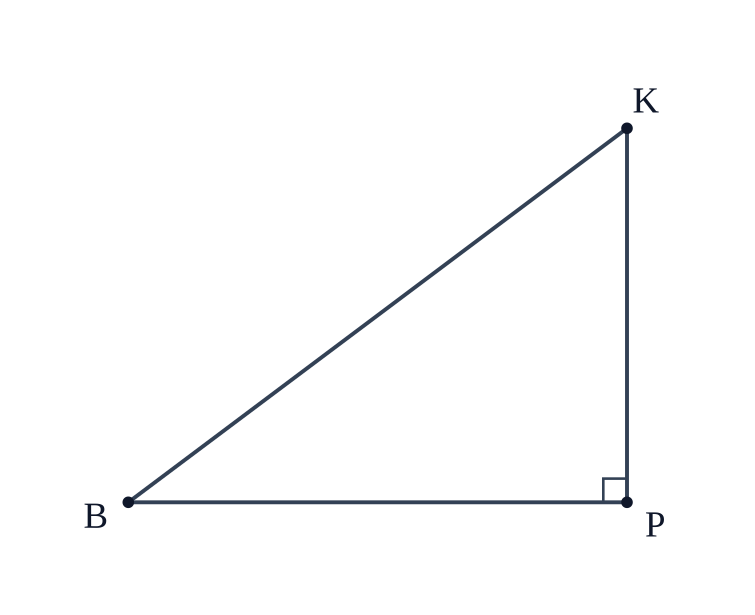
    Take the string to start at the top of the boy, point \(\displaystyle B\); \(\displaystyle K\) is the kite and \(\displaystyle P\) the point of \(\displaystyle B\)'s level directly below it.\[KP = 151.5 - 1.5 = 150 \text{ m} \]NCERT_Solution_Class12_Maths_Exemplar_Ch6_Ex6-3_Q3Let \(\displaystyle BP = x\), \(\displaystyle BK = l\).\[l^2 = x^2 + 150^2 \quad \text{(Pythagoras)} \]\[2l\,\frac{dl}{dt} = 2x\,\frac{dx}{dt} \]For \(\displaystyle l = 250\):\[x = \sqrt{250^2 - 150^2} = 200 \]\[\frac{dl}{dt} = \frac{x}{l}\cdot\frac{dx}{dt} = \frac{200}{250}\times 10 = 8 \]Answer: The string is let out at \(\displaystyle 8\) m/s.
  4. Exercise 4

    Two men A and B start with velocities v\displaystyle v at the same time from the junction of two roads inclined at 45\displaystyle 45° to each other. If they travel by different roads, find the rate at which they are being seperated..

    Matches the book, not yet reviewed

    This working reaches the answer NCERT prints. It has not yet been read through by hand.

    NCERT’s answer
    \(\displaystyle (\sqrt{2-\sqrt{2}}) v\) unit/sec.
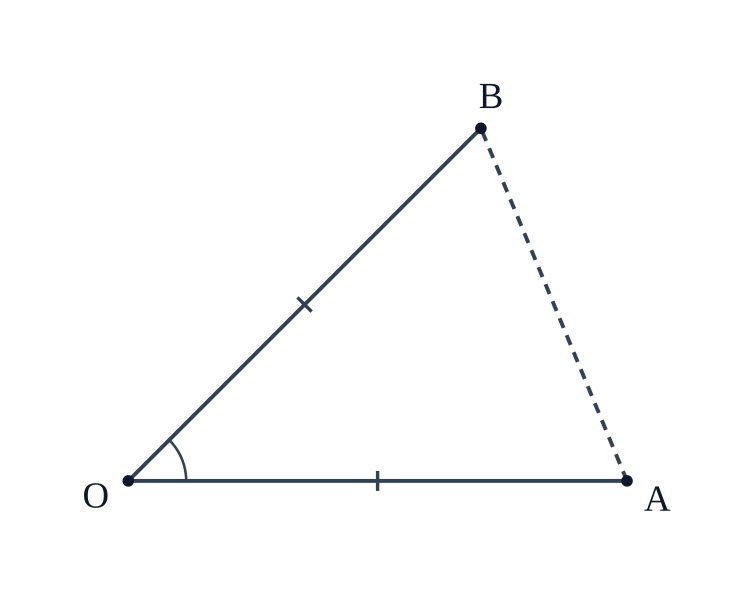
    Let \(\displaystyle O\) be the junction. After time \(\displaystyle t\) the men are at \(\displaystyle A\) and \(\displaystyle B\).\[OA = OB = vt, \qquad \angle AOB = 45^\circ \]NCERT_Solution_Class12_Maths_Exemplar_Ch6_Ex6-3_Q4\[AB^2 = OA^2 + OB^2 - 2\,OA\cdot OB\cos 45^\circ \quad \text{(cosine rule)} \]\[AB^2 = 2v^2t^2 - \sqrt2\,v^2t^2 = (2-\sqrt2)\,v^2t^2 \]\[AB = vt\sqrt{2-\sqrt2} \]\[\frac{d(AB)}{dt} = v\sqrt{2-\sqrt2} \]Answer: They separate at the rate \(\displaystyle v\sqrt{2-\sqrt2}\) (about \(\displaystyle 0.77v\)).
  5. Exercise 5

    Find an angle θ,0<θ<π2\displaystyle \theta, 0<\theta<\frac{\pi}{2}, which increases twice as fast as its sine.

    Matches the book, not yet reviewed

    This working reaches the answer NCERT prints. It has not yet been read through by hand.

    NCERT’s answer
    \(\displaystyle \theta=\frac{\pi}{3}\)
    \[\frac{d\theta}{dt} = 2\,\frac{d}{dt}(\sin\theta) \quad \text{(given)} \]\[\frac{d\theta}{dt} = 2\cos\theta\,\frac{d\theta}{dt} \]Since \(\displaystyle \theta\) is increasing, \(\displaystyle \dfrac{d\theta}{dt}\neq 0\):\[1 = 2\cos\theta \;\Rightarrow\; \cos\theta = \frac12 \]\[\theta = \frac{\pi}{3} \quad \left(0<\theta<\frac{\pi}{2}\right) \]Answer: \(\displaystyle \theta = \dfrac{\pi}{3}\)
  6. Exercise 6

    Find the approximate value of (1.999)5\displaystyle (1.999)^5.

    Matches the book, not yet reviewed

    This working reaches the answer NCERT prints. It has not yet been read through by hand.

    NCERT’s answer
    31.$\displaystyle 92$
    Take \(\displaystyle f(x) = x^5\) with \(\displaystyle x = 2\), \(\displaystyle \Delta x = 1.999 - 2 = -0.001\).\[f'(x) = 5x^4 = 5\cdot 2^4 = 80 \]\[\Delta y \approx f'(x)\,\Delta x = 80\times(-0.001) = -0.08 \]\[(1.999)^5 = f(2) + \Delta y \approx 32 - 0.08 = 31.92 \]Answer: \(\displaystyle (1.999)^5 \approx 31.92\)
  7. Exercise 7

    Find the approximate volume of metal in a hollow spherical shell whose internal and external radii are 3\displaystyle 3 cm and 3.0005\displaystyle 3.0005 cm, respectively.

    Matches the book, not yet reviewed

    This working reaches the answer NCERT prints. It has not yet been read through by hand.

    NCERT’s answer
    \(\displaystyle 0.018 \pi \mathrm{cm}^3\)
    \[V = \tfrac43\pi r^3 \;\Rightarrow\; dV = 4\pi r^2\,dr \]\[r = 3, \qquad dr = 3.0005 - 3 = 0.0005 \]Volume of metal \(\displaystyle = V(3.0005) - V(3) \approx dV\):\[dV = 4\pi(3)^2(0.0005) = 0.018\pi \]\[0.018\pi \approx 0.0565 \]Answer: Volume of metal \(\displaystyle \approx 0.018\pi \approx 0.057\ \text{cm}^3\).
  8. Exercise 8

    A man, 2m tall, walks at the rate of 123 m/s\displaystyle 1 \frac{2}{3} \mathrm{~m} / \mathrm{s} towards a street light which is 513 m\displaystyle 5 \frac{1}{3} \mathrm{~m} above the ground. At what rate is the tip of his shadow moving? At what rate is the length of the shadow changing when he is 313 m\displaystyle 3 \frac{1}{3} \mathrm{~m} from the base of the light?

    Matches the book, not yet reviewed

    This working reaches the answer NCERT prints. It has not yet been read through by hand.

    NCERT’s answer
    \(\displaystyle 2 \frac{2}{3} \mathrm{~m} / \mathrm{s}\) towards light, \(\displaystyle -1 \mathrm{~m} / \mathrm{s}\)
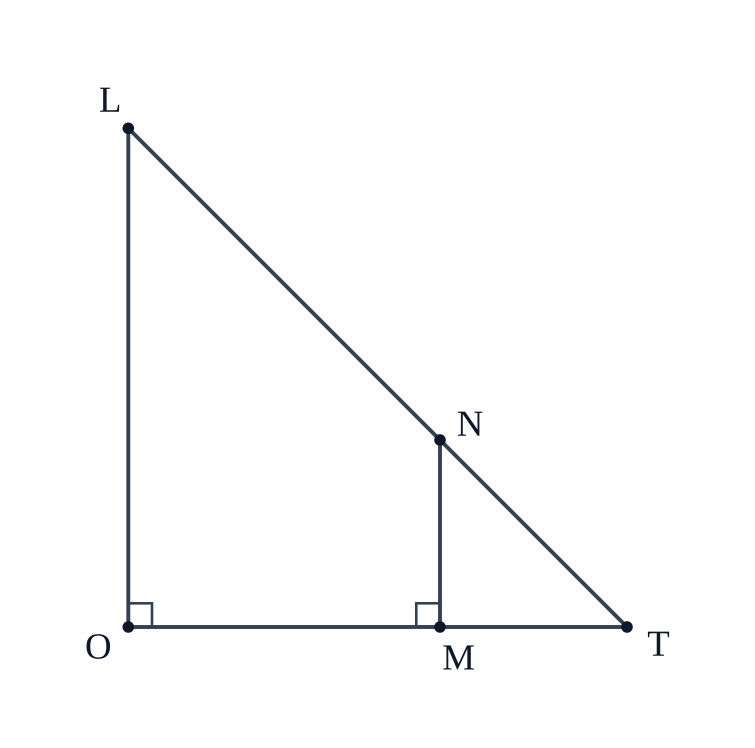
    Let \(\displaystyle OL\) be the lamp-post, \(\displaystyle MN\) the man, \(\displaystyle T\) the tip of the shadow. Put \(\displaystyle OM = x\), \(\displaystyle MT = s\), \(\displaystyle OT = y = x+s\).\[OL = \tfrac{16}{3}, \qquad MN = 2, \qquad \frac{dx}{dt} = -\frac53 \]NCERT_Solution_Class12_Maths_Exemplar_Ch6_Ex6-3_Q8\[\triangle TMN \sim \triangle TOL \;\Rightarrow\; \frac{s}{x+s} = \frac{MN}{OL} = \frac{2}{16/3} = \frac38 \]\[8s = 3x + 3s \;\Rightarrow\; s = \frac35\,x, \qquad y = \frac85\,x \]\[\frac{dy}{dt} = \frac85\cdot\left(-\frac53\right) = -\frac83 \]\[\frac{ds}{dt} = \frac35\cdot\left(-\frac53\right) = -1 \]Answer: The tip moves towards the lamp at \(\displaystyle \dfrac83\) m/s; the shadow shortens at \(\displaystyle 1\) m/s, at \(\displaystyle x = \dfrac{10}{3}\) m as at any other position.
  9. Exercise 9

    A swimming pool is to be drained for cleaning. If L represents the number of litres of water in the pool t\displaystyle t seconds after the pool has been plugged off to drain and L=200(10−t)2\displaystyle \mathrm{L}=200(10-t)^2. How fast is the water running out at the end of 5\displaystyle 5 seconds? What is the average rate at which the water flows out during the first 5\displaystyle 5 seconds?

    Matches the book, not yet reviewed

    This working reaches the answer NCERT prints. It has not yet been read through by hand.

    NCERT’s answer
    $\displaystyle 2000$ litres/s, $\displaystyle 3000$ litre/s
    \[L = 200(10-t)^2 \]\[\frac{dL}{dt} = -400(10-t) \]\[\left.\frac{dL}{dt}\right|_{t=5} = -400(10-5) = -2000 \]The negative sign means the pool is emptying.\[L(0) = 200(10)^2 = 20000, \qquad L(5) = 200(5)^2 = 5000 \]\[\text{average rate} = \frac{L(5)-L(0)}{5-0} = \frac{5000-20000}{5} = -3000 \]Answer: at \(\displaystyle t=5\) s the water runs out at \(\displaystyle 2000\) litres/s; during the first $\displaystyle 5$ s it averages \(\displaystyle 3000\) litres/s.
  10. Exercise 10

    The volume of a cube increases at a constant rate. Prove that the increase in its surface area varies inversely as the length of the side.

    Not cross-checked

    NCERT prints no numerical answer for this exercise, so this working has not been cross-checked against the book.

    Let the side be \(\displaystyle x\) and the constant rate of volume increase be \(\displaystyle k\).\[V = x^3 \;\Rightarrow\; \frac{dV}{dt} = 3x^2\frac{dx}{dt} = k \]\[\frac{dx}{dt} = \frac{k}{3x^2} \]\[S = 6x^2 \;\Rightarrow\; \frac{dS}{dt} = 12x\,\frac{dx}{dt} \]\[\frac{dS}{dt} = 12x\cdot\frac{k}{3x^2} = \frac{4k}{x} \]Answer: \(\displaystyle \dfrac{dS}{dt} = \dfrac{4k}{x}\) with \(\displaystyle 4k\) constant, so the increase in surface area varies inversely as the side.