SolveIt is under development
SolveItNCERT · CBSE · NEET

NCERT Exemplar · Class 12 Mathematics Application of Derivatives

64 questions · 64 still being checked

EXERCISE 6.3 11–20 (part 2 of 7)

  1. Exercise 11

    x\displaystyle x and y\displaystyle y are the sides of two squares such that y=x−x2\displaystyle y=x-x^2. Find the rate of change of the area of second square with respect to the area of first square.

    Check this one against your book

    NCERT’s printed answer for this exercise does not match its own question. This working follows the question as printed.

    \[A_1 = x^2 \;\Rightarrow\; \frac{dA_1}{dx} = 2x \]\[A_2 = y^2 = (x-x^2)^2 \;\Rightarrow\; \frac{dA_2}{dx} = 2(x-x^2)(1-2x) \]\[\frac{dA_2}{dA_1} = \frac{dA_2/dx}{dA_1/dx} = \frac{2x(1-x)(1-2x)}{2x} \]\[\frac{dA_2}{dA_1} = (1-x)(1-2x) \]Answer: \(\displaystyle (1-x)(1-2x) = 2x^2-3x+1\)
  2. Exercise 12

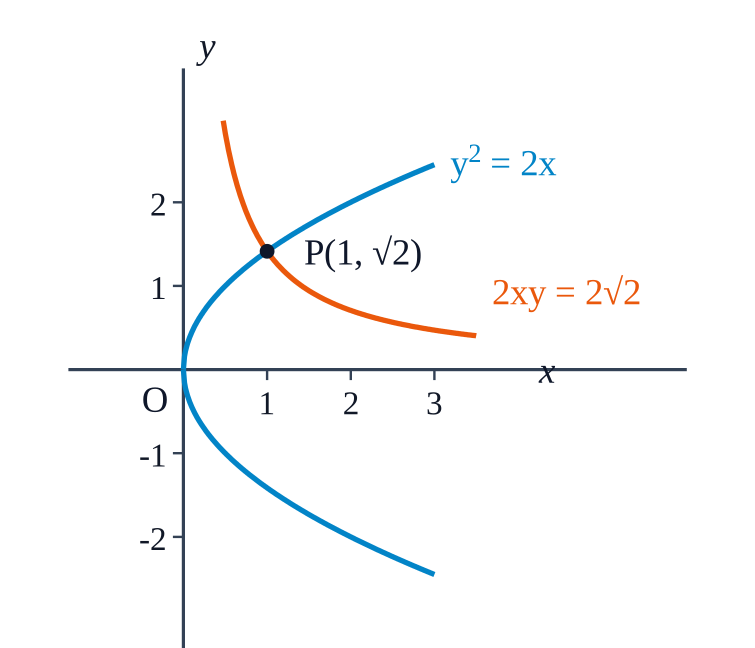
    Find the condition that the curves 2x=y2\displaystyle 2 x=y^2 and 2xy=k\displaystyle 2 x y=k intersect orthogonally.

    Matches the book, not yet reviewed

    This working reaches the answer NCERT prints. It has not yet been read through by hand.

    NCERT’s answer
    \(\displaystyle k^2=8\)
    Slopes at a common point \(\displaystyle (x,y)\):\[2x = y^2 \;\Rightarrow\; 2 = 2y\frac{dy}{dx} \;\Rightarrow\; m_1 = \frac{1}{y} \]\[2xy = k \;\Rightarrow\; 2y + 2x\frac{dy}{dx} = 0 \;\Rightarrow\; m_2 = -\frac{y}{x} \]Orthogonal means \(\displaystyle m_1m_2=-1\):\[\frac{1}{y}\cdot\left(-\frac{y}{x}\right) = -1 \;\Rightarrow\; x = 1 \]\[y^2 = 2x = 2, \qquad k = 2xy = 2y \]\[k^2 = 4y^2 = 8 \]NCERT_Solution_Class12_Maths_Exemplar_Ch6_Ex6-3_Q12Answer: \(\displaystyle k^2 = 8\), i.e. \(\displaystyle k=\pm 2\sqrt2\)
  3. Exercise 13

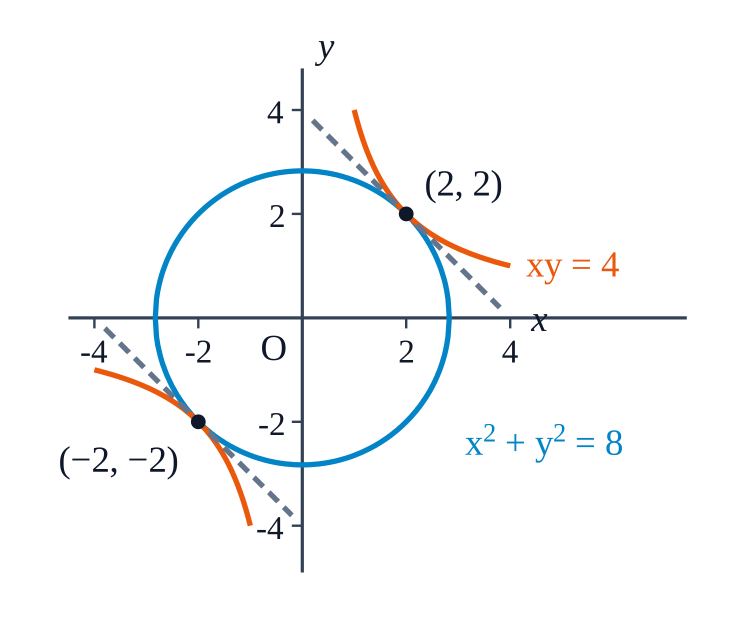
    Prove that the curves xy=4\displaystyle x y=4 and x2+y2=8\displaystyle x^2+y^2=8 touch each other.

    Not cross-checked

    NCERT prints no numerical answer for this exercise, so this working has not been cross-checked against the book.

    Common points:\[(x-y)^2 = (x^2+y^2) - 2xy = 8 - 8 = 0 \;\Rightarrow\; y = x \]\[xy = 4 \;\Rightarrow\; x^2 = 4 \;\Rightarrow\; (2,2),\ (-2,-2) \]Slopes:\[xy = 4 \;\Rightarrow\; y + x\frac{dy}{dx} = 0 \;\Rightarrow\; m_1 = -\frac{y}{x} \]\[x^2+y^2 = 8 \;\Rightarrow\; 2x + 2y\frac{dy}{dx} = 0 \;\Rightarrow\; m_2 = -\frac{x}{y} \]\[\text{at } (2,2) \text{ and } (-2,-2): \quad m_1 = m_2 = -1 \]NCERT_Solution_Class12_Maths_Exemplar_Ch6_Ex6-3_Q13Answer: the curves meet at \(\displaystyle (2,2)\) and \(\displaystyle (-2,-2)\) with the same tangent slope \(\displaystyle -1\), so they touch each other.
  4. Exercise 14

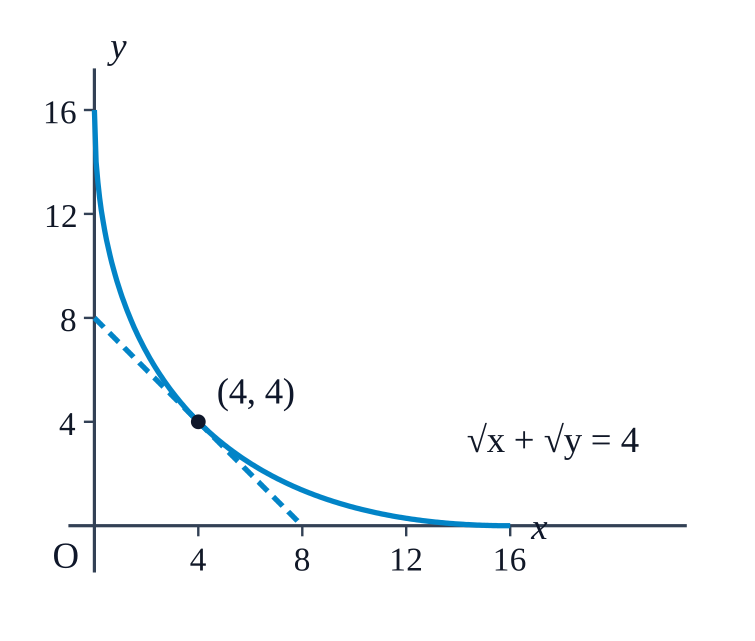
    Find the co-ordinates of the point on the curve x+y=4\displaystyle \sqrt{x}+\sqrt{y}=4 at which tangent is equally inclined to the axes.

    Matches the book, not yet reviewed

    This working reaches the answer NCERT prints. It has not yet been read through by hand.

    NCERT’s answer
    $\displaystyle (4, 4)$
    \[\sqrt x + \sqrt y = 4 \]\[\frac{1}{2\sqrt x} + \frac{1}{2\sqrt y}\frac{dy}{dx} = 0 \;\Rightarrow\; \frac{dy}{dx} = -\frac{\sqrt y}{\sqrt x} \]Equally inclined to the axes means slope \(\displaystyle \pm1\); \(\displaystyle -\sqrt y/\sqrt x\) is never positive, so slope \(\displaystyle =-1\).\[\frac{\sqrt y}{\sqrt x} = 1 \;\Rightarrow\; y = x \]\[\sqrt x + \sqrt x = 4 \;\Rightarrow\; x = 4, \quad y = 4 \]NCERT_Solution_Class12_Maths_Exemplar_Ch6_Ex6-3_Q14Answer: \(\displaystyle (4,\,4)\)
  5. Exercise 15

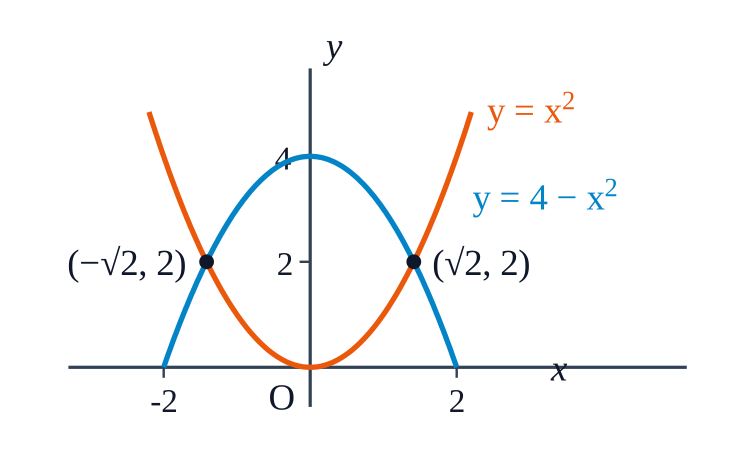
    Find the angle of intersection of the curves y=4−x2\displaystyle y=4-x^2 and y=x2\displaystyle y=x^2.

    Matches the book, not yet reviewed

    This working reaches the answer NCERT prints. It has not yet been read through by hand.

    NCERT’s answer
    \(\displaystyle \tan ^{-1}\left(\frac{4 \sqrt{2}}{7}\right)\)
    Intersection:\[4 - x^2 = x^2 \;\Rightarrow\; x = \pm\sqrt2, \quad y = 2 \]Slopes at \(\displaystyle x=\sqrt2\):\[m_1 = \frac{d}{dx}(4-x^2) = -2x = -2\sqrt2 \]\[m_2 = \frac{d}{dx}(x^2) = 2x = 2\sqrt2 \]\[\tan\theta = \left|\frac{m_1-m_2}{1+m_1m_2}\right| = \left|\frac{-4\sqrt2}{1-8}\right| = \frac{4\sqrt2}{7} \]At \(\displaystyle x=-\sqrt2\) the slopes only swap signs, so \(\displaystyle \tan\theta\) is the same.NCERT_Solution_Class12_Maths_Exemplar_Ch6_Ex6-3_Q15Answer: \(\displaystyle \theta = \tan^{-1}\dfrac{4\sqrt2}{7}\)
  6. Exercise 16

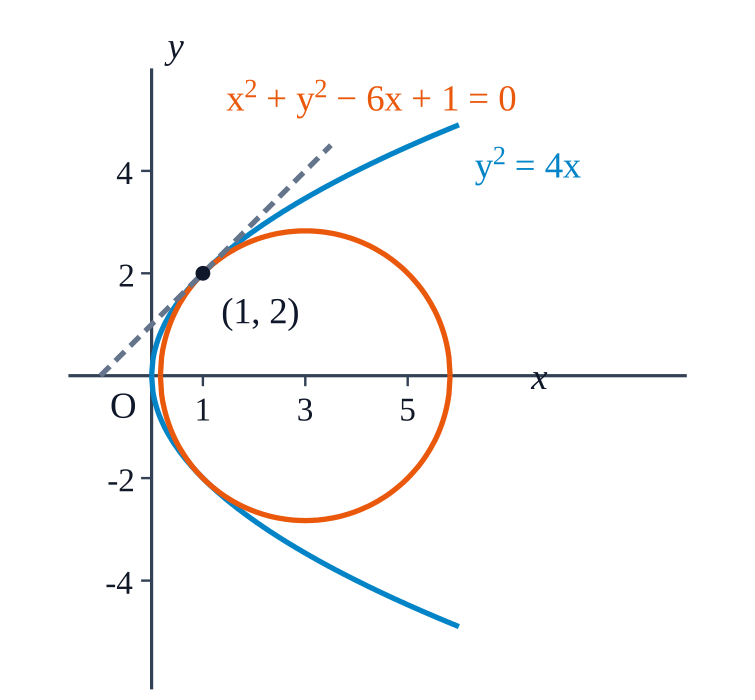
    Prove that the curves y2=4x\displaystyle y^2=4 x and x2+y2−6x+1=0\displaystyle x^2+y^2-6 x+1=0 touch each other at the point (1,2)\displaystyle (1, 2).

    Not cross-checked

    NCERT prints no numerical answer for this exercise, so this working has not been cross-checked against the book.

    The point \(\displaystyle (1,2)\) lies on both curves:\[2^2 = 4\cdot 1 \quad \text{(on } y^2=4x\text{)} \]\[1^2 + 2^2 - 6(1) + 1 = 0 \quad \text{(on the circle)} \]Slopes at \(\displaystyle (1,2)\):\[y^2 = 4x \;\Rightarrow\; 2y\frac{dy}{dx} = 4 \;\Rightarrow\; m_1 = \frac{2}{y} = 1 \]\[2x + 2y\frac{dy}{dx} - 6 = 0 \;\Rightarrow\; m_2 = \frac{3-x}{y} = \frac{2}{2} = 1 \]NCERT_Solution_Class12_Maths_Exemplar_Ch6_Ex6-3_Q16Answer: \(\displaystyle (1,2)\) is common and the slopes are equal \(\displaystyle (m_1=m_2=1)\), so the curves touch at \(\displaystyle (1,2)\).
  7. Exercise 17

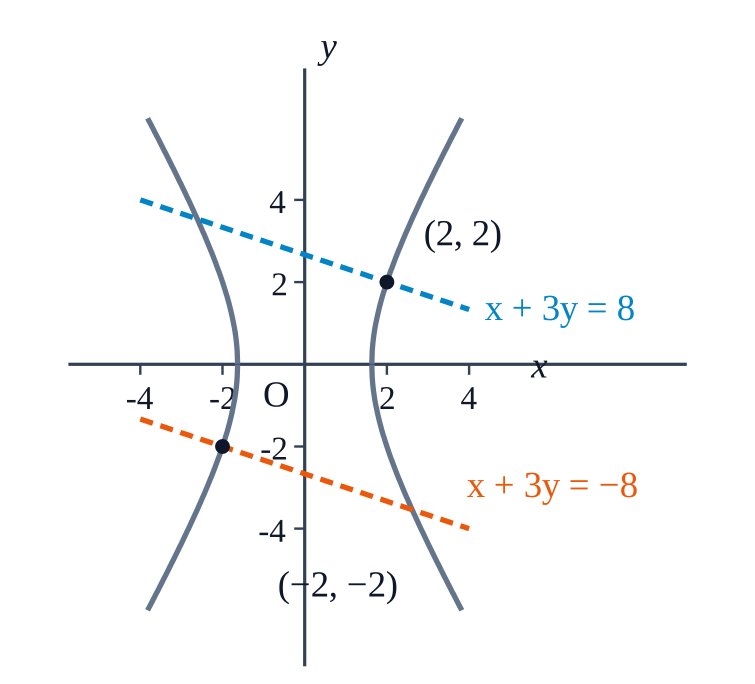
    Find the equation of the normal lines to the curve 3x2−y2=8\displaystyle 3 x^2-y^2=8 which are parallel to the line x+3y=4\displaystyle x+3 y=4.

    Matches the book, not yet reviewed

    This working reaches the answer NCERT prints. It has not yet been read through by hand.

    NCERT’s answer
    \(\displaystyle x+3 y= \pm 8\)
    A normal parallel to \(\displaystyle x+3y=4\) has slope \(\displaystyle -\tfrac13\), so the tangent there has slope \(\displaystyle 3\).\[3x^2-y^2=8 \;\Rightarrow\; 6x-2y\frac{dy}{dx}=0 \;\Rightarrow\; \frac{dy}{dx}=\frac{3x}{y} \]\[\frac{3x}{y}=3 \;\Rightarrow\; y=x \]\[3x^2-x^2=8 \;\Rightarrow\; x=\pm2 \;\Rightarrow\; (2,2),\ (-2,-2) \]Normals of slope \(\displaystyle -\tfrac13\) through these points:\[y-2=-\tfrac13(x-2) \;\Rightarrow\; x+3y=8 \]\[y+2=-\tfrac13(x+2) \;\Rightarrow\; x+3y=-8 \]NCERT_Solution_Class12_Maths_Exemplar_Ch6_Ex6-3_Q17Answer: \(\displaystyle x+3y=8\) and \(\displaystyle x+3y=-8\).
  8. Exercise 18

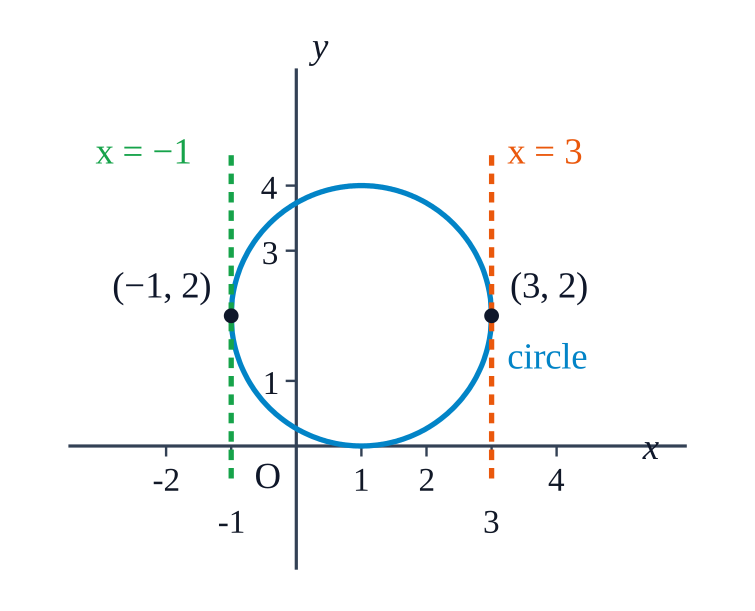
    At what points on the curve x2+y2−2x−4y+1=0\displaystyle x^2+y^2-2 x-4 y+1=0, the tangents are parallel to the y\displaystyle y-axis?

    Matches the book, not yet reviewed

    This working reaches the answer NCERT prints. It has not yet been read through by hand.

    NCERT’s answer
    $\displaystyle (3, 2)$, $\displaystyle (-1, 2)$
    A tangent parallel to the \(\displaystyle y\)-axis is vertical, so \(\displaystyle \dfrac{dy}{dx}\) is not defined.\[2x+2y\frac{dy}{dx}-2-4\frac{dy}{dx}=0 \;\Rightarrow\; \frac{dy}{dx}=\frac{1-x}{y-2} \]\[y-2=0 \;\Rightarrow\; y=2 \]\[x^2+4-2x-8+1=0 \;\Rightarrow\; x^2-2x-3=0 \;\Rightarrow\; (x-3)(x+1)=0 \]\[x=3 \ \text{or}\ x=-1 \]At both points the numerator is non-zero:\[1-x=-2 \ \text{or}\ 2 \neq 0 \]NCERT_Solution_Class12_Maths_Exemplar_Ch6_Ex6-3_Q18Answer: \(\displaystyle (3,2)\) and \(\displaystyle (-1,2)\).
  9. Exercise 19

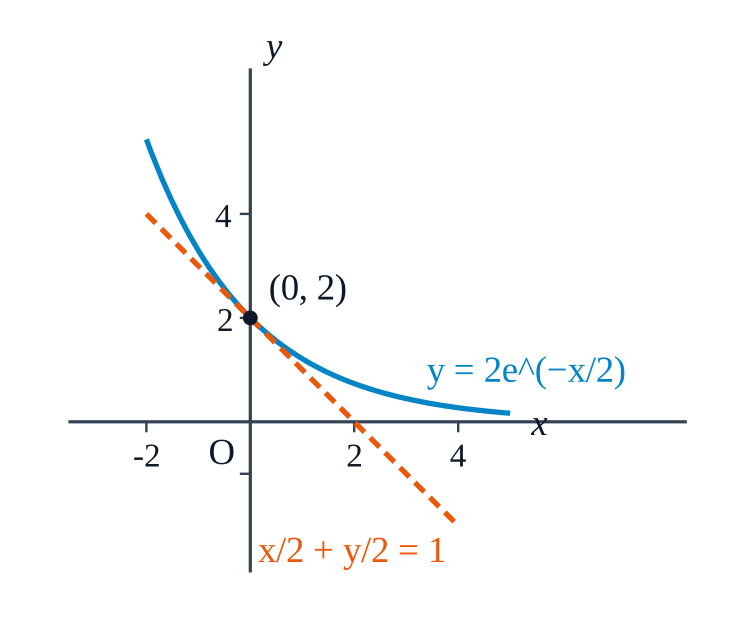
    Show that the line xa+yb=1\displaystyle \frac{x}{a}+\frac{y}{b}=1, touches the curve y=b⋅e−xa\displaystyle y=b \cdot e^{\frac{-x}{a}} at the point where the curve intersects the axis of y\displaystyle y.

    Not cross-checked

    NCERT prints no numerical answer for this exercise, so this working has not been cross-checked against the book.

    The curve meets the \(\displaystyle y\)-axis where \(\displaystyle x=0\).\[y=b\,e^{0}=b \;\Rightarrow\; \text{point } (0,b) \]The line passes through this point:\[\frac{0}{a}+\frac{b}{b}=1 \]Slope of the curve at \(\displaystyle (0,b)\):\[\frac{dy}{dx}=-\frac{b}{a}\,e^{-x/a} \;\Rightarrow\; \left.\frac{dy}{dx}\right|_{(0,b)}=-\frac{b}{a} \]Slope of the line:\[\frac{x}{a}+\frac{y}{b}=1 \;\Rightarrow\; y=b-\frac{b}{a}\,x \;\Rightarrow\; \text{slope}=-\frac{b}{a} \]NCERT_Solution_Class12_Maths_Exemplar_Ch6_Ex6-3_Q19Answer: The line and the curve share the point \(\displaystyle (0,b)\) and the slope \(\displaystyle -\dfrac{b}{a}\), so the line touches the curve at \(\displaystyle (0,b)\).
  10. Exercise 20

    Show that f(x)=2x+cot⁡−1x+log⁡(1+x2−x)\displaystyle f(x)=2 x+\cot ^{-1} x+\log \left(\sqrt{1+x^2}-x\right) is increasing in R\displaystyle \mathbf{R}.

    Not cross-checked

    NCERT prints no numerical answer for this exercise, so this working has not been cross-checked against the book.

    The logarithm is defined for every real \(\displaystyle x\), since \(\displaystyle \sqrt{1+x^2}>|x|\ge x\).\[\frac{d}{dx}\log\left(\sqrt{1+x^2}-x\right)=\frac{\dfrac{x}{\sqrt{1+x^2}}-1}{\sqrt{1+x^2}-x}=\frac{-\left(\sqrt{1+x^2}-x\right)}{\sqrt{1+x^2}\left(\sqrt{1+x^2}-x\right)}=-\frac{1}{\sqrt{1+x^2}} \]\[f'(x)=2-\frac{1}{1+x^2}-\frac{1}{\sqrt{1+x^2}} \]Put \(\displaystyle t=\dfrac{1}{\sqrt{1+x^2}}\), so \(\displaystyle 0<t\le1\):\[f'(x)=2-t^2-t=(1-t)(2+t)\ge0 \]\[f'(x)=0 \iff t=1 \iff x=0 \]Answer: \(\displaystyle f'(x)\ge0\) for all \(\displaystyle x\in\mathbf R\), zero only at \(\displaystyle x=0\), so \(\displaystyle f\) is increasing in \(\displaystyle \mathbf R\).