SolveIt is under development
SolveItNCERT · CBSE · NEET

NCERT Exemplar · Class 12 Mathematics Application of Derivatives

64 questions · 64 still being checked

EXERCISE 6.3 21–30 (part 3 of 7)

  1. Exercise 21

    Show that for a≥1,f(x)=3sin⁡x−cos⁡x−2ax+b\displaystyle a \geq 1, f(x)=\sqrt{3} \sin x-\cos x-2 a x+b is decreasing in R\displaystyle \mathbf{R}.

    Not cross-checked

    NCERT prints no numerical answer for this exercise, so this working has not been cross-checked against the book.

    \[f'(x)=\sqrt3\cos x+\sin x-2a \]\[\sin x+\sqrt3\cos x=2\sin\left(x+\frac{\pi}{3}\right) \]\[f'(x)=2\sin\left(x+\frac{\pi}{3}\right)-2a\le2-2a \]\[a\ge1 \;\Rightarrow\; 2-2a\le0 \;\Rightarrow\; f'(x)\le0 \quad\text{for all } x\in\mathbf R \]Equality can hold only at isolated points:\[f'(x)=0 \iff a=1,\ x=\frac{\pi}{6}+2n\pi \]Answer: \(\displaystyle f'(x)\le0\) on \(\displaystyle \mathbf R\), zero only at isolated points, so \(\displaystyle f\) is decreasing in \(\displaystyle \mathbf R\).
  2. Exercise 22

    Show that f(x)=tan⁡−1(sin⁡x+cos⁡x)\displaystyle f(x)=\tan ^{-1}(\sin x+\cos x) is an increasing function in (0,π4)\displaystyle \left(0, \frac{\pi}{4}\right).

    Not cross-checked

    NCERT prints no numerical answer for this exercise, so this working has not been cross-checked against the book.

    \[f'(x)=\frac{\cos x-\sin x}{1+(\sin x+\cos x)^2} \]\[1+(\sin x+\cos x)^2=2+\sin2x>0 \]\[0<x<\frac{\pi}{4} \;\Rightarrow\; \sin x<\cos x \;\Rightarrow\; \cos x-\sin x>0 \]\[f'(x)>0 \quad\text{for all } x\in\left(0,\frac{\pi}{4}\right) \]Answer: \(\displaystyle f'(x)>0\) on \(\displaystyle \left(0,\dfrac{\pi}{4}\right)\), so \(\displaystyle f\) is increasing there.
  3. Exercise 23

    At what point, the slope of the curve y=−x3+3x2+9x−27\displaystyle y=-x^3+3 x^2+9 x-27 is maximum? Also find the maximum slope.

    Matches the book, not yet reviewed

    This working reaches the answer NCERT prints. It has not yet been read through by hand.

    NCERT’s answer
    $\displaystyle (1, -16)$, max. slope \(\displaystyle =12\)
    \[m=\frac{dy}{dx}=-3x^2+6x+9 \]\[\frac{dm}{dx}=-6x+6=0 \;\Rightarrow\; x=1 \]\[\frac{d^2m}{dx^2}=-6<0 \;\Rightarrow\; m \text{ is maximum at } x=1 \]\[m_{\max}=-3(1)^2+6(1)+9=12 \]\[y(1)=-1+3+9-27=-16 \]Answer: The slope is maximum at \(\displaystyle (1,-16)\), and the maximum slope is \(\displaystyle 12\).
  4. Exercise 24

    Prove that f(x)=sin⁡x+3cos⁡x\displaystyle f(x)=\sin x+\sqrt{3} \cos x has maximum value at x=π6\displaystyle x=\frac{\pi}{6}.

    Not cross-checked

    NCERT prints no numerical answer for this exercise, so this working has not been cross-checked against the book.

    \[f'(x)=\cos x-\sqrt3\sin x \]\[f'\left(\frac{\pi}{6}\right)=\frac{\sqrt3}{2}-\sqrt3\cdot\frac12=0 \]\[f''(x)=-\sin x-\sqrt3\cos x \]\[f''\left(\frac{\pi}{6}\right)=-\frac12-\frac32=-2<0 \]So \(\displaystyle x=\dfrac{\pi}{6}\) is a point of maximum, with value:\[f\left(\frac{\pi}{6}\right)=\frac12+\sqrt3\cdot\frac{\sqrt3}{2}=2 \]This is the greatest value of \(\displaystyle f\), since:\[f(x)=2\sin\left(x+\frac{\pi}{3}\right)\le2 \]Answer: \(\displaystyle f\) has its maximum value \(\displaystyle 2\) at \(\displaystyle x=\dfrac{\pi}{6}\).
  5. Exercise 25

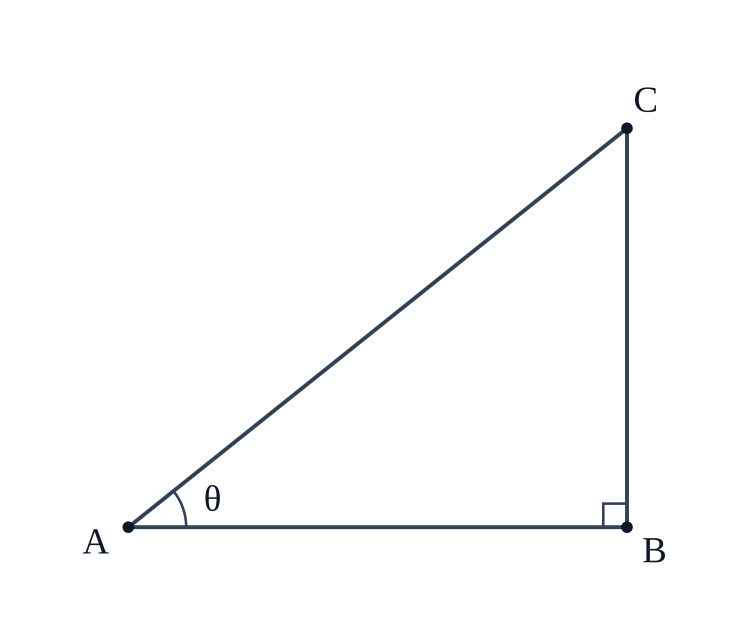
    If the sum of the lengths of the hypotenuse and a side of a right angled triangle is given, show that the area of the triangle is maximum when the angle between them is π3\displaystyle \frac{\pi}{3}.

    Not cross-checked

    NCERT prints no numerical answer for this exercise, so this working has not been cross-checked against the book.

    Right angle at \(\displaystyle B\), \(\displaystyle AB=x\), \(\displaystyle AC=h\), \(\displaystyle \theta=\angle A\), and \(\displaystyle h+x=k\) (constant). NCERT_Solution_Class12_Maths_Exemplar_Ch6_Ex6-3_Q25 \[BC=\sqrt{(h-x)(h+x)}=\sqrt{k(k-2x)} \quad (h-x=k-2x) \] \[S=\tfrac12\,x\cdot BC \;\Rightarrow\; S^2=\frac{k}{4}\left(kx^2-2x^3\right) \] \[\frac{d(S^2)}{dx}=\frac{k}{2}\,x\,(k-3x)=0 \;\Rightarrow\; x=\frac{k}{3} \] \[\frac{d^2(S^2)}{dx^2}=\frac{k}{4}(2k-12x)=-\frac{k^2}{2}<0 \quad\text{(maximum)} \] \[h=k-x=\frac{2k}{3} \] \[\cos\theta=\frac{x}{h}=\frac12 \;\Rightarrow\; \theta=\frac{\pi}{3} \] Answer: the area is maximum when \(\displaystyle \theta=\frac{\pi}{3}\).
  6. Exercise 26

    Find the points of local maxima, local minima and the points of inflection of the function f(x)=x5−5x4+5x3−1\displaystyle f(x)=x^5-5 x^4+5 x^3-1. Also find the corresponding local maximum and local minimum values.

    Check this one against your book

    NCERT’s printed answer for this exercise does not match its own question. This working follows the question as printed.

    \[f'(x)=5x^4-20x^3+15x^2=5x^2(x-1)(x-3) \] \[f'(x)=0 \;\Rightarrow\; x=0,\;1,\;3 \] \[f''(x)=20x^3-60x^2+30x=10x\,(2x^2-6x+3) \] \[f''(1)=-10<0 \;\Rightarrow\; \text{local maximum at } x=1 \] \[f''(3)=90>0 \;\Rightarrow\; \text{local minimum at } x=3 \] \[f(1)=1-5+5-1=0 \] \[f(3)=243-405+135-1=-28 \] \[f''(x)=0 \;\Rightarrow\; x=0,\;\frac{3\pm\sqrt3}{2} \] \[f'''(x)=60x^2-120x+30 \] \[f'''(0)=30\neq0,\qquad f'''\!\left(\frac{3\pm\sqrt3}{2}\right)=30\,(1\pm\sqrt3)\neq0 \] \(\displaystyle f''\) changes sign at each of these three roots, so each is a point of inflection (\(\displaystyle x=0\) is not an extremum). Answer: local maximum at \(\displaystyle x=1\), value \(\displaystyle 0\); local minimum at \(\displaystyle x=3\), value \(\displaystyle -28\); points of inflection at \(\displaystyle x=0,\ \frac{3\pm\sqrt3}{2}\).
  7. Exercise 27

    A telephone company in a town has 500\displaystyle 500 subscribers on its list and collects fixed charges of Rs 300\displaystyle 300/- per subscriber per year. The company proposes to increase the annual subscription and it is believed that for every increase of Re 1\displaystyle 1/- one subscriber will discontinue the service. Find what increase will bring maximum profit?

    Matches the book, not yet reviewed

    This working reaches the answer NCERT prints. It has not yet been read through by hand.

    NCERT’s answer
    Rs $\displaystyle 100$
    Let the annual charge be raised by Rs \(\displaystyle x\). No costs are given, so profit is the income. \[\text{subscribers}=500-x,\qquad \text{charge per subscriber}=300+x \] \[R(x)=(500-x)(300+x)=150000+200x-x^2 \] \[R'(x)=200-2x=0 \;\Rightarrow\; x=100 \] \[R''(x)=-2<0 \quad\text{(maximum)} \] \[R(100)=400\times400=160000 \] Answer: an increase of Rs \(\displaystyle 100\).
  8. Exercise 28

    If the straight line xcos⁡α+ysin⁡α=p\displaystyle x \cos \alpha+y \sin \alpha=p touches the curve x2a2+y2b2=1\displaystyle \frac{x^2}{a^2}+\frac{y^2}{b^2}=1, then prove that a2cos⁡2α+b2sin⁡2α=p2\displaystyle a^2 \cos ^2 \alpha+b^2 \sin ^2 \alpha=p^2.

    Not cross-checked

    NCERT prints no numerical answer for this exercise, so this working has not been cross-checked against the book.

    Let the line touch the ellipse at \(\displaystyle (x_1,y_1)\). \[\frac{2x}{a^2}+\frac{2y}{b^2}\frac{dy}{dx}=0 \;\Rightarrow\; \frac{dy}{dx}=-\frac{b^2x_1}{a^2y_1} \] \[\text{slope of the line}=-\frac{\cos\alpha}{\sin\alpha} \] \[b^2x_1\sin\alpha=a^2y_1\cos\alpha \] \[x_1=\lambda a^2\cos\alpha,\qquad y_1=\lambda b^2\sin\alpha \] Put \(\displaystyle D=a^2\cos^2\alpha+b^2\sin^2\alpha\). \[\frac{x_1^2}{a^2}+\frac{y_1^2}{b^2}=1 \;\Rightarrow\; \lambda^2D=1 \quad\text{(point on the ellipse)} \] \[x_1\cos\alpha+y_1\sin\alpha=p \;\Rightarrow\; \lambda D=p \quad\text{(point on the line)} \] \[p^2=\lambda^2D\cdot D=D \] \[a^2\cos^2\alpha+b^2\sin^2\alpha=p^2 \]
  9. Exercise 29

    An open box with square base is to be made of a given quantity of card board of area c2\displaystyle c^2. Show that the maximum volume of the box is c363\displaystyle \frac{c^3}{6 \sqrt{3}} cubic units.

    Not cross-checked

    NCERT prints no numerical answer for this exercise, so this working has not been cross-checked against the book.

    Base side \(\displaystyle x\), height \(\displaystyle h\).\[x^2+4xh=c^2 \;\Rightarrow\; h=\frac{c^2-x^2}{4x} \] \[V=x^2h=\frac{c^2x-x^3}{4} \] \[\frac{dV}{dx}=\frac{c^2-3x^2}{4}=0 \;\Rightarrow\; x=\frac{c}{\sqrt3} \] \[\frac{d^2V}{dx^2}=-\frac{3x}{2}<0 \quad\text{(maximum)} \] \[V_{\max}=\frac14\left(\frac{c^3}{\sqrt3}-\frac{c^3}{3\sqrt3}\right)=\frac14\cdot\frac{2c^3}{3\sqrt3}=\frac{c^3}{6\sqrt3} \] Answer: the maximum volume is \(\displaystyle \dfrac{c^3}{6\sqrt3}\) cubic units.
  10. Exercise 30

    Find the dimensions of the rectangle of perimeter 36\displaystyle 36 cm which will sweep out a volume as large as possible, when revolved about one of its sides. Also find the maximum volume.

    Matches the book, not yet reviewed

    This working reaches the answer NCERT prints. It has not yet been read through by hand.

    NCERT’s answer
    6cm, $\displaystyle 12$ cm, \(\displaystyle 864\pi\mathrm{cm}^3\)
    Sides \(\displaystyle x\) and \(\displaystyle y\); revolving about the side \(\displaystyle x\) sweeps a cylinder of radius \(\displaystyle y\) and height \(\displaystyle x\).\[2(x+y)=36 \;\Rightarrow\; x=18-y \] \[V=\pi y^2x=\pi\left(18y^2-y^3\right) \] \[\frac{dV}{dy}=\pi(36y-3y^2)=3\pi y(12-y)=0 \;\Rightarrow\; y=12 \] \[\frac{d^2V}{dy^2}=\pi(36-6y)=-36\pi<0 \quad\text{(maximum)} \] \[x=18-12=6 \] \[V_{\max}=\pi(12)^2(6)=864\pi \ \text{cm}^3 \] Answer: sides \(\displaystyle 6\) cm and \(\displaystyle 12\) cm, revolved about the \(\displaystyle 6\) cm side; maximum volume \(\displaystyle 864\pi\) cm\(\displaystyle ^3\).