SolveIt is under development
SolveItNCERT · CBSE · NEET

NCERT Exemplar · Class 11 Mathematics Complex Numbers and Quadratic Equations

50 questions · 50 still being checked

EXERCISE 5.3 31–40 (part 4 of 5)

  1. Exercise 31

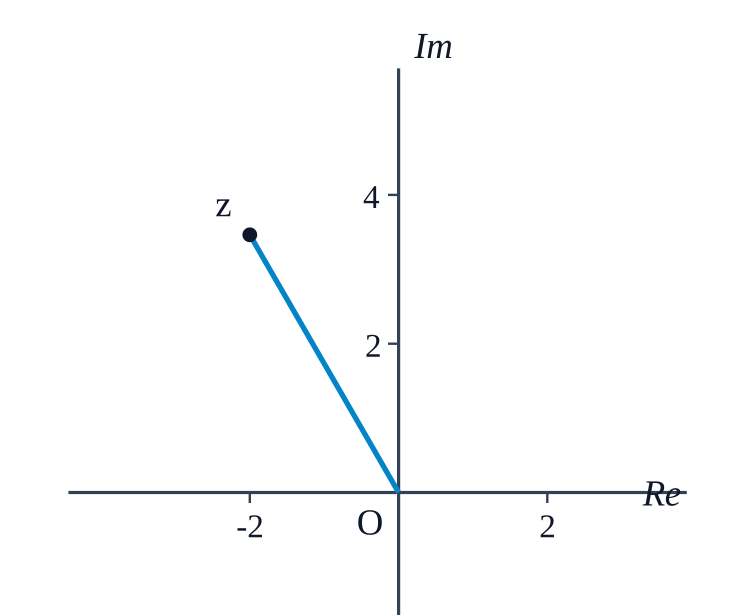
    Find z\displaystyle z if ∣z∣=4\displaystyle |z|=4 and arg⁡(z)=5π6\displaystyle \arg (z)=\frac{5 \pi}{6}.

    Matches the book, not yet reviewed

    This working reaches the answer NCERT prints. It has not yet been read through by hand.

    NCERT’s answer
    \(\displaystyle -2 \sqrt{3}+2 i\)
    \[z = |z|\left(\cos\theta+i\sin\theta\right) = 4\left(\cos\frac{5\pi}{6}+i\sin\frac{5\pi}{6}\right) \] \[\cos\frac{5\pi}{6}=-\frac{\sqrt3}{2}, \qquad \sin\frac{5\pi}{6}=\frac12 \] \[z = 4\left(-\frac{\sqrt3}{2}+\frac{i}{2}\right) = -2\sqrt3+2i \] Answer: \(\displaystyle z=-2\sqrt3+2i\)
  2. Exercise 32

    Find ∣(1+i)(2+i)(3+i)∣\displaystyle \left|(1+i) \frac{(2+i)}{(3+i)}\right|

    Matches the book, not yet reviewed

    This working reaches the answer NCERT prints. It has not yet been read through by hand.

    NCERT’s answer
    $\displaystyle 1$
    \[\left|(1+i)\frac{2+i}{3+i}\right| = \frac{|1+i|\,|2+i|}{|3+i|} = \frac{\sqrt2\cdot\sqrt5}{\sqrt{10}} = 1 \] Answer: \(\displaystyle 1\)
  3. Exercise 33

    Find principal argument of (1+i3)2\displaystyle (1+i \sqrt{3})^2.

    Matches the book, not yet reviewed

    This working reaches the answer NCERT prints. It has not yet been read through by hand.

    NCERT’s answer
    \(\displaystyle \frac{2 \pi}{3}\)
    \[(1+i\sqrt3)^2 = 1 - 3 + 2\sqrt3\, i = -2 + 2\sqrt3\, i \] \[r = \sqrt{(-2)^2 + (2\sqrt3)^2} = 4 \] \[\cos\theta = -\frac{2}{4} = -\frac12, \qquad \sin\theta = \frac{2\sqrt3}{4} = \frac{\sqrt3}{2} \] NCERT_Solution_Class11_Maths_Exemplar_Ch5_Ex5-3_Q33 The point is in the second quadrant, so \[\theta = \pi - \frac{\pi}{3} = \frac{2\pi}{3}, \qquad -\pi < \theta \le \pi \]Answer: \(\displaystyle \dfrac{2\pi}{3}\)
  4. Exercise 34

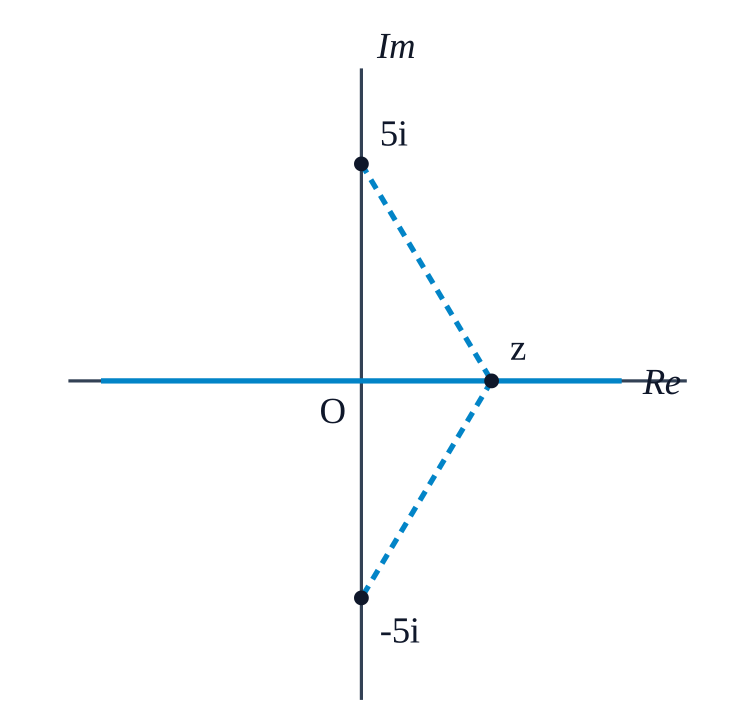
    Where does z\displaystyle z lie, if ∣z−5iz+5i∣=1\displaystyle \left|\frac{z-5 i}{z+5 i}\right|=1.

    Matches the book, not yet reviewed

    This working reaches the answer NCERT prints. It has not yet been read through by hand.

    NCERT’s answer
    Real axis
    \[\left|\frac{z-5i}{z+5i}\right| = 1 \Rightarrow |z-5i| = |z+5i| \] Put \(\displaystyle z = x+iy\). \[x^2 + (y-5)^2 = x^2 + (y+5)^2 \] \[-10y = 10y \Rightarrow y = 0 \] NCERT_Solution_Class11_Maths_Exemplar_Ch5_Ex5-3_Q34 \(\displaystyle z\) is equidistant from \(\displaystyle 5i\) and \(\displaystyle -5i\), so it lies on their perpendicular bisector.Answer: \(\displaystyle z\) lies on the real axis, \(\displaystyle y = 0\).
  5. Choose the correct answer from the given four options indicated against each of the Exercises from $\displaystyle 35$ to $\displaystyle 50$ (M.C.Q)

    Exercise 35

    sin⁡x+icos⁡2x\displaystyle \sin x+i \cos 2 x and cos⁡x−isin⁡2x\displaystyle \cos x-i \sin 2 x are conjugate to each other for:
    (A)
    x=nπ\displaystyle x=n \pi
    (B)
    x=(n+12)π2\displaystyle x=\left(n+\frac{1}{2}\right) \frac{\pi}{2}
    (C)
    x=0\displaystyle x=0
    (D)
    No value of x\displaystyle x

    Matches the book, not yet reviewed

    This working reaches the answer NCERT prints. It has not yet been read through by hand.

    NCERT’s answer
    D
    (D) No value of \(\displaystyle x\).The conjugate of the first number is \(\displaystyle \sin x - i\cos 2x\). Equating it to the second: \[\sin x = \cos x \quad \text{and} \quad \cos 2x = \sin 2x \] \[\sin x = \cos x \Rightarrow \sin^2 x = \tfrac12 \] \[\cos 2x = \cos^2 x - \sin^2 x = 0 \] \[\sin 2x = 2\sin x\cos x = 2\sin^2 x = 1 \] \[0 \ne 1 \] Both equalities cannot hold together.
  6. Exercise 36

    The real value of α\displaystyle \alpha for which the expression 1−isin⁡α1+2isin⁡α\displaystyle \frac{1-i \sin \alpha}{1+2 i \sin \alpha} is purely real is :
    (A)
    (n+1)π2\displaystyle (n+1) \frac{\pi}{2}
    (B)
    (2n+1)π2\displaystyle (2 n+1) \frac{\pi}{2}
    (C)
    nπ\displaystyle n \pi
    (D)
    None of these, where n∈N\displaystyle n \in \mathbf{N}

    Matches the book, not yet reviewed

    This working reaches the answer NCERT prints. It has not yet been read through by hand.

    NCERT’s answer
    C
    (C) \(\displaystyle n\pi\)Rationalise the denominator. \[\frac{1-i\sin\alpha}{1+2i\sin\alpha}\cdot\frac{1-2i\sin\alpha}{1-2i\sin\alpha} = \frac{1-2\sin^2\alpha}{1+4\sin^2\alpha} - i\,\frac{3\sin\alpha}{1+4\sin^2\alpha} \] Purely real requires the imaginary part to vanish. \[\sin\alpha = 0 \Rightarrow \alpha = n\pi \]
  7. Exercise 37

    If z=x+iy\displaystyle z=x+i y lies in the third quadrant, then zˉz\displaystyle \frac{\bar{z}}{z} also lies in the third quadrant if
    (A)
    x>y>0\displaystyle x>y>0
    (B)
    x<y<0\displaystyle x<y<0
    (C)
    y<x<0\displaystyle y<x<0
    (D)
    y>x>0\displaystyle y>x>0

    Check this one against your book

    NCERT’s printed answer for this exercise does not match its own question. This working follows the question as printed.

    (C) \(\displaystyle y<x<0\)\[\frac{\bar z}{z} = \frac{\bar z^{\,2}}{|z|^2} = \frac{(x^2-y^2) - 2xy\,i}{x^2+y^2} \] Imaginary part is negative already, since \(\displaystyle x<0,\ y<0\) give \[-2xy < 0 \] Real part must be negative. \[x^2 - y^2 < 0 \Rightarrow |x| < |y| \Rightarrow y < x < 0 \]
  8. Exercise 38

    The value of (z+3)(zˉ+3)\displaystyle (z+3)(\bar{z}+3) is equivalent to
    (A)
    ∣z+3∣2\displaystyle |z+3|^2
    (B)
    ∣z−3∣\displaystyle |z-3|
    (C)
    z2+3\displaystyle z^2+3
    (D)
    None of these

    Matches the book, not yet reviewed

    This working reaches the answer NCERT prints. It has not yet been read through by hand.

    NCERT’s answer
    A
    (A) \(\displaystyle |z+3|^2\)\[\overline{z+3} = \bar z + 3 \] \[(z+3)(\bar z+3) = (z+3)\,\overline{(z+3)} = |z+3|^2 \]
  9. Exercise 39

    If (1+i1−i)x=1\displaystyle \left(\frac{1+i}{1-i}\right)^x=1, then
    (A)
    x=2n+1\displaystyle x=2 n+1
    (B)
    x=4n\displaystyle x=4 n
    (C)
    x=2n\displaystyle x=2 n
    (D)
    x=4n+1\displaystyle x=4 n+1, where n∈ N\displaystyle n \in \mathrm{~N}

    Matches the book, not yet reviewed

    This working reaches the answer NCERT prints. It has not yet been read through by hand.

    NCERT’s answer
    B
    (B) \(\displaystyle x = 4n\)\[\frac{1+i}{1-i} = \frac{(1+i)^2}{(1-i)(1+i)} = \frac{2i}{2} = i \] \[i^x = 1 \] Powers of \(\displaystyle i\) repeat every four steps and equal $\displaystyle 1$ only at multiples of 4. \[x = 4n \]
  10. Exercise 40

    A real value of x\displaystyle x satisfies the equation (3−4ix3+4ix)=α−iβ(α,β∈R)\displaystyle \left(\frac{3-4 i x}{3+4 i x}\right)=\alpha-i \beta(\alpha, \beta \in \mathbf{R}) if α2+β2=\displaystyle \alpha^2+\beta^2=
    (A)
    1\displaystyle 1 (B) - 1\displaystyle 1 (C) 2\displaystyle 2 (D) - 2\displaystyle 2

    Matches the book, not yet reviewed

    This working reaches the answer NCERT prints. It has not yet been read through by hand.

    NCERT’s answer
    A
    (A) \(\displaystyle 1\)For real \(\displaystyle x\), \(\displaystyle 3+4ix\) is the conjugate of \(\displaystyle 3-4ix\), so both have the same modulus. \[\left|\frac{3-4ix}{3+4ix}\right| = \frac{|3-4ix|}{|3+4ix|} = 1 \] \[|\alpha - i\beta| = 1 \Rightarrow \alpha^2 + \beta^2 = 1 \]