SolveIt is under development
SolveItNCERT · CBSE · NEET

NCERT Exemplar · Class 11 Mathematics Complex Numbers and Quadratic Equations

50 questions · 50 still being checked

EXERCISE 5.3 11–20 (part 2 of 5)

  1. Exercise 11

    Solve the equation ∣z∣=z+1+2i\displaystyle |z|=z+1+2 i.

    Matches the book, not yet reviewed

    This working reaches the answer NCERT prints. It has not yet been read through by hand.

    NCERT’s answer
    \(\displaystyle \frac{3}{2}-2 i\)
    With \(\displaystyle z=x+iy\): \[\sqrt{x^2+y^2}=(x+1)+i(y+2) \] Imaginary parts: \[y+2=0 \Rightarrow y=-2 \] Real parts: \[\sqrt{x^2+4}=x+1 \] \[x^2+4=x^2+2x+1 \Rightarrow x=\tfrac32 \] Check: \(\displaystyle x+1=\tfrac52>0\) and \(\displaystyle \sqrt{\tfrac94+4}=\tfrac52\).Answer: \(\displaystyle z=\tfrac32-2i\)
  2. Exercise 12

    If ∣z+1∣=z+2(1+i)\displaystyle |z+1|=z+2(1+i), then find z\displaystyle z.

    Matches the book, not yet reviewed

    This working reaches the answer NCERT prints. It has not yet been read through by hand.

    NCERT’s answer
    \(\displaystyle \frac{1}{2}-2 i\)
    With \(\displaystyle z=x+iy\): \[\sqrt{(x+1)^2+y^2}=(x+2)+i(y+2) \] Imaginary parts: \[y+2=0 \Rightarrow y=-2 \] Real parts: \[\sqrt{(x+1)^2+4}=x+2 \] \[x^2+2x+5=x^2+4x+4 \Rightarrow x=\tfrac12 \] Check: \(\displaystyle x+2=\tfrac52>0\) and \(\displaystyle \sqrt{\tfrac94+4}=\tfrac52\).Answer: \(\displaystyle z=\tfrac12-2i\)
  3. Exercise 13

    If arg⁡(z−1)=arg⁡(z+3i)\displaystyle \arg (z-1)=\arg (z+3 i), then find x−1:y\displaystyle x-1: y. where z=x+iy\displaystyle z=x+i y

    Matches the book, not yet reviewed

    This working reaches the answer NCERT prints. It has not yet been read through by hand.

    NCERT’s answer
    $\displaystyle 1$:$\displaystyle 3$
    Equal arguments give equal tangents. For \(\displaystyle z=x+iy\), \(\displaystyle z-1=(x-1)+iy\) and \(\displaystyle z+3i=x+i(y+3)\): \[\frac{y}{x-1}=\frac{y+3}{x} \] \[xy=(x-1)(y+3)=xy+3x-y-3 \] \[y=3(x-1) \] \[\frac{x-1}{y}=\frac13 \]Answer: \(\displaystyle (x-1):y=1:3\)
  4. Exercise 14

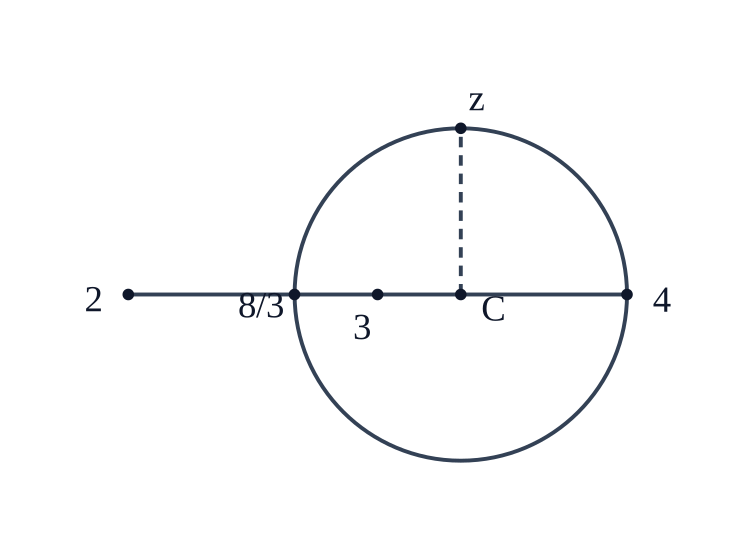
    Show that ∣z−2z−3∣=2\displaystyle \left|\frac{z-2}{z-3}\right|=2 represents a circle. Find its centre and radius.

    Matches the book, not yet reviewed

    This working reaches the answer NCERT prints. It has not yet been read through by hand.

    NCERT’s answer
    \(\displaystyle \left(\frac{10}{3}, 0\right), \frac{2}{3}\)
    With \(\displaystyle z=x+iy\): \[|z-2|=2|z-3| \] \[(x-2)^2+y^2=4\left[(x-3)^2+y^2\right] \] \[3x^2+3y^2-20x+32=0 \] \[\left(x-\tfrac{10}{3}\right)^2+y^2=\tfrac{100}{9}-\tfrac{32}{3}=\tfrac49 \] NCERT_Solution_Class11_Maths_Exemplar_Ch5_Ex5-3_Q14 Answer: a circle with centre \(\displaystyle \left(\tfrac{10}{3},0\right)\) and radius \(\displaystyle \tfrac23\).
  5. Exercise 15

    If z−1z+1\displaystyle \frac{z-1}{z+1} is a purely imaginary number (z≠−1)\displaystyle (z \neq-1), then find the value of ∣z∣\displaystyle |z|.

    Matches the book, not yet reviewed

    This working reaches the answer NCERT prints. It has not yet been read through by hand.

    NCERT’s answer
    $\displaystyle 1$
    A purely imaginary \(\displaystyle w\) satisfies \(\displaystyle w+\bar w=0\): \[\frac{z-1}{z+1}+\frac{\bar z-1}{\bar z+1}=0 \] \[(z-1)(\bar z+1)+(\bar z-1)(z+1)=0 \] \[2z\bar z-2=0 \] \[|z|^2=1 \]Answer: \(\displaystyle |z|=1\)
  6. Exercise 16

    z1\displaystyle z_1 and z2\displaystyle z_2 are two complex numbers such that ∣z1∣=∣z2∣\displaystyle \left|z_1\right|=\left|z_2\right| and arg⁡(z1)+arg⁡(z2)=\displaystyle \arg \left(z_1\right)+\arg \left(z_2\right)= π\displaystyle \pi, then show that z1=−zˉ2\displaystyle z_1=-\bar{z}_2.

    Not cross-checked

    NCERT prints no numerical answer for this exercise, so this working has not been cross-checked against the book.

    Let \(\displaystyle |z_1|=|z_2|=r\) and \(\displaystyle \arg z_1=\theta\). Then \(\displaystyle \arg z_2=\pi-\theta\): \[z_1=r(\cos\theta+i\sin\theta) \] \[z_2=r\left[\cos(\pi-\theta)+i\sin(\pi-\theta)\right]=r(-\cos\theta+i\sin\theta) \] \[\bar z_2=r(-\cos\theta-i\sin\theta)=-r(\cos\theta+i\sin\theta)=-z_1 \]Answer: \(\displaystyle z_1=-\bar z_2\)
  7. Exercise 17

    If ∣z1∣=1(z1≠−1)\displaystyle \left|z_1\right|=1\left(z_1 \neq-1\right) and z2=z1−1z1+1\displaystyle z_2=\frac{z_1-1}{z_1+1}, then show that the real part of z2\displaystyle z_2 is zero.

    Not cross-checked

    NCERT prints no numerical answer for this exercise, so this working has not been cross-checked against the book.

    Since \(\displaystyle |z_1|=1\), \(\displaystyle z_1\bar z_1=1\); \(\displaystyle z_1\ne-1\) keeps the denominator nonzero. Multiply by the conjugate of the denominator. \[z_2=\frac{z_1-1}{z_1+1}\cdot\frac{\bar z_1+1}{\bar z_1+1}=\frac{z_1\bar z_1+z_1-\bar z_1-1}{|z_1+1|^2} \] \[z_2=\frac{z_1-\bar z_1}{|z_1+1|^2}\quad (z_1\bar z_1=1) \] \[z_1-\bar z_1=2i\,\operatorname{Im}(z_1) \] \[z_2=\frac{2\operatorname{Im}(z_1)}{|z_1+1|^2}\,i \] Answer: \(\displaystyle \operatorname{Re}(z_2)=0\)
  8. Exercise 18

    If z1,z2\displaystyle z_1, z_2 and z3,z4\displaystyle z_3, z_4 are two pairs of conjugate complex numbers, then find arg⁡(z1z4)+arg⁡(z2z3)\displaystyle \arg \left(\frac{z_1}{z_4}\right)+\arg \left(\frac{z_2}{z_3}\right).

    Matches the book, not yet reviewed

    This working reaches the answer NCERT prints. It has not yet been read through by hand.

    NCERT’s answer
    $\displaystyle 0$
    Conjugate pairs: \(\displaystyle z_2=\bar z_1\), \(\displaystyle z_4=\bar z_3\). Let \(\displaystyle w=\dfrac{z_1}{z_4}\). \[\frac{z_2}{z_3}=\frac{\bar z_1}{z_3}=\overline{\left(\frac{z_1}{\bar z_3}\right)}=\overline{\left(\frac{z_1}{z_4}\right)}=\bar w \] \[\arg(\bar w)=-\arg(w) \] \[\arg\!\left(\frac{z_1}{z_4}\right)+\arg\!\left(\frac{z_2}{z_3}\right)=\arg w-\arg w=0 \] Answer: \(\displaystyle 0\) (taking the arguments as \(\displaystyle \theta\) and \(\displaystyle -\theta\), i.e. modulo \(\displaystyle 2\pi\))
  9. Exercise 19

    If ∣z1∣=∣z2∣=…=∣zn∣=1\displaystyle \left|z_1\right|=\left|z_2\right|=\ldots=\left|z_n\right|=1, then show that ∣z1+z2+z3+…+zn∣=∣1z1+1z2+1z3+…+1zn∣\displaystyle \left|z_1+z_2+z_3+\ldots+z_n\right|=\left|\frac{1}{z_1}+\frac{1}{z_2}+\frac{1}{z_3}+\ldots+\frac{1}{z_n}\right|.

    Not cross-checked

    NCERT prints no numerical answer for this exercise, so this working has not been cross-checked against the book.

    Each \(\displaystyle z_k\) has modulus 1. \[z_k\bar z_k=|z_k|^2=1\;\Rightarrow\;\frac1{z_k}=\bar z_k \] \[\frac1{z_1}+\frac1{z_2}+\dots+\frac1{z_n}=\bar z_1+\bar z_2+\dots+\bar z_n \] \[\bar z_1+\dots+\bar z_n=\overline{z_1+z_2+\dots+z_n} \] \[|\bar w|=|w| \] \[\left|\frac1{z_1}+\dots+\frac1{z_n}\right|=\left|\overline{z_1+\dots+z_n}\right|=|z_1+z_2+\dots+z_n| \] Answer: \(\displaystyle |z_1+\dots+z_n|=\left|\dfrac1{z_1}+\dots+\dfrac1{z_n}\right|\)
  10. Exercise 20

    If for complex numbers z1\displaystyle z_1 and z2\displaystyle z_2, arg (z1)−arg⁡(z2)=0\displaystyle \left(z_1\right)-\arg \left(z_2\right)=0, then show that ∣z1−z2∣=∣z1∣−∣z2∣\displaystyle \left|z_1-z_2\right|=\left|z_1\right|-\left|z_2\right|

    Not cross-checked

    NCERT prints no numerical answer for this exercise, so this working has not been cross-checked against the book.

    Let \(\displaystyle \arg z_1=\arg z_2=\theta\), \(\displaystyle r_1=|z_1|\), \(\displaystyle r_2=|z_2|\). \[z_1=r_1(\cos\theta+i\sin\theta),\qquad z_2=r_2(\cos\theta+i\sin\theta) \] \[z_1-z_2=(r_1-r_2)(\cos\theta+i\sin\theta) \] \[|z_1-z_2|=|r_1-r_2|\,\sqrt{\cos^2\theta+\sin^2\theta}=|r_1-r_2| \] \[|z_1-z_2|=r_1-r_2=|z_1|-|z_2|\quad (r_1\ge r_2) \] The statement takes \(\displaystyle |z_1|\ge|z_2|\); if \(\displaystyle |z_1|<|z_2|\), swap the roles and the result is \(\displaystyle |z_2|-|z_1|\). Answer: \(\displaystyle |z_1-z_2|=|z_1|-|z_2|\)