SolveIt is under development
SolveItNCERT · CBSE · NEET

NCERT Exemplar · Class 11 Mathematics Complex Numbers and Quadratic Equations

50 questions · 50 still being checked

EXERCISE 5.3 1–10 (part 1 of 5)

  1. Exercise 1

    For a positive integer n\displaystyle n, find the value of (1−i)n(1−1i)n\displaystyle (1-i)^n\left(1-\frac{1}{i}\right)^n

    Matches the book, not yet reviewed

    This working reaches the answer NCERT prints. It has not yet been read through by hand.

    NCERT’s answer
    \(\displaystyle 2^{n}\)
    \[\frac{1}{i} = \frac{i}{i^2} = -i \quad\Rightarrow\quad 1-\frac{1}{i} = 1+i \] \[(1-i)^n(1+i)^n = \big[(1-i)(1+i)\big]^n \] \[(1-i)(1+i) = 1-i^2 = 2 \] \[(1-i)^n\left(1-\frac1i\right)^n = 2^n \] Answer: \(\displaystyle 2^n\)
  2. Exercise 2

    Evaluate ∑n=113(in+in+1)\displaystyle \sum_{n=1}^{13}\left(i^n+i^{n+1}\right), where n∈N\displaystyle n \in \mathbf{N}.

    Matches the book, not yet reviewed

    This working reaches the answer NCERT prints. It has not yet been read through by hand.

    NCERT’s answer
    \(\displaystyle -1+i\)
    \[\sum_{n=1}^{13}\left(i^n+i^{n+1}\right) = (1+i)\sum_{n=1}^{13} i^n \] \[i+i^2+i^3+i^4 = i-1-i+1 = 0 \] Twelve terms make three complete cycles: \[\sum_{n=1}^{12} i^n = 0 \quad\Rightarrow\quad \sum_{n=1}^{13} i^n = i^{13} = i \] \[(1+i)\,i = i+i^2 = -1+i \] Answer: \(\displaystyle -1+i\)
  3. Exercise 3

    If (1+i1−i)3−(1−i1+i)3=x+iy\displaystyle \left(\frac{1+i}{1-i}\right)^3-\left(\frac{1-i}{1+i}\right)^3=x+i y, then find (x,y)\displaystyle (x, y).

    Matches the book, not yet reviewed

    This working reaches the answer NCERT prints. It has not yet been read through by hand.

    NCERT’s answer
    \(\displaystyle (0, -2)\)
    \[\frac{1+i}{1-i} = \frac{(1+i)^2}{(1-i)(1+i)} = \frac{2i}{2} = i \] \[\frac{1-i}{1+i} = \frac{1}{i} = -i \] \[i^3 = -i, \qquad (-i)^3 = -i^3 = i \] \[i^3-(-i)^3 = -i-i = -2i \] \[x+iy = 0-2i \] Answer: \(\displaystyle (x,y)=(0,\,-2)\)
  4. Exercise 4

    If (1+i)22−i=x+iy\displaystyle \frac{(1+i)^2}{2-i}=x+i y, then find the value of x+y\displaystyle x+y.

    Matches the book, not yet reviewed

    This working reaches the answer NCERT prints. It has not yet been read through by hand.

    NCERT’s answer
    \(\displaystyle \frac{2}{5}\)
    \[(1+i)^2 = 1+2i+i^2 = 2i \] \[\frac{2i}{2-i} = \frac{2i(2+i)}{(2-i)(2+i)} = \frac{4i+2i^2}{4-i^2} = \frac{-2+4i}{5} \] \[x=-\frac25, \qquad y=\frac45 \] \[x+y = -\frac25+\frac45 = \frac25 \] Answer: \(\displaystyle \dfrac{2}{5}\)
  5. Exercise 5

    If (1−i1+i)100=a+ib\displaystyle \left(\frac{1-i}{1+i}\right)^{100}=a+i b, then find (a,b)\displaystyle (a, b).

    Matches the book, not yet reviewed

    This working reaches the answer NCERT prints. It has not yet been read through by hand.

    NCERT’s answer
    \(\displaystyle (1, 0)\)
    \[\frac{1-i}{1+i} = \frac{(1-i)^2}{(1+i)(1-i)} = \frac{1-2i+i^2}{2} = \frac{-2i}{2} = -i \] The power $\displaystyle 100$ is even, so \[(-i)^{100} = i^{100} = (i^4)^{25} = 1 \] \[a+ib = 1+0\,i \] Answer: \(\displaystyle (a,b)=(1,\,0)\)
  6. Exercise 6

    If a=cos⁡θ+isin⁡θ\displaystyle a=\cos \theta+i \sin \theta, find the value of 1+a1−a\displaystyle \frac{1+a}{1-a}.

    Matches the book, not yet reviewed

    This working reaches the answer NCERT prints. It has not yet been read through by hand.

    NCERT’s answer
    \(\displaystyle i \cot \frac{\theta}{2}\)
    Since \(\displaystyle |a|=1\), \(\displaystyle a\bar a=1\) and \(\displaystyle a+\bar a=2\cos\theta\). \[\frac{1+a}{1-a} = \frac{(1+a)(1-\bar a)}{(1-a)(1-\bar a)} \] \[(1+a)(1-\bar a) = 1-\bar a+a-a\bar a = a-\bar a = 2i\sin\theta \] \[(1-a)(1-\bar a) = 1-(a+\bar a)+a\bar a = 2-2\cos\theta \] \[\frac{1+a}{1-a} = \frac{2i\sin\theta}{2(1-\cos\theta)} = \frac{4i\sin\frac\theta2\cos\frac\theta2}{4\sin^2\frac\theta2} = i\cot\frac\theta2 \] Answer: \(\displaystyle i\cot\dfrac{\theta}{2}\)
  7. Exercise 7

    If (1+i)z=(1−i)zˉ\displaystyle (1+i) z=(1-i) \bar{z}, then show that z=−izˉ\displaystyle z=-i \bar{z}.

    Not cross-checked

    NCERT prints no numerical answer for this exercise, so this working has not been cross-checked against the book.

    \[(1+i)z = (1-i)\bar z \quad \text{(given)} \] \[z = \frac{1-i}{1+i}\,\bar z \quad \text{(} 1+i\neq 0 \text{)} \] \[\frac{1-i}{1+i} = \frac{(1-i)^2}{(1+i)(1-i)} = \frac{-2i}{2} = -i \] \[z = -i\,\bar z \] Answer: \(\displaystyle z=-i\bar z\)
  8. Exercise 8

    If z=x+iy\displaystyle z=x+i y, then show that zzˉ+2(z+zˉ)+b=0\displaystyle z \bar{z}+2(z+\bar{z})+b=0, where b∈R\displaystyle b \in \mathbf{R}, represents a circle.

    Not cross-checked

    NCERT prints no numerical answer for this exercise, so this working has not been cross-checked against the book.

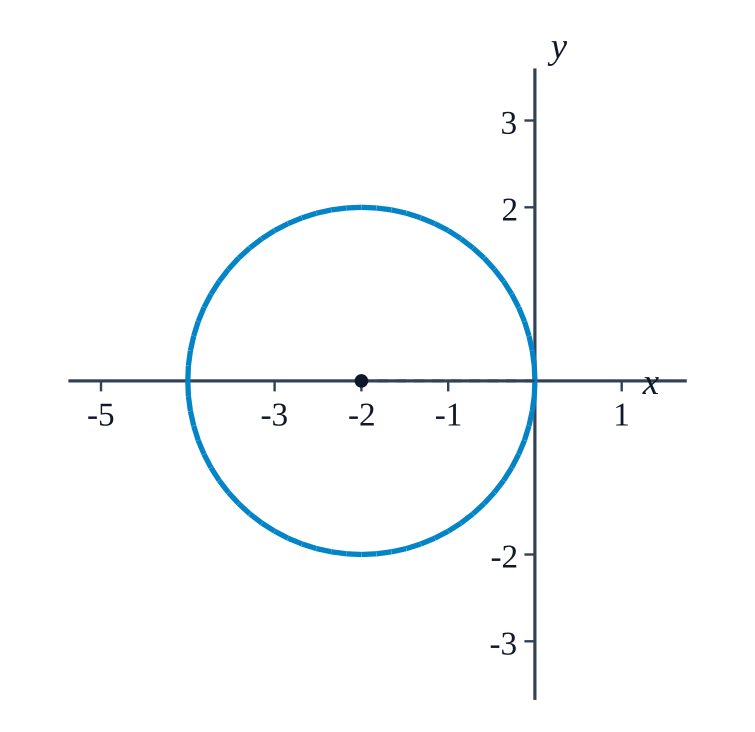
    \[z\bar z=(x+iy)(x-iy)=x^2+y^2, \qquad z+\bar z=2x \] \[x^2+y^2+2(2x)+b=0 \] \[(x^2+4x+4)+y^2=4-b \] \[(x+2)^2+y^2=4-b \] For \(\displaystyle b<4\) this is a circle with centre \(\displaystyle (-2,0)\) and radius \(\displaystyle \sqrt{4-b}\) (\(\displaystyle b=4\) gives only the point \(\displaystyle (-2,0)\); \(\displaystyle b>4\), no point). NCERT_Solution_Class11_Maths_Exemplar_Ch5_Ex5-3_Q8 Answer: a circle with centre \(\displaystyle (-2,0)\) and radius \(\displaystyle \sqrt{4-b}\), for \(\displaystyle b<4\)
  9. Exercise 9

    If the real part of zˉ+2zˉ−1\displaystyle \frac{\bar{z}+2}{\bar{z}-1} is 4\displaystyle 4, then show that the locus of the point representing z\displaystyle z in the complex plane is a circle.

    Not cross-checked

    NCERT prints no numerical answer for this exercise, so this working has not been cross-checked against the book.

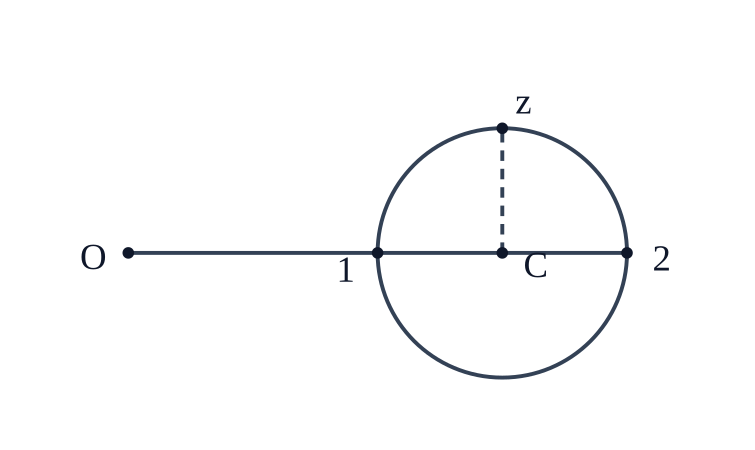
    With \(\displaystyle z=x+iy\): \[\frac{\bar z+2}{\bar z-1}=\frac{(x+2)-iy}{(x-1)-iy}\cdot\frac{(x-1)+iy}{(x-1)+iy}=\frac{(x^2+y^2+x-2)+3iy}{(x-1)^2+y^2} \] Real part is \(\displaystyle 4\): \[x^2+y^2+x-2=4\left[(x-1)^2+y^2\right] \] \[3x^2+3y^2-9x+6=0 \] \[\left(x-\tfrac32\right)^2+y^2=\tfrac14 \] NCERT_Solution_Class11_Maths_Exemplar_Ch5_Ex5-3_Q9 The point \(\displaystyle z=1\) makes the expression undefined, so it is removed.Answer: the locus is the circle with centre \(\displaystyle \left(\tfrac32,0\right)\) and radius \(\displaystyle \tfrac12\), the point \(\displaystyle z=1\) excluded.
  10. Exercise 10

    Show that the complex number z\displaystyle z, satisfying the condition arg⁡(z−1z+1)=π4\displaystyle \arg \left(\frac{z-1}{z+1}\right)=\frac{\pi}{4} lies on a circle.

    Not cross-checked

    NCERT prints no numerical answer for this exercise, so this working has not been cross-checked against the book.

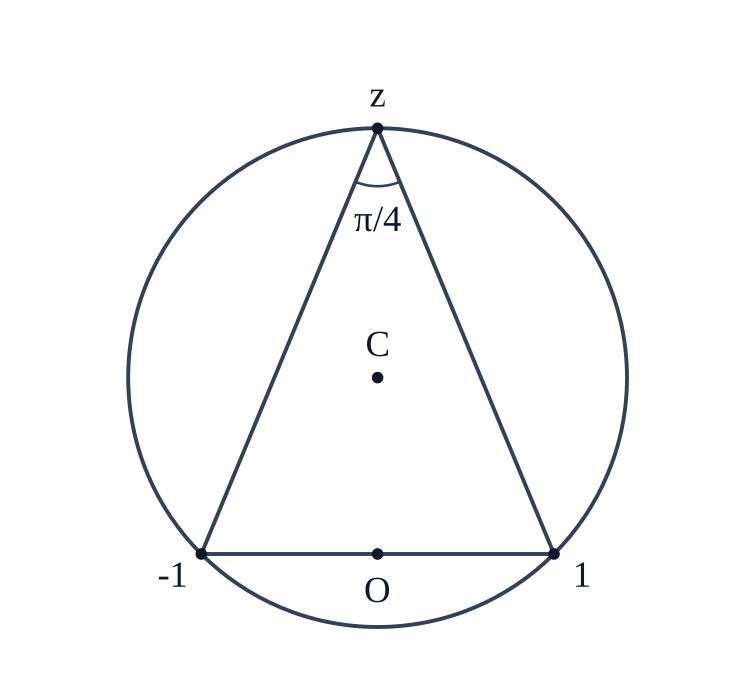
    With \(\displaystyle z=x+iy\): \[\frac{z-1}{z+1}=\frac{(x-1)+iy}{(x+1)+iy}\cdot\frac{(x+1)-iy}{(x+1)-iy}=\frac{(x^2+y^2-1)+2iy}{(x+1)^2+y^2} \] \(\displaystyle \arg=\dfrac{\pi}{4}\) means real part \(\displaystyle =\) imaginary part \(\displaystyle >0\): \[x^2+y^2-1=2y>0 \] \[x^2+(y-1)^2=2,\quad y>0 \] NCERT_Solution_Class11_Maths_Exemplar_Ch5_Ex5-3_Q10 Answer: \(\displaystyle z\) lies on the circle with centre \(\displaystyle (0,1)\) and radius \(\displaystyle \sqrt2\), on the arc above the real axis.