SolveIt is under development
SolveItNCERT · CBSE · NEET

NCERT Exemplar · Class 11 Mathematics Complex Numbers and Quadratic Equations

50 questions · 50 still being checked

EXERCISE 5.3 21–30 (part 3 of 5)

  1. Exercise 21

    Solve the system of equations Re⁡(z2)=0,∣z∣=2\displaystyle \operatorname{Re}\left(z^2\right)=0,|z|=2.

    Matches the book, not yet reviewed

    This working reaches the answer NCERT prints. It has not yet been read through by hand.

    NCERT’s answer
    \(\displaystyle \sqrt{2} \pm i \sqrt{2},-\sqrt{2} \pm i \sqrt{2}\)
    Put \(\displaystyle z=x+iy\). \[z^2=(x^2-y^2)+2xy\,i \] \[\operatorname{Re}(z^2)=0\;\Rightarrow\;x^2-y^2=0 \] \[|z|=2\;\Rightarrow\;x^2+y^2=4 \] \[2x^2=4\;\Rightarrow\;x^2=2,\quad y^2=2 \] \[x=\pm\sqrt2,\quad y=\pm\sqrt2 \] Answer: \(\displaystyle z=\pm\sqrt2\pm\sqrt2\,i\) (four values, signs independent)
  2. Exercise 22

    Find the complex number satisfying the equation z+2∣(z+1)∣+i=0\displaystyle z+\sqrt{2}|(z+1)|+i=0.

    Matches the book, not yet reviewed

    This working reaches the answer NCERT prints. It has not yet been read through by hand.

    NCERT’s answer
    \(\displaystyle -2-i\)
    Put \(\displaystyle z=x+iy\) and separate real and imaginary parts. \[x+\sqrt2\sqrt{(x+1)^2+y^2}+(y+1)i=0 \] \[y+1=0\;\Rightarrow\;y=-1 \] \[x+\sqrt2\sqrt{(x+1)^2+1}=0\;\Rightarrow\;x\le0 \] \[x^2=2\left[(x+1)^2+1\right]=2x^2+4x+4 \] \[x^2+4x+4=0\;\Rightarrow\;(x+2)^2=0\;\Rightarrow\;x=-2 \] \[\text{Check: } -2+\sqrt2\cdot\sqrt{1+1}=0 \] Answer: \(\displaystyle z=-2-i\)
  3. Exercise 23

    Write the complex number z=1−icos⁡π3+isin⁡π3\displaystyle z=\frac{1-i}{\cos \dfrac{\pi}{3}+i \sin \dfrac{\pi}{3}} in polar form.

    Check this one against your book

    NCERT’s printed answer for this exercise does not match its own question. This working follows the question as printed.

    Write numerator and denominator in polar form. \[1-i=\sqrt2\left[\cos\!\left(-\frac\pi4\right)+i\sin\!\left(-\frac\pi4\right)\right] \] \[\frac1{\cos\frac\pi3+i\sin\frac\pi3}=\cos\!\left(-\frac\pi3\right)+i\sin\!\left(-\frac\pi3\right) \] \[z=\sqrt2\left[\cos\!\left(-\frac\pi4-\frac\pi3\right)+i\sin\!\left(-\frac\pi4-\frac\pi3\right)\right] \] \[-\frac\pi4-\frac\pi3=-\frac{7\pi}{12} \] Answer: \(\displaystyle z=\sqrt2\left[\cos\left(-\dfrac{7\pi}{12}\right)+i\sin\left(-\dfrac{7\pi}{12}\right)\right]=\sqrt2\left(\cos\dfrac{7\pi}{12}-i\sin\dfrac{7\pi}{12}\right)\)
  4. Exercise 24

    If z\displaystyle z and w\displaystyle w are two complex numbers such that ∣zw∣=1\displaystyle |z w|=1 and arg⁡(z)−arg⁡(w)=\displaystyle \arg (z)-\arg (w)= π2\displaystyle \frac{\pi}{2}, then show that zˉw=−i\displaystyle \bar{z} w=-i.

    Not cross-checked

    NCERT prints no numerical answer for this exercise, so this working has not been cross-checked against the book.

    Let \(\displaystyle |z|=r\), \(\displaystyle |w|=s\), \(\displaystyle \arg z=\alpha\), \(\displaystyle \arg w=\beta\). \[|zw|=rs=1 \] \[\alpha-\beta=\frac\pi2 \] \[\bar z=r\left[\cos(-\alpha)+i\sin(-\alpha)\right],\qquad w=s(\cos\beta+i\sin\beta) \] \[\bar z\,w=rs\left[\cos(\beta-\alpha)+i\sin(\beta-\alpha)\right] \] \[\bar z\,w=\cos\!\left(-\frac\pi2\right)+i\sin\!\left(-\frac\pi2\right)=-i \] Answer: \(\displaystyle \bar z\,w=-i\)
  5. Exercise 25

    Fill in the blanks of the following
    (i)
    For any two complex numbers z1,z2\displaystyle z_1, z_2 and any real numbers a,b\displaystyle a, b, ∣az1−bz2∣2+∣bz1+az2∣2=\displaystyle \left|a z_1-b z_2\right|^2+\left|b z_1+a z_2\right|^2= ____\displaystyle \_\_\_\_
    (ii)
    The value of −25×−9\displaystyle \sqrt{-25} \times \sqrt{-9} is ____\displaystyle \_\_\_\_
    (iii)
    The number (1−i)31−i3\displaystyle \frac{(1-i)^3}{1-i^3} is equal to ____\displaystyle \_\_\_\_
    (iv)
    The sum of the series i+i2+i3+…\displaystyle i+i^2+i^3+\ldots upto 1000\displaystyle 1000 terms is ____\displaystyle \_\_\_\_
    (v)
    Multiplicative inverse of 1+i\displaystyle 1+i is ____\displaystyle \_\_\_\_
    (vi)
    If z1\displaystyle z_1 and z2\displaystyle z_2 are complex numbers such that z1+z2\displaystyle z_1+z_2 is a real number, then z2=\displaystyle z_2= ____\displaystyle \_\_\_\_
    (vii)
    arg⁡(z)+arg⁡zˉ(zˉ≠0)\displaystyle \arg (z)+\arg \bar{z}(\bar{z} \neq 0) is ____\displaystyle \_\_\_\_
    (viii)
    If ∣z+4∣≤3\displaystyle |z+4| \leq 3, then the greatest and least values of ∣z+1∣\displaystyle |z+1| are ____\displaystyle \_\_\_\_ and ____\displaystyle \_\_\_\_
    (ix)
    If ∣z−2z+2∣=π6\displaystyle \left|\frac{z-2}{z+2}\right|=\frac{\pi}{6}, then the locus of z\displaystyle z is ____\displaystyle \_\_\_\_
    (x)
    If ∣z∣=4\displaystyle |z|=4 and arg⁡(z)=5π6\displaystyle \arg (z)=\frac{5 \pi}{6}, then z=\displaystyle z= ____\displaystyle \_\_\_\_

    Check this one against your book

    NCERT’s printed answer for this exercise does not match its own question. This working follows the question as printed.

    (i) \(\displaystyle (a^2+b^2)\left(|z_1|^2+|z_2|^2\right)\); (ii) \(\displaystyle -15\); (iii) \(\displaystyle -2\); (iv) \(\displaystyle 0\); (v) \(\displaystyle \dfrac{1-i}{2}\); (vi) \(\displaystyle \bar z_1+s\) with \(\displaystyle s\) real; (vii) \(\displaystyle 0\); (viii) \(\displaystyle 6\) and \(\displaystyle 0\); (ix) a circle; (x) \(\displaystyle -2\sqrt3+2i\)
    (i)
    \[|az_1-bz_2|^2 = a^2|z_1|^2+b^2|z_2|^2-2ab\operatorname{Re}(z_1\bar z_2) \]
    \[|bz_1+az_2|^2 = b^2|z_1|^2+a^2|z_2|^2+2ab\operatorname{Re}(z_1\bar z_2) \]
    \[\text{sum} = (a^2+b^2)\left(|z_1|^2+|z_2|^2\right) \]
    (ii)
    \[\sqrt{-25}\,\sqrt{-9} = (5i)(3i) = 15i^2 = -15 \]
    (iii)
    \[(1-i)^2 = -2i, \qquad (1-i)^3 = -2i(1-i) = -2-2i \]
    \[1-i^3 = 1+i \quad\Rightarrow\quad \frac{-2(1+i)}{1+i} = -2 \]
    (iv)
    \[i+i^2+i^3+i^4 = 0, \qquad 1000 = 4\times 250 \quad\Rightarrow\quad S = 0 \]
    (v)
    \[\frac{1}{1+i} = \frac{1-i}{(1+i)(1-i)} = \frac{1-i}{2} \]
    (vi)
    Only the imaginary part is forced; \(\displaystyle s=0\) gives \(\displaystyle \bar z_1\).
    \[\operatorname{Im}(z_1+z_2)=0 \;\Rightarrow\; \operatorname{Im}z_2 = -\operatorname{Im}z_1 \]
    \[z_2 = \operatorname{Re}z_2 - i\operatorname{Im}z_1 = \bar z_1 + s, \qquad s=\operatorname{Re}z_2-\operatorname{Re}z_1 \in\mathbb R \]
    (vii)
    Principal argument, \(\displaystyle z\) not a negative real.
    \[\arg z=\theta \;\Rightarrow\; \arg\bar z=-\theta \;\Rightarrow\; \arg z+\arg\bar z=0 \]
    (viii)
    \[0 \le 3-|z+4| \le |z+1| \le |z+4|+3 \le 6 \]
    \[\text{least } 0 \text{ at } z=-1, \qquad \text{greatest } 6 \text{ at } z=-7 \]
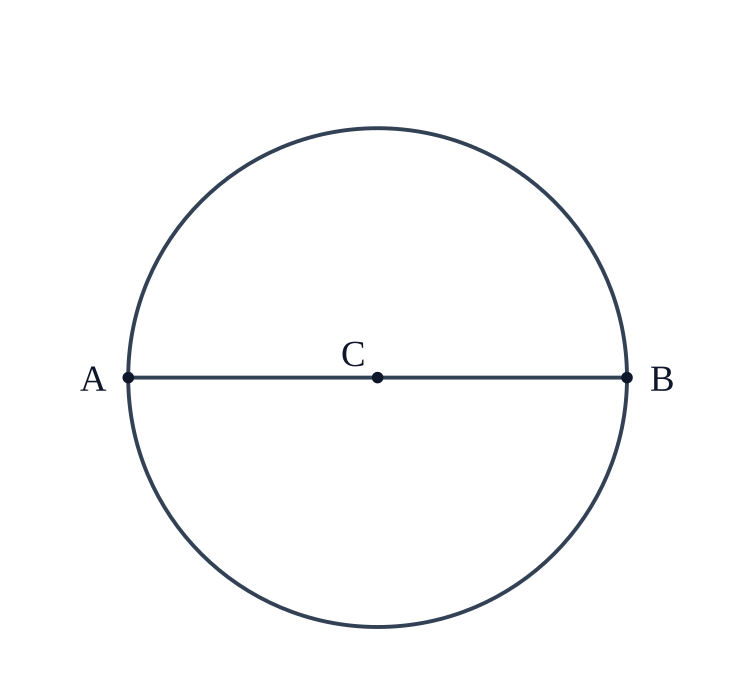
    NCERT_Solution_Class11_Maths_Exemplar_Ch5_Ex5-3_Q25
    (ix)
    Here \(\displaystyle k=\pi/6\ne1\).
    \[|z-2| = k\,|z+2| \]
    \[(1-k^2)(x^2+y^2)-4(1+k^2)x+4(1-k^2)=0 \]
    \[\left(x-\frac{2(1+k^2)}{1-k^2}\right)^2+y^2 = \left(\frac{4k}{1-k^2}\right)^2 \]
    (x)
    \[z = 4\left(\cos\frac{5\pi}{6}+i\sin\frac{5\pi}{6}\right) = 4\left(-\frac{\sqrt3}{2}+\frac{i}{2}\right) = -2\sqrt3+2i \]
  6. Exercise 26

    State True or False for the following :
    (i)
    The order relation is defined on the set of complex numbers.
    (ii)
    Multiplication of a non zero complex number by - i\displaystyle i rotates the point about origin through a right angle in the anti-clockwise direction.
    (iii)
    For any complex number z\displaystyle z the minimum value of ∣z∣+∣z−1∣\displaystyle |z|+|z-1| is 1\displaystyle 1 .
    (iv)
    The locus represented by ∣z−1∣=∣z−i∣\displaystyle |z-1|=|z-i| is a line perpendicular to the join of (1,0)\displaystyle (1,0) and (0,1)\displaystyle (0,1).
    (v)
    If z\displaystyle z is a complex number such that z≠0\displaystyle z \neq 0 and Re⁡(z)=0\displaystyle \operatorname{Re}(z)=0, then Im⁡(z2)=0\displaystyle \operatorname{Im}\left(z^2\right)=0.
    (vi)
    The inequality ∣z−4∣<∣z−2∣\displaystyle |z-4|<|z-2| represents the region given by x>3\displaystyle x>3.
    (vii)
    Let z1\displaystyle z_1 and z2\displaystyle z_2 be two complex numbers such that ∣z1+z2∣=∣z1∣+∣z2∣\displaystyle \left|z_1+z_2\right|=\left|z_1\right|+\left|z_2\right|, then arg⁡(z1−z2)=0\displaystyle \arg \left(z_1-z_2\right)=0.
    (viii)
    2\displaystyle 2 is not a complex number.

    Matches the book, not yet reviewed

    This working reaches the answer NCERT prints. It has not yet been read through by hand.

    NCERT’s answer
    (i)
    F (ii) F
    (iii)
    T
    (iv)
    T
    (v)
    T (vi) T
    (vii)
    F
    (viii)
    F
    (i) False, (ii) False, (iii) True, (iv) True, (v) True, (vi) True, (vii) False, (viii) False
    (i)
    An order needs \(\displaystyle i>0\) or \(\displaystyle i<0\); either gives \(\displaystyle -1>0\).
    \[i>0 \Rightarrow i^2=-1>0, \qquad i<0 \Rightarrow (-i)^2=-1>0 \]
    (ii)
    The rotation is clockwise.
    \[-i = \cos\left(-\frac{\pi}{2}\right)+i\sin\left(-\frac{\pi}{2}\right) \]
    (iii)
    \[|z|+|z-1| = |z|+|1-z| \ge |z+(1-z)| = 1 \]
    Equality holds for \(\displaystyle z\) on the segment from \(\displaystyle 0\) to \(\displaystyle 1\).
    (iv)
    \[|z-1|=|z-i| \iff (x-1)^2+y^2=x^2+(y-1)^2 \iff y=x \]
    \[\text{slope of join} = -1, \qquad \text{slope of line} = 1, \qquad (-1)(1)=-1 \]
    (v)
    \[z=iy \;(y\ne0) \Rightarrow z^2=-y^2 \Rightarrow \operatorname{Im}(z^2)=0 \]
    (vi)
    \[(x-4)^2+y^2<(x-2)^2+y^2 \iff -8x+16<-4x+4 \iff x>3 \]
    (vii)
    Equality needs equal arguments, but \(\displaystyle z_1-z_2\) can be negative.
    \[z_1=1,\; z_2=2: \quad |z_1+z_2|=3=|z_1|+|z_2|, \quad \arg(z_1-z_2)=\arg(-1)=\pi \ne 0 \]
    (viii)
    \[2 = 2+0i \]
  7. Exercise 27

    Match the statements of Column A and Column B.
    Column AColumn B
    (a) The polar form of i+3\displaystyle i+\sqrt{3} is(i) Perpendicular bisector of segment joining (−2,0)\displaystyle (-2,0) and (2,0)\displaystyle (2,0)
    (b) The amplitude of −1+−3\displaystyle -1+\sqrt{-3} is(ii) On or outside the circle having centre at (0,−4)\displaystyle (0, -4) and radius 3.
    (c) If ∣z+2∣=∣z−2∣\displaystyle |z+2|=|z-2|, then locus of z\displaystyle z is(iii) 2π3\displaystyle \frac{2 \pi}{3}
    (d) If ∣z+2i∣=∣z−2i∣\displaystyle |z+2 i|=|z-2 i|, then locus of z\displaystyle z is(iv) Perpendicular bisector of segment joining (0,−2)\displaystyle (0,-2) and (0,2)\displaystyle (0, 2).
    (e) Region represented by ∣z+4i∣≥3\displaystyle |z+4 i| \geq 3 is(v) 2(cos⁡π6+isin⁡π6)\displaystyle 2\left(\cos \frac{\pi}{6}+i \sin \frac{\pi}{6}\right)
    (f) Region represented by ∣z+4∣≤3\displaystyle |z+4| \leq 3 is(vi) On or inside the circle having centre (−4,0)\displaystyle (-4, 0) and radius 3\displaystyle 3 units.
    (g) Conjugate of 1+2i1−i\displaystyle \frac{1+2 i}{1-i} lies in(vii) First quadrant
    (h) Reciprocal of 1−i\displaystyle 1-i lies in(viii) Third quadrant

    Matches the book, not yet reviewed

    This working reaches the answer NCERT prints. It has not yet been read through by hand.

    NCERT’s answer
    (a)
    \(\displaystyle \leftrightarrow\) (v),
    (b)
    \(\displaystyle \leftrightarrow\) (iii),
    (c)
    \(\displaystyle \leftrightarrow\) (i),
    (d)
    \(\displaystyle \leftrightarrow\) (iv),
    (e)
    \(\displaystyle \leftrightarrow\) (ii),
    (f)
    \(\displaystyle \leftrightarrow\) (vi),
    (g)
    \(\displaystyle \leftrightarrow\) (viii) and
    (h)
    \(\displaystyle \leftrightarrow\) (vii)
    (a)-(v), (b)-(iii), (c)-(i), (d)-(iv), (e)-(ii), (f)-(vi), (g)-(viii), (h)-(vii)
    (a)
    \[\sqrt3+i:\quad r=2,\quad \theta=\tan^{-1}\frac{1}{\sqrt3}=\frac{\pi}{6} \]
    \[\sqrt3+i = 2\left(\cos\frac{\pi}{6}+i\sin\frac{\pi}{6}\right) \]
    (b)
    \[-1+\sqrt{-3} = -1+i\sqrt3, \qquad \arg = \pi-\tan^{-1}\sqrt3 = \frac{2\pi}{3} \]
    (c)
    \(\displaystyle z\) is equidistant from \(\displaystyle (-2,0)\) and \(\displaystyle (2,0)\).
    (d)
    \(\displaystyle z\) is equidistant from \(\displaystyle (0,-2)\) and \(\displaystyle (0,2)\).
    (e)
    \(\displaystyle |z-(-4i)|\ge3\): distance from \(\displaystyle (0,-4)\) is at least \(\displaystyle 3\).
    (f)
    \(\displaystyle |z-(-4)|\le3\): distance from \(\displaystyle (-4,0)\) is at most \(\displaystyle 3\).
    (g)
    \[\frac{1+2i}{1-i} = \frac{(1+2i)(1+i)}{2} = \frac{-1+3i}{2} \]
    \[\text{conjugate} = -\frac12-\frac32 i \quad\text{(third quadrant)} \]
    (h)
    \[\frac{1}{1-i} = \frac{1+i}{2} = \frac12+\frac12 i \quad\text{(first quadrant)} \]
  8. Exercise 28

    What is the conjugate of 2−i(1−2i)2\displaystyle \frac{2-i}{(1-2 i)^2} ?

    Matches the book, not yet reviewed

    This working reaches the answer NCERT prints. It has not yet been read through by hand.

    NCERT’s answer
    \(\displaystyle \frac{-2}{25}-i \frac{11}{25}\)
    \[(1-2i)^2 = 1-4i+4i^2 = -3-4i \] \[\frac{2-i}{-3-4i} = \frac{(2-i)(-3+4i)}{(-3)^2+4^2} = \frac{-2+11i}{25} \] \[\overline{\left(\frac{-2+11i}{25}\right)} = \frac{-2-11i}{25} \] Answer: \(\displaystyle -\dfrac{2}{25}-\dfrac{11}{25}\,i\)
  9. Exercise 29

    If ∣z1∣=∣z2∣\displaystyle \left|z_1\right|=\left|z_2\right|, is it necessary that z1=z2\displaystyle z_1=z_2 ?

    Matches the book, not yet reviewed

    This working reaches the answer NCERT prints. It has not yet been read through by hand.

    NCERT’s answer
    No
    Equal moduli only place \(\displaystyle z_1, z_2\) on one circle about the origin. \[z_1=1,\quad z_2=i \] \[|z_1|=1=|z_2|, \qquad z_1\ne z_2 \] \[z_2 = z_1(\cos\varphi+i\sin\varphi) \;\Rightarrow\; |z_2|=|z_1| \quad\text{for every } \varphi \] Answer: No.
  10. Exercise 30

    If (a2+1)22a−i=x+iy\displaystyle \frac{\left(a^2+1\right)^2}{2 a-i}=x+i y, what is the value of x2+y2\displaystyle x^2+y^2 ?

    Matches the book, not yet reviewed

    This working reaches the answer NCERT prints. It has not yet been read through by hand.

    NCERT’s answer
    \(\displaystyle \frac{\left(a^2+1\right)^4}{4 a^2+1}\)
    \[x+iy = \frac{(a^2+1)^2(2a+i)}{(2a-i)(2a+i)} = \frac{(a^2+1)^2(2a+i)}{4a^2+1} \] \[x = \frac{2a(a^2+1)^2}{4a^2+1}, \qquad y = \frac{(a^2+1)^2}{4a^2+1} \] \[x^2+y^2 = \frac{(a^2+1)^4\left(4a^2+1\right)}{\left(4a^2+1\right)^2} = \frac{(a^2+1)^4}{4a^2+1} \] Answer: \(\displaystyle x^2+y^2=\dfrac{(a^2+1)^4}{4a^2+1}\)