SolveIt is under development
SolveItNCERT · CBSE · NEET

NCERT Exemplar · Class 10 Mathematics Pair of Linear Equations in Two Variables

54 questions · 54 still being checked

EXERCISE 3.3 11–22 (part 4 of 5)

  1. Exercise 11

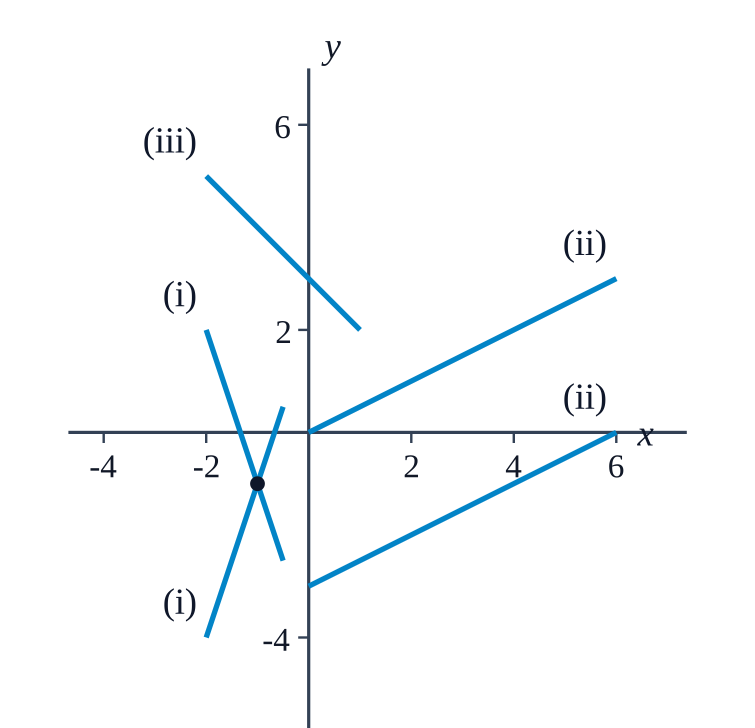
    By the graphical method, find whether the following pair of equations are consistent or not. If consistent, solve them.
    (i)
    3x+y+4=06x−2y+4=0\begin{aligned} & 3 x+y+4=0 \\ & 6 x-2 y+4=0 \end{aligned}
    (ii)
    x−2y=63x−6y=0\begin{aligned} & x-2 y=6 \\ & 3 x-6 y=0 \end{aligned}
    (iii)
    x+y=33x+3y=9\begin{aligned} & x+y=3 \\ & 3 x+3 y=9 \end{aligned}

    Matches the book, not yet reviewed

    This working reaches the answer NCERT prints. It has not yet been read through by hand.

    NCERT’s answer
    (i)
    consistent; \(\displaystyle x=-1, y=-1\)
    (ii)
    inconsistent
    (iii)
    consistent. The solution is given by \(\displaystyle y=3-x\), where \(\displaystyle x\) can take any value, i.e., there are infinitely many solutions.
    (i)
    \[3x+y+4=0 \implies y=-3x-4 \]
    \[6x-2y+4=0 \implies y=3x+2 \]
    Slopes \(\displaystyle -3\) and \(\displaystyle 3\) differ — lines intersect, pair is consistent.
    \[-3x-4=3x+2 \implies x=-1,\ y=-1 \]
    (ii)
    \[x-2y=6 \implies y=\tfrac{x}{2}-3 \]
    \[3x-6y=0 \implies y=\tfrac{x}{2} \]
    Same slope \(\displaystyle \tfrac12\), different intercepts \(\displaystyle -3,0\) — parallel, pair is inconsistent (no solution).
    (iii)
    \[x+y=3 \implies y=3-x \]
    \[3x+3y=9 \implies y=3-x \]
    Same line — coincident, pair is consistent with infinitely many solutions.
    NCERT_Solution_Class10_Maths_Exemplar_Ch3_Ex3-3_Q11
    Answer: (i) consistent, \(\displaystyle (-1,-1)\) (ii) inconsistent (iii) consistent, infinitely many solutions
  2. Exercise 12

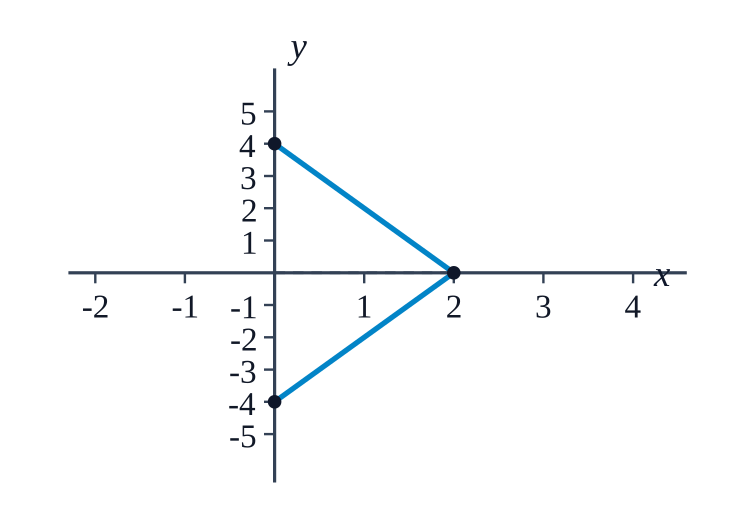
    Draw the graph of the pair of equations 2x+y=4\displaystyle 2 x+y=4 and 2x−y=4\displaystyle 2 x-y=4. Write the vertices of the triangle formed by these lines and the y\displaystyle y-axis. Also find the area of this triangle.

    Matches the book, not yet reviewed

    This working reaches the answer NCERT prints. It has not yet been read through by hand.

    NCERT’s answer
    $\displaystyle (2, 0)$, $\displaystyle (0, 4)$, $\displaystyle (0, -4)$; $\displaystyle 8$ sq. units.
    \[2x+y=4:\ (0,4),\ (2,0) \] \[2x-y=4:\ (0,-4),\ (2,0) \]NCERT_Solution_Class10_Maths_Exemplar_Ch3_Ex3-3_Q12The two lines meet each other at \(\displaystyle (2,0)\) and meet the \(\displaystyle y\)-axis at \(\displaystyle (0,4)\) and \(\displaystyle (0,-4)\). \[\text{Area}=\frac12\times\underbrace{8}_{\text{base on }y\text{-axis}}\times\underbrace{2}_{\text{height}}=8 \]Answer: Vertices \(\displaystyle (0,4),\ (2,0),\ (0,-4)\); area \(\displaystyle =8\) sq units
  3. Exercise 13

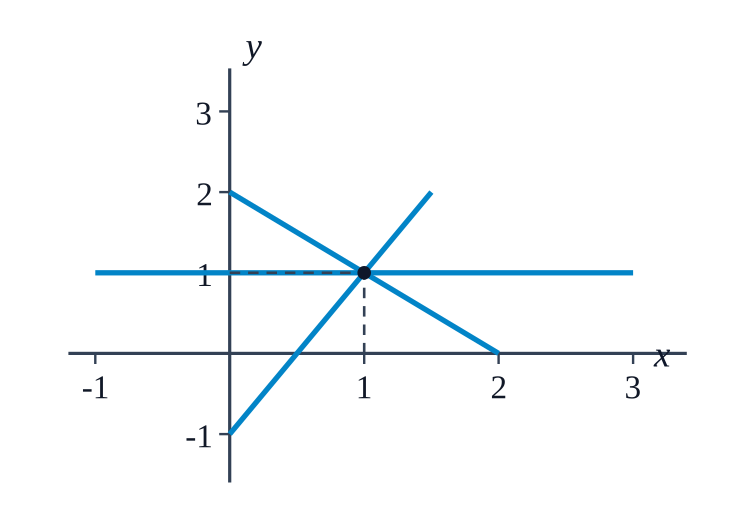
    Write an equation of a line passing through the point representing solution of the pair of linear equations x+y=2\displaystyle x+y=2 and 2x−y=1\displaystyle 2 x-y=1. How many such lines can we find?

    Matches the book, not yet reviewed

    This working reaches the answer NCERT prints. It has not yet been read through by hand.

    NCERT’s answer
    \(\displaystyle x=y\); Infinitely many lines.
    \[x+y=2,\qquad 2x-y=1 \] \[\text{Add: } 3x=3 \implies x=1,\ y=1 \]Point of intersection: \(\displaystyle (1,1)\).NCERT_Solution_Class10_Maths_Exemplar_Ch3_Ex3-3_Q13Infinitely many lines pass through a single point; any line satisfied by \(\displaystyle (1,1)\) works, e.g. \(\displaystyle x-y=0\) or \(\displaystyle y=1\).Answer: Point \(\displaystyle (1,1)\); infinitely many such lines exist (e.g. \(\displaystyle x-y=0\))
  4. Exercise 14

    If x+1\displaystyle x+1 is a factor of 2x3+ax2+2bx+1\displaystyle 2 x^3+a x^2+2 b x+1, then find the values of a\displaystyle a and b\displaystyle b given that 2a−3b=4\displaystyle 2 a-3 b=4.

    Matches the book, not yet reviewed

    This working reaches the answer NCERT prints. It has not yet been read through by hand.

    NCERT’s answer
    \(\displaystyle a=5, b=2\).
    \[p(x)=2x^3+ax^2+2bx+1 \] \[x+1 \text{ is a factor} \implies p(-1)=0 \] \[-2+a-2b+1=0 \implies a-2b=1 \quad (1) \] \[2a-3b=4 \quad (2) \] \[a=1+2b \text{ from (1)};\quad 2(1+2b)-3b=4 \implies b=2 \] \[a=1+2(2)=5 \]Answer: \(\displaystyle a=5,\ b=2\)
  5. Exercise 15

    The angles of a triangle are x,y\displaystyle x, y and 40∘\displaystyle 40^{\circ}. The difference between the two angles x\displaystyle x and y\displaystyle y is 30∘\displaystyle 30^{\circ}. Find x\displaystyle x and y\displaystyle y.

    Matches the book, not yet reviewed

    This working reaches the answer NCERT prints. It has not yet been read through by hand.

    NCERT’s answer
    \(\displaystyle 55^{\circ}, 85^{\circ}\).
    \[x+y+40^\circ=180^\circ \implies x+y=140^\circ \quad (1) \] \[x-y=30^\circ \quad (2) \] \[(1)+(2):\ 2x=170^\circ \implies x=85^\circ,\quad y=55^\circ \]Answer: \(\displaystyle x=85^\circ,\ y=55^\circ\)
  6. Exercise 16

    Two years ago, Salim was thrice as old as his daughter and six years later, he will be four years older than twice her age. How old are they now?

    Matches the book, not yet reviewed

    This working reaches the answer NCERT prints. It has not yet been read through by hand.

    NCERT’s answer
    Salim's age \(\displaystyle =38\) years, Daughter's age \(\displaystyle =14\) years.
    Let Salim's present age be \(\displaystyle x\) and his daughter's be \(\displaystyle y\). \[x-2=3(y-2) \implies x=3y-4 \quad (1) \] \[x+6=2(y+6)+4 \implies x=2y+10 \quad (2) \] \[3y-4=2y+10 \implies y=14,\quad x=38 \]Answer: Salim is \(\displaystyle 38\) years old; his daughter is \(\displaystyle 14\) years old
  7. Exercise 17

    The age of the father is twice the sum of the ages of his two children. After 20\displaystyle 20 years, his age will be equal to the sum of the ages of his children. Find the age of the father.

    Matches the book, not yet reviewed

    This working reaches the answer NCERT prints. It has not yet been read through by hand.

    NCERT’s answer
    $\displaystyle 40$ years.
    Let the father's present age be \(\displaystyle x\) and the sum of his two children's ages be \(\displaystyle y\). \[x = 2y \] After $\displaystyle 20$ years the sum of the children's ages rises by $\displaystyle 40$: \[x+20 = y+40 \] Substitute \(\displaystyle x=2y\): \[2y+20 = y+40 \] \[y = 20 \] \[x = 2y = 40 \] Answer: the father's present age is \(\displaystyle 40\) years.
  8. Exercise 18

    Two numbers are in the ratio 5\displaystyle 5 : 6. If 8\displaystyle 8 is subtracted from each of the numbers, the ratio becomes 4\displaystyle 4 : 5. Find the numbers.

    Matches the book, not yet reviewed

    This working reaches the answer NCERT prints. It has not yet been read through by hand.

    NCERT’s answer
    $\displaystyle 40$, 48.
    Let the numbers be \(\displaystyle 5x\) and \(\displaystyle 6x\). \[\frac{5x-8}{6x-8} = \frac{4}{5} \] \[5(5x-8) = 4(6x-8) \] \[25x-40 = 24x-32 \] \[x = 8 \] \[5x = 40,\quad 6x = 48 \] Answer: the numbers are \(\displaystyle 40\) and \(\displaystyle 48\).
  9. Exercise 19

    There are some students in the two examination halls A and B. To make the number of students equal in each hall, 10\displaystyle 10 students are sent from A to B. But if 20\displaystyle 20 students are sent from B to A, the number of students in A becomes double the number of students in B. Find the number of students in the two halls.

    Matches the book, not yet reviewed

    This working reaches the answer NCERT prints. It has not yet been read through by hand.

    NCERT’s answer
    $\displaystyle 100$ students in hall A, $\displaystyle 80$ students in hall B.
    Let halls A and B have \(\displaystyle a\) and \(\displaystyle b\) students. \[a-10 = b+10 \] \[a+20 = 2(b-20) \] Simplify: \[a-b = 20 \] \[a-2b = -60 \] Subtract: \[b = 80 \] \[a = 100 \] Answer: hall A has \(\displaystyle 100\) students, hall B has \(\displaystyle 80\).
  10. Exercise 20

    A shopkeeper gives books on rent for reading. She takes a fixed charge for the first two days, and an additional charge for each day thereafter. Latika paid Rs 22\displaystyle 22 for a book kept for six days, while Anand paid Rs 16\displaystyle 16 for the book kept for four days. Find the fixed charges and the charge for each extra day.

    Matches the book, not yet reviewed

    This working reaches the answer NCERT prints. It has not yet been read through by hand.

    NCERT’s answer
    Rs $\displaystyle 10$, Rs 3.
    Let the fixed charge be \(\displaystyle x\) and the charge per extra day be \(\displaystyle y\). Latika, $\displaystyle 6$ days ($\displaystyle 2$ fixed + $\displaystyle 4$ extra): \[x+4y = 22 \] Anand, $\displaystyle 4$ days ($\displaystyle 2$ fixed + $\displaystyle 2$ extra): \[x+2y = 16 \] Subtract: \[2y = 6 \] \[y = 3 \] \[x = 16-2y = 10 \] Answer: fixed charge \(\displaystyle \text{Rs }10\), extra charge \(\displaystyle \text{Rs }3\) per day.
  11. Exercise 21

    In a competitive examination, one mark is awarded for each correct answer while 12\displaystyle \frac{1}{2} mark is deducted for every wrong answer. Jayanti answered 120\displaystyle 120 questions and got 90\displaystyle 90 marks. How many questions did she answer correctly?

    Matches the book, not yet reviewed

    This working reaches the answer NCERT prints. It has not yet been read through by hand.

    NCERT’s answer
    100.
    Let \(\displaystyle c\) and \(\displaystyle w\) be the numbers of correct and wrong answers. \[c+w = 120 \] \[c-\tfrac12 w = 90 \] Substitute \(\displaystyle w=120-c\): \[c-\tfrac12(120-c) = 90 \] \[\tfrac32 c-60 = 90 \] \[c = 100 \] Answer: Jayanti answered \(\displaystyle 100\) questions correctly.
  12. Exercise 22

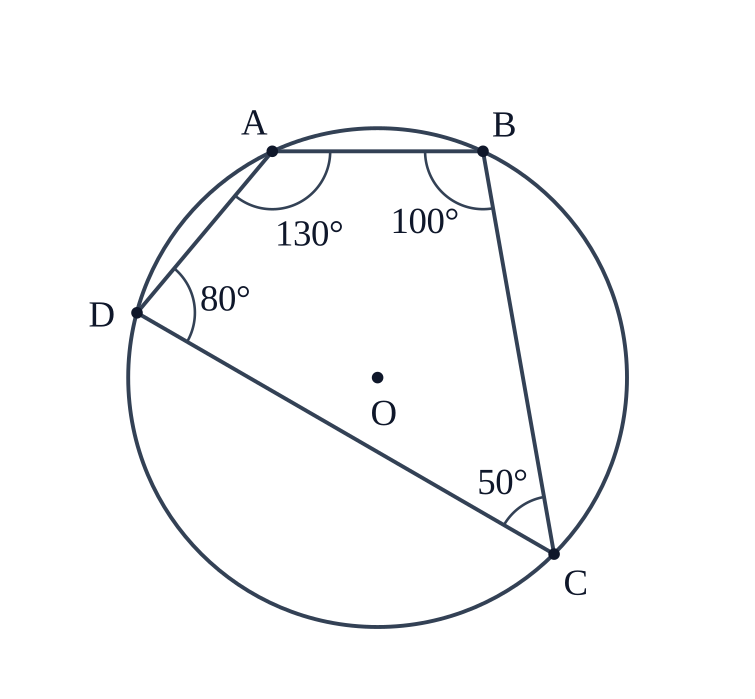
    The angles of a cyclic quadrilateral ABCD are ∠A=(6x+10)∘,∠B=(5x)∘∠C=(x+y)∘,∠D=(3y−10)∘\begin{array}{lr} \angle \mathrm{A}=(6 x+10)^{\circ}, & \angle \mathrm{B}=(5 x)^{\circ} \\ \angle \mathrm{C}=(x+y)^{\circ}, & \angle \mathrm{D}=(3 y-10)^{\circ} \end{array} Find x\displaystyle x and y\displaystyle y, and hence the values of the four angles.

    Matches the book, not yet reviewed

    This working reaches the answer NCERT prints. It has not yet been read through by hand.

    NCERT’s answer
    \(\displaystyle x=20, y=30\), \(\displaystyle \angle \mathrm{A}=130^{\circ}\), \(\displaystyle \angle \mathrm{B}=100^{\circ}\), \(\displaystyle \angle \mathrm{C}=50^{\circ}\), \(\displaystyle \angle \mathrm{D}=80^{\circ}\)
    NCERT_Solution_Class10_Maths_Exemplar_Ch3_Ex3-3_Q22 \[\angle A+\angle C = 180^\circ \quad \text{(opposite angles, cyclic quad.)} \] \[(6x+10)+(x+y) = 180 \] \[7x+y = 170 \] \[\angle B+\angle D = 180^\circ \] \[5x+(3y-10) = 180 \] \[5x+3y = 190 \] Substitute \(\displaystyle y=170-7x\): \[5x+3(170-7x) = 190 \] \[-16x = -320 \] \[x = 20,\quad y = 30 \] \[\angle A=130^\circ,\ \angle B=100^\circ,\ \angle C=50^\circ,\ \angle D=80^\circ \] Answer: \(\displaystyle x=20,\ y=30\); the angles are \(\displaystyle 130^\circ,100^\circ,50^\circ,80^\circ\).