SolveIt is under development
SolveItNCERT · CBSE · NEET

NCERT Exemplar · Class 10 Mathematics Pair of Linear Equations in Two Variables

54 questions · 54 still being checked

EXERCISE 3.2 1–6 (part 2 of 5)

  1. Exercise 1

    Do the following pair of linear equations have no solution? Justify your answer.
    (i)
    2x+4y=312y+6x=6\begin{aligned} & 2 x+4 y=3 \\ & 12 y+6 x=6 \end{aligned}
    (ii)
    x=2yy=2x\begin{aligned} & x=2 y \\ & y=2 x \end{aligned}
    (iii)
    3x+y−3=02x+23y=2\begin{aligned} & 3 x+y-3=0 \\ & 2 x+\frac{2}{3} y=2 \end{aligned}

    Matches the book, not yet reviewed

    This working reaches the answer NCERT prints. It has not yet been read through by hand.

    NCERT’s answer
    (i)
    Yes
    (ii)
    No
    (iii)
    No
    \[(i)\quad 2x+4y-3=0,\qquad 6x+12y-6=0 \] \[\frac{a_1}{a_2}=\frac{2}{6}=\frac13,\quad \frac{b_1}{b_2}=\frac{4}{12}=\frac13,\quad \frac{c_1}{c_2}=\frac{-3}{-6}=\frac12 \] \[\frac{a_1}{a_2}=\frac{b_1}{b_2}\neq\frac{c_1}{c_2}\ \Rightarrow\ \text{parallel lines, no solution} \] \[(ii)\quad x-2y=0,\qquad 2x-y=0 \] \[\frac{a_1}{a_2}=\frac12,\quad \frac{b_1}{b_2}=\frac{-2}{-1}=2 \] \[\frac{a_1}{a_2}\neq\frac{b_1}{b_2}\ \Rightarrow\ \text{intersecting lines, unique solution} \] \[(iii)\quad 3x+y-3=0,\qquad 2x+\frac23y-2=0\ \xrightarrow{\times 3}\ 6x+2y-6=0 \] \[\frac{a_1}{a_2}=\frac{b_1}{b_2}=\frac{c_1}{c_2}=\frac12\ \Rightarrow\ \text{coincident lines, infinitely many solutions} \] Answer: (i) Yes (ii) No (iii) No
  2. Exercise 2

    Do the following equations represent a pair of coincident lines? Justify your answer.
    (i)
    3x+17y=37x+3y=7\begin{aligned} & 3 x+\frac{1}{7} y=3 \\ & 7 x+3 y=7 \end{aligned}
    (ii)
    −2x−3y=16y+4x=−2\begin{aligned} & -2 x-3 y=1 \\ & 6 y+4 x=-2 \end{aligned}
    (iii)
    x2+y+25=04x+8y+516=0\begin{aligned} & \frac{x}{2}+y+\frac{2}{5}=0 \\ & 4 x+8 y+\frac{5}{16}=0 \end{aligned}

    Matches the book, not yet reviewed

    This working reaches the answer NCERT prints. It has not yet been read through by hand.

    NCERT’s answer
    (i)
    No
    (ii)
    Yes
    (iii)
    No
    \[(i)\quad 3x+\frac{1}{7}y-3=0,\qquad 7x+3y-7=0 \] \[\frac{a_1}{a_2}=\frac{3}{7},\quad \frac{b_1}{b_2}=\frac{1/7}{3}=\frac{1}{21} \] \[\frac{a_1}{a_2}\neq\frac{b_1}{b_2}\ \Rightarrow\ \text{intersecting lines, not coincident} \] \[(ii)\quad -2x-3y-1=0,\qquad 4x+6y+2=0 \] \[\frac{a_1}{a_2}=\frac{b_1}{b_2}=\frac{c_1}{c_2}=-\frac12\ \Rightarrow\ \text{coincident lines} \] \[(iii)\quad \frac{x}{2}+y+\frac{2}{5}=0,\qquad 4x+8y+\frac{5}{16}=0 \] \[\frac{a_1}{a_2}=\frac18=\frac{b_1}{b_2},\quad \frac{c_1}{c_2}=\frac{2/5}{5/16}=\frac{32}{25} \] \[\frac{a_1}{a_2}=\frac{b_1}{b_2}\neq\frac{c_1}{c_2}\ \Rightarrow\ \text{parallel lines, not coincident} \] Answer: (i) No (ii) Yes (iii) No
  3. Exercise 3

    Are the following pair of linear equations consistent? Justify your answer.
    (i)
    −3x−4y=124y+3x=12\begin{aligned} & -3 x-4 y=12 \\ & 4 y+3 x=12 \end{aligned}
    (ii)
    35x−y=1215x−3y=16\begin{aligned} & \frac{3}{5} x-y=\frac{1}{2} \\ & \frac{1}{5} x-3 y=\frac{1}{6} \end{aligned}
    (iii)
    2ax+by=a4ax+2by−2a=0;a,b≠0\begin{aligned} & 2 a x+b y=a \\ & 4 a x+2 b y-2 a=0 ; a, b \neq 0 \end{aligned}
    (iv)
    x+3y=112(2x+6y)=22\begin{aligned} & x+3 y=11 \\ & 2(2 x+6 y)=22 \end{aligned}

    Matches the book, not yet reviewed

    This working reaches the answer NCERT prints. It has not yet been read through by hand.

    NCERT’s answer
    (i)
    No
    (ii)
    Yes
    (iii)
    Yes
    (iv)
    No
    \[(i)\quad 3x+4y+12=0,\qquad 3x+4y-12=0 \] \[\frac{a_1}{a_2}=\frac{b_1}{b_2}=1\neq\frac{c_1}{c_2}=-1\ \Rightarrow\ \text{parallel, inconsistent} \] \[(ii)\quad \frac35x-y-\frac12=0,\qquad \frac15x-3y-\frac16=0 \] \[\frac{a_1}{a_2}=3\neq\frac{b_1}{b_2}=\frac13\ \Rightarrow\ \text{intersecting, consistent} \] \[(iii)\quad 2ax+by-a=0,\qquad 4ax+2by-2a=0\quad (a,b\neq0) \] \[\frac{a_1}{a_2}=\frac{b_1}{b_2}=\frac{c_1}{c_2}=\frac12\ \Rightarrow\ \text{coincident, consistent} \] \[(iv)\quad x+3y-11=0,\qquad 4x+12y-22=0 \] \[\frac{a_1}{a_2}=\frac{b_1}{b_2}=\frac14\neq\frac{c_1}{c_2}=\frac12\ \Rightarrow\ \text{parallel, inconsistent} \] Answer: (i) No (ii) Yes (iii) Yes (iv) No
  4. Exercise 4

    For the pair of equations λx+3y=−72x+6y=14\begin{aligned} & \lambda x+3 y=-7 \\ & 2 x+6 y=14 \end{aligned} to have infinitely many solutions, the value of λ\displaystyle \lambda should be 1. Is the statement true? Give reasons.

    Matches the book, not yet reviewed

    This working reaches the answer NCERT prints. It has not yet been read through by hand.

    NCERT’s answer
    No
    False. \[\lambda x+3y+7=0,\qquad 2x+6y-14=0 \] \[\frac{b_1}{b_2}=\frac{3}{6}=\frac12,\qquad \frac{c_1}{c_2}=\frac{7}{-14}=-\frac12 \] \[\frac{b_1}{b_2}\neq\frac{c_1}{c_2}\quad\text{for every }\lambda \] Infinitely many solutions needs all three ratios equal; since \(\displaystyle b_1/b_2\neq c_1/c_2\) always, no \(\displaystyle \lambda\) gives that -- at \(\displaystyle \lambda=1\) the lines are merely parallel, so there is no solution at all.
  5. Exercise 5

    For all real values of c\displaystyle c, the pair of equations x−2y=85x−10y=c\begin{aligned} & x-2 y=8 \\ & 5 x-10 y=c \end{aligned} have a unique solution. Justify whether it is true or false.

    Matches the book, not yet reviewed

    This working reaches the answer NCERT prints. It has not yet been read through by hand.

    NCERT’s answer
    False
    False. \[x-2y-8=0,\qquad 5x-10y-c=0 \] \[\frac{a_1}{a_2}=\frac{1}{5}=\frac{b_1}{b_2}=\frac{-2}{-10}\quad\text{for every }c \] Since \(\displaystyle a_1/a_2=b_1/b_2\) always, the lines are never intersecting: coincident (infinitely many solutions) when \(\displaystyle c=40\), parallel (no solution) otherwise -- a unique solution never occurs.
  6. Exercise 6

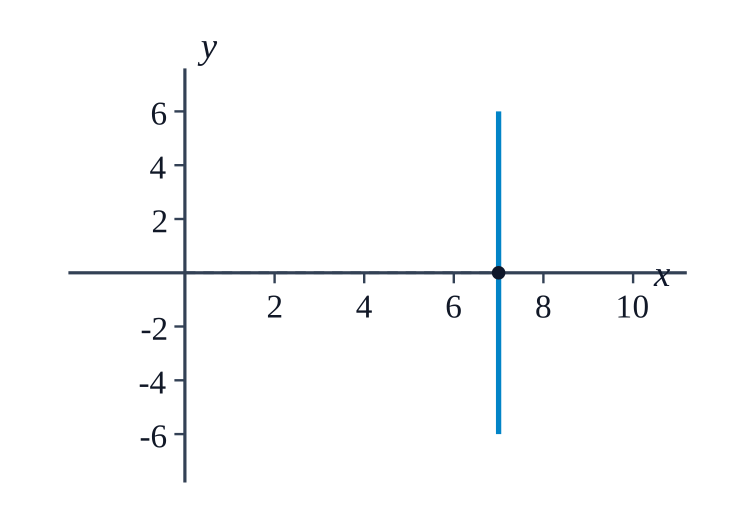
    The line represented by x=7\displaystyle x=7 is parallel to the x\displaystyle x-axis. Justify whether the statement is true or not.

    Matches the book, not yet reviewed

    This working reaches the answer NCERT prints. It has not yet been read through by hand.

    NCERT’s answer
    Not true
    False. \[x=7 \] is the set of points \(\displaystyle (7,y)\) for every \(\displaystyle y\) -- a line perpendicular to the \(\displaystyle x\)-axis, meeting it at \(\displaystyle (7,0)\), and parallel instead to the \(\displaystyle y\)-axis. NCERT_Solution_Class10_Maths_Exemplar_Ch3_Ex3-2_Q6