SolveIt is under development
SolveItNCERT · CBSE · NEET

NCERT Exemplar · Class 10 Mathematics Pair of Linear Equations in Two Variables

54 questions · 54 still being checked

EXERCISE 3.1 1–13 (part 1 of 5)

  1. Choose the correct answer from the given four options:

    Exercise 1

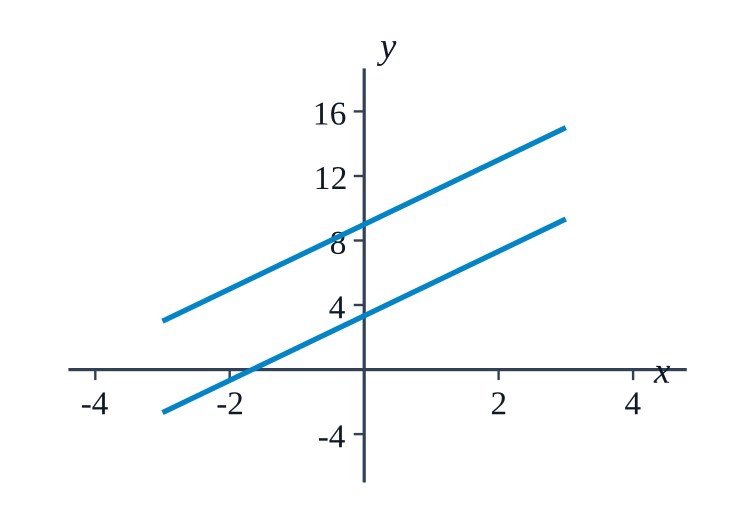
    Graphically, the pair of equations 6x−3y+10=02x−y+9=0\begin{aligned} & 6 x-3 y+10=0 \\ & 2 x-y+9=0 \end{aligned} represents two lines which are
    (A)
    intersecting at exactly one point.
    (B)
    intersecting at exactly two points.
    (C)
    coincident.
    (D)
    parallel.

    Matches the book, not yet reviewed

    This working reaches the answer NCERT prints. It has not yet been read through by hand.

    NCERT’s answer
    (D)
    (D) parallel. \[6x-3y+10=0, \qquad 2x-y+9=0 \] \[\frac{a_1}{a_2}=\frac{6}{2}=3, \qquad \frac{b_1}{b_2}=\frac{-3}{-1}=3, \qquad \frac{c_1}{c_2}=\frac{10}{9} \] \[\frac{a_1}{a_2}=\frac{b_1}{b_2}\neq\frac{c_1}{c_2} \] NCERT_Solution_Class10_Maths_Exemplar_Ch3_Ex3-1_Q1 Equal slope, unequal intercept: the lines never meet.
  2. Exercise 2

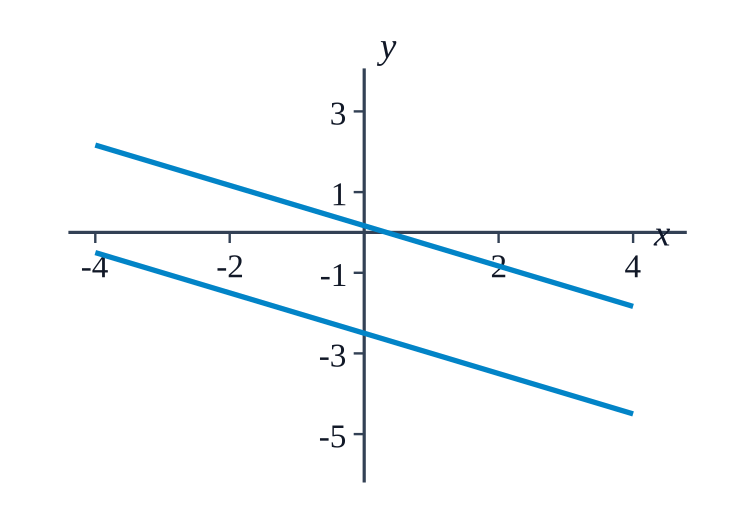
    The pair of equations x+2y+5=0\displaystyle x+2 y+5=0 and −3x−6y+1=0\displaystyle -3 x-6 y+1=0 have
    (A)
    a unique solution
    (B)
    exactly two solutions
    (C)
    infinitely many solutions
    (D)
    no solution

    Matches the book, not yet reviewed

    This working reaches the answer NCERT prints. It has not yet been read through by hand.

    NCERT’s answer
    (D)
    (D) no solution. \[x+2y+5=0, \qquad -3x-6y+1=0 \] \[\frac{a_1}{a_2}=\frac{1}{-3}, \qquad \frac{b_1}{b_2}=\frac{2}{-6}=\frac{1}{-3}, \qquad \frac{c_1}{c_2}=\frac{5}{1}=5 \] \[\frac{a_1}{a_2}=\frac{b_1}{b_2}\neq\frac{c_1}{c_2} \] NCERT_Solution_Class10_Maths_Exemplar_Ch3_Ex3-1_Q2 Parallel lines, equal slope \(\displaystyle -\tfrac12\), unequal intercepts.
  3. Exercise 3

    If a pair of linear equations is consistent, then the lines will be
    (A)
    parallel
    (B)
    always coincident
    (C)
    intersecting or coincident
    (D)
    always intersecting

    Matches the book, not yet reviewed

    This working reaches the answer NCERT prints. It has not yet been read through by hand.

    NCERT’s answer
    (C)
    (C) intersecting or coincident. \[\text{unique solution:}\quad \frac{a_1}{a_2}\neq\frac{b_1}{b_2} \] \[\text{infinitely many:}\quad \frac{a_1}{a_2}=\frac{b_1}{b_2}=\frac{c_1}{c_2} \] Both cases have a solution, so both are consistent; only \(\displaystyle \tfrac{a_1}{a_2}=\tfrac{b_1}{b_2}\neq\tfrac{c_1}{c_2}\) (parallel) is inconsistent.
  4. Exercise 4

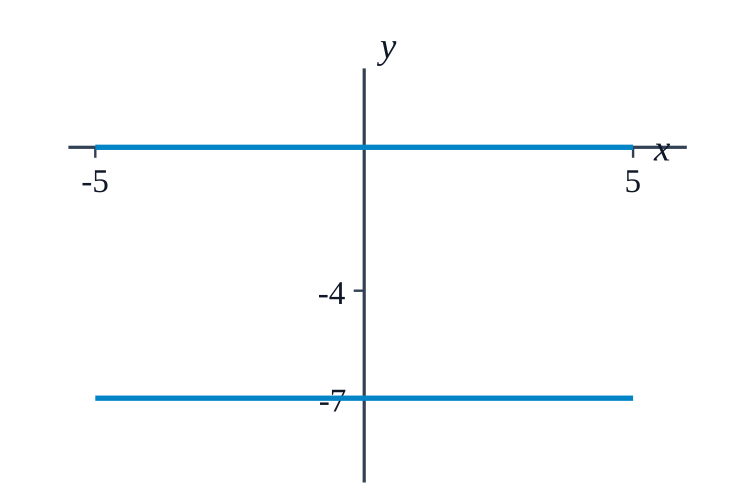
    The pair of equations y=0\displaystyle y=0 and y=−7\displaystyle y=-7 has
    (A)
    one solution
    (B)
    two solutions
    (C)
    infinitely many solutions
    (D)
    no solution

    Matches the book, not yet reviewed

    This working reaches the answer NCERT prints. It has not yet been read through by hand.

    NCERT’s answer
    (D)
    (D) no solution. \[y=0 \quad\text{and}\quad y=-7 \;\Rightarrow\; 0=-7 \] NCERT_Solution_Class10_Maths_Exemplar_Ch3_Ex3-1_Q4 Contradiction: two distinct horizontal lines share no point.
  5. Exercise 5

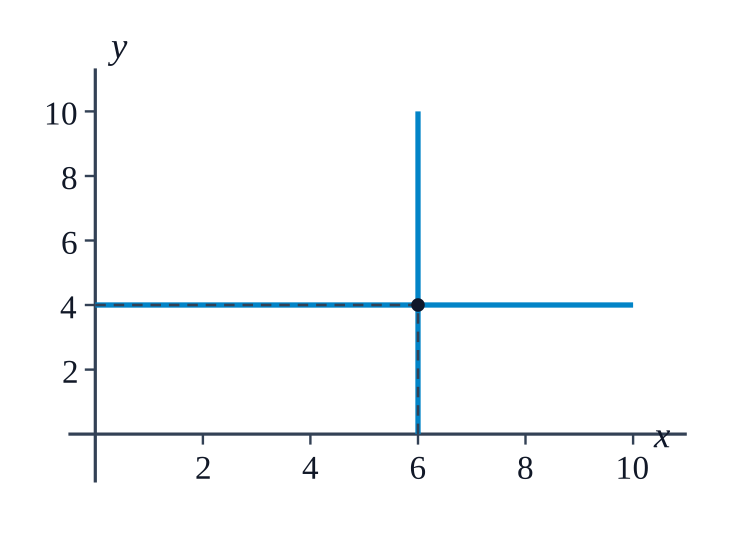
    The pair of equations x=a\displaystyle x=a and y=b\displaystyle y=b graphically represents lines which are
    (A)
    parallel
    (B)
    intersecting at (b,a)\displaystyle (b, a)
    (C)
    coincident
    (D)
    intersecting at (a,b)\displaystyle (a, b)

    Matches the book, not yet reviewed

    This working reaches the answer NCERT prints. It has not yet been read through by hand.

    NCERT’s answer
    (D)
    (D) intersecting at \(\displaystyle (a,b)\). \[x=a \ (\text{vertical line}), \qquad y=b \ (\text{horizontal line}) \] NCERT_Solution_Class10_Maths_Exemplar_Ch3_Ex3-1_Q5 The only point with \(\displaystyle x=a\) and \(\displaystyle y=b\) together is \(\displaystyle (a,b)\).
  6. Exercise 6

    For what value of k\displaystyle k, do the equations 3x−y+8=0\displaystyle 3 x-y+8=0 and 6x−ky=−16\displaystyle 6 x-k y=-16 represent coincident lines?
    (A)
    12\displaystyle \frac{1}{2}
    (B)
    −12\displaystyle -\frac{1}{2}
    (C)
    2\displaystyle 2 (D) -2\displaystyle 2

    Matches the book, not yet reviewed

    This working reaches the answer NCERT prints. It has not yet been read through by hand.

    NCERT’s answer
    (C)
    (C) 2. \[3x-y+8=0, \qquad 6x-ky+16=0 \quad(\text{from } 6x-ky=-16) \] \[\frac{a_1}{a_2}=\frac{3}{6}=\frac12, \qquad \frac{c_1}{c_2}=\frac{8}{16}=\frac12 \] \[\frac{b_1}{b_2}=\frac{-1}{-k}=\frac{1}{k}=\frac12 \;\Rightarrow\; k=2 \] Coincident lines need all three ratios equal.
  7. Exercise 7

    If the lines given by 3x+2ky=2\displaystyle 3 x+2 k y=2 and 2x+5y+1=0\displaystyle 2 x+5 y+1=0 are parallel, then the value of k\displaystyle k is
    (A)
    −54\displaystyle \frac{-5}{4}
    (B)
    25\displaystyle \frac{2}{5}
    (C)
    154\displaystyle \frac{15}{4}
    (D)
    32\displaystyle \frac{3}{2}

    Matches the book, not yet reviewed

    This working reaches the answer NCERT prints. It has not yet been read through by hand.

    NCERT’s answer
    (C)
    (C) \(\displaystyle \frac{15}{4}\). \[3x+2ky-2=0, \qquad 2x+5y+1=0 \] \[\frac{a_1}{a_2}=\frac{3}{2}=\frac{b_1}{b_2}=\frac{2k}{5} \;\Rightarrow\; k=\frac{15}{4} \] \[\frac{c_1}{c_2}=\frac{-2}{1}=-2 \neq \frac32 \] Ratio unequal to \(\displaystyle c_1/c_2\): the lines are parallel, not coincident.
  8. Exercise 8

    The value of c\displaystyle c for which the pair of equations cx−y=2\displaystyle c x-y=2 and 6x−2y=3\displaystyle 6 x-2 y=3 will have infinitely many solutions is
    (A)
    3\displaystyle 3 (B) - 3\displaystyle 3 (C) -12\displaystyle 12
    (D)
    no value

    Matches the book, not yet reviewed

    This working reaches the answer NCERT prints. It has not yet been read through by hand.

    NCERT’s answer
    (D)
    (D) no value. \[cx-y=2,\qquad 6x-2y=3 \] For infinitely many solutions \(\displaystyle \dfrac{a_1}{a_2}=\dfrac{b_1}{b_2}=\dfrac{c_1}{c_2} \). \[\frac{b_1}{b_2}=\frac{-1}{-2}=\frac12,\qquad \frac{c_1}{c_2}=\frac{2}{3} \] \[\frac12\neq\frac23 \] These two ratios already disagree, so no \(\displaystyle c\) can equalise all three.
  9. Exercise 9

    One equation of a pair of dependent linear equations is −5x+7y=2\displaystyle -5 x+7 y=2. The second equation can be
    (A)
    10x+14y+4=0\displaystyle 10 x+14 y+4=0
    (B)
    −10x−14y+4=0\displaystyle -10 x-14 y+4=0
    (C)
    −10x+14y+4=0\displaystyle -10 x+14 y+4=0
    (D)
    10x−14y=−4\displaystyle 10 x-14 y=-4

    Matches the book, not yet reviewed

    This working reaches the answer NCERT prints. It has not yet been read through by hand.

    NCERT’s answer
    (D)
    (D) \(\displaystyle 10x-14y=-4\). \[-5x+7y=2 \] Dependent equations satisfy \(\displaystyle \dfrac{a_1}{a_2}=\dfrac{b_1}{b_2}=\dfrac{c_1}{c_2} \). \[\frac{-5}{10}=\frac{7}{-14}=\frac{2}{-4}=-\frac12 \] All three ratios equal \(\displaystyle -\tfrac12\), so this is the same line.
  10. Exercise 10

    A pair of linear equations which has a unique solution x=2,y=−3\displaystyle x=2, y=-3 is
    (A)
    x+y=−1\displaystyle x+y=-1 2x−3y=−5\displaystyle 2 x-3 y=-5
    (B)
    2x+5y=−11\displaystyle 2 x+5 y=-11 4x+10y=−22\displaystyle 4 x+10 y=-22
    (C)
    2x−y=1\displaystyle 2 x-y=1 3x+2y=0\displaystyle 3 x+2 y=0
    (D)
    x−4y−14=0\displaystyle x-4 y-14=0 5x−y−13=0\displaystyle 5 x-y-13=0

    Matches the book, not yet reviewed

    This working reaches the answer NCERT prints. It has not yet been read through by hand.

    NCERT’s answer
    (D)
    (D) \(\displaystyle x-4y-14=0,\ 5x-y-13=0\). \[2-4(-3)-14=0,\qquad 5(2)-(-3)-13=0 \] Both hold at \(\displaystyle (2,-3)\). \[\frac{1}{5}\neq\frac{-4}{-1} \] Unequal ratios give a unique solution, confirming the pair.
  11. Exercise 11

    If x=a,y=b\displaystyle x=a, y=b is the solution of the equations x−y=2\displaystyle x-y=2 and x+y=4\displaystyle x+y=4, then the values of a\displaystyle a and b\displaystyle b are, respectively
    (A)
    3\displaystyle 3 and 5\displaystyle 5
    (B)
    5\displaystyle 5 and 3\displaystyle 3
    (C)
    3\displaystyle 3 and 1\displaystyle 1
    (D)
    -1\displaystyle 1 and -3\displaystyle 3

    Matches the book, not yet reviewed

    This working reaches the answer NCERT prints. It has not yet been read through by hand.

    NCERT’s answer
    (C)
    (C) $\displaystyle 3$ and 1. \[x-y=2,\qquad x+y=4 \] Adding: \[2x=6\Rightarrow x=3 \] \[y=4-3=1 \] So \(\displaystyle a=3,\ b=1\).
  12. Exercise 12

    Aruna has only Re 1\displaystyle 1 and Rs 2\displaystyle 2 coins with her. If the total number of coins that she has is 50\displaystyle 50 and the amount of money with her is Rs 75\displaystyle 75, then the number of Re 1\displaystyle 1 and Rs 2\displaystyle 2 coins are, respectively
    (A)
    35\displaystyle 35 and 15\displaystyle 15
    (B)
    35\displaystyle 35 and 20\displaystyle 20
    (C)
    15\displaystyle 15 and 35\displaystyle 35
    (D)
    25\displaystyle 25 and 25\displaystyle 25

    Matches the book, not yet reviewed

    This working reaches the answer NCERT prints. It has not yet been read through by hand.

    NCERT’s answer
    (D)
    (D) $\displaystyle 25$ and 25. Let \(\displaystyle x\) = Re $\displaystyle 1$ coins, \(\displaystyle y\) = Rs $\displaystyle 2$ coins. \[x+y=50 \] \[x+2y=75 \] Subtracting: \[y=25,\qquad x=25 \]
  13. Exercise 13

    The father's age is six times his son's age. Four years hence, the age of the father will be four times his son's age. The present ages, in years, of the son and the father are, respectively
    (A)
    4\displaystyle 4 and 24\displaystyle 24
    (B)
    5\displaystyle 5 and 30\displaystyle 30
    (C)
    6\displaystyle 6 and 36\displaystyle 36
    (D)
    3\displaystyle 3 and 24\displaystyle 24

    Matches the book, not yet reviewed

    This working reaches the answer NCERT prints. It has not yet been read through by hand.

    NCERT’s answer
    (C)
    (C) $\displaystyle 6$ and 36. Let the son's present age be \(\displaystyle x\); the father's is \(\displaystyle 6x\). \[6x+4=4(x+4) \] \[6x+4=4x+16 \] \[2x=12\Rightarrow x=6 \] Father's age \(\displaystyle =6(6)=36\).