SolveIt is under development
SolveItNCERT · CBSE · NEET

NCERT Exemplar · Class 10 Mathematics Pair of Linear Equations in Two Variables

54 questions · 54 still being checked

EXERCISE 3.4 1–13 (part 5 of 5)

  1. Exercise 1

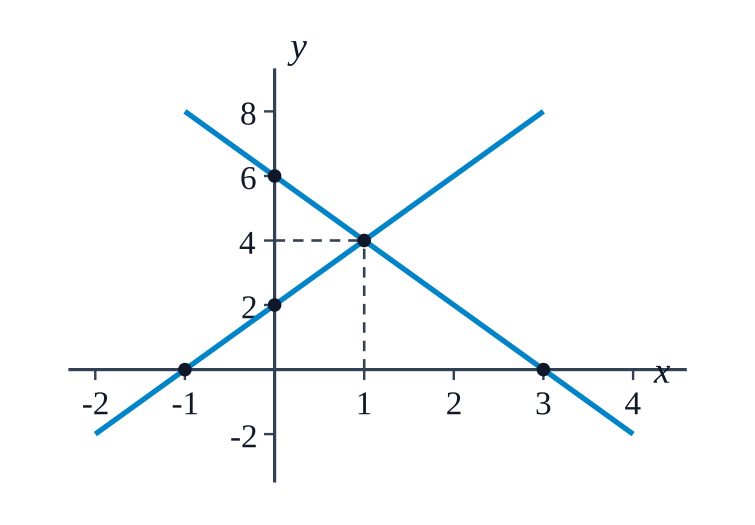
    Graphically, solve the following pair of equations: 2x+y=62x−y+2=0\begin{aligned} & 2 x+y=6 \\ & 2 x-y+2=0 \end{aligned} Find the ratio of the areas of the two triangles formed by the lines representing these equations with the x\displaystyle x-axis and the lines with the y\displaystyle y-axis.

    Matches the book, not yet reviewed

    This working reaches the answer NCERT prints. It has not yet been read through by hand.

    NCERT’s answer
    \(\displaystyle x=1, y=4\); \(\displaystyle 4:1\)
    \[2x+y=6 \quad (i) \] \[2x-y+2=0 \quad (ii) \] Adding (i) and (ii): \[4x=4 \implies x=1,\ y=4 \] NCERT_Solution_Class10_Maths_Exemplar_Ch3_Ex3-4_Q1 Line (i) meets the axes at \(\displaystyle A(3,0)\) and \(\displaystyle C(0,6)\); line (ii) meets them at \(\displaystyle B(-1,0)\) and \(\displaystyle D(0,2)\). Triangle with the \(\displaystyle x\)-axis has vertices \(\displaystyle P(1,4), A(3,0), B(-1,0)\): \[\text{Area}_1=\tfrac12\times AB\times y_P=\tfrac12\times 4\times 4=8 \] Triangle with the \(\displaystyle y\)-axis has vertices \(\displaystyle P(1,4), C(0,6), D(0,2)\): \[\text{Area}_2=\tfrac12\times CD\times x_P=\tfrac12\times 4\times 1=2 \] \[\text{Area}_1:\text{Area}_2=8:2=4:1 \] Answer: \(\displaystyle x=1,\ y=4\); ratio \(\displaystyle 4:1\)
  2. Exercise 2

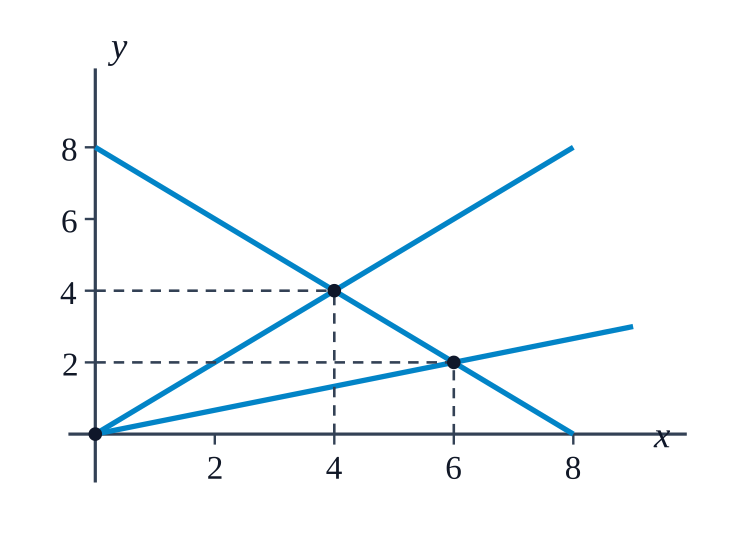
    Determine, graphically, the vertices of the triangle formed by the lines y=x,3y=x,x+y=8y=x, \quad 3 y=x, \quad x+y=8

    Matches the book, not yet reviewed

    This working reaches the answer NCERT prints. It has not yet been read through by hand.

    NCERT’s answer
    $\displaystyle (0, 0)$, $\displaystyle (4, 4)$, $\displaystyle (6, 2)$
    \[y=x,\quad y=\tfrac{x}{3},\quad x+y=8 \] \[y=x,\ y=\tfrac{x}{3}\ \implies\ x=\tfrac{x}{3}\ \implies\ x=0,\ y=0 \] \[y=x,\ x+y=8\ \implies\ 2x=8\ \implies\ x=4,\ y=4 \] \[y=\tfrac{x}{3},\ x+y=8\ \implies\ x+\tfrac{x}{3}=8\ \implies\ x=6,\ y=2 \] NCERT_Solution_Class10_Maths_Exemplar_Ch3_Ex3-4_Q2 Answer: Vertices \(\displaystyle (0,0),\ (4,4),\ (6,2)\)
  3. Exercise 3

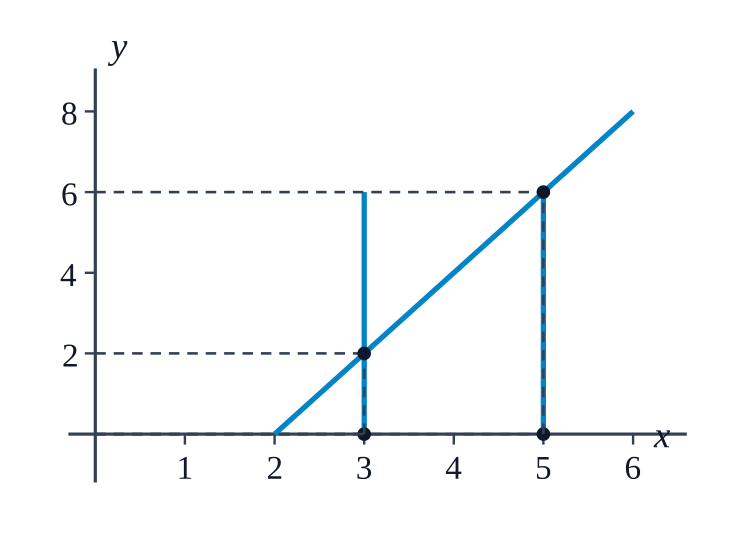
    Draw the graphs of the equations x=3,x=5\displaystyle x=3, x=5 and 2x−y−4=0\displaystyle 2 x-y-4=0. Also find the area of the quadrilateral formed by the lines and the x\displaystyle x-axis.

    Matches the book, not yet reviewed

    This working reaches the answer NCERT prints. It has not yet been read through by hand.

    NCERT’s answer
    $\displaystyle 8$ sq. units
    \[x=3,\quad x=5,\quad y=2x-4 \] \[x=3:\ y=2,\qquad x=5:\ y=6 \] NCERT_Solution_Class10_Maths_Exemplar_Ch3_Ex3-4_Q3 Quadrilateral \(\displaystyle A(3,0), B(5,0), C(5,6), D(3,2)\) is a trapezium: \(\displaystyle AD=2\), \(\displaystyle BC=6\), width \(\displaystyle =5-3=2\). \[\text{Area}=\tfrac12(AD+BC)\times\text{width}=\tfrac12(2+6)\times 2=8 \] Answer: \(\displaystyle 8\) sq units
  4. Exercise 4

    The cost of 4\displaystyle 4 pens and 4\displaystyle 4 pencil boxes is Rs 100. Three times the cost of a pen is Rs 15\displaystyle 15 more than the cost of a pencil box. Form the pair of linear equations for the above situation. Find the cost of a pen and a pencil box.

    Matches the book, not yet reviewed

    This working reaches the answer NCERT prints. It has not yet been read through by hand.

    NCERT’s answer
    \(\displaystyle 4 x+4 y=100,3 x=y+15\), where Rs \(\displaystyle x\) and Rs \(\displaystyle y\) are the costs of a pen and a pencil box respectively; Rs $\displaystyle 10$, Rs $\displaystyle 15$
    Let pen \(\displaystyle =x\), pencil box \(\displaystyle =y\) (Rs). \[4x+4y=100\ \implies\ x+y=25 \quad (i) \] \[3x=y+15\ \implies\ 3x-y=15 \quad (ii) \] Adding (i) and (ii): \[4x=40\ \implies\ x=10,\ y=15 \] Answer: Pen \(\displaystyle =\) Rs $\displaystyle 10$, pencil box \(\displaystyle =\) Rs $\displaystyle 15$
  5. Exercise 5

    Determine, algebraically, the vertices of the triangle formed by the lines 3x−y=32x−3y=2x+2y=8\begin{aligned} & 3 x-y=3 \\ & 2 x-3 y=2 \\ & x+2 y=8 \end{aligned}

    Matches the book, not yet reviewed

    This working reaches the answer NCERT prints. It has not yet been read through by hand.

    NCERT’s answer
    $\displaystyle (1, 0)$, $\displaystyle (2, 3)$, $\displaystyle (4, 2)$
    \[3x-y=3\ (i),\quad 2x-3y=2\ (ii),\quad x+2y=8\ (iii) \]
    (i)
    & (ii): \(\displaystyle y=3x-3\)
    \[2x-3(3x-3)=2\ \implies\ -7x=-7\ \implies\ x=1,\ y=0 \]
    (i)
    & (iii):
    \[x+2(3x-3)=8\ \implies\ 7x=14\ \implies\ x=2,\ y=3 \]
    (ii)
    & (iii): \(\displaystyle x=8-2y\)
    \[2(8-2y)-3y=2\ \implies\ -7y=-14\ \implies\ y=2,\ x=4 \]
    Answer: Vertices \(\displaystyle (1,0),\ (2,3),\ (4,2)\)
  6. Exercise 6

    Ankita travels 14\displaystyle 14 km to her home partly by rickshaw and partly by bus. She takes half an hour if she travels 2\displaystyle 2 km by rickshaw, and the remaining distance by bus. On the other hand, if she travels 4\displaystyle 4 km by rickshaw and the remaining distance by bus, she takes 9\displaystyle 9 minutes longer. Find the speed of the rickshaw and of the bus.

    Matches the book, not yet reviewed

    This working reaches the answer NCERT prints. It has not yet been read through by hand.

    NCERT’s answer
    $\displaystyle 10$ km/h, $\displaystyle 40$ km/h
    Let rickshaw speed \(\displaystyle =x\) km/h, bus speed \(\displaystyle =y\) km/h, \(\displaystyle u=\tfrac1x,\ v=\tfrac1y\). \[\frac{2}{x}+\frac{12}{y}=\frac12\ \implies\ 2u+12v=\frac12 \quad (i) \] \[\frac{4}{x}+\frac{10}{y}=\frac{39}{60}\ \implies\ 4u+10v=\frac{13}{20} \quad (ii) \] \(\displaystyle 2\times(i)\): \(\displaystyle 4u+24v=1\ (i')\) \[(i')-(ii):\quad 14v=\frac{7}{20}\ \implies\ v=\frac1{40}\ \implies\ y=40 \] \[4u+\frac{24}{40}=1\ \implies\ u=\frac1{10}\ \implies\ x=10 \] Answer: Rickshaw \(\displaystyle =10\) km/h, bus \(\displaystyle =40\) km/h
  7. Exercise 7

    A person, rowing at the rate of 5\displaystyle 5 km/h in still water, takes thrice as much time in going 40\displaystyle 40 km upstream as in going 40\displaystyle 40 km downstream. Find the speed of the stream.

    Matches the book, not yet reviewed

    This working reaches the answer NCERT prints. It has not yet been read through by hand.

    NCERT’s answer
    2.$\displaystyle 5$ km/h
    Let stream speed \(\displaystyle =x\) km/h; downstream speed \(\displaystyle =5+x\), upstream speed \(\displaystyle =5-x\). \[\frac{40}{5-x}=3\times\frac{40}{5+x} \] \[5+x=3(5-x)\ \implies\ 4x=10\ \implies\ x=2.5 \] Answer: \(\displaystyle 2.5\) km/h
  8. Exercise 8

    A motor boat can travel 30\displaystyle 30 km upstream and 28\displaystyle 28 km downstream in 7\displaystyle 7 hours. It can travel 21\displaystyle 21 km upstream and return in 5\displaystyle 5 hours. Find the speed of the boat in still water and the speed of the stream.

    Matches the book, not yet reviewed

    This working reaches the answer NCERT prints. It has not yet been read through by hand.

    NCERT’s answer
    $\displaystyle 10$ km/h, $\displaystyle 4$ km/h
    Let the speed of the boat in still water be \(\displaystyle x \) km/h and the speed of the stream be \(\displaystyle y \) km/h, so the upstream speed is \(\displaystyle x-y \) and the downstream speed is \(\displaystyle x+y \). Put \(\displaystyle u=\dfrac{1}{x-y} \), \(\displaystyle v=\dfrac{1}{x+y} \). \[30u+28v=7 \] \[21u+21v=5 \implies u+v=\frac{5}{21} \] Substituting \(\displaystyle u=\frac{5}{21}-v \): \[30\left(\frac{5}{21}-v\right)+28v=7 \] \[\frac{150}{21}-2v=7 \implies v=\frac{1}{14} \] \[u=\frac{5}{21}-\frac{1}{14}=\frac{1}{6} \] \[x-y=\frac{1}{u}=6, \qquad x+y=\frac{1}{v}=14 \] \[x=10, \quad y=4 \] Answer: speed of the boat in still water \(\displaystyle =10 \) km/h, speed of the stream \(\displaystyle =4 \) km/h.
  9. Exercise 9

    A two-digit number is obtained by either multiplying the sum of the digits by 8\displaystyle 8 and then subtracting 5\displaystyle 5 or by multiplying the difference of the digits by 16\displaystyle 16 and then adding 3. Find the number.

    Matches the book, not yet reviewed

    This working reaches the answer NCERT prints. It has not yet been read through by hand.

    NCERT’s answer
    $\displaystyle 83$
    Let the tens digit be \(\displaystyle x \) and the units digit be \(\displaystyle y \), so the number is \(\displaystyle 10x+y \). \[8(x+y)-5=10x+y \implies 2x-7y=-5 \] \[16(x-y)+3=10x+y \implies 6x-17y=-3 \] From the first equation, \(\displaystyle x=\dfrac{7y-5}{2} \); substituting: \[6\cdot\frac{7y-5}{2}-17y=-3 \implies 4y=12 \implies y=3 \] \[x=\frac{7(3)-5}{2}=8 \] \[10x+y=10(8)+3=83 \] Answer: the number is \(\displaystyle 83 \).
  10. Exercise 10

    A railway half ticket costs half the full fare, but the reservation charges are the same on a half ticket as on a full ticket. One reserved first class ticket from the station A to B costs Rs 2530. Also, one reserved first class ticket and one reserved first class half ticket from A to B costs Rs 3810. Find the full first class fare from station A to B, and also the reservation charges for a ticket.

    Matches the book, not yet reviewed

    This working reaches the answer NCERT prints. It has not yet been read through by hand.

    NCERT’s answer
    Rs $\displaystyle 2500$, Rs $\displaystyle 30$
    Let the full fare be Rs \(\displaystyle x \) and the reservation charge be Rs \(\displaystyle y \) (same on a full or half ticket). \[x+y=2530 \] \[(x+y)+\left(\frac{x}{2}+y\right)=3810 \implies \frac{x}{2}+y=1280 \] Subtracting: \[x-\frac{x}{2}=2530-1280 \implies \frac{x}{2}=1250 \implies x=2500 \] \[y=2530-2500=30 \] Answer: full first class fare \(\displaystyle =\text{Rs } 2500 \), reservation charge \(\displaystyle =\text{Rs } 30 \).
  11. Exercise 11

    A shopkeeper sells a saree at 8\displaystyle 8% profit and a sweater at 10\displaystyle 10% discount, thereby, getting a sum Rs 1008. If she had sold the saree at 10\displaystyle 10% profit and the sweater at 8\displaystyle 8% discount, she would have got Rs 1028. Find the cost price of the saree and the list price (price before discount) of the sweater.

    Matches the book, not yet reviewed

    This working reaches the answer NCERT prints. It has not yet been read through by hand.

    NCERT’s answer
    Rs $\displaystyle 600$, Rs $\displaystyle 400$
    Let the cost price of the saree be Rs \(\displaystyle x \) and the list price of the sweater be Rs \(\displaystyle y \). \[1.08x+0.90y=1008 \] \[1.10x+0.92y=1028 \] Multiplying by $\displaystyle 50$: \[54x+45y=50400 \] \[55x+46y=51400 \] Eliminating \(\displaystyle y \): \[46(54x+45y)-45(55x+46y)=46(50400)-45(51400) \] \[9x=5400 \implies x=600 \] \[45y=50400-54(600)=18000 \implies y=400 \] Answer: cost price of the saree \(\displaystyle =\text{Rs } 600 \), list price of the sweater \(\displaystyle =\text{Rs } 400 \).
  12. Exercise 12

    Susan invested certain amount of money in two schemes A and B, which offer interest at the rate of 8\displaystyle 8% per annum and 9\displaystyle 9% per annum, respectively. She received Rs 1860\displaystyle 1860 as annual interest. However, had she interchanged the amount of investments in the two schemes, she would have received Rs 20\displaystyle 20 more as annual interest. How much money did she invest in each scheme?

    Matches the book, not yet reviewed

    This working reaches the answer NCERT prints. It has not yet been read through by hand.

    NCERT’s answer
    Rs $\displaystyle 12000$ in scheme A, Rs $\displaystyle 10000$ in scheme B
    Let Susan invest Rs \(\displaystyle x \) in scheme A ($\displaystyle 8$%) and Rs \(\displaystyle y \) in scheme B ($\displaystyle 9$%). \[0.08x+0.09y=1860 \] \[0.09x+0.08y=1880 \] Adding: \[0.17(x+y)=3740 \implies x+y=22000 \] Subtracting the first from the second: \[0.01(x-y)=20 \implies x-y=2000 \] \[x=12000, \quad y=10000 \] Answer: Rs \(\displaystyle 12{,}000 \) in scheme A ($\displaystyle 8$%), Rs \(\displaystyle 10{,}000 \) in scheme B ($\displaystyle 9$%).
  13. Exercise 13

    Vijay had some bananas, and he divided them into two lots A and B. He sold the first lot at the rate of Rs 2\displaystyle 2 for 3\displaystyle 3 bananas and the second lot at the rate of Re 1\displaystyle 1 per banana, and got a total of Rs 400. If he had sold the first lot at the rate of Re 1\displaystyle 1 per banana, and the second lot at the rate of Rs 4\displaystyle 4 for 5\displaystyle 5 bananas, his total collection would have been Rs 460. Find the total number of bananas he had.

    Matches the book, not yet reviewed

    This working reaches the answer NCERT prints. It has not yet been read through by hand.

    NCERT’s answer
    $\displaystyle 500$
    Let lot A have \(\displaystyle x \) bananas and lot B have \(\displaystyle y \) bananas. \[\frac{2}{3}x+y=400 \] \[x+\frac{4}{5}y=460 \] Clearing fractions: \[2x+3y=1200 \] \[5x+4y=2300 \] Eliminating \(\displaystyle y \): \[4(2x+3y)-3(5x+4y)=4(1200)-3(2300) \] \[-7x=-2100 \implies x=300 \] \[3y=1200-2(300)=600 \implies y=200 \] \[x+y=300+200=500 \] Answer: Vijay had \(\displaystyle 500 \) bananas in all.