✓ Board-verified
Physics · 2026 · 4 marks
CBSE 2026 · Region 5 · Set 1 · Q29
The electric potential (V) and electric field (E) are closely related concepts in electrostatics. The electric field is a vector quantity that…
The electric potential (V) and electric field (E) are closely related concepts in electrostatics. The electric field is a vector quantity that represents the force per unit charge at a given point in space, whereas electric potential is a scalar quantity that represents the potential energy per unit charge at a given point in space. Electric field and electric potential are related by the equations $\displaystyle \mathrm{E}_{\mathrm{r}}=\frac{-\mathrm{dV}}{\mathrm{dr}}$ and $\displaystyle \overrightarrow{\mathrm{E}}=\mathrm{E}_{\mathrm{r}} \hat{\mathrm{r}}$, i.e., electric field is the negative gradient of the electric potential. This means that electric field points in the direction of decreasing potential and its magnitude is the rate of change of potential with distance. The electric field is the force that drives a unit charge to move from higher potential region to lower potential region and electric potential difference between the two points determines the work done in moving a unit charge from one point to the other point.
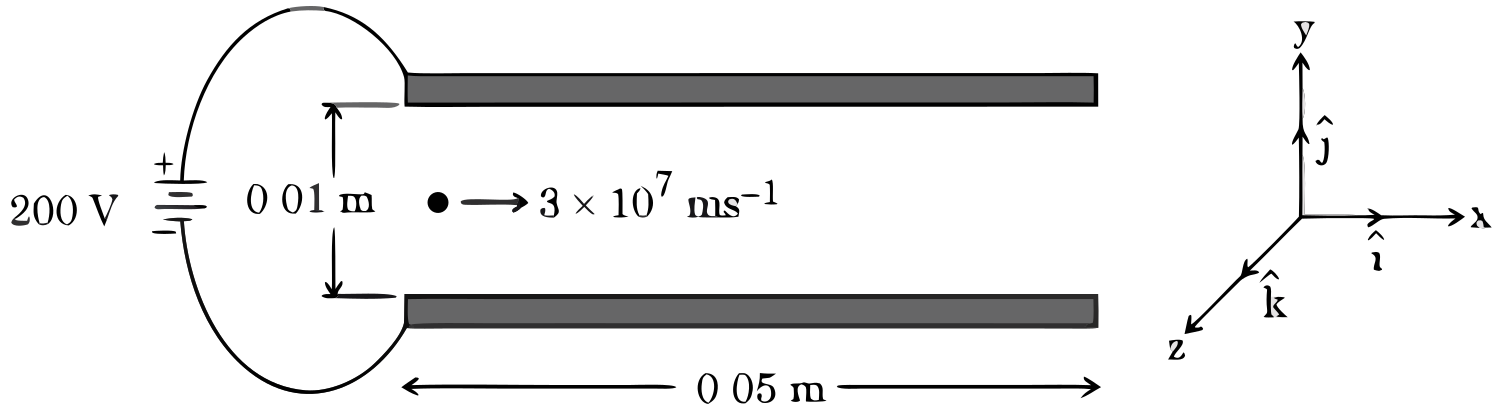
A pair of square conducting plates having sides of length $\displaystyle 0.05$ m are arranged parallel to each other in x-y plane. They are $\displaystyle 0.01$ m apart along z-axis and are connected to a $\displaystyle 200$ V power supply as shown in the figure. An electron enters with a speed of $\displaystyle 3 \times 10^{7} \mathrm{~ms}^{-1}$ horizontally and symmetrically in the space between the two plates. Neglect the effect of gravity on the electron.
(i)
The electric field $\displaystyle \overrightarrow{\mathrm{E}}$ in the region between the plates is :
(A)
$\displaystyle \left(2 \times 10^{2} \frac{\mathrm{~V}}{\mathrm{~m}}\right) \hat{\mathrm{k}}$
(B)
$\displaystyle -\left(2 \times 10^{2} \frac{\mathrm{~V}}{\mathrm{~m}}\right) \hat{\mathrm{k}}$
(C)
$\displaystyle \left(2 \times 10^{4} \frac{\mathrm{~V}}{\mathrm{~m}}\right) \hat{\mathrm{k}}$
(D)
$\displaystyle -\left(2 \times 10^{4} \frac{\mathrm{~V}}{\mathrm{~m}}\right) \hat{\mathrm{k}}$
(ii)
In the region between the plates, the electron moves with an acceleration $\displaystyle \overrightarrow{\mathrm{a}}$ given by :
(A)
$\displaystyle -\left(3 \cdot 5 \times 10^{15} \mathrm{~ms}^{-2}\right) \hat{\mathrm{k}}$
(B)
$\displaystyle \left(3.5 \times 10^{15} \mathrm{~ms}^{-2}\right) \hat{\mathrm{k}}$
(C)
$\displaystyle \left(3 \cdot 5 \times 10^{13} \mathrm{~ms}^{-2}\right) \hat{\mathrm{i}}$
(D)
$\displaystyle -\left(3 \cdot 5 \times 10^{13} \mathrm{~ms}^{-2}\right) \hat{\mathrm{i}}$
(iii)
(a)
Time interval during which an electron moves through the region between the plates is :
(A)
$\displaystyle 9.0 \times 10^{-9} \mathrm{~s}$
(B)
$\displaystyle 1.67 \times 10^{-8} \mathrm{~s}$
(C)
$\displaystyle 1.67 \times 10^{-9} \mathrm{~s}$
(D)
$\displaystyle 2 \cdot 17 \times 10^{-9} \mathrm{~s}$
OR
(b)
The vertical displacement of the electron which travels through the region between the plates is :
(A)
$\displaystyle 10$ mm
(B)
4.$\displaystyle 9$ mm
(C)
$\displaystyle 5 \cdot 9 \mathrm{~mm}$
(D)
3.$\displaystyle 0$ mm
(iv)
Which one of the following is the path traced by the electron in between the two plates ?
(A)
a
(B) b
(C) c
(D) d
Marking-scheme solution
(i)(D)
$\displaystyle \left(-2 \times 10^{4} \mathrm{~V} / \mathrm{m}\right) \hat{k}$
(ii)(B)
$\displaystyle \left(3.5 \times 10^{15} \mathrm{~m} / \mathrm{s}^{2}\right) \hat{k}$
(iii)(a)
(C) $\displaystyle 1.67 \times 10^{-9} \mathrm{~s}$ OR (b) (B) $\displaystyle 4.9$ mm
(iv)(B)
b
All Electrostatic Potential and Capacitance questions2026 question paperNCERT solutions: Electrostatic Potential and CapacitancePractice Electrostatic Potential and Capacitance →
More from Electrostatic Potential and Capacitance
- (i) A parallel plate capacitor with plate area A and plate separation d has a capacitance C_0. A slab of dielectric constant K having area A and…2025
- (i) In the figure, OA and OB show the variation of electric potential V at a point due to two point charges Q_1 and Q_2 with 1/r respectively. Here r…2026
- A point charge q_0 is moving along a circular path of radius a, with a point charge -Q at the centre of the circle. The kinetic energy of q_0 is2023
- The effective capacitance of the network between points A and B shown in the figure is:2025
- Two metal spheres of radii r_1 and r_2(>r_1) having charges q_1 and q_2 respectively kept in air, are brought in contact. Which of the following…2026
- (i) Explain the following statements giving reason: (I) An equipotential surface through a point is normal to the electric field at that point. (II)…2026
- A parallel plate capacitor has plate area A and plate separation d. Half of the space between the plates is filled with a material of dielectric…2025
- A thin spherical conducting shell of radius R has a charge q. A point charge Q is placed at the centre of the shell. Find (i) the charge density on…2024
CBSE Class 12 Physics past-paper question from the 2026 board exam, with the answer as CBSE’s own marking scheme gives it. Where our answers come from.