✓ Board-verified
Physics · 2023 · 5 marks
CBSE 2023 · Region 3 · Set 1 · Q32
(a) (i) Write the principle and explain the working of a moving coil galvanometer. A galvanometer as such cannot be used to measure the current in a…
(a)(i)
Write the principle and explain the working of a moving coil galvanometer. A galvanometer as such cannot be used to measure the current in a circuit. Why ?
(ii)
Why is the magnetic field made radial in a moving coil galvanometer ? How is it achieved ?
OR
(b)(i)
Derive an expression for magnetic field on the axis of a current carrying circular loop.
(ii)
Write any two points of difference between a diamagnetic and a paramagnetic substance.
Marking-scheme solution
(i)
Principle – When a rectangular loop carrying current I is placed in a uniform magnetic field, it experiences a torque.
Working:-
When a current flows through the coil of a galvanometer, a torque acts on it.
$\displaystyle \tau = NiAB\sin\theta$
For radial magnetic field; $\displaystyle \sin\theta = 1$
The spring provides a counter or restoring toqrue $\displaystyle k\phi$.
\[k\phi = NiAB \]
In equilibrium; $\displaystyle \phi = \left(\dfrac{NAB}{k}\right) i$
Galvanometer cannot be used as such to measure current because:
It has large resistance and hence will change the value of current in the circuit.
It is a sensitive device.
(ii)
The magnetic field is made radial in a moving coil galvanometer so that the magnetic dipole moment ($\displaystyle \vec{m}$) is always perpendicular to the magnetic field ($\displaystyle \vec{B}$) Hence, $\displaystyle \sin\theta = 1$ always
Alternatively: The magnetic field is made radial in a moving coil galvanometer to make the scale linear.
It is achieved by using curved magnetic poles.
Alternatively:- By using soft iron cylindrical core.
(i)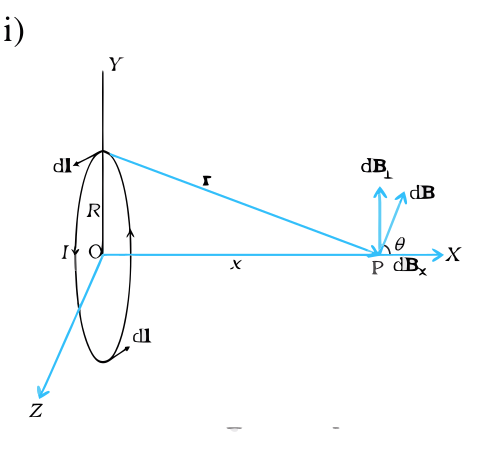
\[dB = \frac{\mu_0}{4\pi}\frac{I\,|d\mathbf{l}\times\mathbf{r}|}{r^{3}} \]
\[= \frac{\mu_o\, i\, dl \sin 90^{o}}{4\pi\left(x^{2}+R^{2}\right)} \]
$\displaystyle dB_{\perp}$ cancels out.
Net B $\displaystyle = \int dB_x = \int dB\cos\theta$
\[= \frac{\mu_o}{4\pi}\int \frac{i\,dl}{\left(x^{2}+R^{2}\right)} \times \frac{R}{\left(x^{2}+R^{2}\right)^{1/2}} \]
\[= \frac{\mu_o i R}{4\pi\left(x^{2}+R^{2}\right)^{3/2}} \int dl \]
\[= \frac{\mu_o i R}{4\pi\left(x^{2}+R^{2}\right)^{3/2}}\,(2\pi R) \]
\[\mathbf{B} = B_x\hat{\mathbf{i}} = \frac{\mu_0 I R^{2}}{2\left(x^{2}+R^{2}\right)^{3/2}}\hat{\mathbf{i}} \]
(ii)
Differences
| Diamagnetic Materials | Paramagnetic Materials |
| (i) Susceptibility is between -$\displaystyle 1$ and 0. | (i) Susceptibility is a small positive number.(slightly greater than zero.) |
| (ii) Relative permeability is between $\displaystyle 0$ and 1. | (ii) Relative permeability is slightly greater than 1. |
| (iii) $\displaystyle \mu < \mu_o$ | (iii) $\displaystyle \mu > \mu_o$ |
| (iv) Tendency to move from stronger to weaker part of external magnetism. | (iv) Tendency to move from region of weak to strong magnetic field. |
| (v) is repelled by a magnet. | (v) is weakly attracted by a magnet. |
| (vi) Field inside the material is reduced. | (vi) Field inside is slightly enhanced. |
(vii) 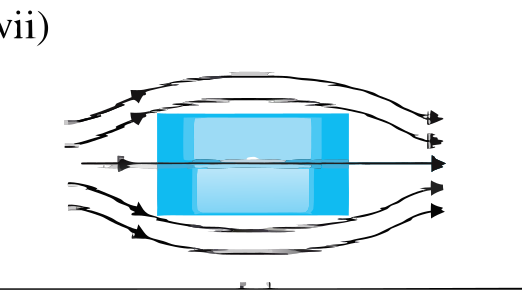 | (vii) 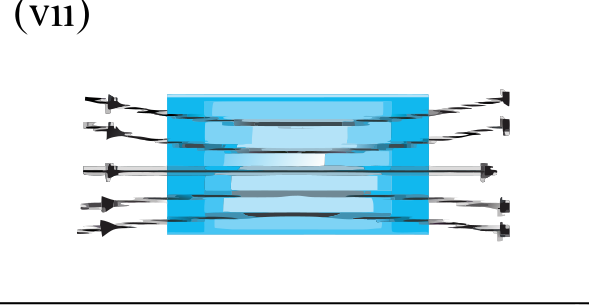 |
All Moving Charges and Magnetism questions2023 question paperNCERT solutions: Moving Charges and MagnetismPractice Moving Charges and Magnetism →
More from Moving Charges and Magnetism
- A 2.0 cm segment of wire, carrying 5.0 A current in positive y-direction lies along y -axis, as shown in the figure. The magnetic field at a point (3…2024
- Two thin long parallel wires A and B are separated by a distance r and carry current I each in the same direction. The force per unit length exerted…2023
- Derive an expression for the magnetic field B, due to a circular coil of N turns, each of radius r carrying current I, at a distance ' x ' from the…2026
- Assertion: A proton and an electron enter a uniform magnetic field B with the same momentum p such that p is perpendicular to B. They describe…2024
- Beams of electrons and protons move parallel to each other in the same direction. They2023
- (i) A particle of mass m and charge q is moving with a velocity v in a magnetic field B as shown in the figure. Show that it follows a helical path.…2024
- Figure shows a narrow beam of electrons entering with a velocity of 3 × 10^7 m / s, symmetrically through the space between two parallel horizontal…2026
- A particle of mass m and charge q moving with a uniform velocity v=v_0 x i+v_0 y j enters a region with a magnetic field B=B_0 j. After some time, an…2023
CBSE Class 12 Physics past-paper question from the 2023 board exam, with the answer as CBSE’s own marking scheme gives it. Where our answers come from.