✓ Board-verified
Physics · 2023 · 5 marks
Moving Charges and MagnetismMagnetic Field due to a Current Element, Biot-Savart Law5 marksApplylong answer
CBSE 2023 · Region 1 · Set 1 · Q32
(a) (i) State Biot-Savart's law for the magnetic field due to a current carrying element. Use this law to obtain an expression for the magnetic field…
(i)
State Biot-Savart's law for the magnetic field due to a current carrying element. Use this law to obtain an expression for the magnetic field at the centre of a circular loop of radius ' $\displaystyle a$ ' and carrying a current ' I '. Draw the magnetic field lines for a current loop indicating the direction of magnetic field.
(ii)
An electron is revolving around the nucleus in a circular orbit with a speed of $\displaystyle 10^{7} \mathrm{~m} \mathrm{~s}^{-1}$. If the radius of the orbit is $\displaystyle 10^{-10} \mathrm{~m}$, find the current constituted by the revolving electron in the orbit.
(i)
Derive an expression for the force acting on a current carrying straight conductor kept in a magnetic field. State the rule which is used to find the direction of this force. Give the condition under which this force is ($\displaystyle 1$) maximum, and
(2)
minimum.
(ii)
Two long parallel straight wires A and B are $\displaystyle 2 \cdot 5 \mathrm{~cm}$ apart in air. They carry $\displaystyle 5 \cdot 0 \mathrm{~A}$ and $\displaystyle 2 \cdot 5 \mathrm{~A}$ currents respectively in opposite directions. Calculate the magnitude of the force exerted by wire $\displaystyle \mathrm{A}$ on a $\displaystyle 10$ cm length of wire $\displaystyle B$.
Marking-scheme solution
(a)(i)
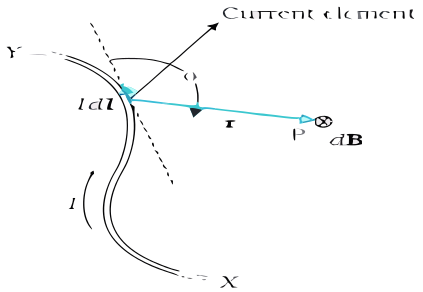
The magnetic field at a point due to a current carrying element is proportional to magnitude of current, element length and inversely proportional to the square of the distance from the element.
\[\begin{aligned}
& \overrightarrow{d B}=\frac{\mu_{o}}{4 \pi} \mathrm{I} \frac{\overrightarrow{d l} \times \vec{r}}{r^{3}} \\
& |d B|=\frac{\mu_{o}}{4 \pi} \frac{\mathrm{I} d l \sin \theta}{r^{2}}
\end{aligned}
\]
Consider a circular coil of radius a carrying current I.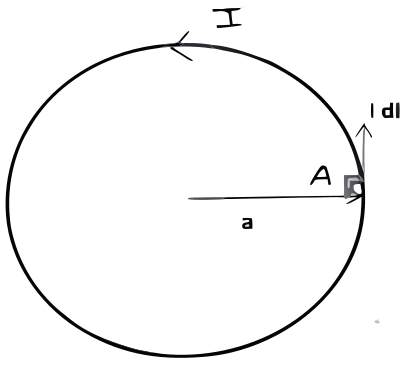
According to Biot-Savart's law
\[|\overrightarrow{d B}|=\frac{\mu_{o}}{4 \pi} \frac{\mathrm{I} d l \sin \theta}{r^{2}}
\]
At point \(\displaystyle \mathrm{A} \quad \mathrm{I} \overrightarrow{d l} \perp \vec{a}\)
All Moving Charges and Magnetism questions2023 question paperNCERT solutions: Moving Charges and MagnetismPractice Moving Charges and Magnetism →
More from Moving Charges and Magnetism
- A 2.0 cm segment of wire, carrying 5.0 A current in positive y-direction lies along y -axis, as shown in the figure. The magnetic field at a point (3…2024
- Two thin long parallel wires A and B are separated by a distance r and carry current I each in the same direction. The force per unit length exerted…2023
- Derive an expression for the magnetic field B, due to a circular coil of N turns, each of radius r carrying current I, at a distance ' x ' from the…2026
- Assertion: A proton and an electron enter a uniform magnetic field B with the same momentum p such that p is perpendicular to B. They describe…2024
- Beams of electrons and protons move parallel to each other in the same direction. They2023
- (i) A particle of mass m and charge q is moving with a velocity v in a magnetic field B as shown in the figure. Show that it follows a helical path.…2024
- Figure shows a narrow beam of electrons entering with a velocity of 3 × 10^7 m / s, symmetrically through the space between two parallel horizontal…2026
- A particle of mass m and charge q moving with a uniform velocity v=v_0 x i+v_0 y j enters a region with a magnetic field B=B_0 j. After some time, an…2023
CBSE Class 12 Physics past-paper question from the 2023 board exam, with the answer as CBSE’s own marking scheme gives it. Where our answers come from.