✓ Board-verified
Physics · 2024 · 5 marks
CBSE 2024 · Region 2 · Set 2 · Q33
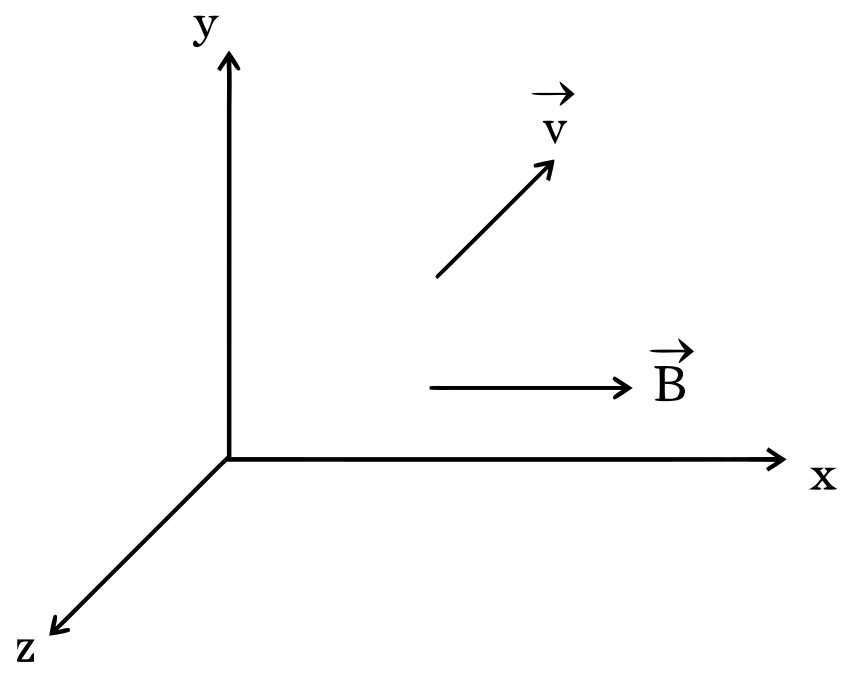
(a) (i) A particle of mass m and charge q is moving with a velocity v in a magnetic field B as shown in the figure. Show that it follows a helical…
(i)
A particle of mass $\displaystyle m$ and charge $\displaystyle q$ is moving with a velocity $\displaystyle \overrightarrow{\mathrm{v}}$ in a magnetic field $\displaystyle \overrightarrow{\mathrm{B}}$ as shown in the figure. Show that it follows a helical path. Hence, obtain its frequency of revolution.
(ii)
In a hydrogen atom, the electron moves in an orbit of radius $\displaystyle 2 \AA$ making $\displaystyle 8 \times 10^{14}$ revolutions per second. Find the magnetic moment associated with the orbital motion of the electron.
(i)
What is current sensitivity of a galvanometer ? Show how the current sensitivity of a galvanometer may be increased. "Increasing the current sensitivity of a galvanometer may not necessarily increase its voltage sensitivity." Explain.
(ii)
A moving coil galvanometer has a resistance $\displaystyle 15 \Omega$ and takes $\displaystyle 20$ mA to produce full scale deflection. How can this galvanometer be converted into a voltmeter of range $\displaystyle 0$ to $\displaystyle 100$ V ?
Marking-scheme solution
(i)
$\displaystyle v_{\perp}=v \sin \theta$ is perpendicular to $\displaystyle \vec{B}$ and $\displaystyle v_{\|}=v \cos \theta$ is parallel to $\displaystyle \vec{B}$.
Due to $\displaystyle v_{\perp}$ the charge describes a circular path and $\displaystyle v_{\|}$ pushes it in the direction of $\displaystyle \vec{B}$. Therefore under the combined effect of the two components the charged particle describes a helical path, as shown in the figure.
The centripetal force:
$\displaystyle \frac{m v_{\perp}^{2}}{r}=B q v_{\perp}$
$\displaystyle v_{\perp}=\frac{B q r}{m}$ $\displaystyle \left(v_{\perp}=v \sin \theta\right)$
Time period $\displaystyle =T=\frac{2 \pi r}{v_{\perp}}$
$\displaystyle =\frac{2 \pi m}{B q}$
frequency $\displaystyle \nu=\frac{1}{T}=\frac{B q}{2 \pi m}$
(ii)
Magnetic moment $\displaystyle M=I A$
$\displaystyle I=\frac{e}{T}=e \nu$
$\displaystyle =1.6 \times 10^{-19} \times 8 \times 10^{14}$
$\displaystyle =1.28 \times 10^{-4} \mathrm{~A}$
$\displaystyle M=1.28 \times 10^{-4} \times 3.14 \times\left(2 \times 10^{-10}\right)^{2}$
$\displaystyle =5.12 \pi \times 10^{-24} \mathrm{~Am}^{2}=1.6 \times 10^{-23} \mathrm{~Am}^{2}$
(i)
Deflection produced per unit current is called its current sensitivity.
$\displaystyle I_{S}=\frac{\theta}{I}=\frac{N B A}{K}$
Current sensitivity can be increased by:
(a)
increasing the number of turns in the coil
(b)
increasing the area of the coil in the magnetic field
(c)
decreasing K (torsional constant)
$\displaystyle V_{S}=\frac{\theta}{V}=\frac{N B A}{K R}$
If current sensitivity is increased by increasing the number of turns of the coil, the resistance of the galvanometer will also increase. Thus voltage sensitivity may not increase.
(ii)
$\displaystyle V=I_{G}(R+G)$
$\displaystyle R=\frac{V}{I_{G}}-G$
$\displaystyle =\frac{100}{20 \times 10^{-3}}-15$
$\displaystyle =5000-15$
$\displaystyle =4985 \Omega$
By connecting $\displaystyle 4985 \Omega$ in series with the galvanometer it is converted to a voltmeter of range ($\displaystyle 0$–$\displaystyle 100$ V).
All Moving Charges and Magnetism questions2024 question paperNCERT solutions: Moving Charges and MagnetismPractice Moving Charges and Magnetism →
More from Moving Charges and Magnetism
- A 2.0 cm segment of wire, carrying 5.0 A current in positive y-direction lies along y -axis, as shown in the figure. The magnetic field at a point (3…2024
- Two thin long parallel wires A and B are separated by a distance r and carry current I each in the same direction. The force per unit length exerted…2023
- Derive an expression for the magnetic field B, due to a circular coil of N turns, each of radius r carrying current I, at a distance ' x ' from the…2026
- Assertion: A proton and an electron enter a uniform magnetic field B with the same momentum p such that p is perpendicular to B. They describe…2024
- Beams of electrons and protons move parallel to each other in the same direction. They2023
- Figure shows a narrow beam of electrons entering with a velocity of 3 × 10^7 m / s, symmetrically through the space between two parallel horizontal…2026
- A particle of mass m and charge q moving with a uniform velocity v=v_0 x i+v_0 y j enters a region with a magnetic field B=B_0 j. After some time, an…2023
- A 1 cm straight segment of a conductor carrying 1 A current in x direction lies symmetrically at origin of Cartesian coordinate system. The magnetic…2025
CBSE Class 12 Physics past-paper question from the 2024 board exam, with the answer as CBSE’s own marking scheme gives it. Where our answers come from.