✓ Board-verified
Physics · 2024 · 5 marks
CBSE 2024 · Region 2 · Set 1 · Q31
(a) (i) Obtain an expression for the electric potential due to a small dipole of dipole moment p, at a point r from its centre, for much larger…
(i)
Obtain an expression for the electric potential due to a small dipole of dipole moment $\displaystyle \vec{p}$, at a point $\displaystyle \vec{r}$ from its centre, for much larger distances compared to the size of the dipole.
(ii)
Three point charges $\displaystyle \mathrm{q}, 2 \mathrm{q}$ and nq are placed at the vertices of an equilateral triangle. If the potential energy of the system is zero, find the value of n .
(i)
State Gauss's Law in electrostatics. Apply this to obtain the electric field $\displaystyle \overrightarrow{\mathrm{E}}$ at a point near a uniformly charged infinite plane sheet.
(ii)
Two long straight wires $\displaystyle 1$ and $\displaystyle 2$ are kept as shown in the figure. The linear charge density of the two wires are $\displaystyle \lambda_{1}=10 \mu \mathrm{C} / \mathrm{m}$ and $\displaystyle \lambda_{2}=-20 \mu \mathrm{C} / \mathrm{m}$. Find the net force $\displaystyle \overrightarrow{\mathrm{F}}$ experienced by an electron held at point P .
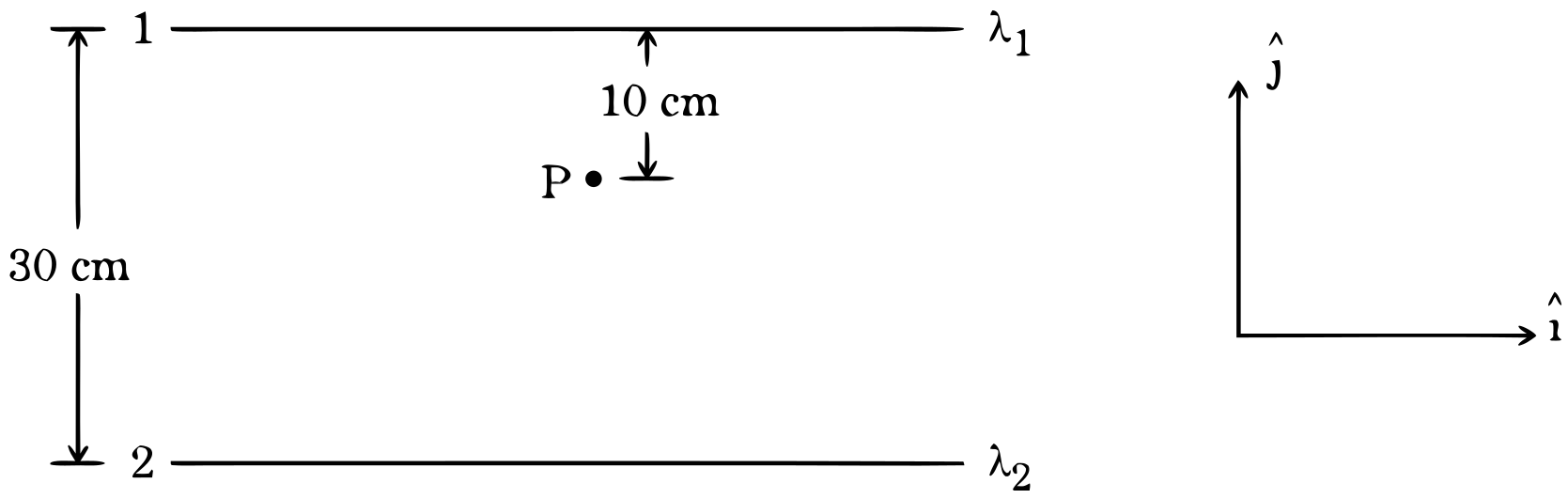
Marking-scheme solution
(a)(i)
Potential due to the dipole is the sum of potentials due to charges q and −q:
$\displaystyle V=\frac{1}{4 \pi \varepsilon_{0}}\left(\frac{q}{r_{1}}-\frac{q}{r_{2}}\right)$ -----------($\displaystyle 1$)
By geometry:
$\displaystyle r_{1}^{2}=r^{2}+a^{2}-2 a r \cos \theta$
$\displaystyle r_{2}^{2}=r^{2}+a^{2}+2 a r \cos \theta$
For $\displaystyle r \gg a$, retaining terms only up to first order in a/r:
$\displaystyle r_{1}^{2}=r^{2}\left(1-\frac{2 a \cos \theta}{r}+\frac{a^{2}}{r^{2}}\right) \cong r^{2}\left(1-\frac{2 a \cos \theta}{r}\right)$
Similarly $\displaystyle r_{2}^{2} \cong r^{2}\left(1+\frac{2 a \cos \theta}{r}\right)$
Using the binomial theorem and retaining terms up to the first order in a/r:
$\displaystyle \frac{1}{r_{1}} \cong \frac{1}{r}\left(1-\frac{2 a \cos \theta}{r}\right)^{-1 / 2} \cong \frac{1}{r}\left(1+\frac{a \cos \theta}{r}\right)$ -------($\displaystyle 2$)
$\displaystyle \frac{1}{r_{2}} \cong \frac{1}{r}\left(1+\frac{2 a \cos \theta}{r}\right)^{-1 / 2} \cong \frac{1}{r}\left(1-\frac{a \cos \theta}{r}\right)$ -------($\displaystyle 3$)
Using eqn. ($\displaystyle 1$), ($\displaystyle 2$), ($\displaystyle 3$) and $\displaystyle p=2 q a$:
$\displaystyle V=\frac{q 2 a \cos \theta}{4 \pi \varepsilon_{0} r^{2}}=\frac{p \cos \theta}{4 \pi \varepsilon_{0} r^{2}}$
$\displaystyle r_{2}=r+a \cos \theta$
$\displaystyle r_{1}=r-a \cos \theta$
$\displaystyle V=\frac{q}{4 \pi \varepsilon_{0}}\left(\frac{1}{r_{1}}-\frac{1}{r_{2}}\right)$
$\displaystyle V=\frac{q}{4 \pi \varepsilon_{0}}\left(\frac{1}{r-a \cos \theta}-\frac{1}{r+a \cos \theta}\right)$
$\displaystyle =\frac{q}{4 \pi \varepsilon_{0}}\left(\frac{2 a \cos \theta}{r^{2}-a^{2} \cos ^{2} \theta}\right)$
$\displaystyle =\frac{p}{4 \pi \varepsilon_{0} r^{2}}\left(\frac{\cos \theta}{1-\dfrac{a^{2}}{r^{2}} \cos ^{2} \theta}\right)$
For $\displaystyle r \gg a$, neglecting $\displaystyle \frac{a^{2}}{r^{2}}$:
$\displaystyle V=\frac{p \cos \theta}{4 \pi \varepsilon_{0} r^{2}}$
Consider the side of the equilateral triangle as 'a':
Potential energy $\displaystyle U=\frac{k q_{1} q_{2}}{a}+\frac{k q_{2} q_{3}}{a}+\frac{k q_{1} q_{3}}{a}$
According to the question:
$\displaystyle U=\frac{k(q)(2 q)}{a}+\frac{k(2 q)(n q)}{a}+\frac{k(q)(n q)}{a}=0$
$\displaystyle =\frac{2 q^{2}}{a}+\frac{2 n q^{2}}{a}+\frac{n q^{2}}{a}=0$
$\displaystyle 2+2 n+n=0$
$\displaystyle 3 n=-2$
$\displaystyle n=-\frac{2}{3}$
(b)
Electric flux through a closed surface is equal to $\displaystyle \frac{q}{\varepsilon_{0}}$, where q is the total charge enclosed by the surface: $\displaystyle \phi=\frac{q}{\varepsilon_{0}}$
The surface integral of electric field over a closed surface is $\displaystyle \frac{1}{\varepsilon_{0}}$ times the total charge enclosed by the surface:
$\displaystyle \oint \vec{E} \cdot d \vec{S}=\frac{q}{\varepsilon_{0}}$
As seen from the figure, only two faces $\displaystyle 1$ and $\displaystyle 2$ will contribute to the flux. Flux $\displaystyle \vec{E} \cdot d \vec{s}$ through both the surfaces is equal and adds up.
The charge enclosed by the surface is $\displaystyle \sigma A$, where $\displaystyle \sigma$ is surface charge density.
According to Gauss's theorem:
$\displaystyle 2 E A=\sigma A / \varepsilon_{0}$
$\displaystyle E=\sigma / 2 \varepsilon_{0}$
$\displaystyle \vec{E}=\frac{\sigma}{2 \varepsilon_{0}} \hat{n}$ where $\displaystyle \hat{n}$ is a unit vector directed normally out of the plane.
(ii)
$\displaystyle \vec{E}=\frac{\lambda}{2 \pi \varepsilon_{0} r} \hat{r}$
According to the question:
$\displaystyle E_{1}$ (at point P) $\displaystyle =\frac{\lambda_{1}}{2 \pi \varepsilon_{0} r_{1}}$
$\displaystyle E=\frac{10 \times 10^{-6}}{2 \pi \varepsilon_{0}\left(10 \times 10^{-2}\right)}(-\hat{j}) \mathrm{N} / \mathrm{C}$
$\displaystyle E_{2}$ (at point P) $\displaystyle =\frac{\lambda_{2}}{2 \pi \varepsilon_{0} r_{2}}$
$\displaystyle E=\frac{20 \times 10^{-6}}{2 \pi \varepsilon_{0}\left(20 \times 10^{-2}\right)}(-\hat{j}) \mathrm{N} / \mathrm{C}$
$\displaystyle E_{n e t}=\frac{10 \times 10^{-6}}{2 \pi \varepsilon_{0}}\left(\frac{1}{0.1}+\frac{2}{0.2}\right)(-\hat{j}) \mathrm{N} / \mathrm{C}$
$\displaystyle =3.6 \times 10^{6}(-\hat{j}) \mathrm{N} / \mathrm{C}$
$\displaystyle F_{n e t}=q \times E_{n e t}$
$\displaystyle F=-1.6 \times 10^{-19} \times 3.6 \times 10^{6}(-\hat{j}) \mathrm{N}$
$\displaystyle =5.76 \times 10^{-13} \mathrm{~N}(\hat{j})$
All Electrostatic Potential and Capacitance questions2024 question paperNCERT solutions: Electrostatic Potential and CapacitancePractice Electrostatic Potential and Capacitance →
More from Electrostatic Potential and Capacitance
- (i) A parallel plate capacitor with plate area A and plate separation d has a capacitance C_0. A slab of dielectric constant K having area A and…2025
- (i) In the figure, OA and OB show the variation of electric potential V at a point due to two point charges Q_1 and Q_2 with 1/r respectively. Here r…2026
- A point charge q_0 is moving along a circular path of radius a, with a point charge -Q at the centre of the circle. The kinetic energy of q_0 is2023
- The effective capacitance of the network between points A and B shown in the figure is:2025
- Two metal spheres of radii r_1 and r_2(>r_1) having charges q_1 and q_2 respectively kept in air, are brought in contact. Which of the following…2026
- (i) Explain the following statements giving reason: (I) An equipotential surface through a point is normal to the electric field at that point. (II)…2026
- A parallel plate capacitor has plate area A and plate separation d. Half of the space between the plates is filled with a material of dielectric…2025
- A thin spherical conducting shell of radius R has a charge q. A point charge Q is placed at the centre of the shell. Find (i) the charge density on…2024
CBSE Class 12 Physics past-paper question from the 2024 board exam, with the answer as CBSE’s own marking scheme gives it. Where our answers come from.