✓ Board-verified
Physics · 2024 · 5 marks
CBSE 2024 · Region 1 · Set 1 · Q31
(a) (i) Derive an expression for potential energy of an electric dipole p in an external uniform electric field E. When is the potential energy of…
(i)
Derive an expression for potential energy of an electric dipole $\displaystyle \overrightarrow{\mathrm{p}}$ in an external uniform electric field $\displaystyle \overrightarrow{\mathrm{E}}$. When is the potential energy of the dipole ($\displaystyle 1$) maximum, and
(2)
minimum ?
(ii)
An electric dipole consists of point charges - $\displaystyle 1.0$ pC and $\displaystyle +1 \cdot 0 \mathrm{pC}$ located at $\displaystyle ( 0,0 )$ and ( $\displaystyle 3 \mathrm{~mm}, 4 \mathrm{~mm}$ ) respectively in $\displaystyle \mathrm{x}-\mathrm{y}$ plane. An electric field $\displaystyle \overrightarrow{\mathrm{E}}=\left(\frac{1000 \mathrm{~V}}{\mathrm{~m}}\right) \hat{\mathrm{i}}$ is switched on in the region. Find the torque $\displaystyle \vec{\tau}$ acting on the dipole.
(i)
An electric dipole (dipole moment $\displaystyle \overrightarrow{\mathrm{p}}=\mathrm{p} \hat{\mathrm{i}}$ ), consisting of charges -q and q , separated by distance $\displaystyle 2$ a , is placed along the $\displaystyle \mathrm{x}$-axis, with its centre at the origin. Show that the potential V , due to this dipole, at a point $\displaystyle \mathrm{x},(\mathrm{x} \gg \mathrm{a})$ is equal to $\displaystyle \frac{1}{4 \pi \varepsilon_{0}} \cdot \frac{\overrightarrow{\mathrm{p}} \cdot \hat{\mathrm{i}}}{\mathrm{x}^{2}}$.
(ii)
Two isolated metallic spheres $\displaystyle \mathrm{S}_{1}$ and $\displaystyle \mathrm{S}_{2}$ of radii $\displaystyle 1$ cm and $\displaystyle 3$ cm respectively are charged such that both have the same charge density $\displaystyle \left(\frac{2}{\pi} \times 10^{-9}\right) \mathrm{C} / \mathrm{m}^{2}$. They are placed far away from each other and connected by a thin wire. Calculate the new charge on sphere $\displaystyle \mathrm{S}_{1}$.
Marking-scheme solution
(a)
(i) 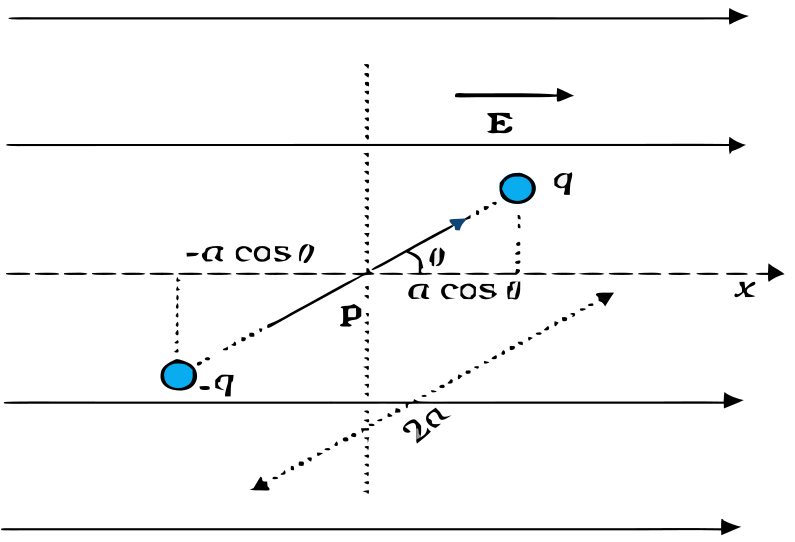
The amount of work done in rotating the dipole from \(\displaystyle \theta=\theta_{0}\) to \(\displaystyle \theta=\theta_{1}\) by the external torque
\[\begin{aligned}
& \mathrm{W}=\int_{\theta_{0}}^{\theta_{0}} \tau_{e \mathrm{x} t} d \theta \\
& \qquad \begin{aligned}
& =\int_{\theta_{0}}^{\theta_{0}} \mathrm{p} \mathrm{E} \sin \theta d \theta \\
\mathrm{~W} & =\mathrm{p} \mathrm{E}\left(\cos \theta_{0}-\cos \theta_{1}\right)
\end{aligned} \\
& \text { For } \theta_{0}=\frac{\pi}{2} \text { and } \theta_{1}=\theta \\
& =\mathrm{p} \mathrm{E}\left(\cos \frac{\pi}{2}-\cos \theta\right) \\
& \begin{aligned}
\mathrm{U}(\theta) & =-\mathrm{p} \mathrm{E} \cos \theta \\
& =-\vec{\mathrm{p}} \cdot \vec{\mathrm{E}}
\end{aligned}
\end{aligned}
\]All Electrostatic Potential and Capacitance questions2024 question paperNCERT solutions: Electrostatic Potential and CapacitancePractice Electrostatic Potential and Capacitance →
More from Electrostatic Potential and Capacitance
- (i) A parallel plate capacitor with plate area A and plate separation d has a capacitance C_0. A slab of dielectric constant K having area A and…2025
- (i) In the figure, OA and OB show the variation of electric potential V at a point due to two point charges Q_1 and Q_2 with 1/r respectively. Here r…2026
- A point charge q_0 is moving along a circular path of radius a, with a point charge -Q at the centre of the circle. The kinetic energy of q_0 is2023
- The effective capacitance of the network between points A and B shown in the figure is:2025
- Two metal spheres of radii r_1 and r_2(>r_1) having charges q_1 and q_2 respectively kept in air, are brought in contact. Which of the following…2026
- (i) Explain the following statements giving reason: (I) An equipotential surface through a point is normal to the electric field at that point. (II)…2026
- A parallel plate capacitor has plate area A and plate separation d. Half of the space between the plates is filled with a material of dielectric…2025
- A thin spherical conducting shell of radius R has a charge q. A point charge Q is placed at the centre of the shell. Find (i) the charge density on…2024
CBSE Class 12 Physics past-paper question from the 2024 board exam, with the answer as CBSE’s own marking scheme gives it. Where our answers come from.