SolveItClass 9 · NCERT

NCERT Solutions · Class 9 Social Science Elections

26 questions · 26 still being checked

Questions and activities 7.11–7.14 (part 8 of 8)

  1. Exercise 7.11

    On the Stage. Elections are to be held in your school for the posts of Head Girl, Head Boy, and Sports Captain. Assume the roles of an Election Commissioner, Returning Officer, Polling Agent, Candidate, Campaigner, Polling Officer, Police Personnel, and a Journalist, and perform their roles while ensuring free, fair, and transparent elections.

    The book prints no answer for this

    NCERT publishes no answers for this textbook, so there is nothing in the book to check this working against. It has also not yet been read through by hand.

    What the task asks forNCERT_Solution_Class9_SocialScience_Ch7_QA_Q7-11
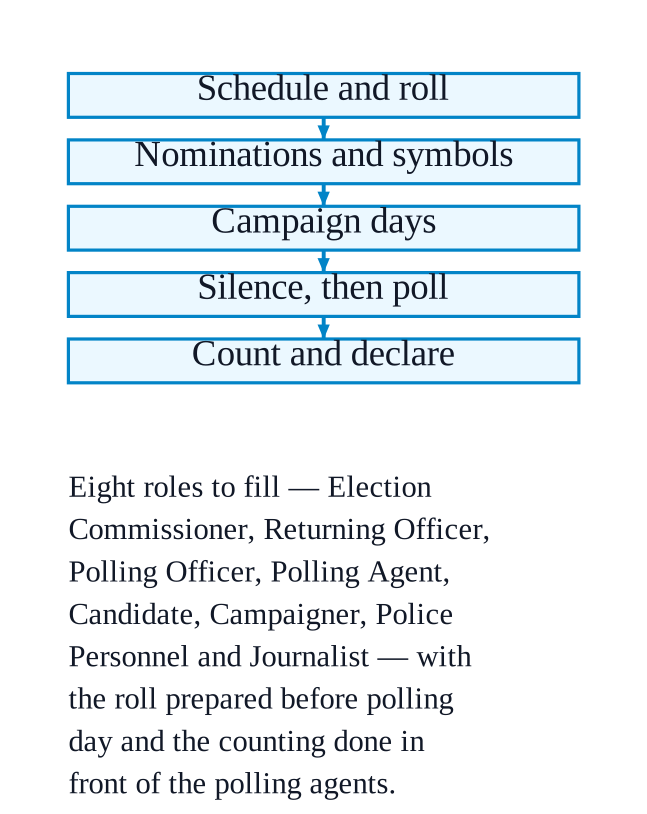
    Run a real school election for Head Girl, Head Boy and Sports Captain, with classmates taking the eight roles and playing them so that the election is free, fair and transparent.
    What each role does — modelled on the chapter's own machinery
    Election Commissioner — announces the schedule and the dates, publishes the list of eligible voters, registers the candidates, allots each one a symbol, and has overall superintendence, direction and control of the whole election.
    Returning Officer — receives and scrutinises nomination papers, publishes the final list of candidates, supervises the counting and declares the result.
    Electoral Registration work — prepares the roll of voters class by class, and settles claims and objections before the final roll is published. Only names on the roll may vote.
    Polling Officer — runs the booth on polling day: verifies each voter's identity against the roll, marks the finger, and issues the ballot.
    Polling Agent — sits in the booth on behalf of a candidate and watches that the poll is conducted correctly, without interfering.
    Candidate — files the nomination, prepares a short manifesto, campaigns within the rules, and accepts the result.
    Campaigner — presents the candidate's agenda and promises, without abuse, without inducement, and without any appeal based on religion, caste, race, community or language.
    Police Personnel — keep the queue orderly and the booth secure, and prevent any intimidation.
    Journalist — reports the campaign and the result accurately, checks claims before printing them, and does not spread rumours.
    A worked running order for the day
    Day $\displaystyle 1$: Commissioner announces the schedule and publishes the voters' roll; claims and objections invited.
    Day $\displaystyle 2$: Nominations filed, scrutinised by the Returning Officer, symbols allotted.
    Days $\displaystyle 3$–$\displaystyle 4$: Campaigning, with a written code of conduct agreed by the class in advance.
    Day $\displaystyle 5$, morning: Silence — no campaigning. Polling, with polling agents present.
    Day $\displaystyle 5$, afternoon: Counting in front of the agents; the Returning Officer declares the result.
    What a good performance must show
    A written code of conduct the class agreed to beforehand, and evidence that it was followed.
    A voters' roll prepared before polling, not on the day.
    Counting done in the presence of polling agents, so the result is transparent.
    Every role played, including the unglamorous ones — an election is machinery, not just candidates.
    A short reflection afterwards: what went wrong, and which safeguard would have prevented it.
  2. Exercise 7.12

    Try and make videos or audios on topics like: My Vote My Nation; No Voter to be Left Behind; How to Eliminate the Ill of Money Power, etc.

    The book prints no answer for this

    NCERT publishes no answers for this textbook, so there is nothing in the book to check this working against. It has also not yet been read through by hand.

    What the task asks for
    Make a short video or audio piece on one of the suggested themes: My Vote My Nation, No Voter to be Left Behind, or How to Eliminate the Ill of Money Power.
    A worked example — a $\displaystyle 60$-second script for "No Voter to be Left Behind"
    $\displaystyle 0$–10s: Open with the number. "India had over $\displaystyle 96.8$ crore eligible voters in 2024. Getting a ballot to every one of them is the hardest part of the election."
    $\displaystyle 10$–25s: One voter who nearly could not vote. "My grandmother is 89. She cannot climb the steps to the school." Then the answer: voting from home, extended across India for the first time during the $\displaystyle 2024$ General Elections for senior citizens above 85.
    $\displaystyle 25$–40s: A second voter. "My brother uses a wheelchair." Then: EVMs with Braille, the Saksham App, accessible booths, and home voting for PwDs with a $\displaystyle 40$% benchmark disability.
    $\displaystyle 40$–50s: A third. "My father is posted far from home." Then: ETPBS, which sends the postal ballot electronically so he can vote from wherever he is.
    $\displaystyle 50$–60s: Close on the pledge — to vote in every election fearlessly and without being influenced by considerations of religion, race, caste, community, language or any inducement.
    What a good piece must contain
    One clear message, stated in the first ten seconds.
    Facts taken from the chapter or from the ECI, each one attributed on screen or in the script.
    No party names, no slogans for or against anyone — the theme is voting, not a party.
    Permission from anyone you film or record, and no personal details of theirs on screen.
    Length kept short. Sixty to ninety seconds is enough.
    A note on the third theme
    For money power, build the piece on what the chapter actually establishes: RPA $\displaystyle 1951$ makes it an offence to give any gift, offer or promise to make a person contest, withdraw, vote or refrain from voting — and cVIGIL lets any voter report it within minutes. Do not invent an incident.
  3. Exercise 7.13

    Select one national or state political party. Using authentic and reliable sources such as the Election Commission of India (ECI) website, the official website of the selected political party, and newspapers. Prepare a comparative chart of the last two State Legislative Assembly elections. The chart should include the following details for the chosen party: a. Some promises made in the Election manifesto b. Percentage of votes polled c. Number of seats won d. Number of women who contested e. Number of women candidates elected Present the data for both elections in a clear and comparative format, citing all sources used.

    The book prints no answer for this

    NCERT publishes no answers for this textbook, so there is nothing in the book to check this working against. It has also not yet been read through by hand.

    What the task asks for
    Pick one national or state party, and build a comparative chart of its performance in the last two Legislative Assembly elections of a State, using the ECI website, the party's official website and newspapers — and cite every source.
    The chart's shape
    Column $\displaystyle 1$: the heading. Column $\displaystyle 2$: the earlier Assembly election, with its year. Column $\displaystyle 3$: the later Assembly election, with its year.
    Rows, in the order the question gives them:
    a. Some promises made in the election manifesto — three or four, quoted from the manifesto itself
    b. Percentage of votes polled
    c. Number of seats won
    d. Number of women who contested
    e. Number of women candidates elected
    Add a final row: Source, naming the exact page for each column.
    A worked example of the shape (fill in from your own research)
    Party chosen: ______ State: ______
    Elections compared: ______ and ______
    Promises: ______ / ______
    Vote share: ______% / ______%
    Seats won: ______ / ______
    Women who contested: ______ / ______
    Women elected: ______ / ______
    Source: ECI statistical report for each election, plus the manifesto PDF
    Where the numbers come from
    Vote percentage, seats won, and the candidate lists all come from the ECI's statistical report for that election — this is the authoritative source and it is published for each election.
    Manifesto promises come from the party's own manifesto, not from a newspaper's summary of it.
    Do not copy figures from memory or from an undated website. Write the date you accessed each source.
    What a good chart must contain
    Both elections named with their years, so the comparison is dated.
    All five rows filled for both elections, with blanks marked "not available" rather than guessed.
    A source under every number.
    Two or three sentences underneath saying what changed between the two elections and, if the sources allow it, why.
  4. Exercise 7.14

    Do you think ‘One Nation, One Election’ can improve the efficiency of the electoral process? Divide the class and discuss into two groups—one to examine its potential advantages and the other to analyse its limitations.

    The book prints no answer for this

    NCERT publishes no answers for this textbook, so there is nothing in the book to check this working against. It has also not yet been read through by hand.

    Start with an honest warning
    This chapter does not discuss 'One Nation, One Election' anywhere. The term appears only in this question. So nothing in the chapter settles the debate — everything below is a scaffold for the two groups to research and argue, not a set of facts to be memorised.
    What the idea means, in one line
    Holding elections to the Lok Sabha and to the State Vidhan Sabhas together, on a common schedule, instead of separately as they fall due.
    How to run the debate
    Divide into two groups: one examines the potential advantages, the other analyses the limitations.
    Each group prepares three or four points, each backed by a source it can name.
    Each point must be argued against the chapter's own test: does it make elections more free, more fair and more inclusive, or less?
    A worked example of the shape — arguments the advantages group usually builds
    Cost and machinery: the ECI must mobilise enormous resources for every election — enumerators, security, vehicles, counting staff. Combining elections could mean doing this once rather than repeatedly.
    Schedule pressure: the chapter notes the ECI must work around weather, the agricultural cycle, examinations and festivals. Fewer election periods means fewer such disruptions.
    Model Code of Conduct: it applies each time a schedule is announced; frequent elections mean it is in force more often.
    A worked example of the shape — arguments the limitations group usually builds
    Accountability timing: the chapter's whole case for elections is that a government must face the people at the end of its term. A common calendar raises the question of what happens when a House is dissolved before completing its term — the chapter says the ECI must then hold an election.
    Federal structure: state and national issues are different; voters may find it harder to judge a State government separately.
    Constitutional change: fixed five-year terms are constitutionally prescribed, so aligning them is not a purely administrative decision.
    What a good debate must produce
    Each side's points sourced — a government report, a Law Commission or committee paper, or a newspaper, named and dated.
    No point asserted as a chapter fact when it is not in the chapter.
    A closing round where each group states the strongest point made by the other side.
    No requirement that the class reach agreement. The question asks you to examine and analyse, not to vote on it.