SolveItClass 9 · NCERT

NCERT Solutions · Class 9 Social Science Elections

26 questions · 26 still being checked

Questions and activities 7.1–7.10 (part 7 of 8)

  1. Exercise 7.1

    What reforms have been introduced by the ECI to make voting more inclusive for the following groups? a. People with Disabilities b. Service Voters c. Senior Citizens— above 85\displaystyle 85 years of age d. Prisoners e. Persons in preventive detention

    The book prints no answer for this

    NCERT publishes no answers for this textbook, so there is nothing in the book to check this working against. It has also not yet been read through by hand.

    a. People with Disabilities (PwDs)NCERT_Solution_Class9_SocialScience_Ch7_QA_Q7-1
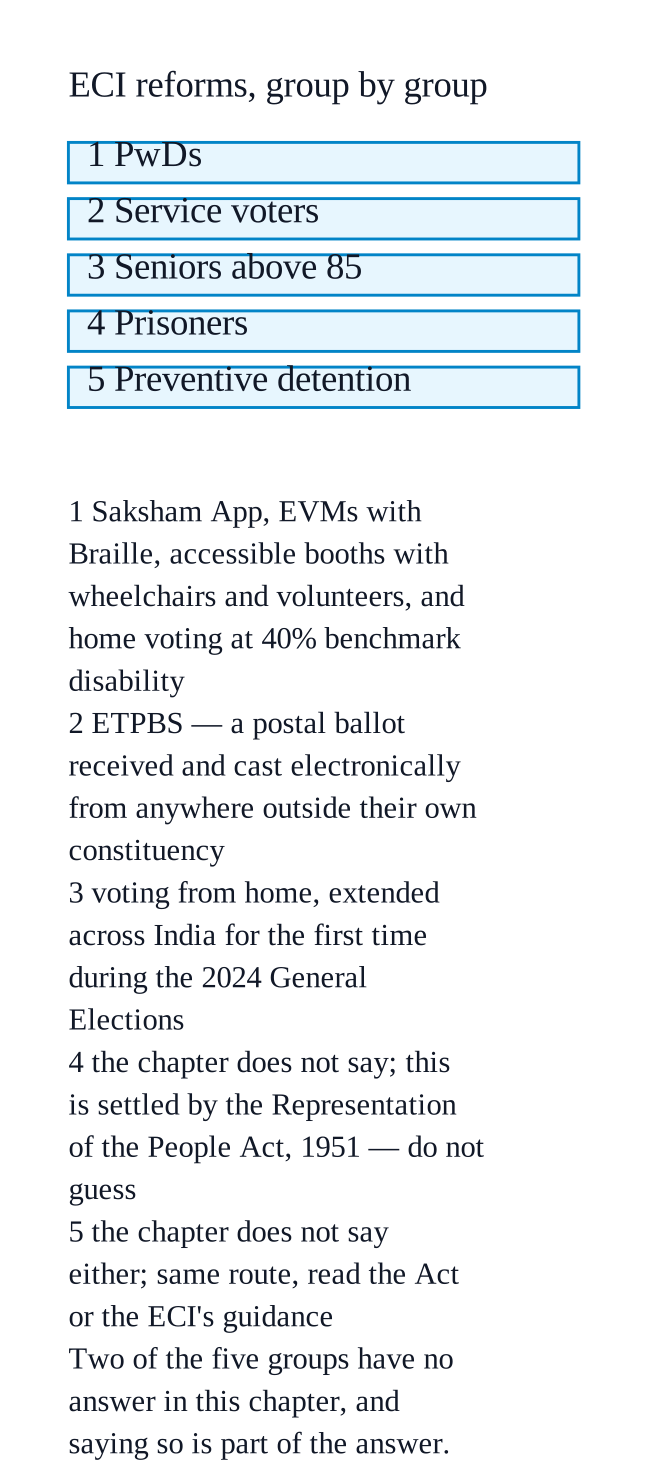
    The Saksham App, which offers customised services to ease voter identification and registration, and helps PwDs register and find their polling station.
    EVMs with Braille, so a voter with a visual disability can vote without help.
    Accessible polling stations — the chapter's own case study shows a wheelchair made available and volunteers guiding the voter to the booth.
    Voting from home for PwDs with a benchmark disability of $\displaystyle 40$%, extended across India for the first time during the $\displaystyle 2024$ General Elections.
    b. Service Voters
    ETPBS — the Electronically Transmitted Postal Ballot System, developed for service voters.
    It lets them receive and cast their postal ballots electronically from anywhere outside their own constituency, so being posted far from home does not cost them their vote.
    c. Senior Citizens above $\displaystyle 85$ years of age
    Voting from home, so a voter who cannot travel to a polling station can still vote.
    This too was extended across India for the first time during the $\displaystyle 2024$ General Elections.
    d. Prisoners
    The chapter does not say. It lists the ECI's inclusion initiatives for PwDs, senior citizens, transgender persons, Particularly Vulnerable Tribal Groups and service voters, but it says nothing about prisoners.
    Where to look: the chapter tells us that the Representation of the People Act, $\displaystyle 1951$ is the law governing voting procedures, so ask your teacher to take you to that Act or to the ECI's guidance.
    e. Persons in preventive detention
    The chapter does not say anything about this group either.
    Same route as above — this is settled by the Representation of the People Act, $\displaystyle 1951$, which the chapter names but does not reproduce. Do not guess the rule.
  2. Exercise 7.2

    What are the various functions of the Election Commission of India? Which of these functions is most important for the conduct of free and fair elections? Explain.

    The book prints no answer for this

    NCERT publishes no answers for this textbook, so there is nothing in the book to check this working against. It has also not yet been read through by hand.

    The functions of the Election Commission of IndiaNCERT_Solution_Class9_SocialScience_Ch7_QA_Q7-2
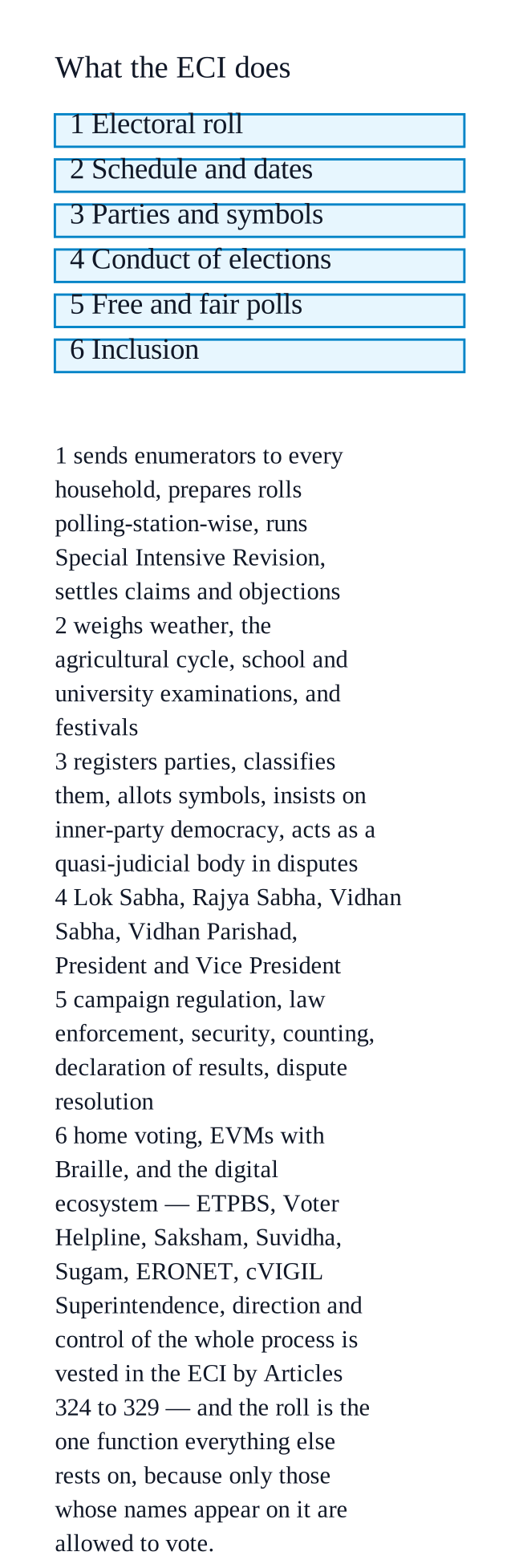
    Superintendence, direction and control of the entire election process — the Constitution vests this in the ECI, and Articles $\displaystyle 324$ to $\displaystyle 329$ define its powers and duties.
    Conducting elections to the Lok Sabha, the Rajya Sabha, the Vidhan Sabha, the Vidhan Parishad, the President and the Vice President.
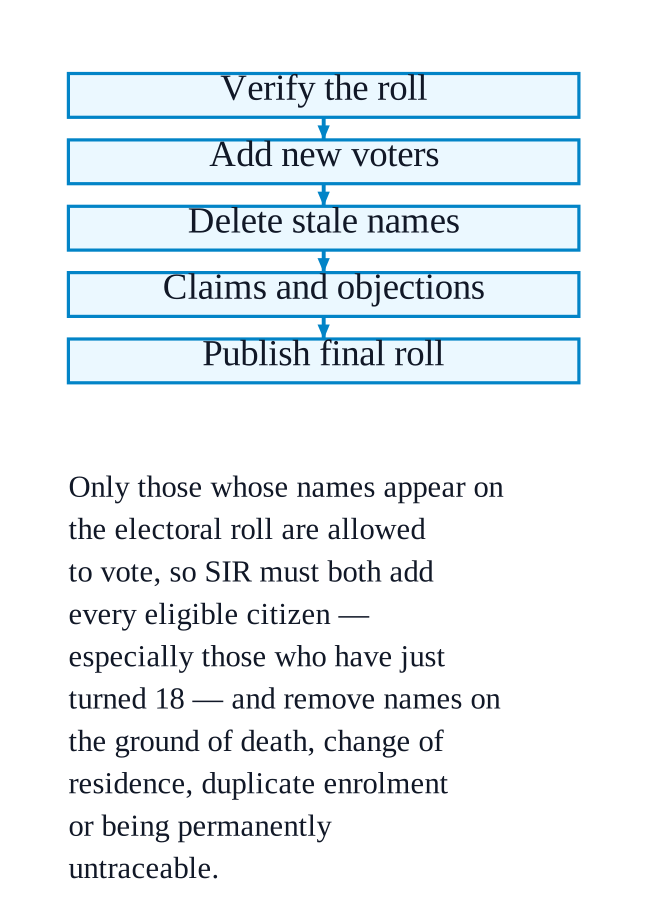
    Creating and revising the electoral roll — it sends enumerators to every household, prepares rolls constituency-wise and polling-station-wise, runs Special Intensive Revision (SIR), and settles claims and objections before publishing the final roll.
    Deciding the schedule and dates, weighing weather conditions, the agricultural cycle, school and university examination schedules and festivals.
    Registering political parties and allotting symbols — only registered parties may contest; the ECI classifies parties as recognised national, state or registered-unrecognised, insists that parties hold organisational elections to keep inner-party democracy, and acts as a quasi-judicial body in disputes over recognition and symbols.
    Ensuring free and fair elections — regulating campaigns, law enforcement, coordination among states, security arrangements, counting of votes, declaration of results and dispute resolution, with heavy use of information and communication technology.
    Making elections inclusive — home voting, EVMs with Braille, and the digital ecosystem of ETPBS, Voter Helpline, Saksham, Suvidha, Sugam, ERONET and cVIGIL.
    Supervising through officers — the Chief Electoral Officer in each State, and District Election Officers, Returning Officers and Electoral Registration Officers.
    The most important one, and why
    Preparing an accurate electoral roll is the one everything else rests on.
    The chapter is blunt about it: only those whose names appear on the roll are allowed to vote. A perfect campaign, a perfect count and a perfect result mean nothing to a citizen whose name is missing.
    A wrong roll fails in both directions — an eligible citizen is silently shut out, and an ineligible person is silently let in.
    That is exactly why SIR exists: to add every eligible voter, especially those who have just turned $\displaystyle 18$, and to remove names on the ground of death, change of residence, duplicate enrolment or being permanently untraceable.
    Other answers can be defended — ensuring free and fair conduct, for instance — provided you give the reason, as this question asks you to explain your choice.
  3. Exercise 7.3

    Elections are the soul of a democracy. Do you agree? Why or why not?

    The book prints no answer for this

    NCERT publishes no answers for this textbook, so there is nothing in the book to check this working against. It has also not yet been read through by hand.

    Yes — elections are the soul of a democracy.Why I agree
    They give every citizen an equal voice in the formation of a government; this is the chapter's own summing-up.
    They are how citizens choose the people who will make decisions on their behalf — participating in the periodic election of those representatives is the most crucial element of democracy.
    They make representatives accountable: the right to elect and the right to hold to account are both exercised through the same vote.
    They stop power from becoming permanent — no representative and no government may continue beyond the prescribed term without seeking the people's mandate again.
    They give the winner legitimacy, and they give the loser a peaceful route back.
    One qualification worth adding
    Holding an election is not by itself enough. The chapter warns that if candidates are influenced by personal favours, votes are not counted accurately, or voters cannot reach the booth, the election happens but its democratic value is reduced.
    So the fuller answer is: elections are the soul of democracy when they are free, fair, inclusive, impartial and trustworthy.
  4. Exercise 7.4

    Explain at least three differences between the national and state/regional political parties.

    The book prints no answer for this

    NCERT publishes no answers for this textbook, so there is nothing in the book to check this working against. It has also not yet been read through by hand.

    Three differences, drawn from the ECI's recognition criteria1. Spread across the country versus strength in one State
    A national party must show support in several states — $\displaystyle 6$% of valid votes in four or more states, or candidates elected from at least three states.
    A state party has to show its strength only in the State concerned; nothing outside that State counts.
    2. The thresholds themselves are different, and measured against different houses
    National: $\displaystyle 6$% of valid votes polled in any four or more states in a General Election to the Lok Sabha or the Legislative Assembly, and in addition four Lok Sabha seats from one or more states; or at least $\displaystyle 2$% of Lok Sabha seats with candidates elected from at least three states.
    State: $\displaystyle 6$% of Assembly votes in that State plus at least two Assembly seats; or $\displaystyle 6$% of Lok Sabha votes from that State plus at least one Lok Sabha seat; or $\displaystyle 3$% of Assembly seats or three seats, whichever is more; or one Lok Sabha seat for every $\displaystyle 25$ seats allotted to the State; or $\displaystyle 8$% of valid votes polled in the State.
    3. State recognition can add up to national recognition, but not the other way round
    A party that is recognised as a State Party in at least four states becomes a national party on that ground alone.
    There is no matching rule that turns a national party into a state party. Recognition builds upwards.
    Worth remembering alongside
    Both national and state parties are allotted election symbols by the ECI.
    Below both sit the Registered Unrecognised Political Parties (RUPPs) — parties that have not secured enough percentage of votes, or that have never contested an election since registering.
  5. Exercise 7.5

    Why should you vote? Arrange the following in the descending order of your choice. Discuss the reasons for your choice. a. Opportunity to choose my representative b. Makes me a responsible person c. Opportunity to change the non-performing representative d. Strengthens democracy

    The book prints no answer for this

    NCERT publishes no answers for this textbook, so there is nothing in the book to check this working against. It has also not yet been read through by hand.

    What the task asks for
    Put the four reasons in your own descending order of importance, then defend that order. There is no single correct order — the marks are in the reasoning.
    A worked example of an order, with reasons
    1st — (a) Opportunity to choose my representative. This is what a vote actually is. The chapter calls participating in the periodic election of those who will make decisions on our behalf the most crucial element of democracy.
    2nd — (c) Opportunity to change the non-performing representative. Choosing matters only if I can also un-choose. This is how representatives are held accountable at the end of five years.
    3rd — (d) Strengthens democracy. Every vote cast makes the mandate more genuine; the chapter says elections give every citizen an equal voice in the formation of a government.
    4th — (b) Makes me a responsible person. True, and the Voters' Pledge is about exactly this — but it is a benefit to me, while the first three are benefits to everyone.
    What a good answer must contain
    All four items ranked, none left out.
    One reason per item, and the reason must explain the rank, not just repeat the item.
    At least one link back to the chapter — accountability, representation, legitimacy or equality.
    Your own honest order. A different order is fully acceptable if it is argued; for example, putting (c) first because removing a bad representative is the sharpest power a voter has.
  6. Exercise 7.6

    What is the Special Intensive Revision (SIR) initiative of the ECI? Explain the objectives and the necessity of conducting SIR.

    The book prints no answer for this

    NCERT publishes no answers for this textbook, so there is nothing in the book to check this working against. It has also not yet been read through by hand.

    What SIR isNCERT_Solution_Class9_SocialScience_Ch7_QA_Q7-6
    SIR is the Special Intensive Revision conducted by the Election Commission of India — an exercise of updating, verifying and correcting the electoral rolls.
    Its objectives
    To ensure that no eligible citizen is left out of the electoral roll.
    To ensure that no ineligible person is included in it.
    To add all voters, especially the young voters who have just turned $\displaystyle 18$ and may be left out through lack of awareness or any other reason.
    To delete names where the voter has died, has changed residence, is enrolled twice, or has become permanently untraceable.
    To give people time to raise claims or objections against the revised roll, and to settle those claims and objections before the final roll is published.
    Why it is necessary
    Because only those whose names appear on the electoral roll are allowed to vote — a missing name is a lost vote, however eligible the citizen.
    Because a roll goes stale on its own: people die, families move, names get entered twice, and a new batch of citizens turns $\displaystyle 18$ every year.
    Because duplicate and ineligible entries damage the fairness of the count, and the chapter warns that when fairness slips, public confidence in electoral institutions weakens.
    Because an accurate roll is the foundation on which the whole free and fair election is built.
  7. Exercise 7.7

    Match the political party name with its symbol. Political Parties Name Symbol Aam Aadmi Party (AAP) Bharatiya Janata Party (BJP) Bahujan Samaj Party (BSP) Communist Party of India (Marxist) [CPI (M)] Indian National Congress (INC) National People’s Party (NPP)

    The book prints no answer for this

    NCERT publishes no answers for this textbook, so there is nothing in the book to check this working against. It has also not yet been read through by hand.

    How to do this question
    The symbols are printed as pictures in the book's table. Draw a line from each party's name to its symbol; the pairing below is the one to check your lines against.
    The pairings
    Aam Aadmi Party (AAP) — the broom
    Bharatiya Janata Party (BJP) — the lotus
    Bahujan Samaj Party (BSP) — the elephant
    Communist Party of India (Marxist) [CPI (M)] — the hammer, sickle and star
    Indian National Congress (INC) — the hand
    National People's Party (NPP) — the book
    Why symbols exist at all
    The chapter tells you that the ECI registers political parties and allots election symbols, and that recognised national and state parties are the ones allotted symbols.
    A symbol lets a voter identify a party on the ballot or the EVM without having to read the party's name — which is why the ECI, and not the party, controls it.
    The ECI also acts as a quasi-judicial body in disputes over the recognition of parties and the allotment of symbols.
  8. Exercise 7.8

    Read the case study below and answer the following questions. Ishani and her mother were in the local market, day before the state assembly elections. She noticed wall writing and campaign posters pasted everywhere. Large groups of campaigners were distributing pamphlets and raising slogans in support of the respective candidates. Ishani has turned 18\displaystyle 18 and will be voting for the first time. She had registered to vote through the ECI’s online portal. The next morning, she, along with her mother and her disabled elder brother, went to the polling station, which was well guarded by the police personnel. A wheelchair was made available to them, and volunteers guided them to the polling booth. Inside the polling booth, there were only three people who were performing all duties. Ishani had forgotten her voter ID card and Aadhaar card, but her identity was verified with an alternative document. After casting her vote, she was also able to see the VVPAT slip. While leaving, she wondered how the police personnel vote, as they must be on duty from early morning till late evening. When she went home, she narrated her entire experience to her 89\displaystyle 89-year-old grandmother, who cast her vote from home. a. What initiatives were taken by the ECI to enable the voters to cast their vote? b. If Ishani was allowed to vote even without carrying her Voter ID card or Aadhaar card, which other document might she be carrying that is valid for voting? c. Cite the examples of violations of the Model Code of Conduct. d. Give a suitable title to the passage. e. Find out how the police and army personnel cast their votes.

    The book prints no answer for this

    NCERT publishes no answers for this textbook, so there is nothing in the book to check this working against. It has also not yet been read through by hand.

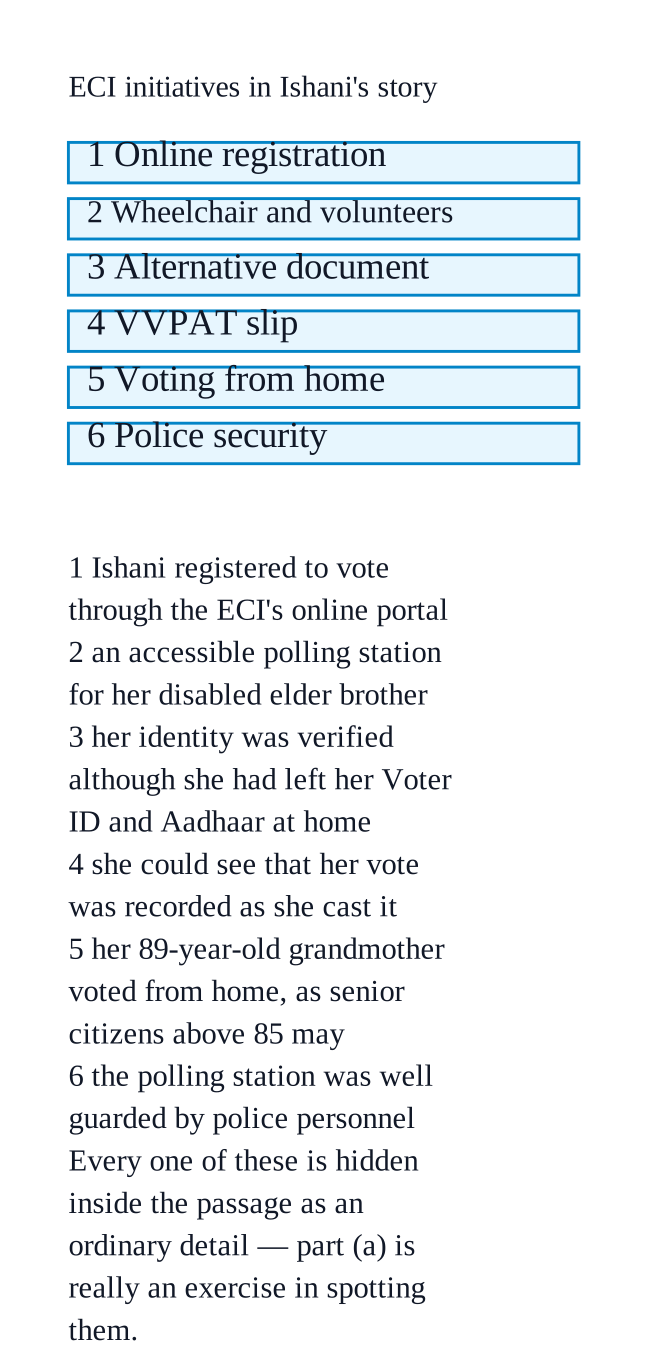
    a. What initiatives were taken by the ECI to enable the voters to cast their vote?NCERT_Solution_Class9_SocialScience_Ch7_QA_Q7-8
    Online voter registration — Ishani registered through the ECI's online portal instead of going anywhere in person.
    Accessible polling stations — a wheelchair was made available and volunteers guided the family to the booth, which is the kind of infrastructure accessibility the chapter describes for Persons with Disabilities.
    Alternative identity documents accepted — Ishani could vote even though she had left her Voter ID and Aadhaar at home.
    VVPAT — she could see the Voter Verifiable Paper Audit Trail slip after voting, which lets a voter confirm her vote was recorded as she cast it.
    Voting from home — her $\displaystyle 89$-year-old grandmother voted from home, the facility the chapter says was extended across India for the first time during the $\displaystyle 2024$ General Elections for senior citizens above 85.
    Security arrangements — police personnel guarded the polling station, part of the extensive security the ECI arranges.
    b. Which other document might she be carrying that is valid for voting?
    She must have been carrying some other identity document that the ECI accepts as an alternative to the Voter ID card.
    The chapter does not print the list of such documents, so do not guess a particular one.
    The list is issued by the ECI for each election; look it up on the ECI website, or ask your teacher, and then name the document.
    c. Examples of violations of the Model Code of Conduct
    Wall writing and campaign posters pasted everywhere — defacing walls and property in the market.
    Loud campaigning on the day before polling — large groups distributing pamphlets and raising slogans right up to the eve of the poll.
    Note carefully: the chapter names the Model Code of Conduct but does not print its rules. It only tells us that the MCC is one of the ECI's measures and that the cVIGIL app lets a voter report an MCC violation within minutes of witnessing it, after which flying squads reach the spot using auto-location.
    So identify these two from the passage, then check them against the actual Model Code with your teacher before treating them as settled.
    d. A suitable title for the passage
    "Ishani's First Vote"
    Other good titles: "No Voter to Be Left Behind" — the chapter's own heading, which fits the wheelchair, the alternative document and the grandmother voting from home; or "My Vote, My Right".
    e. How do the police and army personnel cast their votes?
    This is a find-out, and the chapter gives you the thread rather than the answer.
    What the chapter does say: ETPBS, the Electronically Transmitted Postal Ballot System, was developed for service voters and lets them receive and cast a postal ballot electronically from anywhere outside their own constituency.
    What you must find out: who exactly the ECI classifies as service voters, and what arrangement covers personnel who are on election duty within their own state. Read this off the ECI website and cite it.
    Do not assume the two cases are the same — a soldier posted far from home and a police officer on duty in her own city face different problems.
  9. Exercise 7.9

    A comparative chart of three countries is given below. Based on the information given in the chart, answer the questions. Country A Country B Country C Written constitution, periodic elections, Political voting rights, Dimension party system varies from two-party to multi-party. Average Economic standard of Dimension living. a. What is the difference between having a voting right in a country with a multi-party system and another with a single-party system? b. In which of the above countries would you like to stay and why?NCERT_Question_Class9_SocialScience_Ch7_QA_Q7-9

    The book prints no answer for this

    NCERT publishes no answers for this textbook, so there is nothing in the book to check this working against. It has also not yet been read through by hand.

    First, read the chart straightNCERT_Solution_Class9_SocialScience_Ch7_QA_Q7-9
    Country A — written constitution, periodic elections, voting rights, and a party system that varies from two-party to multi-party; average standard of living.
    Country B — written constitution, periodic elections, voting rights, but one political party; above-average standard of living.
    Country C — written constitution, a monarchy, no voting rights and no political party; high standard of living.
    a. The difference between a voting right in a multi-party country and in a single-party country
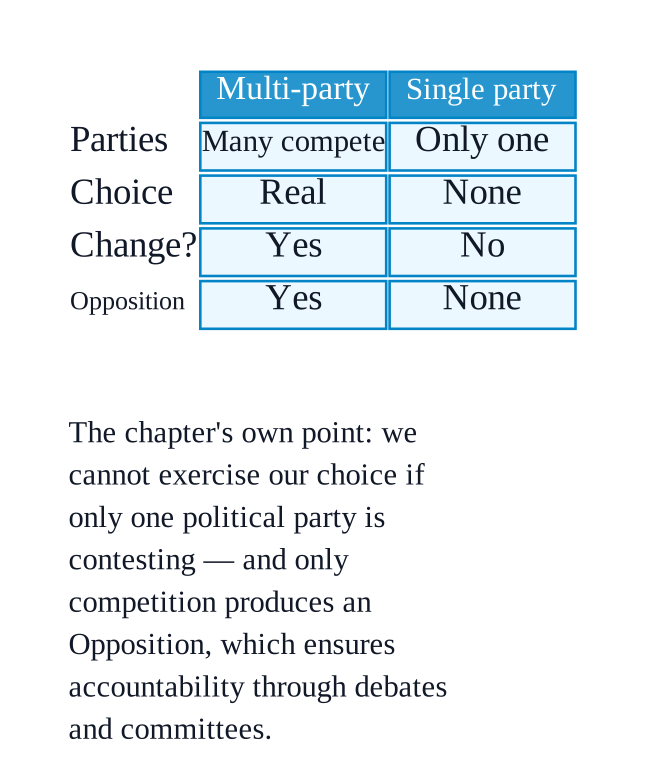
    In a multi-party system the vote is a real choice — several parties compete, each with its own programme, so the voter picks between genuinely different futures.
    In a single-party system the citizen may cast a vote, but there is no alternative to vote for. The chapter puts the point directly: we cannot exercise our choice if only one political party is contesting.
    So the vote can change the government in the first case and cannot in the second.
    Multi-party competition also produces an Opposition, which the chapter says ensures accountability by participating in debates and committees. A single-party system has none.
    And only where parties compete do voters get the thing parties are for — meaningful choices and the information needed to make an informed decision.
    b. Which country would you like to stay in, and why?
    This part asks for your own view, so the marks are in the reason, not the choice.
    A worked answer: I would choose Country A. It has a written constitution, periodic elections, voting rights and competing parties, so my vote can actually change who governs. Country B has a higher standard of living but only one party, so my vote cannot remove a government that stops performing. Country C is the richest of the three, but with no voting rights and no parties I would have no say at all in the decisions made about my life.
    The counter-argument you should acknowledge: someone may pick Country B or C for the higher standard of living. A good answer then has to explain what they are giving up.
    What a good answer must contain: a clear choice; a reason built on both dimensions in the chart, political and economic; and a line on why a comfortable life without a vote is not the same as a democracy.
  10. Exercise 7.10

    What are the challenges to conducting free and fair elections?

    The book prints no answer for this

    NCERT publishes no answers for this textbook, so there is nothing in the book to check this working against. It has also not yet been read through by hand.

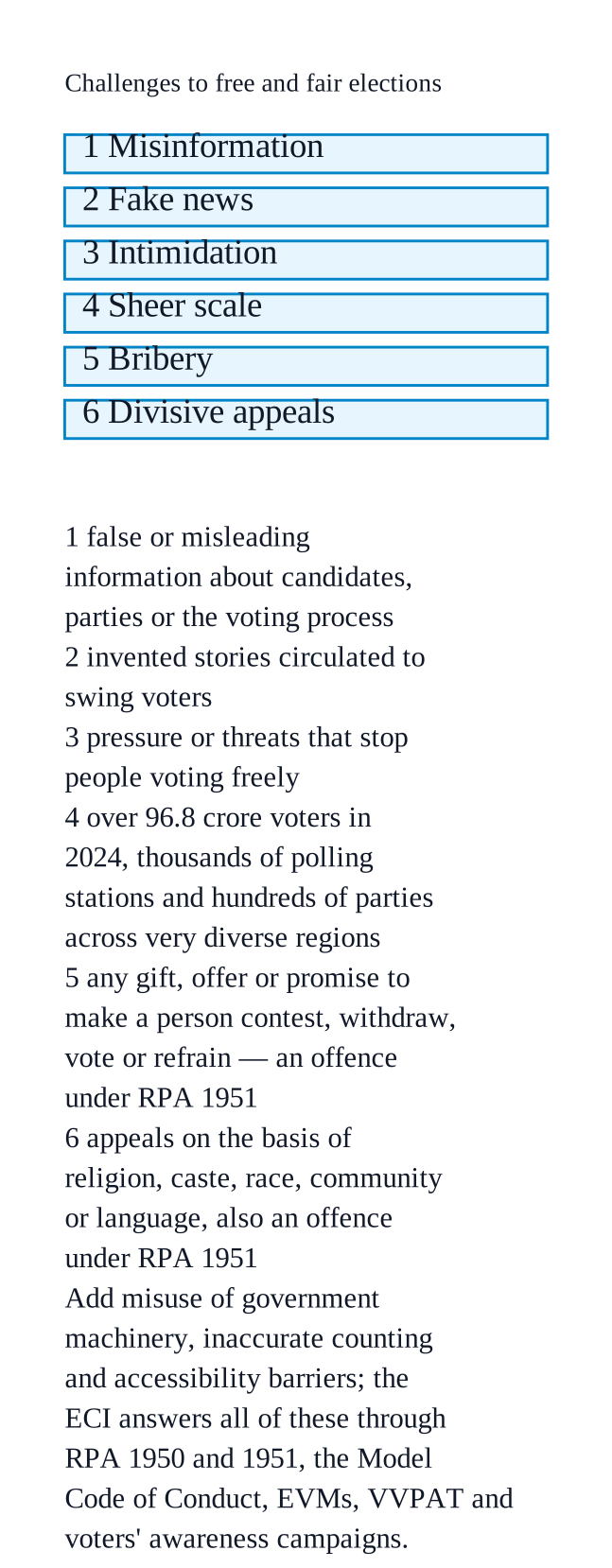
    The challenges the chapter namesNCERT_Solution_Class9_SocialScience_Ch7_QA_Q7-10
    Misinformation — false or misleading information spread about candidates, parties or the voting process.
    Fake news — invented stories circulated to swing voters.
    Intimidation — pressure or threats that stop people voting freely.
    Challenges that come from the scale of the exercise
    Over $\displaystyle 96.8$ crore voters in $\displaystyle 2024$, thousands of polling stations and hundreds of political parties, spread across diverse regions, terrains and socio-economic realities.
    Keeping the electoral roll correct across all of that, so no eligible citizen is left out and no ineligible person is included.
    Challenges that come from unfair practice — the offences listed in RPA $\displaystyle 1951$
    Bribery and inducement — any gift, offer or promise made by a candidate, or with their consent, to make someone contest, withdraw, vote or refrain from voting.
    Appeals on the basis of religion, caste, race, community or language.
    Misuse of government machinery — help taken from gazetted officers, judges and magistrates, armed forces personnel, police personnel or excise officers.
    Challenges of fairness and access
    Candidates influenced by personal favours, or votes not counted accurately.
    Voters unable to exercise their right because of accessibility problems.
    The chapter's warning about all of these: the election still happens, but its democratic value is reduced, and public confidence in electoral institutions gradually weakens.
    How the ECI meets them
    The Representation of the People Acts of $\displaystyle 1950$ and $\displaystyle 1951$, the Model Code of Conduct, EVMs and VVPAT, and voters' awareness campaigns.
    The cVIGIL app, which lets any voter report an MCC violation within minutes, with flying squads reaching the spot by auto-location.
    Inclusion measures — home voting, EVMs with Braille, the Saksham App, ETPBS.
    And, the chapter insists, constant vigilance and active citizen participation.