SolveItClass 9 · NCERT

NCERT Solutions · Class 9 Social Science Elections

26 questions · 26 still being checked

The Big Questions 7.1–7.4 (part 1 of 8)

  1. Exercise 7.1

    Why are elections essential to a democratic system?

    The book prints no answer for this

    NCERT publishes no answers for this textbook, so there is nothing in the book to check this working against. It has also not yet been read through by hand.

    Elections are essential because they are the only way citizens choose the people who make decisions for them, and remove them if they fail.
    NCERT_Solution_Class9_SocialScience_Ch7_BQ_Q7-1
    Periodic elections lie at the core of democracy — no representative and no government may continue past the fixed term (five years) without asking the people again.
    They create accountability: elected representatives answer to the people, and our vote is the main way we hold them to it.
    They give a government legitimacy — its power comes from a fresh mandate of the people, not from anything else.
    They deliver equality and representation: every citizen of $\displaystyle 18$ and above may vote without discrimination, so every voice counts the same.
    A real election also needs real choice — the chapter says we cannot exercise our choice if only one political party is contesting.
  2. Exercise 7.2

    How do electoral systems and rules shape political representation and fairness?

    The book prints no answer for this

    NCERT publishes no answers for this textbook, so there is nothing in the book to check this working against. It has also not yet been read through by hand.

    The electoral system decides how votes are converted into seats, and the same votes can produce very different results under different systems.
    India uses the plurality or First-Past-The-Post (FPTP) system for the Lok Sabha and the Vidhan Sabha: the candidate with the most votes wins, even if that is less than $\displaystyle 50$% of the votes polled.
    The Rajya Sabha, the President, the Vice President and the Vidhan Parishad are chosen by proportional representation, where seats or weight match the share of votes; the Vidhan Parishad uses a single transferable vote.
    The chapter's imaginary countries show the difference — in FPTP Haritbhumi, Party A wins with $\displaystyle 40$% and forms the government alone; in PR Swarnalok, seats are split $\displaystyle 40$/$\displaystyle 35$/$\displaystyle 15$/$\displaystyle 10$ so power is shared proportionately; in majority-system Ratnadweep, the top two fight a second round until someone crosses $\displaystyle 50$%.
    Rules matter as much as the system: delimitation redraws constituency boundaries with shifts in population, so that one MP does not represent five lakh people while another represents twenty-five lakh.
  3. Exercise 7.3

    What role do institutions and laws play in ensuring free and fair elections?

    The book prints no answer for this

    NCERT publishes no answers for this textbook, so there is nothing in the book to check this working against. It has also not yet been read through by hand.

    Institutions and laws supply the machinery and the rulebook, without which an election on India's scale could not be trusted.
    NCERT_Solution_Class9_SocialScience_Ch7_BQ_Q7-3
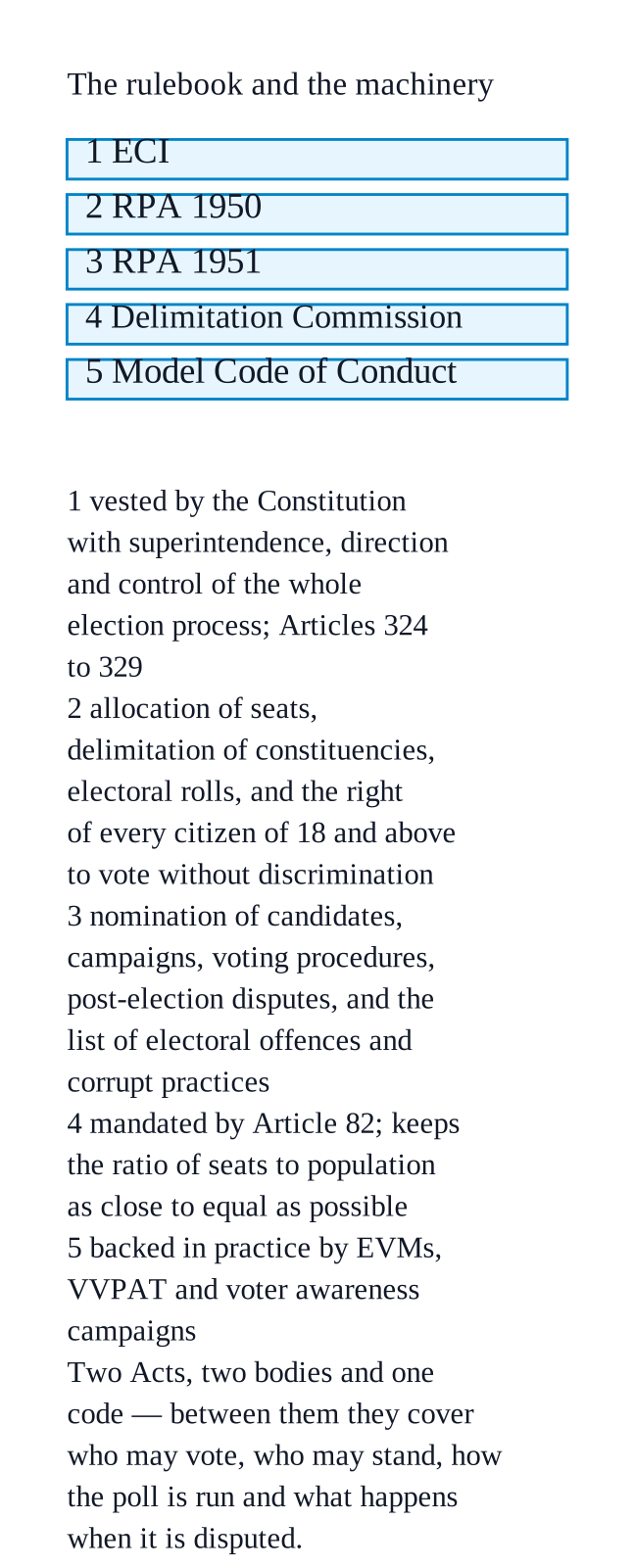
    The Election Commission of India (ECI) is vested by the Constitution with the superintendence, direction and control of the entire election process; Articles $\displaystyle 324$ to $\displaystyle 329$ set out its powers and duties.
    The Representation of the People Act, $\displaystyle 1950$ covers allocation of seats, delimitation of constituencies, preparation and revision of electoral rolls, and the right of every citizen of $\displaystyle 18$ and above to vote without discrimination.
    The Representation of the People Act, $\displaystyle 1951$ covers nomination of candidates, campaigns, voting procedures and post-election disputes, and lists the electoral offences and corrupt practices.
    The Delimitation Commission, mandated by Article $\displaystyle 82$, keeps the ratio of seats to population as close to equal as possible.
    In practice these are backed by the Model Code of Conduct, EVMs, VVPAT and voter awareness campaigns.
  4. Exercise 7.4

    What challenges do elections face in practice, and how can these challenges affect democracy?

    The book prints no answer for this

    NCERT publishes no answers for this textbook, so there is nothing in the book to check this working against. It has also not yet been read through by hand.

    The chapter names misinformation, fake news and intimidation as the main challenges to free and fair elections.
    NCERT_Solution_Class9_SocialScience_Ch7_BQ_Q7-4
    Sheer scale is itself a challenge: over $\displaystyle 96.8$ crore voters in $\displaystyle 2024$, thousands of polling stations and hundreds of political parties, spread across very diverse regions and terrains.
    Elections lose their democratic value when candidates are influenced by personal favours, votes are not counted accurately, or some voters cannot reach the booth because of accessibility problems.
    The damage is to trust — the chapter warns that if fairness is not ensured, public confidence in electoral institutions may gradually weaken.
    The ECI answers these through RPA $\displaystyle 1950$ and $\displaystyle 1951$, the Model Code of Conduct, EVMs, VVPAT and voter awareness campaigns; the chapter adds that constant vigilance and active citizen participation make elections more representative and democracy more robust.