SolveItClass 9 · NCERT

NCERT Solutions · Class 9 Social Science Elections

26 questions · 26 still being checked

Let's Explore 7.1–7.4 (part 3 of 8)

  1. Exercise 7.1

    Different democracies use different electoral systems. Make groups of 5\displaystyle 5-6\displaystyle 6 students. Each group will select six countries from different continents. Prepare and present a case study on the type of electoral system(s) operating in those countries, and discuss their latest election results of those countries.

    The book prints no answer for this

    NCERT publishes no answers for this textbook, so there is nothing in the book to check this working against. It has also not yet been read through by hand.

    What the task asks for
    Work in a group of $\displaystyle 5$–$\displaystyle 6$, pick six countries from different continents, and present a case study on the electoral system each one uses, ending with a discussion of that country's most recent election result.
    A worked example of the shape (using the chapter's own imaginary countries)
    Haritbhumi — system: First-Past-The-Post. How voting works: each voter votes for one candidate in their constituency; the candidate with the most votes wins even if below $\displaystyle 50$%. Result: Party A polled $\displaystyle 40$% and formed the government.
    Ratnadweep — system: Majority system. A candidate must cross $\displaystyle 50$%; if nobody does, the top two fight a second round. Result: no one reached $\displaystyle 50$% in Round $\displaystyle 1$, and Party Y won Round $\displaystyle 2$ with $\displaystyle 55$%.
    Swarnalok — system: Proportional Representation. Voters vote for a party, not a person; the $\displaystyle 100$ nationwide seats are shared in proportion to votes. Result: M $\displaystyle 40$, N $\displaystyle 35$, O $\displaystyle 15$, P $\displaystyle 10$, so power is shared proportionately.
    Write each real country up in exactly these four lines: name, system, how voting works, latest result.
    What a good answer must contain
    Six countries from different continents, each clearly labelled FPTP, majority, proportional representation, or a mixed system.
    One sentence on how a vote becomes a seat in that country.
    The latest election result with the source named (the country's election commission website is best).
    A closing comparison: which system gave the winner a majority of seats on a minority of votes, and which did not.
    Do not copy results from memory or from an undated web page — cite the date of the election you are describing.
  2. Exercise 7.2

    → Do you know what ETPBS is? ETPBS stands for Electronically Transmitted Postal Ballot System. It enables service voters to cast their vote on an electronically received postal ballot from their preferred location, which is outside their originally assigned voting constituency. → Find out who are classified as service voters and who can vote using ETPBS?

    The book prints no answer for this

    NCERT publishes no answers for this textbook, so there is nothing in the book to check this working against. It has also not yet been read through by hand.

    What the task asks for
    The box tells you what ETPBS is; it then asks you to go and find out who counts as a service voter, and who is allowed to vote using ETPBS.
    What the chapter does give you
    ETPBS stands for Electronically Transmitted Postal Ballot System.
    It lets service voters receive a postal ballot electronically and cast it from wherever they are, outside their own assigned constituency.
    The chapter lists ETPBS as one of the ECI's inclusion initiatives, alongside home voting and the Saksham App.
    Question $\displaystyle 8$ of the chapter gives you the clue to chase: Ishani wonders how police personnel on duty all day manage to vote.
    How to find the rest
    The category of "service voter" is defined in election law and on the ECI website — read the definition there, not from memory.
    Note down each group the ECI lists, and beside it write why that group cannot reach its own polling station on polling day.
    What a good answer must contain
    The full expansion of ETPBS.
    The ECI's own list of who is classified as a service voter, with the page you read it on.
    One line saying what problem ETPBS solves: a voter posted far from home would otherwise lose their vote.
  3. Exercise 7.3

    Find out the number of State parties and Registered Unrecognised Political Parties (RUPP). You may visit the website of ECI.

    The book prints no answer for this

    NCERT publishes no answers for this textbook, so there is nothing in the book to check this working against. It has also not yet been read through by hand.

    What the task asks forNCERT_Solution_Class9_SocialScience_Ch7_LE_Q7-3
    Look up, on the ECI website, how many State parties and how many Registered Unrecognised Political Parties (RUPP) there are.
    Why the number is not printed here
    These counts change as parties are registered, recognised and de-recognised, so the only correct number is the one on the ECI's own list, read on a stated date.
    Write it as: "As on ______ , the ECI website lists ______ State parties and ______ RUPPs."
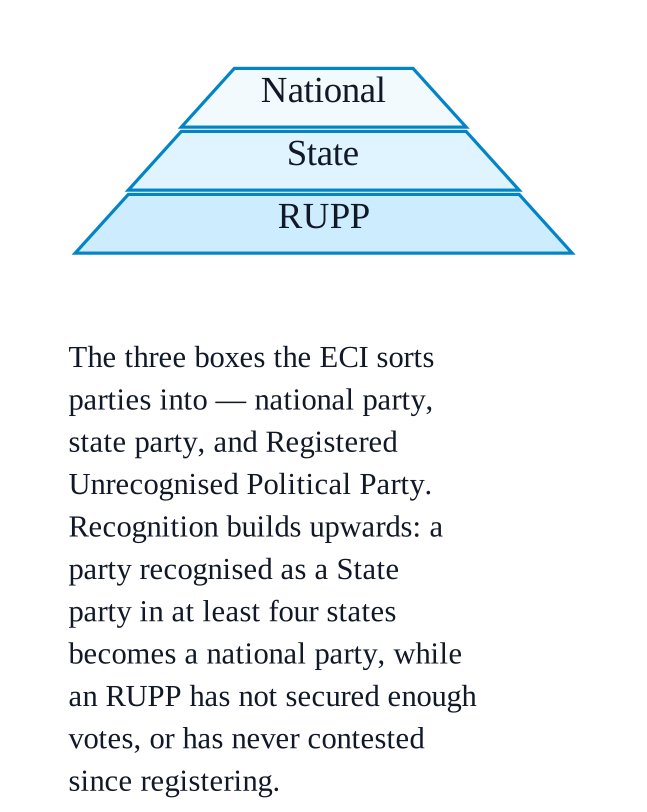
    What the chapter does settle — how a party lands in each box
    A party becomes a State party by fulfilling any one of the conditions in the chapter's table: $\displaystyle 6$% of valid votes at that State's Assembly election plus at least two Assembly seats; or $\displaystyle 6$% of valid votes at the Lok Sabha election from that State plus at least one Lok Sabha seat; or $\displaystyle 3$% of Assembly seats or three seats, whichever is more; or one Lok Sabha seat for every $\displaystyle 25$ seats allotted to the State; or $\displaystyle 8$% of the valid votes polled in the State.
    A party is an RUPP if it has not secured enough percentage of votes in the Legislative Assembly or General Elections, or if it has never contested an election since its registration.
    What a good answer must contain
    Both numbers, with the date you read them and the ECI page you read them on.
    One line saying why there are so many more RUPPs than recognised parties — registration is easy, recognition demands votes and seats.
  4. Exercise 7.4

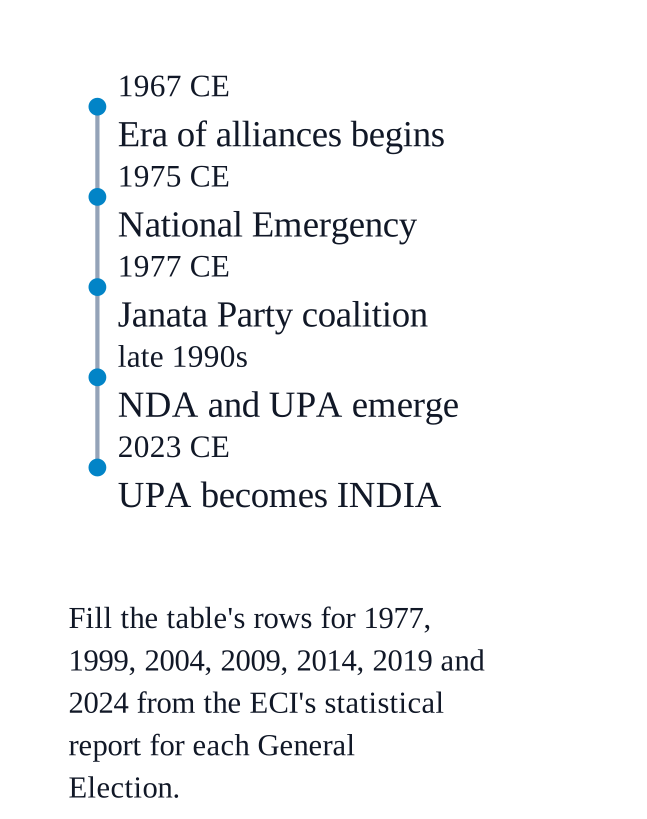
    The year 1967\displaystyle 1967 witnessed an end to the era of single-party dominated elections in India and an era of alliances began. Even though various states witnessed politics of alliance starting from 1967\displaystyle 1967, it was in 1977\displaystyle 1977 that various political parties formed an alliance as the Janata Party against the backdrop of the National Emergency (1975\displaystyle 1975-1977\displaystyle 1977). The Janata Party formed the first coalition government at the national level, which was popularly known as the Janata Government. Since the late 1990s, the National Democratic Alliance (NDA), led by the Bharatiya Janata Party (BJP), and the United Progressive Alliance (UPA), led by the Indian National Congress (INC) until the UPA's dissolution in 2023\displaystyle 2023 and subsequent reconstitution as the Indian National Developmental Inclusive Alliance, have been the major political alliances in Indian elections. Find out the name and the composition (number and name of the national and state parties) of the alliances that won in the following elections to the Lok Sabha. Year Alliance Won National parties State parties

    The book prints no answer for this

    NCERT publishes no answers for this textbook, so there is nothing in the book to check this working against. It has also not yet been read through by hand.

    What the task asks forNCERT_Solution_Class9_SocialScience_Ch7_LE_Q7-4
    Fill a table with, for each of $\displaystyle 1977$, $\displaystyle 1999$, $\displaystyle 2004$, $\displaystyle 2009$, $\displaystyle 2014$, $\displaystyle 2019$ and $\displaystyle 2024$: the alliance that won, the national parties in it, and the state parties in it.
    What the chapter itself settles
    $\displaystyle 1967$ ended the era of single-party dominated elections and began the era of alliances.
    $\displaystyle 1977$ — against the backdrop of the National Emergency ($\displaystyle 1975$–$\displaystyle 1977$), several parties came together as the Janata Party, which formed the first coalition government at the national level, popularly called the Janata Government.
    Since the late 1990s the two major alliances have been the National Democratic Alliance (NDA), led by the Bharatiya Janata Party, and the United Progressive Alliance (UPA), led by the Indian National Congress until the UPA's dissolution in $\displaystyle 2023$ and its reconstitution as the Indian National Developmental Inclusive Alliance.
    A worked row, filled the way the rest should be filled
    Year: $\displaystyle 1977$ Alliance won: Janata Party National parties: to be listed from your source State parties: to be listed from your source Source: ______
    How to fill the other six rows
    Use the ECI's statistical reports for each General Election — they are published for every Lok Sabha election and list every party and its seats.
    For each year, write the alliance name first, then the parties, and mark each one N (national) or S (state) as the ECI classified it at that time, not today.
    Count the parties as well as naming them, because the question asks for number and name.
    What a good answer must contain
    All seven rows filled, with a source for each.
    Party classifications taken from the ECI for that election year.
    One closing sentence on what the table shows — whether single parties or alliances have formed governments over these years.