SolveItClass 9 · NCERT

NCERT Solutions · Class 9 Social Science Building Blocks in Economics: The Problem of Choice

17 questions · 17 still being checked

The Big Questions 8.1–8.3 (part 1 of 4)

  1. Exercise 8.1

    What does economics deal with?

    The book prints no answer for this

    NCERT publishes no answers for this textbook, so there is nothing in the book to check this working against. It has also not yet been read through by hand.

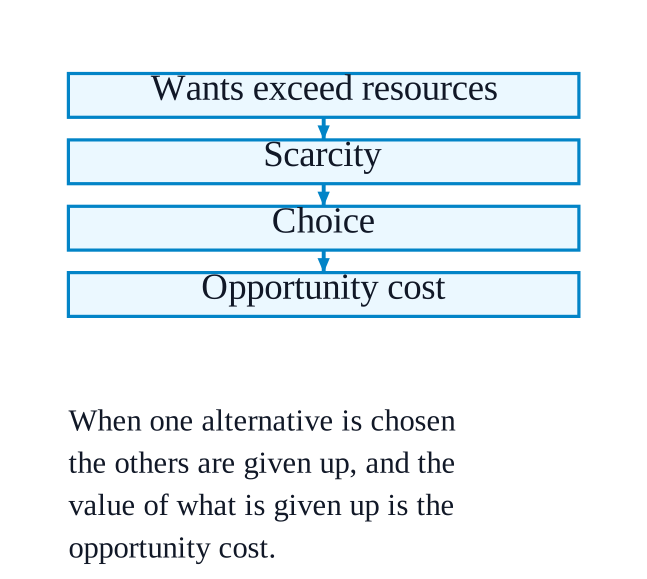
    Economics deals with choice under scarcity — how limited resources are used to satisfy unlimited wants.NCERT_Solution_Class9_SocialScience_Ch8_BQ_Q8-1
    The name comes from the Greek oikonomia, from oikos ('household') and nemein ('management'), so economics began as household management; the chapter extends the same idea from families to whole nations.
    It studies how choices are made by optimising the use of limited resources to satisfy needs and wants.
    It explains how economic entities — consumers, producers, governments and financial institutions — interact: how people work and earn wages, how wealth and resources are distributed, how prices are determined in the market, and how government policy and trade affect prices and employment.
    Every choice it studies carries an opportunity cost — the value of the option given up when one alternative is chosen.
    It runs on data and analysis, not guesswork: economists use government reports such as economic surveys and the financial statements of companies, and work in policy-making, business consulting, finance, and research and education.
  2. Exercise 8.2

    What are the key questions in economics?

    The book prints no answer for this

    NCERT publishes no answers for this textbook, so there is nothing in the book to check this working against. It has also not yet been read through by hand.

    Economics asks three key questions: what to produce, how to produce, and for whom to produce.NCERT_Solution_Class9_SocialScience_Ch8_BQ_Q8-2
    They arise from scarcity — unlimited wants meeting limited resources — and scarcity forces choices.
    What to produce asks which goods and services, and in what quantities, an economy should make in a given period. The chapter's example: water-intensive crops such as sugarcane and paddy, or drought-resistant millets and pulses.
    How to produce asks which methods, resources and technologies to use — the right mix of land, labour, capital and technology, and whether production should be labour-intensive (more workers, less machinery) or capital-intensive (more machines, fewer workers).
    For whom to produce asks who the goods are meant for and who benefits. The chapter's shoe example: simple, durable school shoes for students, leather office shoes for professionals, light grippy sports shoes for athletes, and cheap comfortable casual shoes for daily use.
    Answering all three well means limited resources are used properly and not wasted.
  3. Exercise 8.3

    How do different economic systems address these questions?

    The book prints no answer for this

    NCERT publishes no answers for this textbook, so there is nothing in the book to check this working against. It has also not yet been read through by hand.

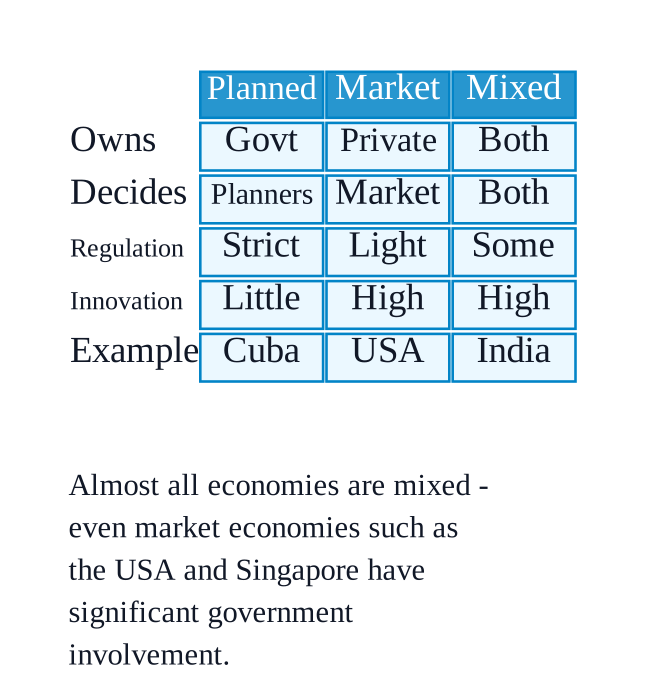
    They answer them differently depending on who owns the resources and who controls the decision-making — that is what the chapter calls a country's economic system.NCERT_Solution_Class9_SocialScience_Ch8_BQ_Q8-3
    Planned economy — a central planning authority of the government decides what and how much is produced, how, who gets it and at what prices. The government owns most resources and sectors: land, factories, banks, transport. Strict permits and licences restrict competition, so there is little motivation to improve quality or innovate. Chapter's examples: the former Soviet Union, North Korea, Cuba.
    Market economy — the questions are settled mainly by the forces of demand and supply, with little government intervention. The chapter compares the government to a referee in a football match: it ensures safety and law and order but does not control prices or production. Ownership rests largely with individuals and private companies, and many producers offering similar products encourages better quality, lower prices and innovation. Examples: the USA, Japan, Hong Kong.
    Mixed economy — private individuals, enterprises and the government all take economic decisions. There is private ownership with some degree of government regulation, plus large public sector companies, public goods, fair competition rules, consumer protection, transparency and welfare programmes. Examples: India (post-$\displaystyle 1991$), China (post-$\displaystyle 1978$), Germany, Sweden.
    The chapter's own conclusion: almost all economies are mixed. Even market economies such as the USA and Singapore have significant government involvement.