SolveItClass 9 · NCERT

NCERT Solutions · Class 9 Social Science Building Blocks in Economics: The Problem of Choice

17 questions · 17 still being checked

Let's Explore 8.1–8.3 (part 2 of 4)

  1. Exercise 8.1

    → List three things your parents bought this month. Can you classify them into needs or wants? → Do you think having too many wants may create problems? Why or why not?

    The book prints no answer for this

    NCERT publishes no answers for this textbook, so there is nothing in the book to check this working against. It has also not yet been read through by hand.

    What the task asksNCERT_Solution_Class9_SocialScience_Ch8_LE_Q8-1
    Look at your own household's spending, sort three real purchases into needs or wants, then judge whether having too many wants causes problems. The list has to be yours.
    Worked example — the shape to copy (your own three items will be different)
    Wheat flour and dalneed. Food is an essential, which the chapter lists along with water and shelter.
    A school uniformneed. Required for school; simple, durable and affordable, like the school shoes in the chapter.
    A second mobile phonewant. It is a gadget — the chapter's own example of a want, along with vacations and luxury items.
    Worked example — can too many wants create problems?
    Yes. Human wants are unlimited while resources are limited, so more wants only widen that gap — the chapter calls the gap scarcity.
    Every want satisfied has an opportunity cost: money put into a gadget is money not put into medicines or school supplies.
    Wants also keep climbing rather than stopping. The chapter's example is upgrading from a bicycle to a motorbike and then to a car.
    A good answer must
    Name three real purchases, each labelled need or want with a one-line reason.
    Take a clear yes or no on the second part in the first line.
    Base the reason on scarcity and opportunity cost, not just on 'it costs a lot'.
  2. Exercise 8.2

    → Ask your parents about how they make choices for everyday purchase. What is the opportunity cost of making a particular decision? → How do you decide to spend your time? Is time a scarce resource?

    The book prints no answer for this

    NCERT publishes no answers for this textbook, so there is nothing in the book to check this working against. It has also not yet been read through by hand.

    What the task asks
    Interview your parents about an everyday buying decision, name its opportunity cost, then apply the same idea to how you spend your time. The interview has to be real.
    Worked example — an everyday purchase (an example; ask your own family)
    Suppose ₹$\displaystyle 600$ is left for the week, and the choice is between repairing the cooler and buying a week's vegetables.
    They choose the vegetables. The opportunity cost is the repaired cooler — the value of what was given up.
    Note the shape: the opportunity cost is not '₹$\displaystyle 600$'. It is the best alternative that was dropped.
    Worked example — your time
    Say an evening has three free hours, and the options are cricket, revision, or helping at home.
    Two hours of cricket means two hours not spent revising. That forgone revision is the opportunity cost of the game.
    So yes, time is scarce: the hours in a day are fixed, and they have alternative uses — exactly the condition the chapter describes for limited resources.
    A good answer must
    Report a decision your family actually made, in their words.
    State the opportunity cost as the alternative given up, not as an amount of money.
    Give a clear yes or no on time, with a reason built on fixed supply and alternative uses.
  3. Exercise 8.3

    → In your opinion, should the government completely stay out of enterprise decisions? → Can you think of an example where government action helped or harmed an industry or sector?

    The book prints no answer for this

    NCERT publishes no answers for this textbook, so there is nothing in the book to check this working against. It has also not yet been read through by hand.

    What the task asksNCERT_Solution_Class9_SocialScience_Ch8_LE_Q8-3
    Give your own view on whether the government should stay out of enterprise decisions altogether, then back it with a real case where government action helped or harmed an industry.
    Worked example — one defensible view
    No, it should not stay out completely — but nor should it decide everything.
    Too much control does damage. In a planned economy, strict permits and licences prevent a large number of enterprises from operating, which restricts competition, so firms have little motivation to improve quality or innovate.
    A pure market leaves gaps too. Someone must ensure safety and law and order, supply public goods such as parks, roads, police services, street lights and basic education, protect consumers, keep competition fair and require transparency. The chapter gives all of these to the government even where markets dominate.
    So the workable position is the mixed economy: private ownership with some degree of government regulation, which is what almost all economies actually have.
    Worked example — a case the chapter itself supplies
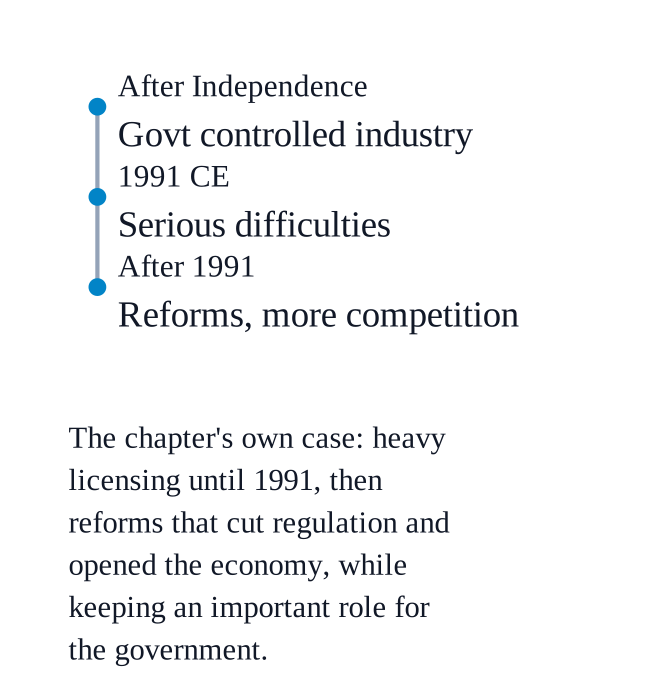
    Before $\displaystyle 1991$, India followed a state-led approach close to a planned economy: the government controlled industries, allocated resources and regulated production through licences and permits, and the public sector dominated banking, transport and heavy industry. By $\displaystyle 1991$ the country faced serious economic difficulties.
    The $\displaystyle 1991$ reforms then reduced excessive regulations, encouraged private enterprise, opened the economy to global trade and investment, and increased competition — shifting India towards a more market-oriented system while keeping an important role for the government.
    A good answer must
    Answer 'completely stay out?' with a clear yes or no in the first line.
    Use one named case, saying what the government did and what followed.
    State plainly whether the action helped or harmed, and why.