SolveItClass 9 · NCERT

NCERT Solutions · Class 9 Social Science Building Blocks in Economics: The Problem of Choice

17 questions · 17 still being checked

Questions and activities 8.1–8.10 (part 4 of 4)

  1. Exercise 8.1

    Why do you think people’s wants keep changing over time? How does this affect production in an economy? Why cannot all our wants be satisfied?

    The book prints no answer for this

    NCERT publishes no answers for this textbook, so there is nothing in the book to check this working against. It has also not yet been read through by hand.

    Why people's wants keep changingNCERT_Solution_Class9_SocialScience_Ch8_QA_Q8-1
    Because human wants are unlimited — satisfying one only opens up the next.
    People upgrade as their means grow. The chapter's example: from a bicycle to a motorbike and then to a car.
    Tastes, lifestyles and income levels differ from person to person, and they shift over time.
    Needs such as food, water and shelter stay much the same; it is the wants — gadgets, vacations, luxury items — that keep moving.
    How this affects production
    Producers must keep changing what they produce and in what quantities.
    Before deciding what to make, they analyse what consumers like, how much money they have, and how much demand there is.
    They split the market by group. The chapter's shoes: simple, durable, affordable school shoes; comfortable, formal, good-quality office shoes, often in leather; light, grippy sports shoes with special rubber soles; and cheap, comfortable casual shoes or slippers.
    The materials change with the buyer too — leather for office-goers and high-income customers, rubber or synthetic for sports players, factory workers and anyone needing something affordable and durable.
    Changing wants also reopen how to produce: customised or designer work needs skilled labour, while mass production suits machines.
    Resources get pulled from one use to another. Steel, for instance, can go into medical equipment, aircraft manufacturing or refrigerator manufacturing.
    Why all our wants cannot be satisfied
    Because resources are limited and wants are not. That mismatch is scarcity.
    Both natural resources (like water and coal) and human-made ones (like capital and technology) are limited in quantity, and each has alternative uses.
    So choosing one use means giving up another, and the value of what is given up is the opportunity cost.
    The chapter's Production Possibility Curve shows it exactly: with limited land, water and labour, the farmer moving from combination A to E gets more barley only by sacrificing wheat.
    Even at maximum efficiency — every point on that curve, with no wastage — more of one good still means less of the other.
  2. Exercise 8.2

    ‘Human wants are unlimited and keep changing’. How do you think this constant desire for more creates pressure on the environment? Can the fulfilment of wants and the extraction of resources be balanced?

    The book prints no answer for this

    NCERT publishes no answers for this textbook, so there is nothing in the book to check this working against. It has also not yet been read through by hand.

    More wants mean more production, and more production means pulling harder on resources that are limited in quantity.NCERT_Solution_Class9_SocialScience_Ch8_QA_Q8-2How the pressure builds
    Natural resources such as water and coal are limited, but wants are unlimited and keep changing.
    Meeting those wants uses the resources up. The chapter's case is water-intensive crops such as sugarcane and paddy.
    Wasteful use makes it worse: the chapter treats efficient production as production that avoids wastage.
    Short-term profit hides the damage. Sugarcane yields high profits and supports the sugar industry, so the water used up and the soil health lost never appear on the profit sheet.
    Can the two be balanced?
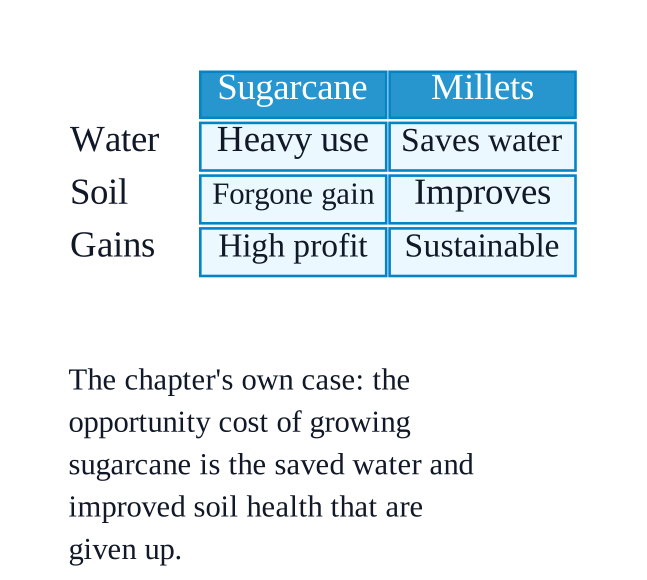
    To a large degree, yes — by counting the opportunity cost honestly. The chapter says the opportunity cost of producing sugarcane is the forgone gains from saved water and improved soil health.
    Choose the alternative with the bigger long-term gain where it exists: millets and pulses save water, improve soil health and promote sustainable agriculture.
    Use resources efficiently, without wastage, so the same resources yield more — which is what the points on the Production Possibility Curve represent.
    Plan with data, not guesswork, so future challenges are seen before the resource runs short.
    The honest limit
    The chapter presents this as a trade-off between short-term economic gains and long-term sustainability, to be judged by weighing opportunity costs.
    It does not promise that wants and extraction can be perfectly reconciled — only that better decisions narrow the gap.
  3. Exercise 8.3

    Can you think of a resource in your region that is scarce but used wastefully? How could it be managed better?

    The book prints no answer for this

    NCERT publishes no answers for this textbook, so there is nothing in the book to check this working against. It has also not yet been read through by hand.

    What the task asks
    Name a resource in your own area that is short in supply yet used wastefully, and say how it could be managed better. This needs a local observation, so the finding must be yours.
    Worked example — the shape to copy (an example only; check what is true where you live)
    Resource: water.
    Why it is scarce: it is a natural resource, limited in quantity, and in many places supply reaches homes for only a few hours a day.
    How it is wasted: leaking pipes and taps left running; vehicles washed with a hose; fields flood-irrigated for water-hungry crops.
    Better management: repair the leaks; harvest rainwater; reuse household water for gardens; shift some land from water-intensive crops such as sugarcane and paddy to drought-resistant millets and pulses, which the chapter says save water and improve soil health.
    The economics of it: water has alternative uses, so every litre poured on sugarcane is a litre not available for drinking or for another crop. That forgone use is its opportunity cost.
    A good answer must
    Name one real, local resource — water, electricity, firewood, farmland, forest — not a general one.
    Give one line of evidence that it is genuinely scarce where you live.
    Describe a waste you have actually seen, not a guessed one.
    Offer two or three practical steps.
    Close by linking it to scarcity and opportunity cost.
  4. Exercise 8.4

    Which economic system—market, planned, or mixed—do you think gives people the most freedom? Which economic system is best suited for promoting innovation? Why?

    The book prints no answer for this

    NCERT publishes no answers for this textbook, so there is nothing in the book to check this working against. It has also not yet been read through by hand.

    The market economy gives people the most freedom, and it is also the system best suited to promoting innovation.NCERT_Solution_Class9_SocialScience_Ch8_QA_Q8-4Most freedom — the market economy
    Ownership of factories, shops, land and other resources rests largely with individuals and private companies.
    What, how and how much to produce is settled mainly by the forces of demand and supply, with little government intervention.
    The government acts only as a referee: it ensures safety and law and order and does not control prices or production.
    Compare the planned economy: the government owns most resources, a central planning authority decides output, methods, users and prices, and private ownership is limited — so individual choice is small.
    A mixed economy sits in between — private ownership, but with some degree of government regulation.
    Best for innovation — the market economy again
    Many producers offer similar products, and that competition encourages better quality, lower prices and innovation.
    In a planned economy, strict permits and licences prevent a large number of enterprises from operating and so restrict competition; as a result there is little motivation to improve quality or innovate.
    The caution the chapter adds
    Governments play an important role even in market economies, and almost all economies are mixed.
    So in practice innovation happens inside mixed systems, where the government supplies fair competition rules, consumer protection and transparency while profit-making businesses compete.
  5. Exercise 8.5

    Critically examine why pure economic systems rarely exist in reality. Assess the limitations of such systems and justify why a mixed economy is often considered a more practical and effective approach in real-world contexts.

    The book prints no answer for this

    NCERT publishes no answers for this textbook, so there is nothing in the book to check this working against. It has also not yet been read through by hand.

    Pure systems are rare because each one, on its own, leaves out something an economy needs — which is why the chapter says almost all economies are mixed.NCERT_Solution_Class9_SocialScience_Ch8_QA_Q8-5Why pure systems rarely exist in reality
    The chapter states it directly: in reality, most economies have features of mixed economic systems.
    Even textbook market economies such as the USA and Singapore have significant government involvement.
    Even where markets dominate, the government must still keep safety and law and order, so no market is genuinely left alone.
    Systems also shift over time. India followed a state-led, planned-style approach after Independence and moved towards a market-oriented one after $\displaystyle 1991$ — real economies adapt rather than stay pure.
    Limitations of a pure planned economy
    A central planning authority must decide what, how much, how, for whom and at what price — an enormous load of decisions for one body.
    Private ownership is limited and enterprises follow the central authority's targets rather than market demand, so output may not match what people actually want.
    Strict permits and licences keep most enterprises out of the market and restrict competition.
    With little competition comes little motivation to improve quality or innovate.
    Limitations of a pure market economy
    Production follows demand and supply, and demand depends on purchasing power — so those who can pay are served first.
    The government does not control prices or production, so it has few tools when outcomes go wrong.
    Public goods — parks, roads, police services, street lights, basic education — are available to all and exclude nobody, which makes them a poor fit for profit-seeking supply.
    Fair competition rules, consumer protection and transparency do not appear on their own.
    Why a mixed economy is the practical answer
    It keeps the market's strengths: private ownership, competition, innovation and profit-making businesses.
    It keeps the government's: fair competition rules, consumer protection, transparency, public goods and welfare programmes.
    Large public sector companies can operate alongside private ones.
    India is the chapter's own illustration — heavy control and licensing until serious difficulties in $\displaystyle 1991$, then reforms that cut excessive regulation, encouraged private enterprise, opened the economy and increased competition, while still retaining an important role for the government.
  6. Exercise 8.6

    A student has ₹100\displaystyle 100 and must choose between buying a notebook or saving the money for buying a tennis racket later. Which economic concept best explains this situation? a.  Demand b.  Opportunity cost c.  Production d.  Inflation

    The book prints no answer for this

    NCERT publishes no answers for this textbook, so there is nothing in the book to check this working against. It has also not yet been read through by hand.

    b. Opportunity costNCERT_Solution_Class9_SocialScience_Ch8_QA_Q8-6
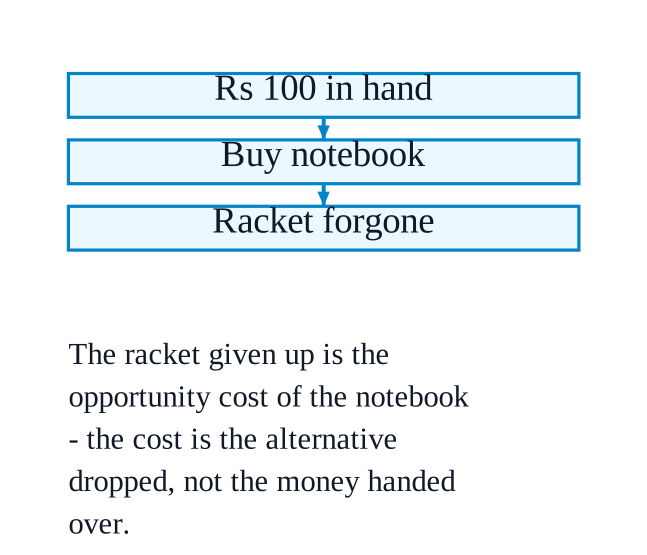
    The student has only ₹$\displaystyle 100$ and cannot do both: money spent on the notebook is money not saved towards the tennis racket.
    Opportunity cost is the value of what is given up when one alternative is chosen — here, the racket, if the notebook is bought.
    It fits the chapter's definition exactly: a limited resource with alternative uses, so choosing one means giving up the other.
    The other three do not describe this situation. Demand is about how much buyers want in a market, production is about making goods, and inflation is not a concept this chapter uses to explain one person's choice.
  7. Exercise 8.7

    How does understanding opportunity cost improve the quality of economic decision-making?

    The book prints no answer for this

    NCERT publishes no answers for this textbook, so there is nothing in the book to check this working against. It has also not yet been read through by hand.

    It improves decisions by making the hidden cost of every choice visible, so alternatives get compared instead of one option being taken by default.NCERT_Solution_Class9_SocialScience_Ch8_QA_Q8-7
    It forces you to name the alternative you are giving up, not just the money you are handing over.
    It reminds you that resources have alternative uses — the same money buys fruit or a pair of shoes; the same steel becomes medical equipment, an aircraft or a refrigerator.
    It exposes costs that profit figures hide: the chapter says the opportunity cost of producing sugarcane is the forgone saved water and improved soil health.
    It therefore weighs short-term economic gains against long-term sustainability, instead of counting only the immediate return.
    It underpins the Production Possibility Curve, whose points show the maximum output from efficient use of resources — which the chapter says helps in better planning and decision-making by enterprises and governments.
    It works at every level: a family choosing between essentials, non-essentials and savings; an enterprise choosing labour-intensive or capital-intensive methods; a government choosing between highways and hospitals.
  8. Exercise 8.8

    Can effective economic decisions be made without reliable data? Support your answer with an example.

    The book prints no answer for this

    NCERT publishes no answers for this textbook, so there is nothing in the book to check this working against. It has also not yet been read through by hand.

    No. The chapter is explicit that good decisions rely on data and analysis, not guesswork — without reliable data, a decision is only a guess.NCERT_Solution_Class9_SocialScience_Ch8_QA_Q8-8Why data is needed
    Data is facts and statistics collected together for reference or analysis; surveys are the systematic way of gathering it on economic conditions and behaviour.
    Without it, producers cannot know what consumers like, how much money they have, or how much demand exists — and the chapter says those are exactly the three things they analyse before deciding what to make.
    Without it, the alternatives, their opportunity costs and their likely outcomes cannot be compared, which is precisely the work economists do.
    Bad data therefore means resources are used badly and wasted, which is the one thing scarcity does not allow.
    Example from the chapter — the Economic Survey of India
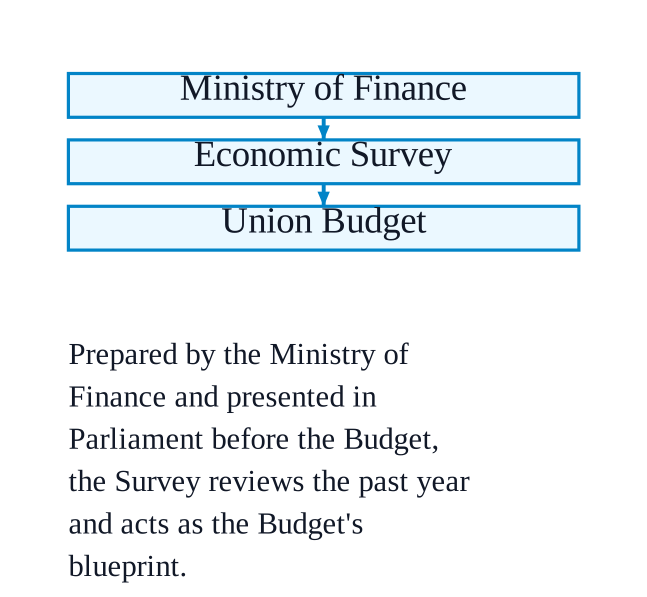
    It is an annual document prepared by the Ministry of Finance and presented in Parliament before the Union Budget.
    It reviews the past year's performance across agriculture, industry and services, and areas such as employment, inflation, education, health and infrastructure, and it discusses future challenges and opportunities.
    It acts as a blueprint for the coming Union Budget, giving policymakers crucial insights.
    Take that data away and the Budget would be framed blind — spending decided without knowing where the economy is actually weak.
    A second, smaller example
    A garment manufacturer choosing between labour-intensive and capital-intensive production needs the real cost of machines, the cost and availability of labour, the technology on hand and the type of garment demanded.
    Guess any one of these wrongly and the wrong method is chosen — machines bought when labour was cheaper, or manual production kept when automation had become affordable.
  9. Exercise 8.9

    Analyse how a country’s present economic choices can shape its long-term future. Why is it important to consider future consequences while making economic decisions today?

    The book prints no answer for this

    NCERT publishes no answers for this textbook, so there is nothing in the book to check this working against. It has also not yet been read through by hand.

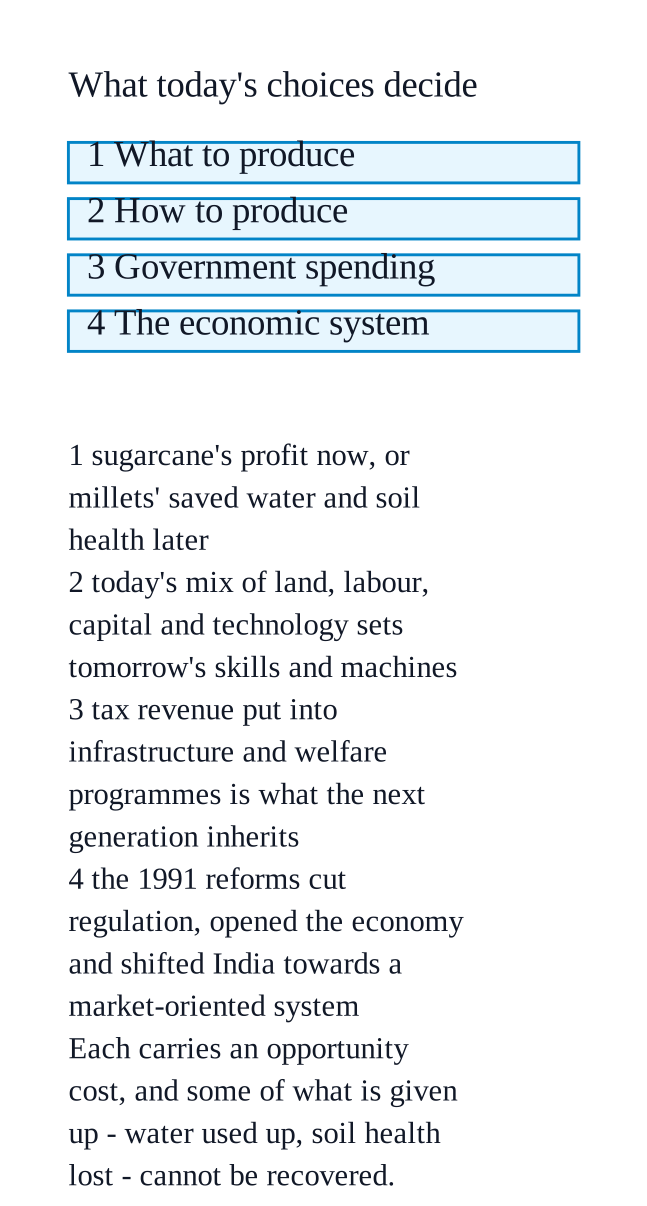
    Today's choices decide what a country will still have, and still be able to do, years from now — because resources given up now are not there to use later.NCERT_Solution_Class9_SocialScience_Ch8_QA_Q8-9How present choices shape the long term
    Every choice carries an opportunity cost, and some of what is given up cannot be recovered. The chapter's own case is water used up and soil health lost.
    What to produce sets the path. Sugarcane brings high profits now and supports the sugar industry; millets and pulses save water, improve soil health and promote sustainable agriculture for later. The chapter calls this a trade-off between short-term economic gains and long-term sustainability.
    How to produce matters too: the mix of land, labour, capital and technology chosen today decides what skills, machines and technology the country has tomorrow.
    Government spending shapes the future directly — revenue from taxation put into infrastructure and welfare programmes is what the next generation inherits.
    Even the economic system can be changed by present decisions. India's $\displaystyle 1991$ reforms cut excessive regulations, encouraged private enterprise, opened the economy to global trade and investment and increased competition, gradually shifting the country towards a more market-oriented system.
    Why future consequences must be weighed today
    Resources are limited, so using them wastefully now narrows the choices available later.
    Only counting the future puts both sides of the trade-off on the scale; short-term profit on its own hides the long-term loss.
    These decisions affect the well-being of people and society as a whole, not just the person or firm deciding.
    Sound planning needs data on future challenges and opportunities — which is exactly what the chapter says the Economic Survey discusses.
    Points on the Production Possibility Curve represent efficient use with no wastage, and staying efficient today is what keeps future options open.
  10. Exercise 8.10

    Identify a news article from any newspaper of your choice about a product or commodity (such as vegetables, fruits, fuel, or electronics) where producers or companies are deciding how much to produce or supply. Write 2\displaystyle 2-3\displaystyle 3 sentences explaining the example you found and why the production decision was made.

    The book prints no answer for this

    NCERT publishes no answers for this textbook, so there is nothing in the book to check this working against. It has also not yet been read through by hand.

    What the task asks
    Find one real, current news article about a product or commodity where a producer or company is deciding how much to produce or supply, then explain in $\displaystyle 2$–$\displaystyle 3$ sentences what the decision was and why. The article must be a real one you have read.
    How to find one
    Look at the business, market or agriculture pages of any newspaper. The chapter's own suggestions — vegetables, fruits, fuel, electronics — all turn up there regularly.
    Hunt for a sentence saying output, supply, acreage or production is being raised, cut, or held steady.
    Worked example — the shape to copy (this is a made-up illustration, not a real report; use a genuine article and name it)
    Article: a report in a daily newspaper about tomato growers in a producing district.
    Your $\displaystyle 2$–$\displaystyle 3$ sentences: "The article reports that farmers in the district have planted less land under tomatoes this season and shifted to another vegetable. They did this because prices crashed last year when everyone harvested at once, so the crop did not cover its costs. The decision shows the question of what to produce: with limited land, growing more tomatoes has the opportunity cost of the other crop given up."
    A good answer must
    Name the newspaper, the date and the commodity.
    State clearly what the production or supply decision was — up, down or unchanged.
    Give the reason the article itself gives, not one you invented.
    Link it to a chapter idea: what to produce, how to produce, for whom to produce, or opportunity cost.
    Stay within $\displaystyle 2$–$\displaystyle 3$ sentences for the explanation itself, as the question asks.