SolveItClass 9 · NCERT

NCERT Solutions · Class 9 Social Science Atmosphere and Climate

20 questions · 20 still being checked

Let's Explore 3.1–3.3 (part 3 of 6)

  1. Exercise 3.1

    Find out other categories of wind based on speed and their common effects, and share your findings in class.

    The book prints no answer for this

    NCERT publishes no answers for this textbook, so there is nothing in the book to check this working against. It has also not yet been read through by hand.

    What this asks forNCERT_Solution_Class9_SocialScience_Ch3_LE_Q3-1
    Extend Table $\displaystyle 3.1$ with the wind categories it leaves out, give their common effects, and share the list in class.
    Where the gaps are
    Table $\displaystyle 3.1$ prints only four bands: Calm $\displaystyle 0$–$\displaystyle 1$, Light breeze $\displaystyle 6$–$\displaystyle 11$, Strong breeze $\displaystyle 39$–$\displaystyle 49$, Storm $\displaystyle 103$–$\displaystyle 117$ km/hr.
    So the categories you have to find sit in the gaps — roughly $\displaystyle 2$–$\displaystyle 5$, $\displaystyle 12$–$\displaystyle 38$, $\displaystyle 50$–$\displaystyle 102$, and above $\displaystyle 117$ km/hr.
    A worked example of the shape (this row is copied from Table $\displaystyle 3.1$; fill your new rows the same way)
    CategoryWind speed (km/hr)Common effects
    Strong breeze$\displaystyle 39$–$\displaystyle 49$Large branches sway in the wind; umbrellas are difficult to use
    What a good answer must contain
    The same three columns, so your rows slot straight into Table 3.1.
    An effect you could actually see, not just a number.
    The source you used — the chapter names none, so use the India Meteorological Department, a school atlas or an encyclopaedia, and write down where each band came from.
    Never invent a band or its speeds.
  2. Exercise 3.2

    Describe in your own words how monsoon affects the lives of the people around you.

    The book prints no answer for this

    NCERT publishes no answers for this textbook, so there is nothing in the book to check this working against. It has also not yet been read through by hand.

    What this asks for
    Your own words on how the monsoon changes life where you live — not a copy of the textbook paragraph.
    A worked example (an example; replace it with what you actually see)
    "In our village the sowing waits for the first heavy rain. In a good year the pond fills and the tube-well runs right through the winter; the year the rain came late, the paddy had to be sown twice. When the causeway floods, the bus to the block town stops for two or three days, and our fair is held only after the rain has passed."
    Points from the chapter you can build on
    Most of India's agriculture depends on monsoon rainfall — farmers rely on the rain for sowing and growing crops.
    A good monsoon means enough food production and water in rivers, reservoirs and wells.
    Monsoon also shapes daily life, transport, festivals and employment, especially in rural areas.
    Too much rain brings floods; a weak monsoon brings drought.
    What a good answer must contain
    Your own place, named.
    At least one crop, festival or journey that the rain decides.
    Both sides — a year the rain helped, and a year it hurt.
  3. Exercise 3.3

    My Carbon Footprint Step 1\displaystyle 1: My Daily Habits Tick the options that best describe you. A. Transport • I usually walk/use a cycle. (Low impact) • I use public transport/carpool. (Medium impact) • I travel by private cars even for short distances. (High impact). • I take flights more than twice a year. (Very high impact) B. Electricity Use • I always switch off electrical appliances (lights, fans, etc.) when not in use. (Low impact) • I sometimes forget to switch off electrical appliances (lights, fans, etc.). (Medium impact) • I leave electrical appliances (lights, fans, etc.) on frequently. (High impact) C. Water Use • I use water judiciously, for example, just one bucket of water for bathing. (Low impact) • I sometimes waste water (leaving the tap running/more buckets of water for a bath/long showers). (Medium impact) • I rarely think about saving water. (High impact) D. Waste and Plastics • I reuse, recycle, and avoid single-use plastics. (Low impact) • I sometimes use disposable plastics (bottles/bags/straws). (Medium impact) • I often throw away plastic and do not recycle. (High impact) Step 2\displaystyle 2: Score Yourself • Low impact choices = 1\displaystyle 1 point • Medium impact choices = 2\displaystyle 2 points • High impact choices = 3\displaystyle 3 points • Very high impact choices = 4\displaystyle 4 points Now add up your total score: points Step 3\displaystyle 3: My Climate Action Pledge Think about two simple changes you can make to reduce your score, and write them down below. 1. 2.

    The book prints no answer for this

    NCERT publishes no answers for this textbook, so there is nothing in the book to check this working against. It has also not yet been read through by hand.

    What this asks forNCERT_Solution_Class9_SocialScience_Ch3_LE_Q3-3
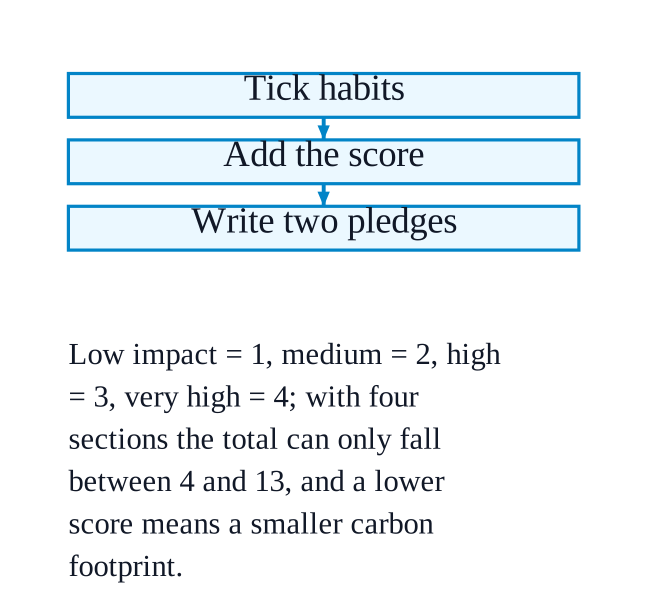
    Tick one option in each of the four sections — Transport, Electricity Use, Water Use, Waste and Plastics — add up your score, then write two changes you promise to make.
    How the scoring works
    Low impact = $\displaystyle 1$, Medium = $\displaystyle 2$, High = $\displaystyle 3$, Very high = $\displaystyle 4$.
    With four sections, your total can only fall between $\displaystyle 4$ and $\displaystyle 13$ points. A lower score means a smaller carbon footprint.
    A worked example (a sample sheet — not anyone's real answer)
    Transport: uses public transport → $\displaystyle 2$
    Electricity: sometimes forgets to switch off → $\displaystyle 2$
    Water: sometimes wastes water → $\displaystyle 2$
    Waste: sometimes uses disposable plastics → $\displaystyle 2$
    Total: $\displaystyle 8$ points.
    Two pledges that fit that sheet 1. "I will switch off the fan and the light every single time I leave the room." 2. "I will carry a steel bottle to school and refuse plastic straws for one month."What a good answer must contain
    Honest ticks — the point is to find out which of the four habits costs the most, then change that one.
    Pledges that are small, specific and checkable: a habit you can keep for a month, not a promise like "I will save the planet".
    A line saying what your score tells you, using the chapter's definition: carbon footprint is the total greenhouse gases released into the atmosphere by human activities such as energy use, transportation, or the production of goods and services.