SolveItClass 9 · NCERT

NCERT Solutions · Class 9 Social Science Atmosphere and Climate

20 questions · 20 still being checked

The Big Questions 3.1–3.4 (part 1 of 6)

  1. Exercise 3.1

    What is the composition of the atmosphere?

    The book prints no answer for this

    NCERT publishes no answers for this textbook, so there is nothing in the book to check this working against. It has also not yet been read through by hand.

    The atmosphere is a mixture of gases, and just two of them make up almost all of it: nitrogen $\displaystyle 78$% and oxygen $\displaystyle 21$%.
    NCERT_Solution_Class9_SocialScience_Ch3_BQ_Q3-1
    Next come argon ($\displaystyle 0.93$%) and carbon dioxide ($\displaystyle 0.04$%); every other gas together adds up to only about $\displaystyle 0.03$%.
    Those small-quantity gases include helium, neon, krypton, xenon, ozone and hydrogen.
    The air also carries water vapour, which varies from about $\displaystyle 0.1$% to $\displaystyle 0.4$%, and tiny dust particles. Water vapour plays a big part in cloud formation and precipitation.
    The mixture is not the same everywhere — the composition of the atmosphere varies with altitude.
  2. Exercise 3.2

    How do the different layers of the atmosphere affect the planet Earth?

    The book prints no answer for this

    NCERT publishes no answers for this textbook, so there is nothing in the book to check this working against. It has also not yet been read through by hand.

    Each layer does a different job, and together they keep the Earth fit for life.
    NCERT_Solution_Class9_SocialScience_Ch3_BQ_Q3-2
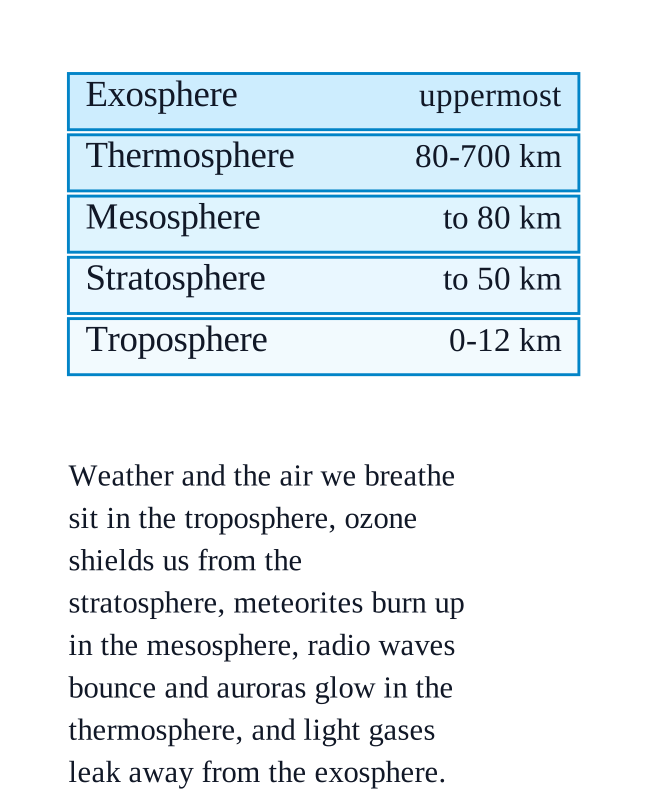
    Troposphere (average height about $\displaystyle 12$ km): holds the air we breathe, most of the water vapour and the clouds. Nearly all weather — rainfall, fog, hail — happens here.
    Stratosphere (up to $\displaystyle 50$ km): its ozone layer shields us by filtering the Sun's harmful radiation, including ultraviolet radiation. Being free of clouds, it is ideal for flying aeroplanes.
    Mesosphere (up to $\displaystyle 80$ km): most meteorites burn up here before they can reach the ground.
    Thermosphere ($\displaystyle 80$ to $\displaystyle 700$ km): absorbs the Sun's X-rays and short-wave ultraviolet radiation, reflects radio waves back to the Earth so radio transmission works, and is where the auroras appear. The ionosphere is a part of it.
    Exosphere: the uppermost layer, with very thin air, from which light gases like helium and hydrogen float into space because gravity is weak there.
  3. Exercise 3.3

    What is the mechanism of monsoon?

    The book prints no answer for this

    NCERT publishes no answers for this textbook, so there is nothing in the book to check this working against. It has also not yet been read through by hand.

    Monsoon is the seasonal reversal of the wind direction during a year, and it is mainly caused by the unequal heating of land and sea.
    Summer — the south-west monsoon (June to September): the Indian landmass heats up faster than the surrounding oceans. This creates a low-pressure area over the subcontinent, while the cooler Indian Ocean stays at high pressure.
    Air always moves from high pressure to low pressure, so moist winds blow from the sea to the land — across the Indian Ocean, the Arabian Sea and the Bay of Bengal — bringing most of India's rainfall.
    Winter — the north-east monsoon (October to February): the land cools faster than the seas, so high pressure sits over the land and low pressure over the seas, and cold, dry winds blow from land to sea.
    These winter winds bring no rain to most of India, except where they cross the Bay of Bengal, pick up moisture and water the eastern coast — Tamil Nadu, Andhra Pradesh and parts of Karnataka.
  4. Exercise 3.4

    How can we reduce our carbon footprint?

    The book prints no answer for this

    NCERT publishes no answers for this textbook, so there is nothing in the book to check this working against. It has also not yet been read through by hand.

    Carbon footprint means the total greenhouse gases released by our activities — so we shrink it by changing the everyday habits that burn fuel and waste resources.
    Travel: walk or use a cycle for short distances, and choose public transport or a carpool instead of a private car.
    Electricity: always switch off lights, fans and other appliances when they are not in use, and shift to renewable energy.
    Water and waste: use water judiciously, and reuse, recycle and avoid single-use plastics.
    Beyond the home: protect forests, plant trees and adopt sustainable lifestyles. The chapter stresses that tackling climate change needs collective effort, and that every small step counts.