SolveItClass 9 · NCERT

NCERT Solutions · Class 9 Science Sound Waves: Characteristics and Applications

28 questions · 16 still being checked

Revise, Reflect, Refine 10.9–10.10 (part 13 of 21)

  1. Exercise 10.9

    A source produces a sound wave of wavelength 3.44\displaystyle 3.44 m. If the wave travels with a speed of 344\displaystyle 344 m s1\displaystyle s^{-1} find its time period.
    NCERT’s answer
    0.$\displaystyle 01$ s
    Time period \(\displaystyle T = 0.01\ \text{s} \).
    NCERT_Solution_Class9_Science_Ch10_RRR_Q10-9
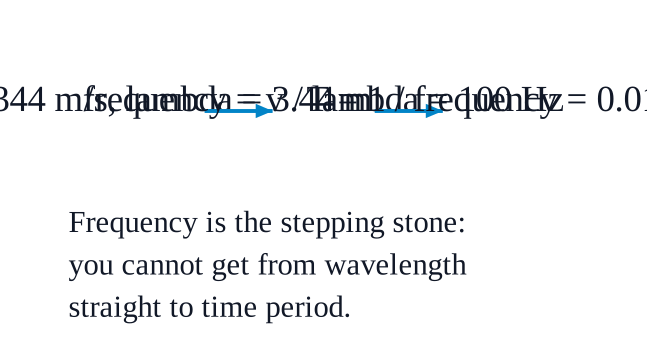
    From \(\displaystyle v = \nu \times \lambda \), the frequency is \(\displaystyle \nu = \dfrac{v}{\lambda} = \dfrac{344\ \text{m s}^{-1}}{3.44\ \text{m}} = 100\ \text{Hz} \).
    From \(\displaystyle \nu = \dfrac{1}{T} \), the time period is \(\displaystyle T = \dfrac{1}{\nu} = \dfrac{1}{100\ \text{Hz}} = 0.01\ \text{s} \).
  2. Exercise 10.10

    A ship searching for a sunken ship sent a sonar signal and detected an echo after 5\displaystyle 5 s. If ultrasonic wave travels at 1525\displaystyle 1525 m s1\displaystyle s^{-1} in seawater, approximately how far down in the ocean is the wreckage of the sunken ship located?

    Disagrees with the book

    This working does not reach the answer printed in NCERT. One of the two is wrong and it has not yet been settled which — check it before you rely on it.

    NCERT’s answer
    $\displaystyle 3812.5$ m $\displaystyle 65$
    The wreck lies about $\displaystyle 3812.5$ m down.
    NCERT_Solution_Class9_Science_Ch10_RRR_Q10-10
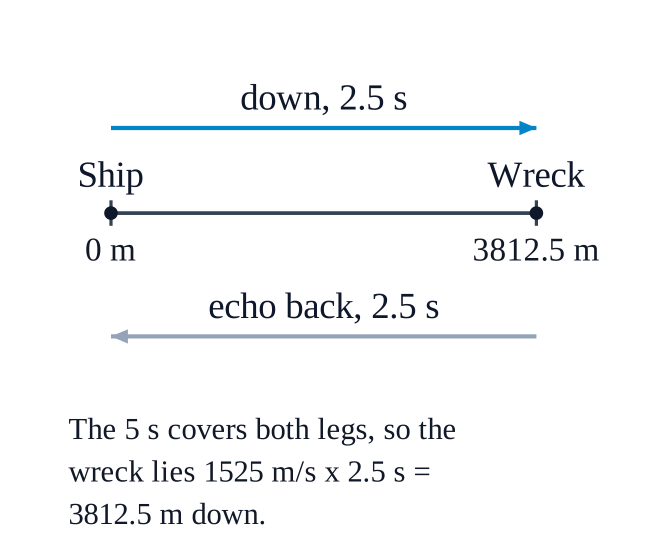
    The $\displaystyle 5$ s is the round trip, so the signal takes \(\displaystyle \dfrac{5\ \text{s}}{2} = 2.5\ \text{s} \) to reach the wreck.
    \(\displaystyle \text{depth} = v \times t = 1525\ \text{m s}^{-1} \times 2.5\ \text{s} = 3812.5\ \text{m} \).
    In one step: \(\displaystyle d = \dfrac{v t}{2} = \dfrac{1525\ \text{m s}^{-1} \times 5\ \text{s}}{2} = 3812.5\ \text{m} \).