Exercise 10.2
For a sound wave propagating in a medium, increasing its frequency will increase its (i) wavelength (ii) speed (iii) number of compressions per second (iv) time period
Not cross-checked
NCERT prints no numerical answer for this exercise, so this working has not been cross-checked against the book.
NCERT’s answer
(iii)
(iii) number of compressions per second.
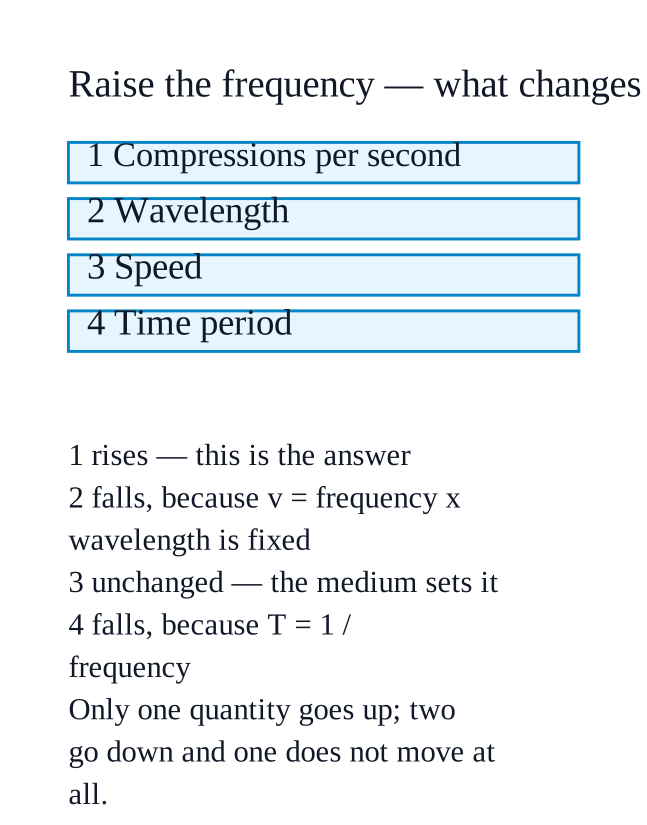
Frequency is the number of density oscillations passing a point each second, so raising it means more compressions arrive every second.
(ii) is wrong: in a given medium the speed depends on the medium (and its temperature and humidity), not on the source or its frequency.
(i) is wrong: since \(\displaystyle v = \nu \times \lambda \) stays fixed, a larger \(\displaystyle \nu \) forces a smaller \(\displaystyle \lambda \).
(iv) is wrong: \(\displaystyle T = \dfrac{1}{\nu} \), so a higher frequency gives a shorter time period.