Exercise 10.12
The speed of sound in air is about m at ºC and nearly m at ºC. Roughly how much extra time will the sound of thunder take to travel a distance of m, if the air temperature changes from ºC to ºC? Assume that all other conditions remain unchanged.
Check this one against your book
NCERT’s printed answer for this exercise does not match its own question. This working follows the question as printed.
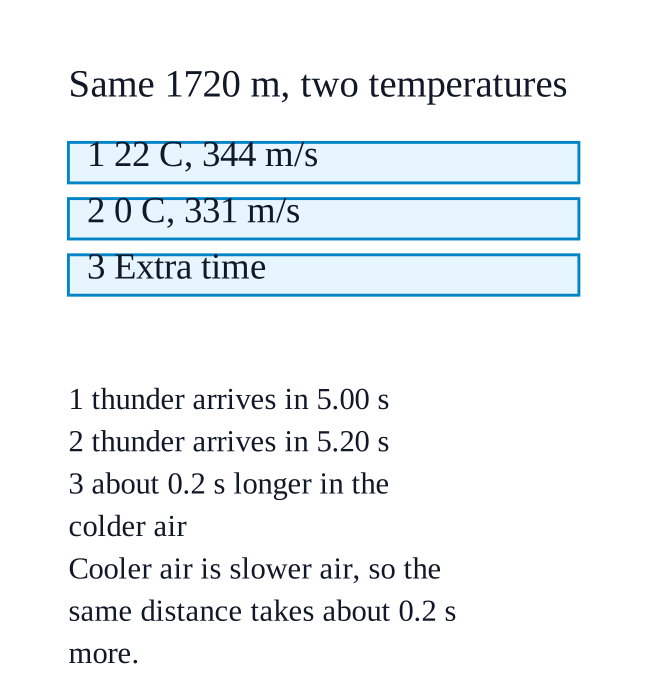
The sound of the thunder takes about \(\displaystyle 0.2\ \text{s}\) extra to cover the same \(\displaystyle 1720\ \text{m}\) once the air cools from \(\displaystyle 22\ ^\circ\text{C}\) to \(\displaystyle 0\ ^\circ\text{C}\).
Section $\displaystyle 10.6.3$ gives the tool: speed \(\displaystyle =\) distance \(\displaystyle \div\) time, used in Example $\displaystyle 10.3$ as distance \(\displaystyle = v \times t\); rearranged, time \(\displaystyle = \dfrac{\text{distance}}{\text{speed}}\).
At \(\displaystyle 22\ ^\circ\text{C}\) the speed is \(\displaystyle 344\ \text{m s}^{-1}\) (Section $\displaystyle 10.6.3$, repeated in the question), so \(\displaystyle t_{22} = \dfrac{1720\ \text{m}}{344\ \text{m s}^{-1}} = 5.00\ \text{s} \).
At \(\displaystyle 0\ ^\circ\text{C}\) the speed is \(\displaystyle 331\ \text{m s}^{-1}\), so \(\displaystyle t_{0} = \dfrac{1720\ \text{m}}{331\ \text{m s}^{-1}} = 5.196\ \text{s} \approx 5.2\ \text{s} \).
The extra time is the difference: \(\displaystyle \Delta t = t_{0} - t_{22} = 5.196\ \text{s} - 5.00\ \text{s} = 0.196\ \text{s} \approx 0.2\ \text{s} \).
Direction check against the chapter: Section $\displaystyle 10.6.3$ states that as the temperature is increased the speed of sound increases, so cooling the air lowers the speed, and a slower wave needs longer for the same distance. The difference therefore has to come out positive and small compared with the \(\displaystyle 5\ \text{s}\) journey itself \(\displaystyle -\) which \(\displaystyle 0.196\ \text{s}\) is.
The book's printed Answer Key gives $\displaystyle 331$ s, which does not agree with Section $\displaystyle 10.6.3$ (nor with the question's own stem): \(\displaystyle 331\) there is the speed of sound in dry air at \(\displaystyle 0\ ^\circ\text{C}\), in \(\displaystyle \text{m s}^{-1}\), not a time. The key entry appears to have copied that speed and re-labelled it as seconds.
Reasoning beyond the chapter, to show the printed figure cannot be rescued by any reading of the question: the entire trip at \(\displaystyle 0\ ^\circ\text{C}\) lasts only \(\displaystyle 5.2\ \text{s}\), so no delay inside this problem can be \(\displaystyle 331\ \text{s}\); and \(\displaystyle 331\ \text{s}\) of travel at roughly \(\displaystyle 340\ \text{m s}^{-1}\) would be \(\displaystyle 331\ \text{s} \times 340\ \text{m s}^{-1} = 112540\ \text{m} \approx 113\ \text{km} \), not the \(\displaystyle 1720\ \text{m}\) the question sets. The chapter's own two speeds settle it the other way, at \(\displaystyle 0.196\ \text{s} \approx 0.2\ \text{s}\).