Exercise 10.13
Sound travels much farther in water than light, and thus, is used for various underwater applications. A sonar signal sent to find the depth of ocean takes s to return. What is the depth of the ocean at that location if the speed of sound in seawater is m ? The Quest Continues … Sound helps us explore places and phenomenon beyond human hearing. Space probes have recorded the first sounds from Mars, scientists are timing the sound of distant earthquakes to measure tiny changes in ocean temperature to understand the Earth’s changing climate, biologists are using the buzz of mosquitoes to identify disease-carrying mosquitoes, and researchers are listening to the tiny crackles produced by microbes in the soil to study soil health and biodiversity. As technology improves, sound is becoming an even more powerful tool to explore planets, living organisms, and the hidden activities of nature.
NCERT’s answer
$\displaystyle 3000$ m
The ocean is $\displaystyle 3000$ m deep at that location.
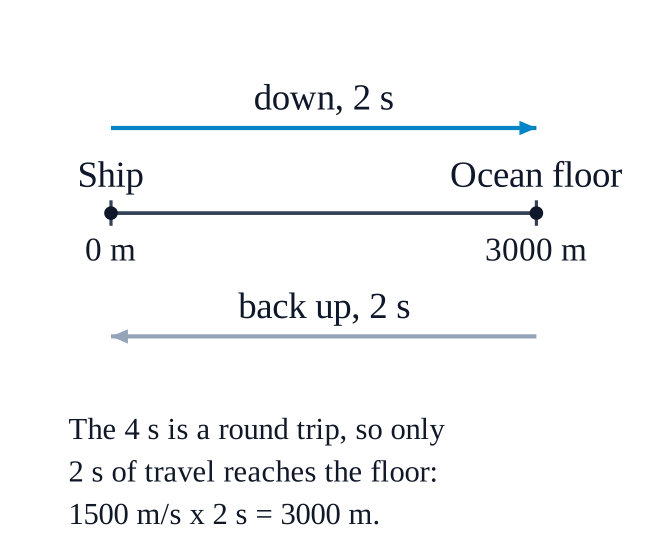
The $\displaystyle 4$ s is the time for the signal to go down and come back, so the one-way time is \(\displaystyle \dfrac{4\ \text{s}}{2} = 2\ \text{s} \).
\(\displaystyle \text{depth} = v \times t = 1500\ \text{m s}^{-1} \times 2\ \text{s} = 3000\ \text{m} \).
This is sonar — ultrasonic pulses are used because sound travels far in water, while light does not.