Exercise 4.4
During a family road trip, you drive km north in three hours. Afterwards, you drive km south in two hours. Find the average speed and average velocity for your entire trip.
Disagrees with the book
This working does not reach the answer printed in NCERT. One of the two is wrong and it has not yet been settled which — check it before you rely on it.
NCERT’s answer
$\displaystyle 80$ km \(\displaystyle h^{- 1}\); $\displaystyle 0$ km \(\displaystyle h^{- 1}\)
Average speed \(\displaystyle = 80\ \text{km h}^{-1} \); average velocity \(\displaystyle = 0\ \text{km h}^{-1} \).
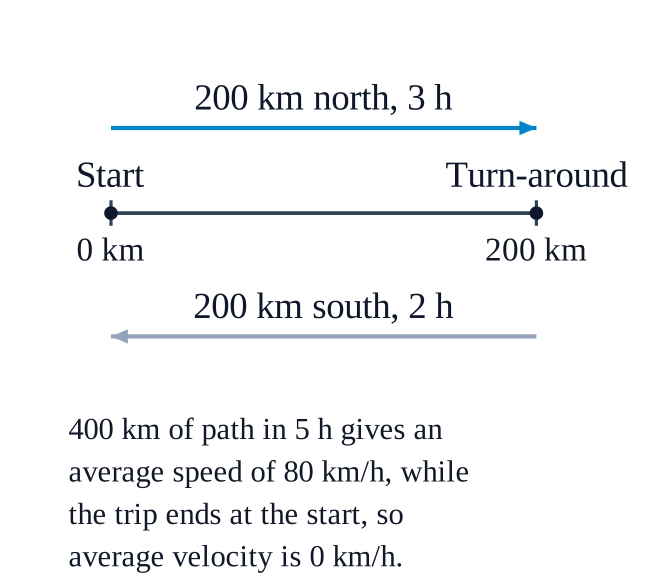
Total distance travelled \(\displaystyle = 200\ \text{km} + 200\ \text{km} = 400\ \text{km} \); total time \(\displaystyle = 3\ \text{h} + 2\ \text{h} = 5\ \text{h} \).
\(\displaystyle \text{average speed} = \frac{400\ \text{km}}{5\ \text{h}} = 80\ \text{km h}^{-1} \)
Displacement: $\displaystyle 200$ km north followed by $\displaystyle 200$ km south brings you back to the starting point, so \(\displaystyle s = 0\ \text{km} \).
\(\displaystyle v_{av} = \frac{0\ \text{km}}{5\ \text{h}} = 0\ \text{km h}^{-1} \)
The two differ because speed is built from the path length ($\displaystyle 400$ km) while velocity is built from the net change in position ($\displaystyle 0$ km).