SolveIt is under development
SolveItClass 9 · NCERT

NCERT Solutions · Class 9 Mathematics Two Variables, One Line

42 questions · 42 still being checked

Exercise Set 13.5 1–9 (part 5 of 7)

  1. Exercise 1

    Form a pair of linear equations for each of the following problems and find their solutions.
    (i)
    The sum of two integers is +5\displaystyle 5 and their difference is -21. Find the two numbers.
    (ii)
    The difference between two numbers is 26\displaystyle 26 and one number is three times the other. Find the numbers.
    (iii)
    The coach of a cricket team buys 7\displaystyle 7 bats and 6\displaystyle 6 balls for ₹8880. Later, she buys 3\displaystyle 3 bats and 5\displaystyle 5 balls for ₹4000. Find the cost of each bat and each ball.
    (iv)
    The taxi charges in a city consist of a fixed charge together with the charge for the distance covered for every km. For a distance of 10\displaystyle 10 km, the total amount paid is ₹155\displaystyle 155 and for a journey of 15\displaystyle 15 km, the total amount paid is ₹220. What is the fixed charge and the charge per km? How much does a person have to pay for travelling a distance of 25\displaystyle 25 km?
    (v)
    A fraction becomes equal to 911\displaystyle \frac{9}{11} if 2\displaystyle 2 is added to both the numerator and the denominator. If 3\displaystyle 3 is added to both the numerator and the denominator, it becomes equal to 56\displaystyle \frac{5}{6}. Find the fraction.
    (vi)
    If we add 1\displaystyle 1 to the numerator and subtract 1\displaystyle 1 from the denominator, a fraction reduces to 1. It becomes equal to 12\displaystyle \frac{1}{2} if we add 1\displaystyle 1 only to the denominator. What is the fraction?
    (vii)
    Five years ago, Nuri was thrice as old as Sonu. Ten years later, Nuri will be twice as old as Sonu. How old are Nuri and Sonu?
    (viii)
    The sum of the digits of a two-digit number is 9. Also, nine times this number is twice the number obtained by reversing the order of the digits. Find the number.
    (ix)
    Meena went to a bank to withdraw ₹2000. She asked the cashier to give her ₹50\displaystyle 50 and ₹100\displaystyle 100 notes only. Meena got 25\displaystyle 25 notes in all. Find how many notes of ₹50\displaystyle 50 and ₹100\displaystyle 100 did she receive?
    (x)
    A lending library has a fixed charge for the first three days and an additional charge for each day thereafter. Saritha paid ₹27\displaystyle 27 for a book kept for seven days, while Susy paid ₹21\displaystyle 21 for the book she kept for five days. Find the fixed charge and the charge for each extra day.

    Not cross-checked

    This solution has not been cross-checked against the answer printed in NCERT.

    (i) Let the numbers be \(\displaystyle x \) and \(\displaystyle y \). \[x+y=5, \qquad x-y=-21 \] \[(x+y)+(x-y)=5-21 \;\Rightarrow\; 2x=-16 \;\Rightarrow\; x=-8 \] \[y=5-x=13 \](ii) Let the positive numbers be \(\displaystyle x>y \). \[x-y=26, \qquad x=3y \] \[3y-y=26 \;\Rightarrow\; y=13 \] \[x=3\times 13=39 \](iii) A bat costs \(\displaystyle x \) rupees and a ball \(\displaystyle y \) rupees. \[7x+6y=8880, \qquad 3x+5y=4000 \] Multiply by $\displaystyle 3$ and by $\displaystyle 7$ to match the \(\displaystyle x \)-terms, then subtract: \[21x+18y=26640, \qquad 21x+35y=28000 \] \[17y=1360 \;\Rightarrow\; y=80 \] \[7x=8880-6(80)=8400 \;\Rightarrow\; x=1200 \](iv) Fixed charge \(\displaystyle x \) rupees, charge per km \(\displaystyle y \) rupees. \[x+10y=155, \qquad x+15y=220 \] \[5y=65 \;\Rightarrow\; y=13, \qquad x=155-10(13)=25 \] \[\text{Fare for 25 km}=x+25y=25+25(13)=350 \](v) Let the fraction be \(\displaystyle \dfrac{x}{y} \). \[\frac{x+2}{y+2}=\frac{9}{11}, \qquad \frac{x+3}{y+3}=\frac{5}{6} \] \[11x-9y=-4, \qquad 6x-5y=-3 \] Multiply by $\displaystyle 5$ and by $\displaystyle 9$, then subtract: \[55x-45y=-20, \qquad 54x-45y=-27 \;\Rightarrow\; x=7 \] \[9y=11(7)+4=81 \;\Rightarrow\; y=9 \](vi) Let the fraction be \(\displaystyle \dfrac{x}{y} \). \[\frac{x+1}{y-1}=1, \qquad \frac{x}{y+1}=\frac12 \] \[y=x+2, \qquad 2x=y+1 \] \[2x=x+3 \;\Rightarrow\; x=3, \qquad y=5 \](vii) Nuri is \(\displaystyle N \) and Sonu is \(\displaystyle S \) years old now. \[N-5=3(S-5), \qquad N+10=2(S+10) \] \[N-3S=-10, \qquad N-2S=10 \] Subtract the first from the second: \[S=20, \qquad N=10+2(20)=50 \](viii) Tens digit \(\displaystyle x \), units digit \(\displaystyle y \); the number is \(\displaystyle 10x+y \) and its reverse is \(\displaystyle 10y+x \). \[x+y=9, \qquad 9(10x+y)=2(10y+x) \] \[88x=11y \;\Rightarrow\; y=8x \] \[x+8x=9 \;\Rightarrow\; x=1, \qquad y=8 \](ix) \(\displaystyle x \) notes of ₹$\displaystyle 50$ and \(\displaystyle y \) notes of ₹100. \[x+y=25, \qquad 50x+100y=2000 \;\Rightarrow\; x+2y=40 \] \[(x+2y)-(x+y)=40-25 \;\Rightarrow\; y=15, \qquad x=10 \](x) Fixed charge \(\displaystyle x \) rupees, each extra day \(\displaystyle y \) rupees. Seven days means $\displaystyle 4$ extra days; five days means 2. \[x+4y=27, \qquad x+2y=21 \] \[2y=6 \;\Rightarrow\; y=3, \qquad x=21-2(3)=15 \]Answer: (i) \(\displaystyle -8 \) and \(\displaystyle 13 \); (ii) \(\displaystyle 39 \) and \(\displaystyle 13 \); (iii) bat ₹$\displaystyle 1200$, ball ₹$\displaystyle 80$; (iv) fixed ₹$\displaystyle 25$, ₹$\displaystyle 13$ per km, ₹$\displaystyle 350$ for $\displaystyle 25$ km; (v) \(\displaystyle \dfrac{7}{9} \); (vi) \(\displaystyle \dfrac{3}{5} \); (vii) Nuri $\displaystyle 50$ years, Sonu $\displaystyle 20$ years; (viii) \(\displaystyle 18 \); (ix) ten ₹$\displaystyle 50$ notes and fifteen ₹$\displaystyle 100$ notes; (x) fixed ₹$\displaystyle 15$, ₹$\displaystyle 3$ per extra day.
  2. Exercise 2

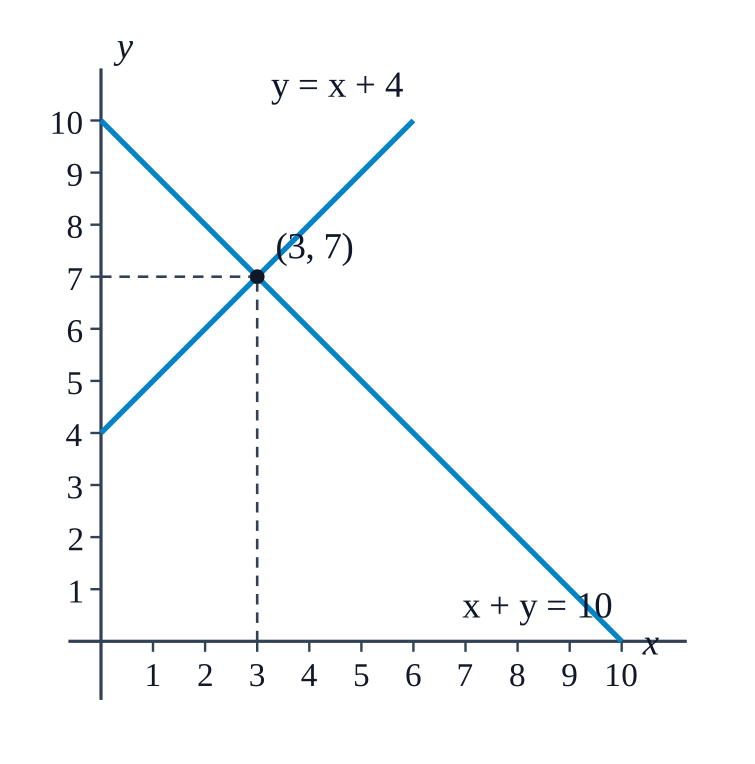
    Form a pair of linear equations and find their common solutions graphically. 10\displaystyle 10 students of Grade 9\displaystyle 9 took part in a Mathematics quiz. If the number of girls is 4\displaystyle 4 more than the number of boys, find the number of boys and girls who took part in the quiz.

    Not cross-checked

    This solution has not been cross-checked against the answer printed in NCERT.

    Let \(\displaystyle x \) be the number of boys and \(\displaystyle y \) the number of girls. \[x+y=10, \qquad y=x+4 \] \[\begin{array}{c|ccc} x & 0 & 5 & 10 \\ \hline y=10-x & 10 & 5 & 0 \end{array} \qquad \begin{array}{c|ccc} x & 0 & 3 & 6 \\ \hline y=x+4 & 4 & 7 & 10 \end{array} \] Plot both lines on the same axes.NCERT_Solution_Class9_Maths_Ch13_Ex13-5_Q2The lines meet at \(\displaystyle (3,7) \): \[3+7=10, \qquad 7=3+4 \]Answer: $\displaystyle 3$ boys and $\displaystyle 7$ girls.
  3. Exercise 3

    Use the ratios a1a2,b1b2,c1c2\displaystyle \frac{a_1}{a_2}, \frac{b_1}{b_2}, \frac{c_1}{c_2}, to determine whether the lines representing the following pairs of linear equations intersect at a point, are parallel or are coincident.
    (i)
    5x−4y+8=0;7x+6y−9=0\displaystyle 5 x-4 y+8=0 ; 7 x+6 y-9=0
    (ii)
    9x+3y+12=0;18x+6y+24=0\displaystyle 9 x+3 y+12=0 ; 18 x+6 y+24=0
    (iii)
    6x−3y+10=0;2x−y+9=0\displaystyle 6 x-3 y+10=0 ; 2 x-y+9=0

    Not cross-checked

    This solution has not been cross-checked against the answer printed in NCERT.

    (i) \[\frac{a_1}{a_2}=\frac57, \qquad \frac{b_1}{b_2}=\frac{-4}{6}=-\frac23, \qquad \frac{c_1}{c_2}=\frac{8}{-9} \] \[\frac{a_1}{a_2}\neq\frac{b_1}{b_2} \] The lines intersect at a point.(ii) \[\frac{a_1}{a_2}=\frac{9}{18}=\frac12, \qquad \frac{b_1}{b_2}=\frac{3}{6}=\frac12, \qquad \frac{c_1}{c_2}=\frac{12}{24}=\frac12 \] All three ratios are equal, so the lines are coincident.(iii) \[\frac{a_1}{a_2}=\frac{6}{2}=3, \qquad \frac{b_1}{b_2}=\frac{-3}{-1}=3, \qquad \frac{c_1}{c_2}=\frac{10}{9} \] \[\frac{a_1}{a_2}=\frac{b_1}{b_2}\neq\frac{c_1}{c_2} \] The lines are parallel.Answer: (i) intersect at a point; (ii) coincident; (iii) parallel.
  4. Exercise 4

    Which of the following pairs of linear equations have solutions? If they have solutions, find them graphically.
    (i)
    x+y=5,2x+2y=10\displaystyle x+y=5,2 x+2 y=10
    (ii)
    x−y=8,3x−3y=16\displaystyle x-y=8,3 x-3 y=16
    (iii)
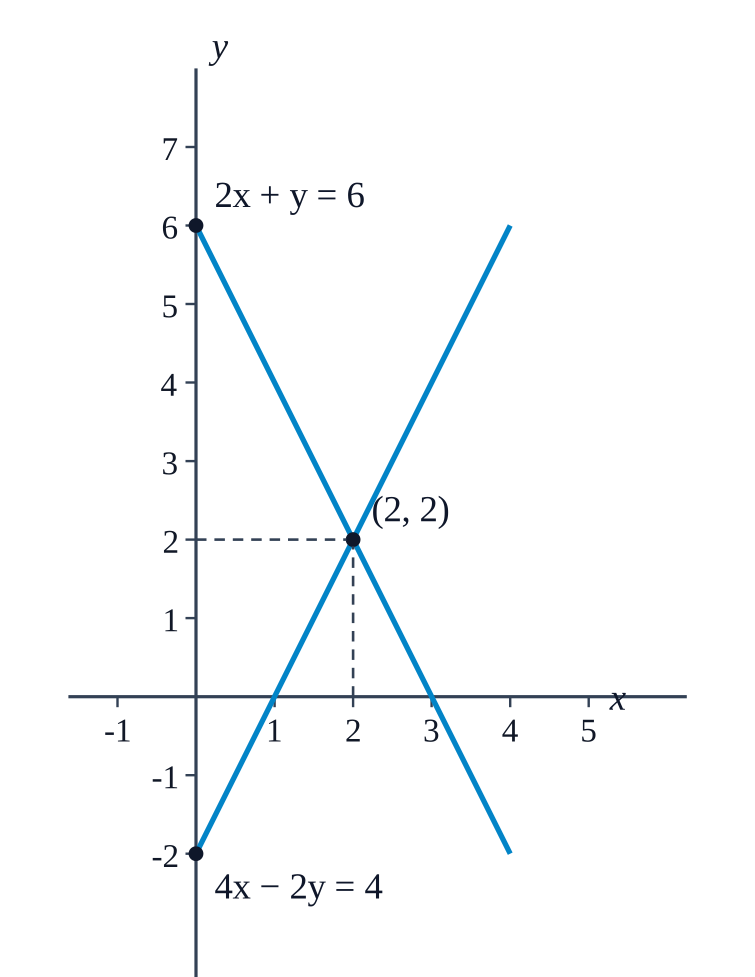
    2x+y−6=0,4x−2y−4=0\displaystyle 2 x+y-6=0,4 x-2 y-4=0
    (iv)
    2x−2y−2=0,4x−4y−5=0\displaystyle 2 x-2 y-2=0,4 x-4 y-5=0

    Not cross-checked

    This solution has not been cross-checked against the answer printed in NCERT.

    (i) Standard form: \(\displaystyle x+y-5=0 \) and \(\displaystyle 2x+2y-10=0 \). \[\frac{a_1}{a_2}=\frac12, \qquad \frac{b_1}{b_2}=\frac12, \qquad \frac{c_1}{c_2}=\frac{-5}{-10}=\frac12 \] Points on each line: \[\begin{array}{c|ccc} x & 0 & 2 & 5 \\ \hline y=5-x & 5 & 3 & 0 \end{array} \qquad \begin{array}{c|ccc} x & 0 & 2 & 5 \\ \hline y=\dfrac{10-2x}{2} & 5 & 3 & 0 \end{array} \] Both tables give the same points, so the two graphs are one line. Every point of it is a solution, for example \(\displaystyle (1,4) \) and \(\displaystyle (2,3) \): infinitely many solutions.(ii) Standard form: \(\displaystyle x-y-8=0 \) and \(\displaystyle 3x-3y-16=0 \). \[\frac{a_1}{a_2}=\frac13, \qquad \frac{b_1}{b_2}=\frac{-1}{-3}=\frac13, \qquad \frac{c_1}{c_2}=\frac{-8}{-16}=\frac12 \] \[\frac{a_1}{a_2}=\frac{b_1}{b_2}\neq\frac{c_1}{c_2} \] The lines are parallel: no solution.(iii) \[\frac{a_1}{a_2}=\frac24=\frac12, \qquad \frac{b_1}{b_2}=\frac{1}{-2}=-\frac12 \] The ratios differ, so the lines intersect and there is one solution. Points on each line: \[\begin{array}{c|ccc} x & 0 & 2 & 3 \\ \hline y=6-2x & 6 & 2 & 0 \end{array} \qquad \begin{array}{c|ccc} x & 0 & 1 & 2 \\ \hline y=2x-2 & -2 & 0 & 2 \end{array} \]NCERT_Solution_Class9_Maths_Ch13_Ex13-5_Q4The lines cross at \(\displaystyle (2,2) \), so \(\displaystyle x=2,\ y=2 \).(iv) Standard form: \(\displaystyle 2x-2y-2=0 \) and \(\displaystyle 4x-4y-5=0 \). \[\frac{a_1}{a_2}=\frac24=\frac12, \qquad \frac{b_1}{b_2}=\frac{-2}{-4}=\frac12, \qquad \frac{c_1}{c_2}=\frac{-2}{-5}=\frac25 \] \[\frac{a_1}{a_2}=\frac{b_1}{b_2}\neq\frac{c_1}{c_2} \] The lines are parallel: no solution.Answer: (i) infinitely many solutions (both equations give the line \(\displaystyle x+y=5 \)); (ii) no solution; (iii) \(\displaystyle x=2,\ y=2 \); (iv) no solution.
  5. Exercise 5

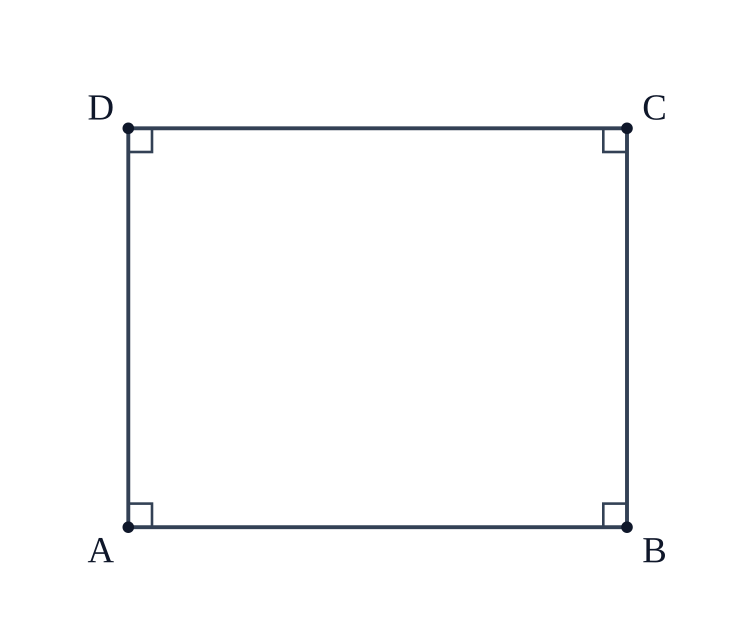
    Half the perimeter of a rectangular garden, whose length is 4\displaystyle 4 m more than its width, is 36\displaystyle 36 m . Find the dimensions of the garden.

    Not cross-checked

    This solution has not been cross-checked against the answer printed in NCERT.

    Let the garden be the rectangle \(\displaystyle ABCD \) with length \(\displaystyle AB=\ell \) m and width \(\displaystyle BC=w \) m.NCERT_Solution_Class9_Maths_Ch13_Ex13-5_Q5\[\ell-w=4 \quad \text{(length is 4 m more)} \] \[\ell+w=36 \quad \text{(half the perimeter)} \] Adding: \[2\ell=40 \;\Rightarrow\; \ell=20 \] \[w=36-20=16 \]Answer: length $\displaystyle 20$ m, width $\displaystyle 16$ m.
  6. Exercise 6

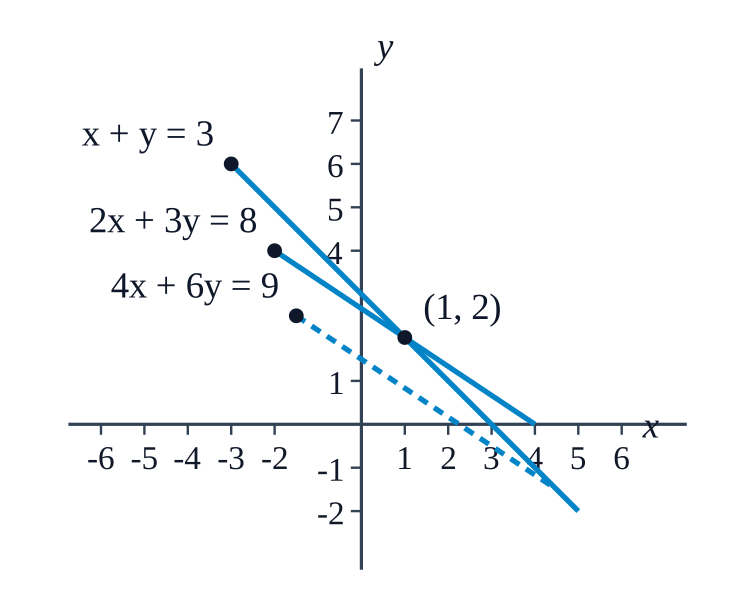
    Given the linear equation 2x+3y−8=0\displaystyle 2 x+3 y-8=0, write another linear equation in two variables so that the graphs of the pair formed represent
    (i)
    intersecting lines
    (ii)
    parallel lines
    (iii)
    coincident lines.

    Not cross-checked

    This solution has not been cross-checked against the answer printed in NCERT.

    (i) Take \(\displaystyle x+y-3=0 \). \[\frac{a_1}{a_2}=\frac21, \qquad \frac{b_1}{b_2}=\frac31, \qquad \frac{a_1}{a_2}\neq\frac{b_1}{b_2} \] The lines intersect, at \(\displaystyle (1,2) \): \[2x+3y=8, \quad 2x+2y=6 \;\Rightarrow\; y=2, \quad x=1 \](ii) Take \(\displaystyle 4x+6y-9=0 \). \[\frac{a_1}{a_2}=\frac24=\frac12, \qquad \frac{b_1}{b_2}=\frac36=\frac12, \qquad \frac{c_1}{c_2}=\frac{-8}{-9}=\frac89 \] \[\frac{a_1}{a_2}=\frac{b_1}{b_2}\neq\frac{c_1}{c_2} \;\Rightarrow\; \text{parallel} \](iii) Take \(\displaystyle 4x+6y-16=0 \), twice the given equation. \[\frac{a_1}{a_2}=\frac{b_1}{b_2}=\frac{c_1}{c_2}=\frac12 \] Its line coincides with the given line.NCERT_Solution_Class9_Maths_Ch13_Ex13-5_Q6For another equation \(\displaystyle a_2x+b_2y+c_2=0 \): \[\text{(i) } \frac{2}{a_2}\neq\frac{3}{b_2}; \qquad \text{(ii) } \frac{2}{a_2}=\frac{3}{b_2}\neq\frac{-8}{c_2}; \qquad \text{(iii) } \frac{2}{a_2}=\frac{3}{b_2}=\frac{-8}{c_2} \] Any equation meeting these conditions is equally valid.Answer: (i) \(\displaystyle x+y-3=0 \); (ii) \(\displaystyle 4x+6y-9=0 \); (iii) \(\displaystyle 4x+6y-16=0 \) (other answers are valid).
  7. Exercise 7

    Here is a problem that was posed by Mahāvīrāchārya in Gaṇita sāra saṅgraha (c. 850\displaystyle 850 CE). The price of 9\displaystyle 9 citrons and 7\displaystyle 7 fragrant wood-apples taken together is 107\displaystyle 107; and the price of 7\displaystyle 7 citrons and 9\displaystyle 9 fragrant wood-apples taken together is 101. O mathematician, tell me quickly the price of each citron and of each fragrant wood-apple. (Hint: The given problem can be modelled as 9x+7y=1077x+9y=101\begin{aligned} & 9 x+7 y=107 \\ & 7 x+9 y=101 \end{aligned} Can you figure out a way of solving these equations without directly using elimination or the substitution method? What is special in this pair of equations? The x\displaystyle x and y\displaystyle y coefficients are interchanged in the 2\displaystyle 2 equations. What will happen if we add the pair of equations? What will happen if we subtract the pair of equations? Can the resulting equations be solved to find the values of x\displaystyle x and y\displaystyle y ?)

    Not cross-checked

    This solution has not been cross-checked against the answer printed in NCERT.

    Let a citron cost \(\displaystyle x \) and a wood-apple \(\displaystyle y \). The coefficients are interchanged, so adding and subtracting the equations gives simpler ones. \[9x+7y=107, \qquad 7x+9y=101 \] Adding: \[16x+16y=208 \;\Rightarrow\; x+y=13 \] Subtracting the second from the first: \[2x-2y=6 \;\Rightarrow\; x-y=3 \] Adding these two: \[2x=16 \;\Rightarrow\; x=8, \qquad y=13-8=5 \] \[9(8)+7(5)=107, \qquad 7(8)+9(5)=101 \]Answer: a citron costs $\displaystyle 8$ and a wood-apple costs 5.
  8. Exercise 8

    5\displaystyle 5 pencils and 7\displaystyle 7 pens together cost ₹50\displaystyle 50, whereas 7\displaystyle 7 pencils and 5\displaystyle 5 pens together cost ₹46. Find the cost of each pencil and pen.

    Not cross-checked

    This solution has not been cross-checked against the answer printed in NCERT.

    Let a pencil cost \(\displaystyle x \) rupees and a pen \(\displaystyle y \) rupees. \[5x+7y=50, \qquad 7x+5y=46 \] Adding: \[12x+12y=96 \;\Rightarrow\; x+y=8 \] Subtracting the first from the second: \[2x-2y=-4 \;\Rightarrow\; x-y=-2 \] Adding these two: \[2x=6 \;\Rightarrow\; x=3, \qquad y=8-3=5 \] \[5(3)+7(5)=50, \qquad 7(3)+5(5)=46 \]Answer: pencil ₹$\displaystyle 3$, pen ₹5.
  9. Exercise 9

    NCERT_Question_Class9_Maths_Ch13_Ex13-5_Q9 Find the height of the stool.

    Not cross-checked

    This solution has not been cross-checked against the answer printed in NCERT.

    Let the height of the stool be \(\displaystyle x\) cm and the height of the cat be \(\displaystyle y\) cm.In the first picture the cat sits on the stool, so the stool and the cat together measure $\displaystyle 85$ cm. In the second picture the cat sits on the floor under the stool, and the top of the stool is $\displaystyle 25$ cm above the cat's head.\[x + y = 85 \quad \text{(1)} \] \[x - y = 25 \quad \text{(2)} \]Adding ($\displaystyle 1$) and ($\displaystyle 2$):\[2x = 110 \] \[x = 55 \]Substituting in ($\displaystyle 1$):\[y = 85 - 55 = 30 \]Check:\[55 + 30 = 85, \qquad 55 - 30 = 25 \]Answer: The stool is $\displaystyle 55$ cm high (the cat is $\displaystyle 30$ cm).