SolveIt is under development
SolveItClass 9 · NCERT

NCERT Solutions · Class 9 Mathematics Two Variables, One Line

42 questions · 42 still being checked

End-of-Chapter Exercises 1–10 (part 6 of 7)

  1. Exercise 1

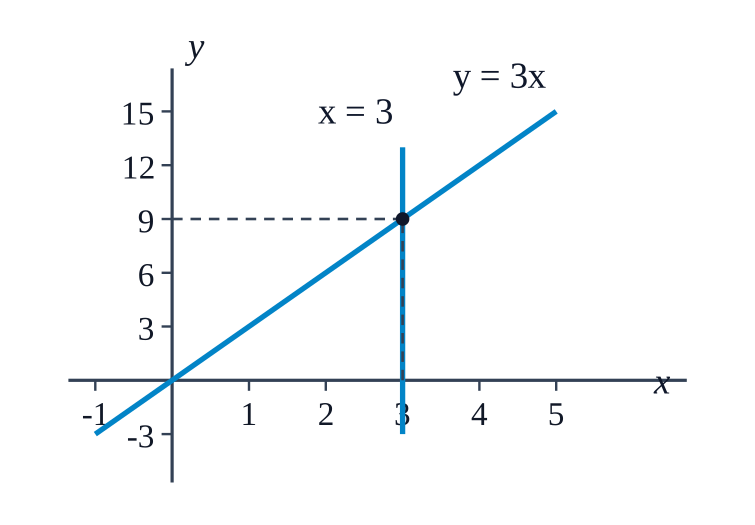
    The graph of the line y=3x\displaystyle y=3 x, passing through (0,0)\displaystyle (0,0) and (2,6)\displaystyle (2,6) is given below. NCERT_Question_Class9_Maths_Ch13_EoC_Q1
    (i)
    Identify the slope of the line from the graph and explain how you calculated it using the two points on the line.
    (ii)
    What is the y-intercept of the line? Explain its significance.
    (iii)
    A water tank is being filled so that the water level y\displaystyle y (in cm) after x\displaystyle x minutes follows this graph.
    (a)
    How high is the water after 5\displaystyle 5 minutes?
    (b)
    How many minutes will it take for the water to reach a height of 21\displaystyle 21 cm?
    (iv)
    Without drawing a new graph, determine whether the point (4,10)\displaystyle (4,10) lies on this line. Justify your answer.
    (v)
    Plot the point where this line intersects the line x=3\displaystyle x=3. Explain how you found the coordinates.

    Not cross-checked

    This solution has not been cross-checked against the answer printed in NCERT.

    (i) Rise over run between \(\displaystyle (0,0)\) and \(\displaystyle (2,6)\). \[m=\frac{y_2-y_1}{x_2-x_1}=\frac{6-0}{2-0}=3 \](ii) The line meets the y-axis where \(\displaystyle x=0\). \[y=3(0)=0 \] The y-intercept is \(\displaystyle 0\): the line passes through the origin, so the tank is empty at the start ($\displaystyle 0$ cm at $\displaystyle 0$ minutes).(iii)(a) Level after $\displaystyle 5$ minutes: \[y=3(5)=15 \](iii)(b) Time for a level of $\displaystyle 21$ cm: \[3x=21 \Rightarrow x=7 \](iv) Put \(\displaystyle x=4\) in \(\displaystyle y=3x\): \[y=3(4)=12\neq 10 \] So \(\displaystyle (4,10)\) is not on the line.(v) Put \(\displaystyle x=3\) in \(\displaystyle y=3x\): \[y=3(3)=9 \] NCERT_Solution_Class9_Maths_Ch13_EoC_Q1 The lines meet at \(\displaystyle (3,9)\).Answer: (i) slope \(\displaystyle 3\); (ii) \(\displaystyle 0\), the line passes through the origin; (iii)(a) $\displaystyle 15$ cm, (b) $\displaystyle 7$ minutes; (iv) no; (v) \(\displaystyle (3,9)\).
  2. Exercise 2

    In countries like the USA, temperature is measured in Fahrenheit, whereas in countries like India, it is measured in Celsius. Here is a linear equation that converts Celsius to Fahrenheit: F=95C+32F=\frac{9}{5} C+32
    (i)
    Draw the graph of the linear equation above using Celsius on the x-axis and Fahrenheit on the y-axis.
    (ii)
    If the temperature is 30∘C\displaystyle 30^{\circ} \mathrm{C}, what is the temperature in Fahrenheit?
    (iii)
    If the temperature is 95\displaystyle 95 °F, what is the temperature in Celsius?
    (iv)
    If the temperature is 0∘C\displaystyle 0^{\circ} \mathrm{C}, what is the temperature in Fahrenheit and if the temperature is 0∘F\displaystyle 0^{\circ} \mathrm{F}, what is the temperature in Celsius?
    (v)
    Is there a temperature which is numerically the same in both Fahrenheit and Celsius? If yes, find it.

    Not cross-checked

    This solution has not been cross-checked against the answer printed in NCERT.

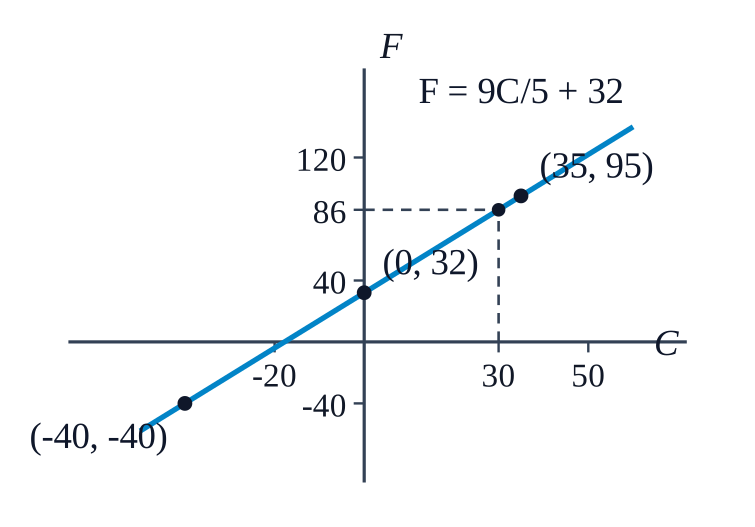
    (i) Find \(\displaystyle F\) for chosen values of \(\displaystyle C\): \[\begin{array}{c|cccc} C & -40 & 0 & 30 & 35 \\ \hline F & -40 & 32 & 86 & 95 \end{array} \] Plot these with \(\displaystyle C\) on the x-axis and \(\displaystyle F\) on the y-axis; they lie on one straight line. NCERT_Solution_Class9_Maths_Ch13_EoC_Q2(ii) \[F=\frac{9}{5}(30)+32=54+32=86 \](iii) \[95=\frac{9}{5}C+32 \Rightarrow C=\frac{5}{9}(95-32)=35 \](iv) \[C=0 \Rightarrow F=\frac{9}{5}(0)+32=32 \] \[F=0 \Rightarrow C=\frac{5}{9}(0-32)=-\frac{160}{9}\approx -17.8 \](v) Put \(\displaystyle F=C\): \[C=\frac{9}{5}C+32 \Rightarrow -\frac{4}{5}C=32 \Rightarrow C=-40 \] Yes: \(\displaystyle -40^{\circ}\mathrm{C}=-40^{\circ}\mathrm{F}\), the point \(\displaystyle (-40,-40)\) on the graph.Answer: (ii) \(\displaystyle 86^{\circ}\mathrm{F}\); (iii) \(\displaystyle 35^{\circ}\mathrm{C}\); (iv) \(\displaystyle 32^{\circ}\mathrm{F}\) and \(\displaystyle -\tfrac{160}{9}\approx-17.8^{\circ}\mathrm{C}\); (v) yes, \(\displaystyle -40\).
  3. Exercise 3

    Solve the following system of equations graphically: 2x+y=6,2x−y−2=0.2 x+y=6,2 x-y-2=0 .

    Not cross-checked

    This solution has not been cross-checked against the answer printed in NCERT.

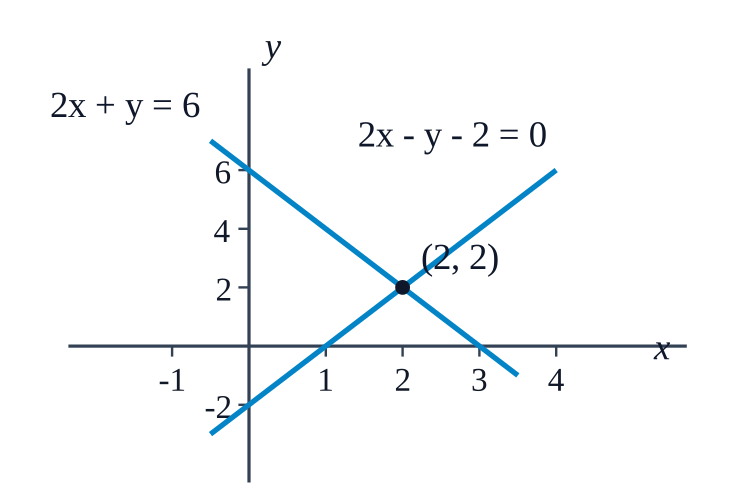
    Points on each line: \[2x+y=6:\quad (0,6),\ (2,2),\ (3,0) \] \[2x-y-2=0:\quad (0,-2),\ (1,0),\ (2,2) \] NCERT_Solution_Class9_Maths_Ch13_EoC_Q3 The lines cross at \(\displaystyle (2,2)\). Check in both equations: \[2(2)+2=6, \qquad 2(2)-2-2=0 \]Answer: \(\displaystyle x=2,\ y=2\)
  4. Exercise 4

    Find the point of intersection of the lines shown on the cover page.

    Solution being prepared

  5. Exercise 5

    Give a formula to find the x-intercept of the line y=mx+c\displaystyle y=m x+c.

    Not cross-checked

    This solution has not been cross-checked against the answer printed in NCERT.

    The x-intercept is where the line meets the x-axis, that is \(\displaystyle y=0\). \[0=mx+c \] \[x=-\frac{c}{m}, \qquad m\neq 0 \] The line cuts the x-axis at \(\displaystyle \left(-\dfrac{c}{m},\,0\right)\). Check with \(\displaystyle y=2x-6\): \[x=-\frac{-6}{2}=3, \qquad y=2(3)-6=0 \] If \(\displaystyle m=0\), the line \(\displaystyle y=c\) is parallel to the x-axis and has no x-intercept (for \(\displaystyle c\neq 0\)).Answer: x-intercept \(\displaystyle =-\dfrac{c}{m}\) (for \(\displaystyle m\neq 0\))
  6. Exercise 6

    A person is choosing between two mobile plans. Plan A: ₹50\displaystyle 50 monthly fee + ₹0.20\displaystyle 0.20 per minute of call time. Plan B: ₹30\displaystyle 30 monthly fee + ₹0.30\displaystyle 0.30 per minute of call time. For how many minutes of calling per month is Plan A cheaper than Plan B? For how many minutes is Plan B cheaper? Also find the number of minutes at which both plans cost the same.

    Not cross-checked

    This solution has not been cross-checked against the answer printed in NCERT.

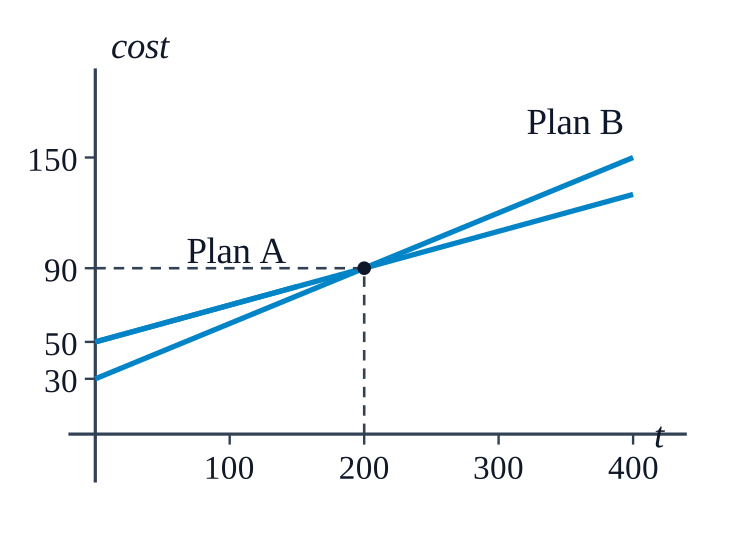
    Let \(\displaystyle t\) be the minutes of calls in a month. Monthly cost in ₹: \[\text{Plan A: } 50+0.20\,t \qquad \text{Plan B: } 30+0.30\,t \] Equal cost: \[50+0.20\,t=30+0.30\,t \] \[20=0.10\,t \Rightarrow t=200 \] \[50+0.20(200)=90=30+0.30(200) \] NCERT_Solution_Class9_Maths_Ch13_EoC_Q6 Plan A starts higher but rises more slowly, so the lines cross at \(\displaystyle t=200\). Test one value on each side: \[t=100:\ 70\ (\text{A})>60\ (\text{B}) \] \[t=300:\ 110\ (\text{A})<120\ (\text{B}) \]Answer: Plan A is cheaper for more than $\displaystyle 200$ minutes; Plan B is cheaper for fewer than $\displaystyle 200$ minutes; both cost ₹$\displaystyle 90$ at $\displaystyle 200$ minutes.
  7. Exercise 7

    How many lines exist that
    (i)
    have a given slope?
    (ii)
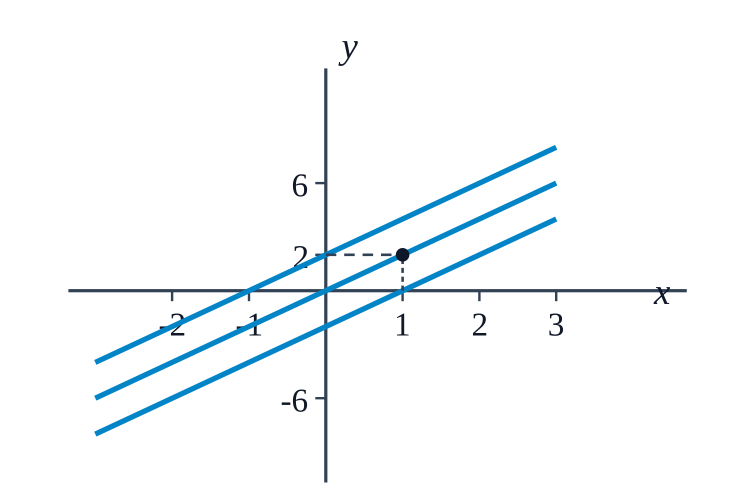
    have a given slope and pass through a given point?

    Not cross-checked

    This solution has not been cross-checked against the answer printed in NCERT.

    (i) A line of slope \(\displaystyle m\) is \(\displaystyle y=mx+d\), and \(\displaystyle d\) can be any real number. \[y=2x-2,\quad y=2x,\quad y=2x+2,\ \dots \] Each \(\displaystyle d\) gives a different line, all parallel.(ii) The point \(\displaystyle (x_1,y_1)\) must satisfy the equation, which fixes \(\displaystyle d\): \[y_1=mx_1+d \Rightarrow d=y_1-mx_1 \] \[y-y_1=m(x-x_1) \] For slope \(\displaystyle 2\) through \(\displaystyle (1,2)\): \[d=2-2(1)=0 \Rightarrow y=2x \] NCERT_Solution_Class9_Maths_Ch13_EoC_Q7Answer: (i) infinitely many (all parallel); (ii) exactly one.
  8. Exercise 8

    For what values of p\displaystyle p does the pair of equations given below have a unique solution? 4x+py+8=0;2x+2y+2=0.4 x+p y+8=0 ; \quad 2 x+2 y+2=0 .

    Not cross-checked

    This solution has not been cross-checked against the answer printed in NCERT.

    A unique solution needs \(\displaystyle \dfrac{a_1}{a_2}\neq\dfrac{b_1}{b_2}\). \[\frac{a_1}{a_2}=\frac{4}{2}=2, \qquad \frac{b_1}{b_2}=\frac{p}{2} \] \[\frac{p}{2}\neq 2 \Rightarrow p\neq 4 \] Check: from the second equation \(\displaystyle x=-y-1\); substituting in the first, \[4(-y-1)+py+8=0 \Rightarrow (p-4)\,y=-4 \] This gives one \(\displaystyle y\) exactly when \(\displaystyle p\neq 4\). For \(\displaystyle p=4\): \[\frac{a_1}{a_2}=\frac{b_1}{b_2}=2\neq\frac{c_1}{c_2}=4 \] The lines are then parallel, with no solution.Answer: all real \(\displaystyle p\) except \(\displaystyle p=4\)
  9. Exercise 9

    Find the values of a\displaystyle a and b\displaystyle b for which the following system of equations has infinitely many solutions: (a+b)x−2by=5a+2b+1;3x−y=14.(a+b) x-2 b y=5 a+2 b+1 ; 3 x-y=14 .

    Not cross-checked

    This solution has not been cross-checked against the answer printed in NCERT.

    Write both equations as \(\displaystyle a_1x+b_1y+c_1=0\); infinitely many solutions need equal ratios.\[(a+b)x-2by-(5a+2b+1)=0, \qquad 3x-y-14=0 \]\[\frac{a+b}{3}=\frac{-2b}{-1}=\frac{-(5a+2b+1)}{-14} \]\[\frac{a+b}{3}=2b \Rightarrow a+b=6b \Rightarrow a=5b \]\[2b=\frac{5a+2b+1}{14} \Rightarrow 26b=5a+1 \]\[26b=25b+1 \Rightarrow b=1, \quad a=5 \]Check:\[6x-2y=28 \iff 3x-y=14 \]Answer: \(\displaystyle a=5,\ b=1\)
  10. Exercise 10

    Find the value of ' k\displaystyle k ' for which the following system of equations represents a pair of coincident lines: x+2y=3;(k−1)x+(k+1)y=k+3.x+2 y=3 ;(k-1) x+(k+1) y=k+3 .

    Not cross-checked

    This solution has not been cross-checked against the answer printed in NCERT.

    Write both equations as \(\displaystyle a_1x+b_1y+c_1=0\); coincident lines need equal ratios.\[x+2y-3=0, \qquad (k-1)x+(k+1)y-(k+3)=0 \]\[\frac{1}{k-1}=\frac{2}{k+1}=\frac{3}{k+3} \]\[\frac{1}{k-1}=\frac{2}{k+1} \Rightarrow k+1=2k-2 \Rightarrow k=3 \]Check:\[\frac{1}{2}=\frac{2}{4}=\frac{3}{6} \]Answer: \(\displaystyle k=3\)